Business
‘Emilia Pérez’ Leads the 2025 Oscar Nominations With 13 Nods


The Academy of Motion Picture Arts and Sciences showered little-seen movies rooted in progressive politics with nominations for the 97th Oscars on Thursday.
“Emilia Pérez,” a musical exploration of trans identity, and “The Brutalist,” a three-and-a-half-hour study of immigrant trauma and antisemitism, emerged as films to beat by securing nominations in most of the major categories, including best picture and best director. “Emilia Pérez,” a Netflix entry, received 13 nominations in total, the most of any film.
“The Brutalist,” a low-budget movie from A24 that arrives in theaters nationwide on Friday, received 10 nominations. One blockbuster, “Wicked,” with its messages about the dangers of authoritarianism and the power of resistance, also did well with voters. It garnered 10 nominations, but failed to crack the important directing and screenplay categories.
While the acting races have taken clearer shape over the past month, the best picture contest remains unusually wide open. Unlike last year, when “Oppenheimer” cemented its front-runner status almost immediately and never looked back, multiple films remain in the hunt for Hollywood’s top prize this time around.
The nominees for best picture included “Conclave,” a Vatican thriller that explores identity politics; “The Substance,” a feminist manifesto in the form of a body horror flick; “Nickel Boys,” a historical drama set at a racist reform school in 1960s Florida; “Anora,” a Cinderella story about a sex worker who impulsively marries the hard-partying son of a Russian oligarch; “I’m Still Here,” a Brazilian drama about family life and political oppression; and the Bob Dylan biopic “A Complete Unknown.”
The big-budget studio movies “Wicked” and “Dune: Part Two” filled out the category. The academy expanded the best picture field to 10 in 2022; it previously had a sliding number with as few as five slots. The academy positioned the changes as part of an expanded focus on diversity, equity and inclusion.
Adrien Brody (“The Brutalist”), Timothée Chalamet (“A Complete Unknown”), Colman Domingo (“Sing Sing”) and Ralph Fiennes (“Conclave”) were nominated for best actor, as expected. Sebastian Stan drew the wild-card spot for his performance as an unsavory, early-career Donald Trump in “The Apprentice,” an independent film that nearly did not make it to theaters. (The big studios balked, in part because Trump threatened to sue. He has called the film “garbage.”)
Demi Moore (“The Substance”) has been the favorite to win best actress since she delivered a poignant acceptance speech about Hollywood pigeonholing at the Golden Globes this month. Academy voters waved her through to the nomination stage while also giving best actress nods to Cynthia Erivo (“Wicked”), Mikey Madison (“Anora”), Fernanda Torres (“I’m Still Here”) and Karla Sofía Gascón (“Emilia Pérez”). Gascón became the first openly trans actress to receive an Oscar nomination.
Left out were Angelina Jolie (“Maria”) and Nicole Kidman (“Babygirl”), both of whom were active on the Oscar campaign circuit.
Kieran Culkin, fresh off winning a Golden Globe for his performance in the dramedy “A Real Pain,” received a nomination for best supporting actor. Filling out the category were Yura Borisov (“Anora”), Guy Pearce (“The Brutalist”), Edward Norton (“A Complete Unknown”) and Jeremy Strong (“The Apprentice”).
For supporting actress, Oscar voters handed nominations to the favorites Zoe Saldaña (“Emilia Pérez”) and Ariana Grande (“Wicked”), both of whom played lead roles but decided to run as secondary candidates. Joining them were Isabella Rossellini (“Conclave”), Monica Barbaro (“A Complete Unknown”) and Felicity Jones (“The Brutalist”).
A majority of the acting nominees — 13 out of 20 — were first-time academy honorees, perhaps underscoring the organization’s effort over the past decade to make its voting ranks less dominated by older white men. The academy now has roughly 10,000 voting members, up from about 6,700 in 2017.
In the director category, the academy nominated the favorites Sean Baker (“Anora”), Brady Corbet (“The Brutalist”) and Jacques Audiard (“Emilia Pérez”). Rounding out the category were James Mangold (“A Complete Unknown”) and the French filmmaker Coralie Fargeat (“The Substance”). Prominent omissions included Edward Berger (“Conclave”) and Jon M. Chu (“Wicked”).
Fargeat becomes the 10th woman to be nominated in the best director category in the academy’s 97-year history. Only three have won: Jane Campion (“The Power of the Dog”) in 2022, Chloé Zhao (“Nomadland”) in 2021 and Kathryn Bigelow (“The Hurt Locker”) in 2009.
The nominees for original screenplay included the favorites “Anora,” “The Brutalist” and “A Real Pain.” The remaining two slots went to “The Substance” and “September 5.”
Adapted screenplay nods went to “Conclave,” “Emilia Pérez ,” “A Complete Unknown,” “Nickel Boys” and “Sing Sing.”
Netflix is having a banner week, announcing on Tuesday that it crossed 300 million subscribers and then walking away Thursday morning with 16 nominations, beating all of the big studios. (Universal had 25 in total, but 12 of those came from its semiautonomous Focus Features art film division.)
Thirteen nods for “Emilia Pérez” alone makes the irreverent musical Netflix’s most-nominated film ever. (“Emilia Pérez,” which is presented in Spanish, also became the most-nominated non-English-language film in Oscar history. The previous record-holders were “Roma” and “Crouching Tiger, Hidden Dragon” with 10 each.)
“Emilia Pérez” was an acquisition for Netflix out of last year’s Cannes Film Festival and has been on an awards tear ever since, even though it has not attracted a wide audience. Previously, Netflix’s most-nominated film was 2018’s “Roma,” which garnered 10 nominations.
The streaming giant has amassed 23 trophies since 2016, when it landed its first with the documentary short “The White Helmets.” It has also scored two best director wins: Campion for “The Power of the Dog” and Alfonso Cuarón for “Roma.” It has yet to land the coveted best picture prize.
The nominations were announced at the academy’s Beverly Hills, Calif., headquarters in an early-morning ceremony hosted by Bowen Yang and Rachel Sennott. The ceremony will be held on March 2.
In their quest to find a host who will generate buzz but not blow up in their faces, Academy Awards organizers traded a current late-night comedian (Jimmy Kimmel) for a former one: Conan O’Brien. Since he has never hosted the Oscars before, O’Brien will presumably bring a freshness to the show, which can come off as old-fashioned at best and out-of-touch at worst. At the same time, he is a safe choice — a seasoned pro whose comedic style has been honed over decades and who has successfully hosted other award shows, including the Emmys.
The recent wildfires in Los Angeles County, which have destroyed at least 10,000 homes, had prompted the academy to delay the nominations announcement. Amid the devastation, questions about the ceremony have circulated in Hollywood. Should it be turned into a fund-raising telethon? Or scrapped altogether?
Academy officials rejected both of those notions, saying in a letter to members on Wednesday that “honoring the unifying spirit and creative synergy of moviemaking” remained their primary focus for the ceremony. Still, the show will “acknowledge those who fought so bravely against the wildfires.” Perhaps to add a sense of solemnity, the show will also “move away from live performances” of nominated songs.
A toned-down Oscars would mark a reversal from recent years, when the academy sought to dial up the razzle-dazzle as part of a frantic effort to attract more viewers. ABC’s telecast of the most recent ceremony attracted about 20 million viewers, a four-year high. Double that number tuned in as recently as 2014, however.
To make the Oscars more relevant to young people, the academy agreed in December to stream the ceremony online (on Hulu) for the first time. ABC, which like Hulu is owned by Disney, remains the academy’s broadcast partner.




Waymo, the driverless taxi company that operates in more than 10 cities, will soon serve customers in San Diego.
The company has been testing its autonomous vehicles in San Diego with a safety driver behind the wheel since earlier this year. Rides without a human driver became available to employees Thursday and will open to members of the public later this year.
Waymo, which announced the expansion Wednesday, will also bring its taxis to Tampa, Las Vegas and Denver.
“If you’re in one of these four new cities, download the app to be notified when it’s time to ride,” the company said in a blog post.
Waymo has offered fully autonomous rides in San Francisco since 2022 and in Los Angeles since 2024.
It also serves customers in Nashville, Phoenix, Miami and other cities.
In May, Waymo launched a cheaper robotaxi dubbed the Ojai, which is better equipped for difficult driving conditions such as snowy roads.
The Ojai will supplement Waymo’s fleet of Jaguar I-Paces, the company said. In San Diego, services will be provided with the Ojai.
Waymo also announced Wednesday it’s beginning autonomous driving with a safety driver in its newest retrofitted vehicle, the Hyundai IONIQ 5.
“This phase allows us to validate our technology for fully autonomous operations as we work to bring riders even more ways to enjoy Waymo in the future,” the company said.
The company plans to eventually have tens of thousands of driverless taxis made per year, starting with the Ojai, then scaling using the IONIQ 5s.
The move into San Diego and three other cities widens the gap between Waymo and its competitors in the robotaxi race.
Elon Musk’s Tesla robotaxis and Amazon-owned Zoox are shuttling customers autonomously, but are nowhere near the scale at which Waymo operates.
Other companies are working on autonomous trucks and freight trains.
Waymo’s San Diego service area will include Pacific Beach, Normal Heights, La Playa and Southcrest, among other neighborhoods, the company said.
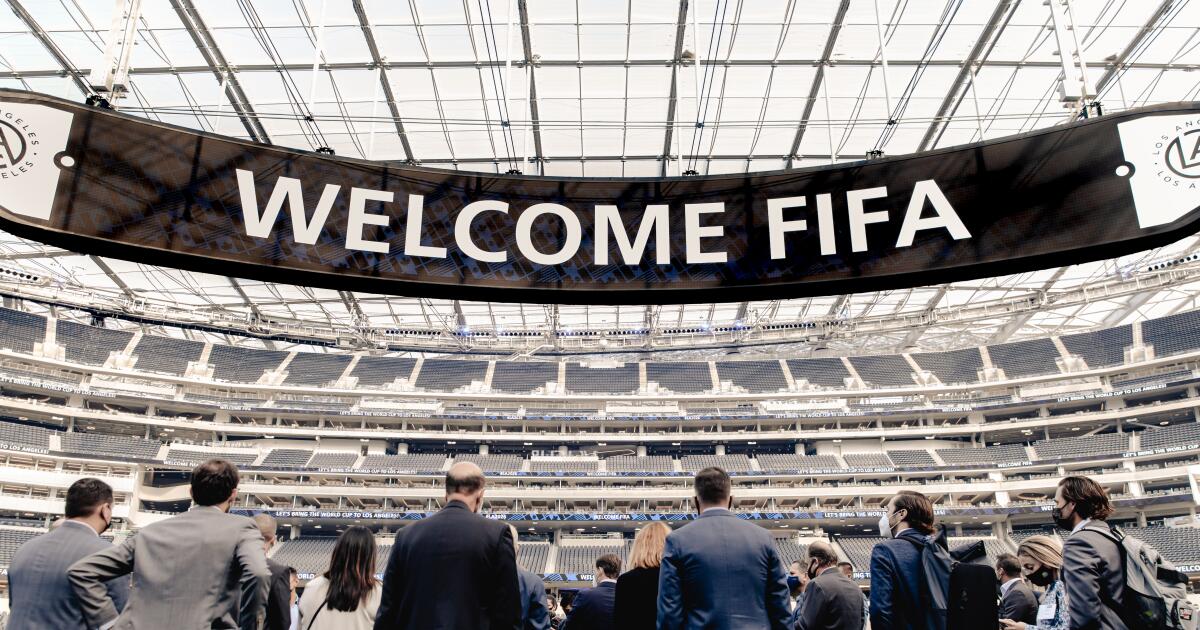
StubHub is getting a red card from some World Cup fans
Two World Cup customers are suing the New York-based ticket-selling company, alleging “false and misleading” advertising that left them without tickets or a refund for the World Cup games they paid to attend.
In federal court in New York last week, two Californians — Julia Reeker Moghal and Reuben Renteria — sued StubHub seeking monetary damages and a ban on the company selling World Cup tickets. The lawsuit aims to become a class action and comes after weeks of fierce criticism and complaints from customers regarding the company’s practices.
Throughout the World Cup, videos have emerged on Instagram and TikTok of StubHub customers describing their nightmare experiences with the ticket-selling platform.
Some said they had purchased tickets to World Cup games as early as November of last year, booked flights and hotels and arranged travel plans, then StubHub notified them days to weeks before the match of a refund for their tickets, which they never requested.
There were similar complaints about last-minute cancellations from people who bought Coachella tickets on StubHub.
In the lawsuit, Moghal said she had purchased three tickets for nearly $2,000 for the June 18 match between Switzerland and Bosnia-Herzegovina at SoFi Stadium in Inglewood, which were then canceled by StubHub. Moghal said she was contacted by StubHub and told her tickets would remain canceled, then was later told the tickets would be available one hour before the game.
When the match began, Moghal said she was at SoFi Stadium, but the tickets never came.
Renteria said he paid around $2,300 for the June 18 Mexico versus South Korea match in Guadalajara, Mexico, but they were canceled
“Devoted soccer fans have traveled from around the world to attend World Cup matches — and they reasonably relied on StubHub to provide the tickets they paid for as well as on StubHub’s warranty,” Blake Hunter Yagman, the attorney representing the two, said in a statement. “Instead of rewarding their business, StubHub sold them World Cup tickets that they either could not provide or on speculation, only to be stranded, in many cases, at the stadium gates without any recourse.”
According to StubHub’s website, its Fan Protect Guarantee states the platform will deliver valid tickets or refund in the event of a ticket issue, and that it will “go out of our way to find replacement tickets” of a comparable value. The lawsuit alleges the replacement tickets many fans were given by StubHub were worse than their original tickets.
FIFA, the World Cup organizer, states in its terms and conditions that the FIFA Marketplace, its own ticket-selling platform, is the only authorized platform for World Cup tickets, and that only tickets purchased through it are guaranteed by FIFA to be valid.
Despite the risk of purchasing through a third-party platform such as StubHub, many fans opted to do so to avoid the 30% FIFA resale tax, believing that the Fan Protect Guarantee would safeguard their order.
Since World Cup tickets began selling on FIFA Marketplace last September, fans have expressed disappointment in the expensive price tag. FIFA utilized a dynamic pricing system for the sale, and as sales phases progressed leading up to the games, the cost of tickets increased tremendously. In March, the extreme cost of tickets prompted 69 members of Congress to write a letter to FIFA urging them to lower their prices.
Tickets for the upcoming Friday match between Spain and Belgium in Los Angeles are selling on StubHub for over $1,300.
StubHub said in various statements to the news and in legal proceedings that ticket cancellations were a result of transfer problems and issues with FIFA’s ticketing infrastructure.
StubHub did not respond to requests for comment.
A FIFA spokesperson responded to this accusation in a statement, saying, “FIFA has no visibility over, or control of, secondary market ticket transactions carried out on third-party platforms. The transactions facilitated on these platforms occur entirely independently of FIFA’s official ticketing platform. With reference to the reliability of the services available to fans on FIFA’s official ticket platform, FIFA rejects any suggestion that the functional issues being experienced by users of third-party platforms with respect to FIFA World Cup 2026 tickets are the result of FIFA’s ticketing infrastructure.”
Business
Commentary: Trump wants to let companies make fewer disclosures, thus keeping investors in the dark

Trump’s SEC is considering eliminating the mandate for quarterly corporate financial reports, but even some big investors call it a lousy idea.
This being the “information age,” it would be understandable if investors sometimes feel inundated with too much information to wade through about the stocks in their mutual fund portfolios.
The Securities and Exchange Commission, bowing like a puppy to the urgings of President Trump, is considering exactly the wrong solution to this supposed burden. It’s proposing to allow public companies to give their investors less information, as though that’s a good thing.
On May 8, the SEC proposed rescinding its mandate that public companies report financial results on a quarterly schedule. Instead, it suggests, semiannual and annual reports should suffice.
This takes an already-unlevel playing field where Main Street investors are already disadvantaged, and makes it more unlevel.
— Dennis Kelleher, Better Markets
The SEC left its proposal open for public comment for 60 days, meaning the window closed Monday. By then, the agency had received more than 68,000 comments, according to a tracker posted online by accounting professor Tzachi Zach of Ohio State.
Almost 99.9% of the comments were negative. Several organizations of institutional investors and auditing professionals, as well as a tsunami of individual investors, expressed opposition.
A similar initiative the SEC aired in 2018, during Trump’s first term, received an overwhelmingly negative response and was eventually dropped.
The tide of opposition coming from individual investors shouldn’t be surprising. “Taking away basic quarterly information means investors are blind for six months at a time,” says Dennis Kelleher, co-founder and chief executive of the investor advocacy nonprofit Better Markets.
That’s especially true for small investors, though perhaps not so much for major institutions, insiders or deep-pocketed individuals. “If you’re a big dog, you’ll get the information anyway,” Kelleher told me. “And insiders, who are trading in their own stock all the time, will have the information. This takes an already-unlevel playing field where Main Street investors are already disadvantaged, and makes it more unlevel.”
Trump set off the latest initiative with a social media post on Sept. 15, advocating the move to a six-month reporting schedule. It read, in part, “This will save money, and allow managers to focus on properly running their companies. Did you ever hear the statement that, ‘China has a 50 to 100 year view on management of a company, whereas we run our companies on a quarterly basis???’ Not good!!!”
As was usual with Trump, his argument was a string of uninformed and irrelevant non sequiturs.
It’s doubtful that eliminating quarterly reports will save much, if any, money. Most 10-Qs are cookie cutter documents disclosing financial figures already embedded in corporate records.
The idea that managers would become empowered to “focus on properly running their companies” if only they were relieved of the burden of preparing a report every three months is just malarkey: Any CEOs who feel the impulse to drop everything and involve themselves in what is essentially an automated process can’t be very good at their jobs.
As for China’s “50 to 100 year view on management of a company,” what would that even mean, even if it were true? China doesn’t operate on a 50 to 100 year corporate horizon, but rather on a string of five-year plans. The most recent of these was adopted by the government in March, covers the period up to 2030, and is its 15th in a row.
Despite the flaws in Trump’s arguments, Trump’s SEC Chairman Paul Atkins, a former corporate lawyer and securities industry consultant, fell into line. Within a few days of Trump’s post, he showed up on CNBC to minimize the potential effect of the change. Private companies rely on semiannual reports, after all, he noted, although the idea of taking private companies as models for publicly traded corporations might not strike experienced investors as the wisest thing.
Atkins cited an enduring chestnut, for which there’s no evidence, that quarterly reporting is responsible for “short-term thinking” in corporate suites (though he admitted that his evidence was “anecdotal”). And he suggested that small investors have ample access to corporate information even without quarterly reports — why, he said, they can just tune in to CNBC!
“To propose change in what our rules are now would be a good way forward,” he said. “So I welcome the president’s putting this up for discussion.”
Something more insidious undergirds the SEC’s proposal than its immediate effect on corporate behavior. The agency rationalizes its proposal as seeking “a tradeoff between reducing regulatory burdens … and promoting efficient financial markets through timely disclosure.”
The problem here, Kelleher points out, is that “reducing regulatory burdens” isn’t part of the SEC’s mission in any way, shape or form. It’s a regulatory agency, and its mission since its founding in 1934 has been to protect investors, not to make things fluffier for stock issuers.
The history of financial disclosure in the U.S. shows a long-term trend favoring more disclosure, not less. In the 1880s, quarterly reporting by railroads and other transportation companies were common.
Early on, pressure for more frequent disclosure came not from government regulators, who barely existed before 1934, but from investors. The reporting of quarterly earnings, notes corporate finance expert Owen Lamont of Acadian Asset Management, was “a bottom-up historical phenomenon reflecting voluntary arrangements between firms and investors, not a top-down phenomenon imposed by law.”
By 1931, according to financial historians, 63% of New York Stock Exchange-listed firms were publishing their quarterly earnings. The Big Board mandated that frequency for most listed companies in 1939. The SEC mandated semiannual reports in 1955 and quarterly reports, as Atkins said, in 1970.
The evidence in favor of dropping the quarterly reports is uniformly thin. Some advocates cite a 2018 op-ed in the Wall Street Journal by JPMorgan Chase CEO Jamie Dimon and Warren Buffett that was headlined “Short-Termism Is Harming the Economy.”
Couple of points about this: First, the target of Dimon and Buffett wasn’t quarterly financial reporting, but quarterly earnings guidance — that is, the practice of some top executives who project their earnings into the future. (This guidance usually comes at the same time they issue their SEC disclosures.)
It’s guidance, they wrote, that is “a major driver” of short-termism in corporate behavior. That’s because management is giving itself a target it feels obligated to meet, even if factors outside its control interfere with the quest.
Furthermore, Dimon and Buffett wrote, “Our views on quarterly earnings forecasts should not be misconstrued as opposition to quarterly and annual reporting.” They called transparency about financial and operating results “an essential aspect of U.S. public markets … so that the public, including shareholders and other stakeholders, can reliably assess real progress.”
Individual investors may be unmoved by the SEC’s proposal because — let’s be candid — how many of them read quarterly earnings reports, anyway? But that’s unimportant, Kelleher says, because other market participants are reading them. “So that information is in the marketplace, and that’s what actually enables price discovery, so stock prices roughly reflect what’s going on at a company, most of the time.”
More to the point, the quarterly reports reflect the highest-quality, detailed information, the information the SEC requires executives to disclose on pain of facing a civil lawsuit from the agency or even criminal liability for faking data. “Main Street investors, whether they read quarterly reports or not, are the real beneficiaries,” Kelleher says.
That’s so. The bottom line is that quarterly financial reporting helps investors. It doesn’t promote short-term behavior and its costs, modest as they are, don’t outweigh its benefits.
Over the decades, scandal-ridden corporations have hidden fraudulent behavior in the interstices between mandated disclosures—think Enron, WorldCom and Tyco, among others. Why give any corporation, even an honest one, the opportunity to disclose less?
-

 Los Angeles, Ca1 hour ago
O.C. police prep for beach, theme park ‘takeovers’ promoted on social media
-

 Detroit, MI2 hours ago
Detroit city leaders to DHS: Stop ICE pursuits which endanger the community
-

 San Francisco, CA2 hours ago
SF Supervisor Jackie Fielder hosts listening session after medical leave
-

 Dallas, TX2 hours ago
The Stewpot artists find healing, purpose and income through art in Dallas
-

 Miami, FL2 hours ago
Can Jason Marshall push for a starting spot – The Splash Zone 7/10/26
-

 Boston, MA2 hours ago
Police investigating shooting in Downtown Crossing – Boston News, Weather, Sports | WHDH 7News
-
 Denver, CO2 hours ago
Denver mayor announces new $100 million plan to bring in 10,000 jobs
-

 San Diego, CA2 hours ago
WEBTOON Brings Top Creators for San Diego Comic-Con Panels

