Business
Disney’s Josh D’Amaro era begins following Bob Iger handoff


Walt Disney Co. installed Josh D’Amaro as chief executive Wednesday, beginning a new chapter for the storied Burbank entertainment giant.
Bob Iger passed the reins during Disney’s virtual annual meeting of shareholders, completing the company’s high-stakes and tightly choreographed changing of the guard. After spending two decades molding Disney into a media colossus, Iger segued into a senior advisory role, which will run through December when he officially retires.
The leadership shift comes amid an upheaval in Hollywood as traditional companies wage a desperate battle for survival.
“While others in our industry are consolidating just to compete, or struggling to be relevant in a fragmented and disrupted world, Disney is in a category of one,” D’Amaro said during a recorded segment broadcast at the meeting. “This next chapter will be driven by staying focused on world-class creativity, enhanced by technology, bringing unforgettable stories to audiences wherever they are.”
D’Amaro, 55, becomes the ninth leader in Disney’s 102-year history. He was selected last month by Disney board members after a more than two-year internal bake-off among high-ranking division leaders. Board members were impressed with his business acumen, charisma and his deep love for Disney and its storied history.
D’Amaro inherits a company that is beloved by millions, generates $94 billion a year in revenue and employs 230,000 people.
He faces enormous challenges as he steers the company through a turbulent media environment and tense geopolitics. The war in Iran prompted a sharp increase in fuel costs, which could become a drag on Disney’s critically important tourism business. Executives already have signaled “headwinds” in international visitation at theme parks this year.
Lingering Middle East tensions also could weigh on Disney’s plans for a new Persian Gulf waterfront theme park and resort near Abu Dhabi.
D’Amaro, who served as parks and experiences chief until Wednesday, got his corporate start at Disneyland 28 years ago.
“Like so many of you, my connection to Disney goes back to my childhood, long before I began my career here,” D’Amaro told shareholders. “I grew up in a Disney family. We watched ‘The Wonderful World of Disney’ on Sunday nights. I was 10 years old when my family visited Disneyland for the first time. … Disney has always been a place of imagination, innovation and infinite potential.”
Disney previously announced a $60-billion, 10-year expansion program, but it must strike a balance by keeping attractions true to their nostalgic core. In Anaheim, the expansion could result in at least $1.9 billion of development.
Disney also must turbocharge the animation business, manage revenue declines from its traditional linear television channels, including ESPN and ABC, and fortify its streaming services to remain among the leaders in the field.
“Disney+ will continue to evolve beyond a traditional streaming service to become the digital centerpiece of our company,” D’Amaro said, calling the service “a portal that connects our stories, experiences, games, films, and more in entirely new ways.”
He mentioned the company’s efforts to unify Disney+ and Hulu later this year.
Disney also must learn how to exploit new technologies while safeguarding its characters and franchises.
“We will continue to develop and embrace new technologies to empower our storytellers — but never at the expense of our characters and worlds, our creative partners, or the trust people place in us,” D’Amaro said. “Because Disney at its core is a company that celebrates human creativity.”
Board members recognized that D’Amaro lacks deep connections among Hollywood’s writers and producers so they created a new management structure that elevates longtime television executive Dana Walden to chief creative officer and the company’s first woman president.
ESPN will continue to be managed by Jimmy Pitaro and Disney Entertainment, Studios chairman Alan Bergman will remain in his influential role overseeing film studios including production, marketing and distribution, and sharing oversight for streaming programming with Walden.
D’Amaro’s total compensation package is valued at about $40 million a year, including a $2-million annual base salary, $26.2 million in annual long-term stock incentives, a cash bonus and a one-time promotion award of $9.7 million.
Iger first stepped into the CEO role in 2005; his first 15 years were almost magical.
Iger led acquisitions of Pixar Animation, Marvel Entertainment and Lucasfilm, the studio behind “Star Wars,” that turned Disney into a blockbuster machine. Sports king ESPN spawned staggering profits, and Disney’s theme parks set industry standards.
Disney’s former Chief Executive Bob Iger will stay on through the end of the year as a senior advisor.
(Jay L. Clendenin / Los Angeles Times)
His decision to buy much of Rupert Murdoch’s 21st Century Fox, a $71-billion deal that closed in 2019, boosted Disney’s television production, refreshed its TV executive bench, and provided a controlling stake in general entertainment streaming service Hulu. The acquisition also gave Disney access to fan-favorite franchises, including “Deadpool,” and James Cameron’s “Avatar.”
But the purchase left Disney saddled with debt just as the COVID-19 pandemic prompted production shutdowns and closures at theme parks and sports venues.
Iger initially passed the CEO baton to Bob Chapek in February 2020. Iger, then chairman, retired the following year but came back in November 2022 to a mess. At the time, the company was losing billions of dollars on its shift to streaming but that unit is now profitable.
Iger spent the next three years focusing on four business pillars, including improving the quality and profitability of its film studios.
During the last two years, Disney has produced five franchise films that racked up more than $1 billion in worldwide ticket sales, including “Inside Out 2,” “Zootopia 2,” and “Avatar: Fire and Ash.”
Disney and Pixar’s latest animated film “Hoppers” has hauled in $46 million at the domestic box office in its opening weekend, marking the highest theatrical debut for an original animated film since Disney’s 2017 success “Coco.”
The company is banking this year on several other films with blockbuster potential, including Disney and Pixar’s “Toy Story 5,” Lucasfilm’s “Star Wars: The Mandalorian & Grogu” and Marvel Studios’ “Avengers: Doomsday.”
“I would want to be known as someone who was given the keys to this kingdom and brought it to a place that even Walt would be proud of — more storytelling, more innovation, more risk‑taking, and more creation of happiness,” Iger said during a “The Rest is History” podcast last year.
During the meeting, D’Amaro saluted his predecessor and longtime boss.
“Bob, on behalf of our employees, cast members, shareholders, and fans around the world, thank you so much for your tremendous leadership, your steadfast support, and your countless contributions to The Walt Disney Co.,” D’Amaro said. “You’ve set an incredible example for all of us. … You will be missed.”



It is the industrial version of what homeowners might do to get through a hurricane. Only in this case, some technology companies are planning to rely on off-grid gas power for many years.
This is happening as electricity is becoming a major political issue, with fights breaking out over how much energy costs, where it comes from and who ought to pay for what. Data centers, which consume huge amounts of energy, are at the center of these debates.
Going off grid was no one’s first choice. Off-grid power generally costs a lot more, partly because developers need to install more equipment than will be used at any one time in case machines break or need servicing. A lot of this gear is also less efficient than the airplane-size machines used at big power plants, meaning it needs to burn more gas to generate the same amount of electricity.
But in some states, it might take years to get permission to plug new power plants into the grid.
By the end of 2025, an estimated 39 percent of the gas power capacity being developed in the United States was designed to serve data centers on-site, according to the Global Energy Monitor, a nonprofit organization that tracks energy projects. That is up from 5 percent at the end of 2024.
“Necessity is the mother of invention,” said Joe Kava, a consultant who previously led global data center development for Google. “The hyperscalers are not going to be curtailed because they can’t get power,” he said, using a term that refers to large tech companies.
Power plants have bloomed in New Albany, Ohio, near Columbus, as if overnight. It was little more than a year ago that Sloan Spalding, the mayor, learned that a data center developer wanted to build the town’s first gas-fired power plant. Now, three are under construction, all meant to exclusively power data centers, and at least one other is planned.
“Frankly, we were all a little surprised,” Mr. Spalding said.
Together, the plants that are already under construction are expected to rely on about 61 engines, 30 small turbines and 16 other generators, regulatory filings show. All of that equipment burns natural gas to generate electricity, but each operates differently. That does not include battery storage systems to manage demand fluctuations and diesel generators for backup power in emergencies.
It is the kind of equipment you might expect in remote oil fields. Were they connected to the grid, the machines being installed in New Albany could potentially power around 600,000 homes. Another power plant that was proposed last week would be big enough to provide electricity for an additional 200,000 homes or more if regulators approve it.
“For better or for worse, we are the pioneers in this process,” Mr. Spalding said. “There’s not a lot we can do to stop it.”
Tech giants generally say they don’t want to build or operate power plants. In some places, the companies are fighting efforts to require data centers to rely on their own power sources or reduce energy consumption when electricity systems are under strain.
But the tech industry’s appetite for energy has become almost insatiable because of artificial intelligence, and there are only so many places where companies can draw large amounts of power from the grid quickly. Wait times vary by region, but it now takes an average of four years or more for data centers to connect to U.S. grids, according to JLL, a real estate services firm.
One of the first companies to go it alone was Elon Musk’s xAI, which opened a data center in Memphis in 2024, powering it with more than a dozen gas turbines rolled in on flatbed trucks. The Southern Environmental Law Center later claimed the company flouted permitting requirements and violated the federal Clean Air Act in Memphis and at another location in Southaven, Miss. xAI, which eventually received permits for some turbines in Memphis and stopped using others, did not respond to requests for comment.
Dozens of natural gas plants being built to serve data centers will be off the grid
An armada of off-grid power plants
By that point, tech companies were flocking to Ohio, so much so that the main electric utility serving the Columbus area stopped accepting data center applications for new grid connections in March 2023. The state quickly became one of the first battlegrounds between utilities and some of the world’s most valuable companies.
It was against that backdrop that some developers started going off-grid in New Albany, which is near the western edge of a large natural gas deposit.
EdgeConneX, a Washington-area data center developer that did not respond to requests for comment, is behind one of the power plants. Williams Companies, an Oklahoma pipeline operator, is building at least two for Meta, Facebook’s parent company.
Meta has agreed to buy the power that Williams generates for at least a decade, said Chad Zamarin, Williams’s chief executive.
“Whether they use it or not, we will get paid,” Mr. Zamarin said.
The power deal is among the most expensive that Paul Zimbardo, an analyst at the investment firm Jefferies, said he had come across. Meta may have agreed to pay Williams $140 to $160 per megawatt-hour, the investment bank estimated, well above the price of grid power.
Last week, Williams told regulators that it wanted to build a third power plant in New Albany for an undisclosed customer.
These plants will not affect the price of electricity for Ohio residents because the facilities are not connected to the grid, though higher gas demand could drive up fuel prices over time.
Meta said the local utility’s pause on serving new data centers, which ended last year, influenced its decision to go off grid. The company, which has pledged to fully offset its greenhouse-gas emissions by 2030, is buying renewable energy to compensate for the electricity it gets from fossil fuels, said Ryan Daniels, a company spokesman.
Companies are gravitating to gas because it can theoretically generate electricity all day, unlike the wind or sun. And smaller gas generators and engines can be installed much faster than nuclear power plants.
Power capacity of publicly disclosed equipment
Natural gas will provide most of the onsite power for U.S. data centers
That worries Noah Malik, who lives several miles from New Albany’s new plants. “By building this infrastructure, you’ve cemented that dependence on fossil fuels,” said Mr. Malik, who is 25.
Most of the off-grid power plants being planned around the country are either under construction or about to be, meaning the full environmental effects have yet to be felt.
New Albany’s new power plants are expected to release more nitrogen oxides — a group of pollutants linked to respiratory diseases like asthma — for each unit of electricity they produce than the larger gas plants that power most of Ohio, according to an analysis of regulatory filings and manufacturer data by the Environmental Defense Fund. That analysis, performed for The New York Times, accounts for the emissions controls that the developers have said they would install.
“I do worry about the near-term impacts of this choice on air quality and communities today,” said Mark Brownstein, a senior vice president at the Environmental Defense Fund. “Why exactly are we rushing?” he added. “There is a concern that haste is making waste here.”
A Williams spokesman said the company would “meet and exceed all state-established requirements to protect public health and the environment.” A spokesman for the Ohio Environmental Protection Agency said it modeled air quality to assess the facilities’ cumulative impact and ensure compliance with federal standards before giving developers permission to build the plants.
Noise levels must remain within five decibels of ambient levels, said a spokesman for the Ohio Power Siting Board, which also reviews major energy projects.
A big question is how long this gas power frenzy will last. Manufacturers of gas turbines and related equipment have been wrestling with how much money to invest in new manufacturing lines. Their big concern is that, by the time the new capacity is ready, demand for the equipment might have weakened significantly.
Baker Hughes, an oil field service company that makes the kinds of turbines being used off grid, is betting on strong data center demand for at least several years. It is one of many oil and gas companies that have piled into the power business as oil field work has slowed.
“We don’t see this being a fad,” said Lorenzo Simonelli, the company’s chief executive.
Industry analysts and executives also question whether power plants built alongside data centers will remain competitive if it becomes easier to connect to the grid.
Siemens Energy makes some of the equipment that the New Albany power plants plan to use. But even that company’s chief executive, Christian Bruch, is skeptical about using smaller machines as permanent power sources.
“These will not be long-term installations,” Mr. Bruch said in a recent interview, discussing the broader trend. “Is it good in terms of efficiency? And is that a smart power supply solution? Absolutely not.”
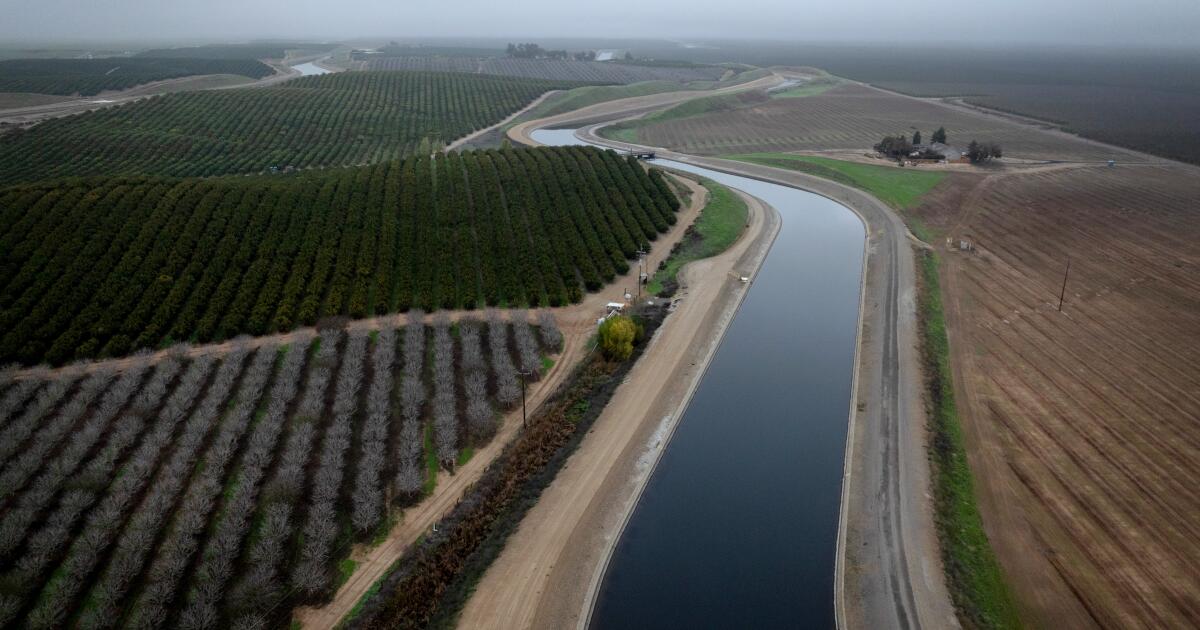
The Trump administration announced Tuesday it will spend $540 million on water infrastructure projects in California, much of it to repair aging and sinking canals in the Central Valley.
The largest share, $235 million, will be used to rehabilitate the Delta-Mendota Canal, which carries water to farmlands. An additional $200 million will help continue repairs on the Friant-Kern Canal, another major conduit for water in the valley.
Sinking ground due to heavy groundwater pumping has damaged segments of the Friant-Kern Canal and reduced its capacity.
Secretary of the Interior Doug Burgum said in the announcement that the investments, together with nearly $350 million for water projects in other western states, “strengthen our nation’s water security, modernize aging infrastructure and support the farmers, communities and industries that depend on reliable water supplies.”
California water agencies praised the announcement, saying the funding will improve the water system.
The Interior Department said it also will spend $40 million to begin a plan to raise the height of Shasta Dam — a proposal that growers and water agencies have supported.
Allison Febbo, general manager of Westlands Water District, said the plan to enlarge Shasta Dam “represents an important step toward advancing a long-overdue investment in water supply reliability.”
Shasta Lake is California’s largest manmade reservoir, and part of the federally managed Central Valley Project. The plan to raise the dam and expand the reservoir is strongly opposed by tribes, fishing advocates and environmental groups.
“The president is very close to a tiny group of Central Valley growers,” said Barry Nelson, an advisor with the Golden State Salmon Assn., a nonprofit group. “Raising this dam is for a couple hundred rich farmers. It does virtually nothing for California’s urban residents.”
Enlarging the reservoir, he said, would be “disastrously bad for salmon,” harming the environment downstream from the dam and hitting the state’s fishing industry.
The Winnemem Wintu Tribe has also been fighting the proposal for years. Gary Mulcahy, the tribe’s government liaison, said the plan to raise the dam 18.5 feet would flood sacred sites.
It also could end up costing $3 billion to $5 billion, a high price for the additional water it might yield, Mulcahy said. “It’s a terrible proposition for taxpayers. It’s a terrible proposition for the state.”
The Trump administration’s announcement of a large sum for water projects is significant but not unprecedented. The Biden administration in 2024 announced nearly $850 million to improve water infrastructure in western states in 2024. That round of federal funding also included $204 million for repairs of the Delta-Mendota Canal.
The additional $235 million will help address land subsidence along the Delta-Mendota Canal and restore its water-carrying capacity for farms and communities, said Federico Barajas, executive director of the San Luis & Delta-Mendota Water Authority.
The funds come from the “Big Beautiful Bill” that President Trump signed last year.
Barajas thanked members of Congress including Rep. David Valadao (R-Hanford) and Rep. Vince Fong (R-Bakersfield) for pushing for the bill’s passage.

The online service Grammarly originated in 2009 as a suite of tools to help ferret out plagiarism in schoolwork or help students hone their grammar and spelling. Eventually it incorporated artificial intelligence bots as sources of its writing assistance.
In August 2025, however, the firm stepped way over the line of what is — or should be — permissible as an AI-generated service.
This was its “expert review” service, available to those willing to fork over up to $30 a month. The pitch was that subscribers could get their writing samples reviewed by established writers, including some household names as Stephen King and Neil DeGrasse Tyson, and receive feedback from them about how to improve their prose.
This is an area I cover and there have been a lot of lows. But I still feel like this is a new low.
— Julia Angwin, technology journalist and plaintiff in a lawsuit against Grammarly
A few problems have surfaced about this.
First, it appears that many, if not all, the cited “experts” haven’t granted Grammarly permission to use their names or work in connection with this service. Second, none of them actually reviewed the submitted writing samples — the samples were screened by AI bots, which generated the suggestions based on the authors’ published works.
Third, Grammarly didn’t make the truth clear to its users — the suggestions seemed on first impression to come directly from the cited “experts”; it was only when a user clicked through for more detail that Grammarly disclosed that its suggestions were “inspired” by the experts’ published works.
Last week, Grammarly suspended the “expert review” function. That happened the same day that Julia Angwin, a veteran technology and investigative journalist who has worked at the Wall Street Journal and Propublica, filed a federal class-action lawsuit alleging that Grammarly had in effect stolen the real authors’ identities and attributed to them advice that the authors might disagree with, or that might even undermine the authors’ reputations for sound writing.
This isn’t the first time that someone has tried to use AI as a shortcut, with parlous consequences. Over the last couple of years, AI-generated material has appeared in legal briefs and medical diagnoses. Not a few news organizations have been caught publishing AI-generated articles without adequately disclosing that they weren’t written by humans.
Often, the shortcuts have been exposed because the AI bot outputs were riddled with errors — citations to nonexistent legal precedents, proposed medical treatments that were actually life-threatening, factual mistakes that even novice human journalists would know to avoid.
“Expert review” appeared at a time when many authors and artists are taking AI companies to court for allegedly violating copyright law by “training” their bots on published work without acknowledgment or payment.
Numerous lawsuits are making their way through the courts, although the judiciary hasn’t settled on a single conclusion about where the line stands distinguishing “fair use” from copyright infringement.
Yet one doesn’t need an AI bot to explain why Grammarly’s stunt has to rank among the sleaziest misuses of AI technology yet to appear.
San Francisco-based Grammarly didn’t make things any better with a mea culpa posted on LinkedIn by its chief executive, Shishir Mehrotra. Grammarly’s AI agent, he wrote, “was designed to help users discover influential perspectives and scholarship relevant to their work, while also providing meaningful ways for experts to build deeper relationships with their fans.”
In other words, he asserted that “expert review” was designed as a boon not only for Grammarly’s users, but for the experts whose names and works had been exploited for the firm’s profit and without their say-so. He stated that Grammarly will “reimagine” its service to give the experts “real control over how they want to be represented — or not represented at all.”
In an email, Mehrotra responded to my request for comments by acknowledging that “we believe this feature missed the mark on what both experts and users expect out of us.” He added, however, that Grammarly considers the claims in Angwin’s lawsuit to be “without merit and will strongly defend against them.”
Grammarly hasn’t been shy about pushing AI-powered services to users. In November, it changed its corporate name to Superhuman, reflecting what it called its “mission … to unlock the superhuman potential in everyone.”
By then, “expert review” already had been launched. From the outset, the company was a little vague about what the service actually entailed. According to the web page originally posted to pitch the service (the page has since been removed but survives in a web archive), users could improve their writing by “drawing on insights from subject-matter experts and trusted publications.”
Users were instructed to upload their document to the system. The bot then “cross-referenced your writing with relevant experts” and offered “specific … expert-informed feedback.” Users could then choose from a list of a few such experts, each offering a couple of lines of feedback.
Buried in the pitch were subtle disclaimers.
Grammarly slipped a warning onto its web page noting that its feedback was merely “inspired by real experts” and a further notification that its references to “experts” were “for informational purposes only and do not indicate any affiliation with Grammarly or endorsement by those individuals.”
The roster of experts was impressive indeed. They included novelist King, astrophysicist Tyson and numerous book and magazine writers of varied eminence. I couldn’t reach King, and Tyson didn’t respond to my request for comment, but some other writers have made their reactions known via other routes.
The tech journalist Kara Swisher, for instance, answered a query from a fellow journalist by labeling the Grammarly folks “rapacious information and identity thieves.”
It might have become obvious to some users that the likelihood was remote that their work was being personally vetted by the cited experts. I might have asked the respected grammarian William Strunk Jr., author of that indispensable primer “The Elements of Style,” what he thought about having been offered up by Grammarly as an expert writing coach, except that he died in 1946. Other deceased writers also have appeared on the roster, such as astronomer Carl Sagan (d. 1996).
“Expert review” coasted under the radar for months, until a few tech journalists caught its scent. The first may have been Miles Klee of Wired, whose report appeared on March 3. Within days, similar reports appeared on The Verge and Defector.
It was a post by Casey Newton of Platformer, which listed several of Grammarly’s “experts,” that alerted Angwin that the company was exploiting her name and work. “They were attempting to take my livelihood and automate it,” she told me. “They were literally selling a service that claims that Julia Angwin will edit your piece. Obviously, that’s a direct threat to me and my ability to earn a living.”
Moreover, Angwin says, the edits that Grammarly proposed under her name to a user were “terrible — so they weren’t just stealing my livelihood but ruining my reputation.”
In its initial response to the burgeoning controversy, Grammarly offered to allow writers to opt out of “expert review” by sending the company an email. The problem there is that the “experts” have no way of knowing that there’s anything to opt out from, since Grammarly hasn’t published a comprehensive roster.
As the author of eight books and years of newspaper columns, I was interested to know if my own name or works were offered. Grammarly told me only that its “data on experts was sourced from third-party LLMs [that is, AI bots]. … Experts were surfaced based on their expertise with the topic.” It added that it “won’t be providing additional comment at this time.”
The extent of Superhuman’s legal exposure for this program is hard to gauge. Angwin’s lawsuit, which seeks to empower a class of authors whose names were used by the company without their consent, cites California and New York laws barring the use of anyone’s name or likeness for commercial purposes without their consent.
As for how many people have been affected, Angwin’s attorney, Peter Romer-Friedman, told me that obtaining the full roster would be his first task under discovery if the case heads to trial. (Superhuman hasn’t yet responded to the lawsuit in court.) But he says more than 100 writers have reached out to say they want to be part of the case since it was filed, and speculates that the total number could be in the thousands.
“This is an area I cover,” Angwin says, “and there have been a lot of lows. But I still feel like this is a new low.”

Why Tech Giants Are Ditching the Power Grid

Cesar Chavez abused and raped women and girls, NYT investigation says

Trump’s AI chief’s big Iran warning gets big time ignored

Afghanistan accuses Pakistan of killing hundreds in Kabul hospital strike

NYC spends more per homeless person than a typical household earns in a year, data shows

Florida High School Football Rankings: Top 25 teams – Oct. 21

How old is Bo Nix? What to know about Oregon quarterback ahead of 2024 NFL Draft

Cleary's 21 help Le Moyne down Central Connecticut State 69-64 in OT

99th annual Pony Swim held in Virginia

Indiana Members Credit Union announced as new anchor tenant at Bottleworks District
NYC spends more per homeless person than a typical household earns in a year, data shows

President or Congress? Who in the US has the power to declare war?

Mamdani put Ramadan at the center of NYC’s cultural life, bringing joy — and a backlash

Dem congressional candidate Bobby Pulido depicts lewd behavior in controversial music video for his song

Ukraine ‘informally’ opens all six clusters in EU membership bid
-

 Oklahoma1 week ago
OSSAA unveils Class 6A-2A basketball state tournament brackets, schedule
-

 Oklahoma4 days ago
Family rallies around Oklahoma father after head-on crash
-

 Michigan1 week ago
Operation BBQ Relief helping with Southwest Michigan tornado recovery
-

 Nebraska5 days ago
Wildfire forces immediate evacuation order for Farnam residents
-

 Southeast1 week ago
‘90 Day Fiancé’ alum’s boyfriend on trial for attempted murder over wild ‘Boca Bash’ accusations
-

 Georgia2 days ago
How ICE plans for a detention warehouse pushed a Georgia town to fight back | CNN Politics
-

 Connecticut1 week ago
Exclusive | Ex-CBS anchor Josh Elliott back on Connecticut dating scene after ugly Liz Cho split
-

 Alaska3 days ago
Police looking for man considered ‘armed and dangerous’