Business
Data centers under scrutiny by California lawmakers as fears rise about health and energy impacts


IMPERIAL — Whenever the weather changes suddenly, or the skyline becomes shrouded in a windy haze, Fernanda Camarillo braces herself for an asthma attack.
Her condition has become more manageable, but the 27-year-old said it’s still scary when her chest tightens and she starts to wheeze. It was one of her first thoughts when she heard about plans to develop a massive data center next to her home in Imperial County, a farming community near the border of Mexico that struggles with poor air quality.
“A lot of people in the county are asthmatic,” she said, explaining that she worries the new center would add more pollution. “I’ve been anxious — so many of us are voicing our concerns.”
Data centers have existed for decades but are rapidly changing and expanding due to the worldwide boom in artificial intelligence, or AI as it’s known. States and communities nationwide have started pushing back, citing concerns that the projects could strain power grids, increase utility bills and have negative health and environmental impacts.
In California, state legislators are debating how to protect residents and natural resources without creating so much red tape that developers go elsewhere, taking their jobs and taxable earnings with them.
No Data Center signs are posted in the front yard of a home that is right behind the proposed site.
“We can be supportive of innovation and a technology that is needed but also protect our communities and our health and our environment,” said state Sen. Steve Padilla (D-San Diego). “We can do both at the same time.”
The California Legislature is considering bills to prohibit the projects from being exempted from the state’s stringent environmental law and to impose new tariffs on new major energy users that strain power supplies. Lawmakers also have proposed restrictions on new data centers, requiring companies to provide verifiable estimates on expected water and energy usage before they can be granted a business permit.
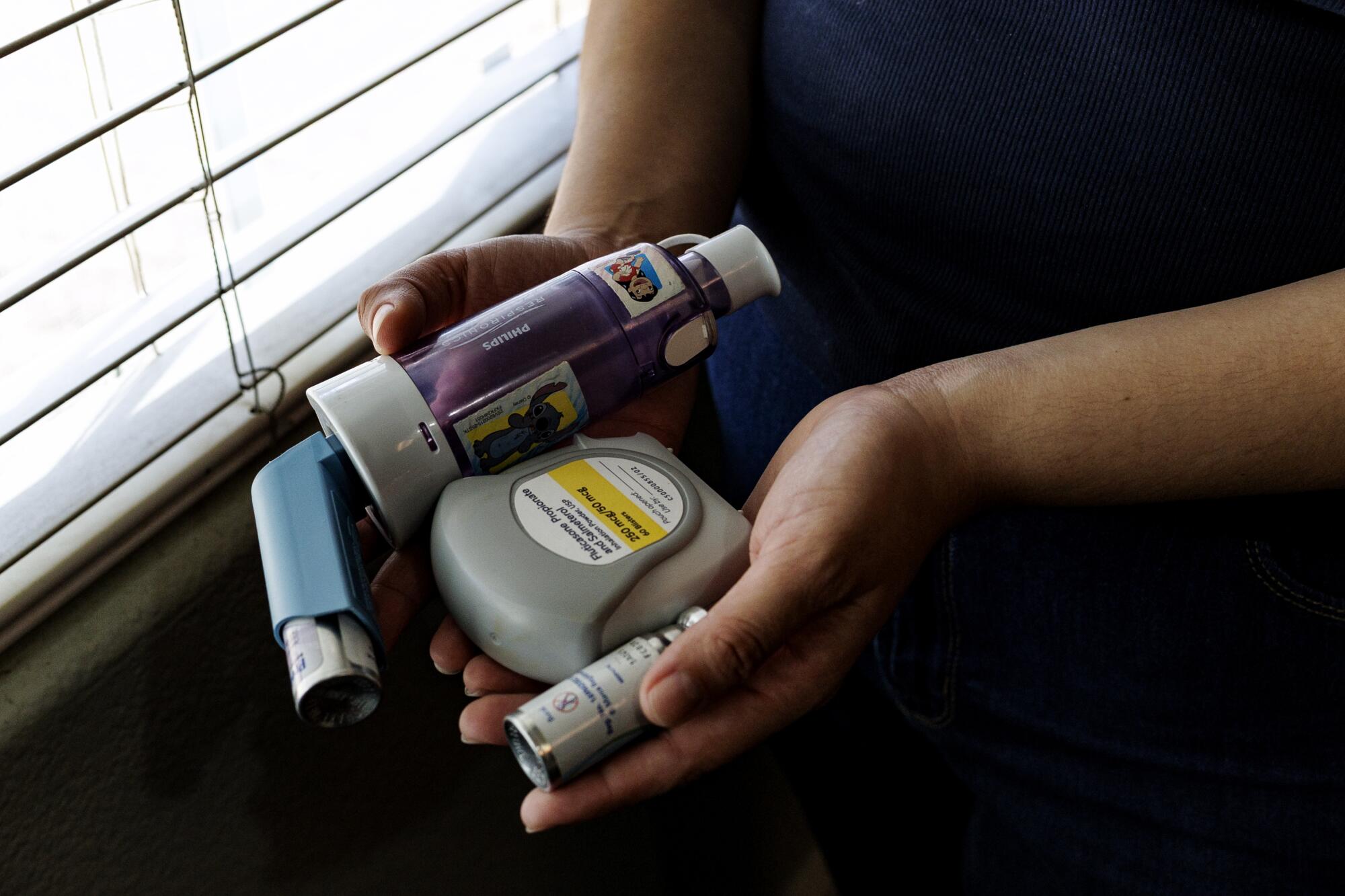
Imperial resident Fernanda Camarillo, who is an asthmatic, holds some of her medications.
Members of Congress also expressed concerns. Rep. Ro Khanna, speaking at a town hall about AI last month at Stanford University, said legislators must ensure data centers serve the communities that power them.
“We live in a new gilded age,” said Khanna (D-Fremont). “What kind of future are we going to build?”
::
Eric Masanet, a professor at UC Santa Barbara specializing in sustainability science for emerging technologies, described the facilities as the “brains” of the internet. The sprawling centers are filled with banks of specialized computers that process online shopping orders, stream movies, host websites, encode Zoom and other videoconferencing apps, store data and serve as switching stations for the digital world that’s now woven into daily life.
Data centers, particularly those that power AI, use significant amounts of water and energy. The facilities accounted for about 4.4% of the nation’s total electricity consumption in 2023, up from 1.9% in 2018, according to a report provided to Congress from the Lawrence Berkeley National Laboratory. The researchers projected that figure will reach 6.7% to 12% by 2028.
Many companies, including big tech giants like Meta, Google and Amazon, are making major investments in AI.
“We are building a lot more data centers faster than we ever did — and a new AI data center is 10 to 20, maybe 30 times, the size of the largest data centers we had before,” Masanet said.
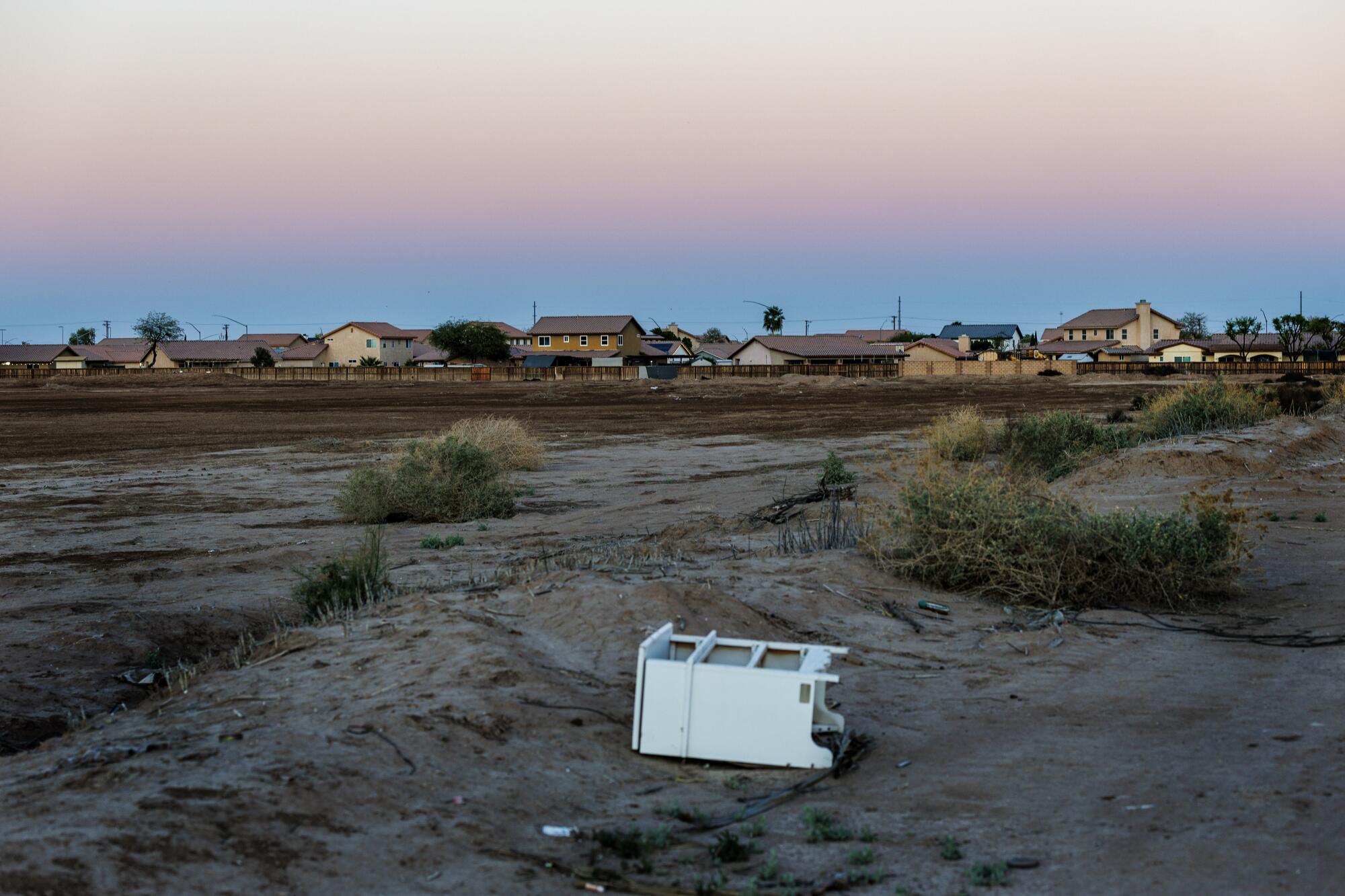
The proposed site of the 950,000-square-foot data center is on a dusty parcel that is next to the Victoria Ranch housing community and adjacent to farmland in Imperial, Calif.
It’s unclear how many data centers are in the state. A California Energy Commission spokesperson told the Los Angeles Times it does not track this information. Data Center Map, a nongovernmental website that tracks data centers across the world, lists 289 facilities in California, with more than 4,000 nationwide.
The federal government has, so far, largely left it to states or localities to regulate data centers.
The facilities can generate significant revenue for local governments due to sales and property taxes.
But some new proposals are sparking a backlash. More than 200 community and environmental organizations, including a dozen from California, sent an open letter to Congress in December calling for a national moratorium on new data centers.
Robert Gould, a pathologist with San Francisco Bay Physicians for Social Responsibility, one of the organizations that signed the letter, explained data centers are causing a shift away from renewable energy and back toward fossil fuels because the facilities need a reliable and constant stream of power.
Cornell University researchers last year estimated that AI growth could add 24 to 44 million metric tons of carbon dioxide to the atmosphere annually by 2030, unless steps are taken to change course.
Gould said fossil fuel emissions are associated with various cancers, an increase in hospitalizations for older adults due to respiratory conditions, and asthma attacks or stunted lung growth in children. Particulate matter from fossil fuel emissions is also linked to cardiovascular events and negative effects on maternal fetal health.
Gould’s organization has noticed an alarming trend.
“These are generally placed in communities that are the least able to defend themselves,” he said.

Farmworkers toil in the noon heat to pick vegetables in Imperial. Agriculture is an important part of the Imperial Valley economy.
::
The debate over data centers is heating up in the Imperial Valley, a rural desert region in southeastern California where a proposed center faces fierce opposition from residents.
The county in 2025 granted the project an exemption for the California Environmental Quality Act, known as CEQA. The landmark 56-year-old state law has been credited with helping to preserve California’s natural beauty and protecting communities from hazardous impacts of construction projects — but also blamed for stymieing construction.
Imperial Valley Computer Manufacturing, a California-based limited liability company that started two years ago, plans to develop a 950,000-square-foot facility in the county that’s designed for advanced artificial intelligence and machine learning operations. The company says it will use reclaimed wastewater and EPA-certified natural gas generators, and create 2,500 to 3,500 construction jobs and 100 to 200 permanent positions.
“We are committed to Imperial County and to creating lasting economic opportunity,” the company website states. “The project will generate $28.75 million in annual property tax revenue for local schools, fire departments, libraries, and essential services.”
The Imperial County Board of Supervisors is moving toward finalizing the proposal.

Farmland spreads out in front of the Imperial Valley Fair near a proposed data center in Imperial.
Sebastian Rucci, an attorney and chief executive officer of Imperial Valley Computer Manufacturing, said he commissioned multiple studies assessing the proposed center’s potential effect on issues like traffic or the environment that found no or minimal harms. He threatened to pull his proposal if a CEQA review was required.
“CEQA leaves you in an unknown territory — some of the environmental groups have used it for extortion, they sue, they have no basis for the suit but they delay you, and then they can squeeze money out of you for settling the lawsuit,” said Rucci.
The exemption, however, has alarmed residents, who have spoken up at county board meetings and launched a community organization, Not in My Backyard Imperial, to protest the data center and demand a CEQA review.
“It feels like it’s us against the county,” said Camarillo, adding that many feel the board has dismissed their questions and concerns.
None of the Imperial County Board of Supervisors responded to requests for comment.
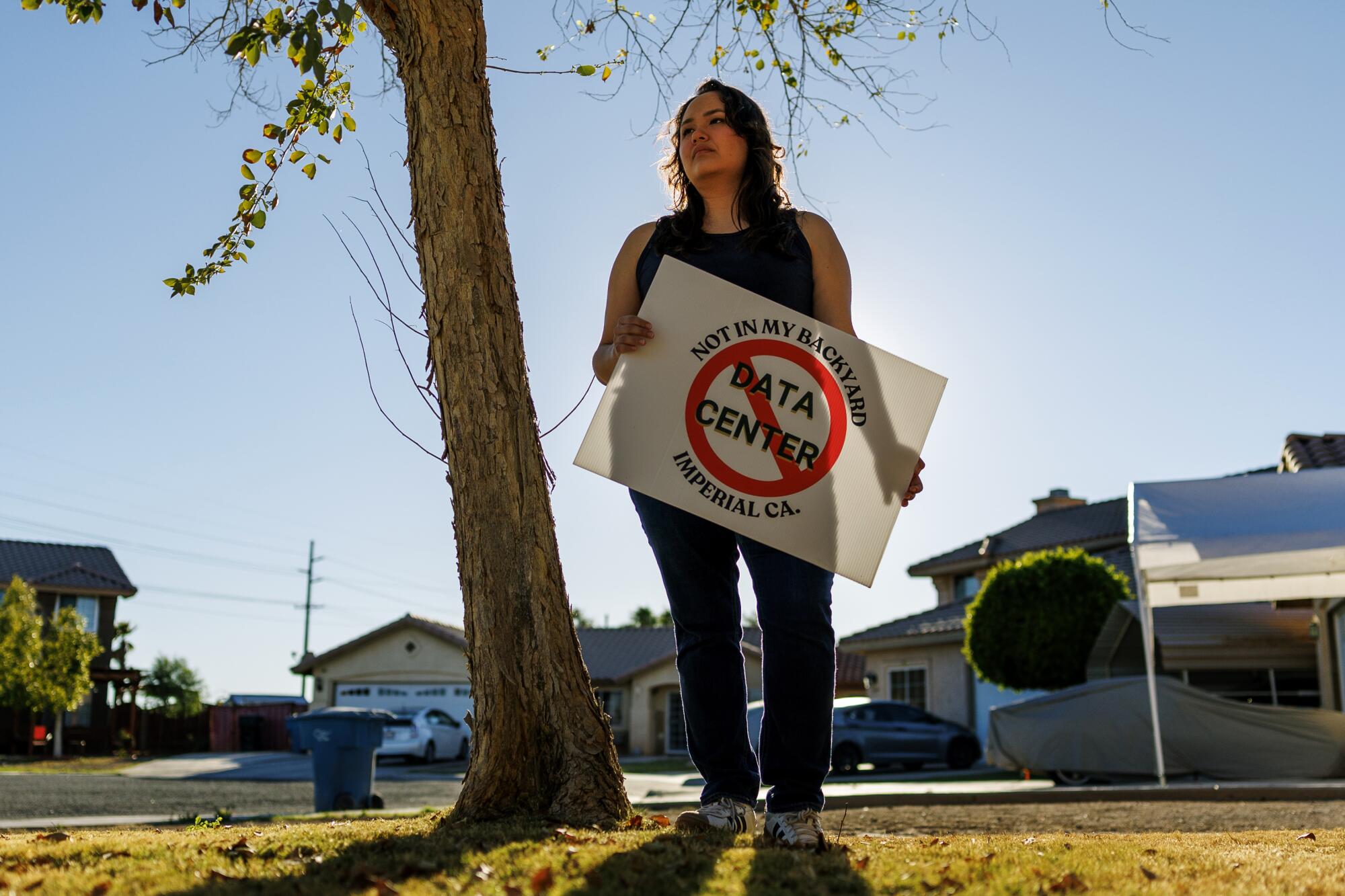
Resident Fernanda Camarillo’s home is right behind the proposed site of the data center in Imperial.
The center would be a neighbor to Camarillo’s house in Victoria Ranch, a family-friendly area with beige stucco homes topped with terracotta tile roofs. She worries about noise, pollution and spiking utility bills. Power companies that have to upgrade grids to meet data centers’ energy demands sometimes seek to recoup that cost by hiking up rates for all consumers.
Camarillo, a substitute teacher, is also scared for her students. The air quality in Imperial Valley is already so poor that schools use a system of color-coded flags to signal whether it’s safe for children to go outside during gym or recess, she said.
“I think they see [the valley] as easy pickings because we are a low-income community and we have such a large population of Latinos here,” Camarillo said.
A quick drive around the neighborhood shows others share her concerns. Signs protesting the data center pop up throughout the community, displayed on front lawns or nestled into rocky garden beds.
Victoria Ranch was quiet and peaceful on a sunny Sunday in late February. Francisco Leal, a resident and lead organizer for NIMBY Imperial, said that’s a major part of its appeal.
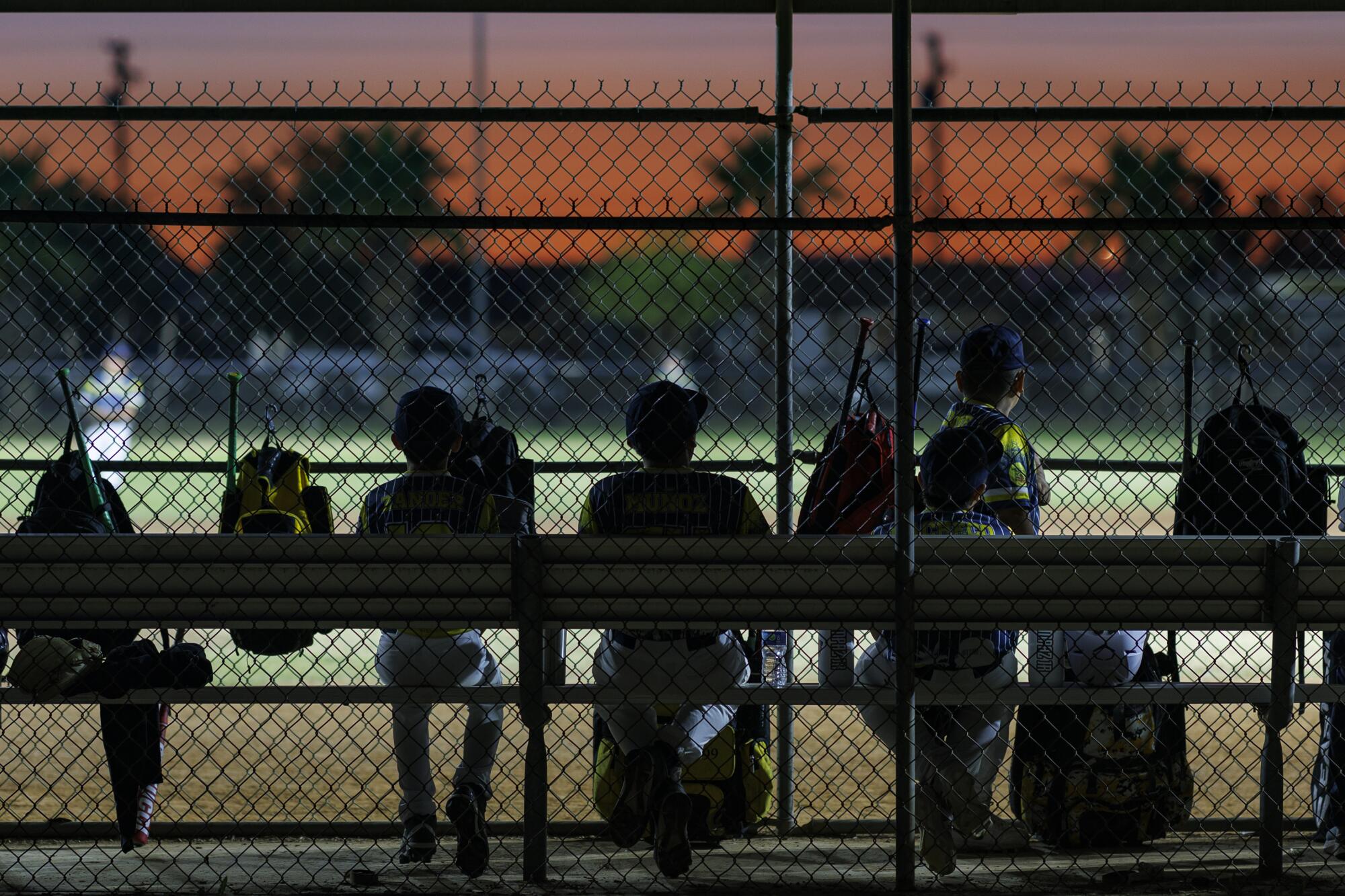
The colorful dusk sky hovers over a Little League baseball game at Freddie White Park in Imperial. The debate over data centers is heating up in the Imperial Valley, a rural desert region in southeastern California.
Leal wants answers about everything from potential health hazards and impacts on the local water supply to whether the fire department is equipped to handle a large-scale electrical blaze. But without a CEQA review, he says residents are left to trust assurances from the developer or privately hired consultants.
Leal plans to sell his property if the project goes forward, but the thought makes him emotional.
“It’s not just a house; it’s a home,” he said. “This is the only home my kids have ever known and all of our family memories are here.”
Gina Snow, another resident, isn’t necessarily against bringing a data center to the county. But she wants the proposal to undergo a CEQA review.
“Clearly we understand that there is economic development and the potential for that to be positive for the county, but at what cost?” she said.
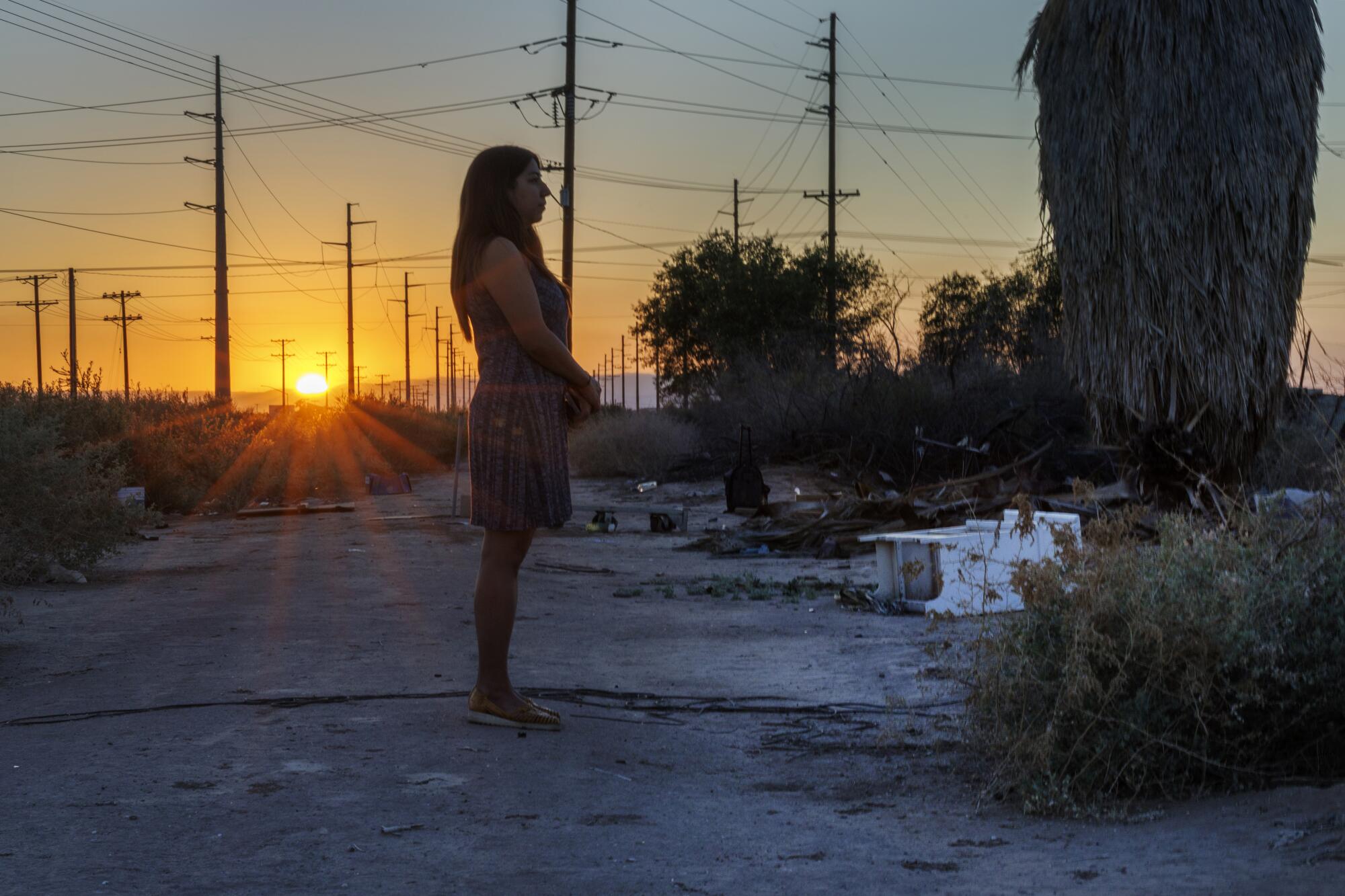
Daniela Flores, executive director of Imperial Valley Equity and Justice, a nonprofit that works for social and environmental equality, stands on the site of the proposed data center.
::
Daniela Flores, executive director of Imperial Valley Equity and Justice, a nonprofit that works for social and environmental equality, said the community has good reason to be wary. Various industries have come into the region over the years and made grand promises that never panned out.
“We became a sacrifice zone,” she said, adding industries use the area’s resources while ultimately doing little to permanently improve the lives of most residents.
Flores said the community continues to struggle with a range of problems, including poor air quality, high poverty rates, weak worker protections and crumbling infrastructure. She believes a data center could add new and potentially dangerous challenges.
The valley has long, brutal summers with temperatures that swell to 120 degrees. If the data center strains the grid and causes a lengthy blackout, or low-income residents have their power shut off because they can’t afford the rising bills, Flores fears the situation could quickly turn deadly.
The city of Imperial also has concerns. The city has filed a lawsuit calling on the county to halt the project, arguing it should not have received a CEQA exemption.
The controversy has drawn attention from Padilla, whose district includes Imperial Valley. Padilla has echoed residents’ calls for more transparency from the county and introduced Senate Bill 887, which would ban data centers from receiving exemptions from CEQA.
“I am not anti-data center or anti-artificial intelligence,” Padilla said. But, he added, we need to “find a way to do this right and make sure there is adequate review and understanding.”
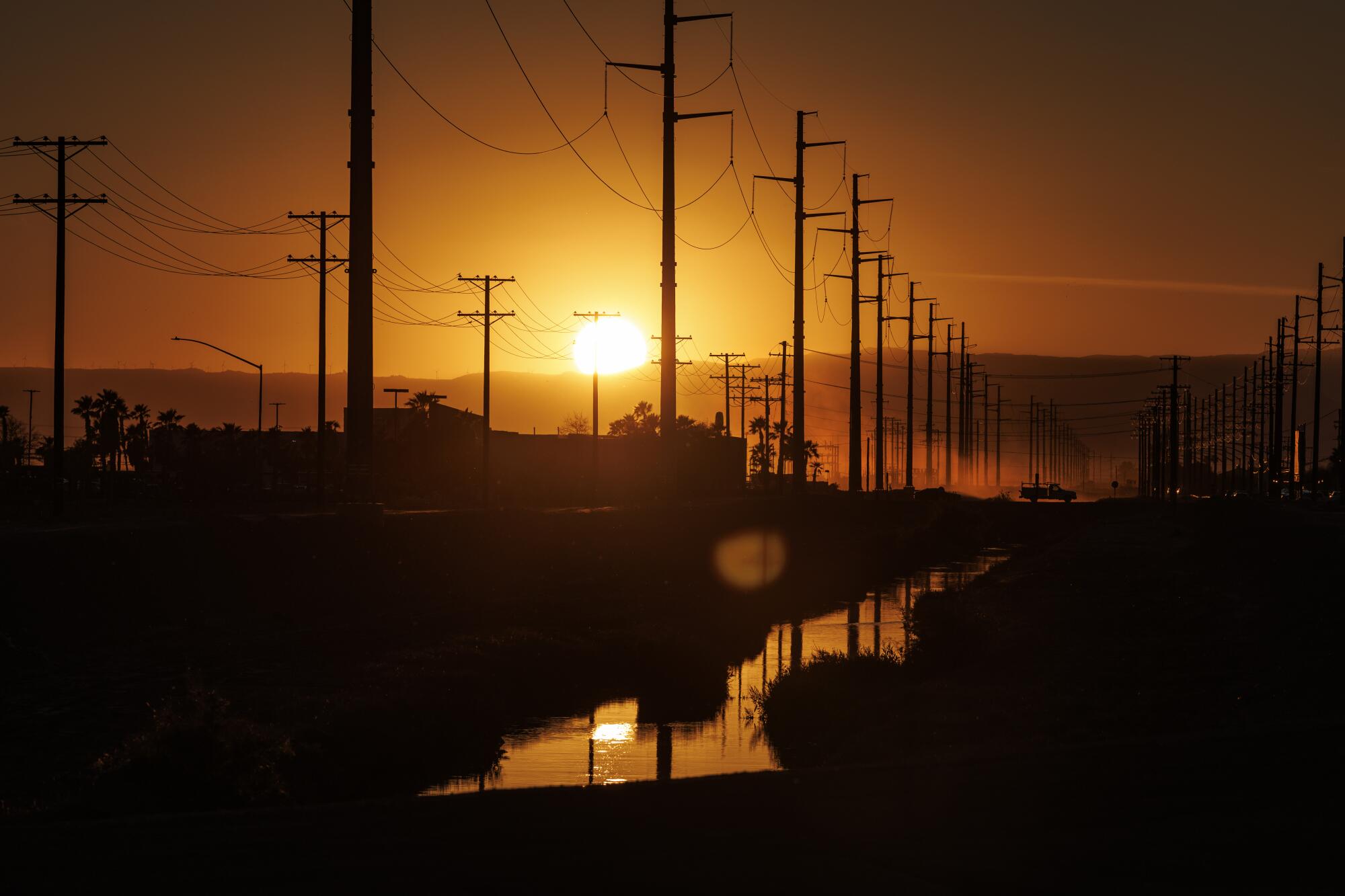
A dusty haze settles over the city of Imperial at dusk near the site of a proposed data center.
Another measure from Padilla, Senate Bill 886, would direct the Public Utilities Commission to create an electrical corporation tariff to cover the cost of data center-related grid upgrades.
Other related legislation this year includes Assembly Bill 2619 from Assemblymember Diane Papan (D-San Mateo) that would require data center owners to provide an estimate about expected water usage and sources before applying for a business license, and Assembly Bill 1577, by Assemblymember Rebecca Bauer-Kahan (D-Orinda), which would require data center owners to submit monthly information to a state commission about water and fuel consumption and energy efficiency.
While lawmakers weigh new policies at the statehouse, Camarillo said she hopes the priority will be protecting communities.
“Innovation is important, but innovation for the sake of innovation has never really been something that hasn’t had negative impacts,” she said. “Think about human lives.”



Singer-songwriter FKA twigs is suing her ex-boyfriend, actor Shia LaBeouf, claiming that he is trying to “silence” her from speaking out against sexual abuse through the use of an “unlawful” nondisclosure agreement.
The complaint, filed in Los Angeles Superior Court on Wednesday, seeks a court order to prohibit LeBeouf from enforcing sections of an NDA which Tahliah Barnett — the Grammy Award-winning singer’s legal name — says violates California law.
“Shia LaBeouf has tried to control Tahliah Barnett for the better part of a decade,” the filing states.
“This action was taken in response to Mr. LaBeouf’s attempt to bully and intimidate twigs through a frivolous and unlawful secret arbitration he filed against her in December in which he sought to extract money from her,” said the singer’s attorney Mathew Rosengart, national co-chair of media & entertainment litigation at Greenberg Traurig in Century City, in a statement.
Rosengart added that twigs “refuses to be bullied anymore. She is instead standing up for herself and other survivors of sexual abuse who have improperly been silenced. This is the unusual case that is not about money but about justice and upholding and enforcing California law and policy designed to protect survivors by nullifying illegal NDAs.”
LaBeouf’s attorney Shawn Holley of Kinsella Holley Iser Kump Steinsapir denied the claims.
“When Ms. Barnett and Mr. LaBeouf both decided to resolve their differences and move on with their lives, no one forced her or ‘bullied’ her to stay silent,” Holley said in a statement.
“As a woman with agency, she decided to settle the case and accepted money to dismiss her lawsuit.”
The suit arises out of litigation that Barnett brought against LaBeouf in 2020, when she accused the actor of “physical, sexual, and mental abuse” during their relationship,” as well as “knowingly infect[ing]” Barnett with a sexually transmitted disease.” That case was settled last year.
In a response to the suit, the actor told the New York Times that “many of these allegations are not true.”
But he added, “I am not in the position to defend any of my actions. I owe these women the opportunity to air their statements publicly and accept accountability for those things I have done.”
In the statement Thursday, Holley added that the claim of sexual battery “was disputed, as were the other claims made in Ms. Barnett’s lawsuit.”
Shia LaBeouf poses for photographers upon arrival at the premiere of the film “The Phoenician Scheme” at the 78th annual Cannes Film Festival May 18, 2025.
(Lewis Joly / Invision / AP)
According to the new lawsuit, LaBeouf filed a secret arbitration complaint and “improperly sought exorbitant monies” from Barnett last December, claiming she had breached their agreement by violating its nondisclosure provisions after she gave an interview to the Hollywood Reporter in October.
In the interview, Barnett was asked if she felt safe and answered that as a woman of color in the entertainment industry, she “wouldn’t feel safe” and discussed her involvement with organizations that support survivors, saying, “I think it’s less about me at this point and more about looking forward. Just, you know, moving on with my life.”
The agreement Barnett reached with LaBeouf “contained a deficient and unlawful NDA that is unenforceable,” under California’s Stand Together Against Non-Disclosure Act, according to the complaint. The law forbids NDAs from being used to silence victims of sexual misconduct.
“As the California Legislature has made clear, survivors should have the right to tell their stories without fear or coercion, and California law does not and must not allow abusers and bullies to silence them through secret agreements containing unconscionable, unlawful gag orders,” the complaint states.
The lawsuit further alleges that while LaBeouf has sought to prohibit Barnett from talking about her abuse, he has “repeatedly brought up his relationship with Ms. Barnett—on his own and without being directly asked about her—materially breaching the very confidentiality provisions that he had just contended were fully enforceable against Ms. Barnett.”
While the actor agreed to drop the arbitration in February, he has “refused to acknowledge, however, that the NDA provisions are illegal and unenforceable,” the filing states.
The latest round in LaBeouf’s legal battle with Barnett comes just weeks after a New Orleans judge ordered the actor to begin substance abuse treatment and undergo weekly drug testing after he was arrested on suspicion of assaulting two men in the city’s French Quarter. LaBeouf was also required to post $100,000 bond as part of the conditions of his release. He was charged with two counts of simple battery, the Associated Press reported.

Warner Bros. Discovery shareholders will soon render a verdict on Hollywood’s biggest merger in nearly a decade.
Warner has set an April 23 special meeting of stockholders to vote on the company’s proposed sale, for $31-a-share, to the Larry Ellison family’s Paramount Skydance.
The $111-billion deal is expected to reshape the entertainment industry by combining two historic film studios, dozens of prominent TV networks, including CBS, HBO, HGTV and Comedy Central, streaming services and two news organizations, CNN and CBS News. The tie-up would give Paramount such beloved characters as Batman, Wile E. Coyote, and Harry Potter, television shows including “Hacks,” and “The Pitt,” and a rich vault of movies that includes “Casablanca,” and “One Battle After Another.”
The $31-a-share offer represents a 63% increase over Paramount Chairman David Ellison’s initial $19-a-share proposal for the company in mid-September, and a 147% premium over Warner’s stock’s trading levels prior to news of Ellison’s interest.
“This transaction is the culmination of the Board’s robust process to unlock the full value of our world-class portfolio,” Warner Bros. Discovery Chief Executive David Zaslav said Thursday in a statement. “We are working closely with Paramount to close the transaction and deliver its benefits to all stakeholders.”
Paramount hopes to finalize the takeover by September. It has been working to secure the blessing of government regulators in the U.S. and abroad.
Should those regulatory deliberations stretch beyond September, Paramount will pay shareholders a so-called “ticking fee” — an extra 25 cents a share for every 90-day-period until the deal closes.
The transaction will leave the combined company with nearly $80-billion in debt, a sum that experts say will lead to significant cost cuts.
Paramount Skydance Chairman and CEO David Ellison attends President Trump’s State of the Union address three days before clinching his hard-fought Warner Bros. Discovery deal.
(Mark Schiefelbein / Associated Press)
For weeks it appeared that Netflix would scoop up Warner Bros.
Netflix initially won the bidding war in early December with a $27.75 offer for the studios and streaming services, including HBO Max. But Ellison refused to throw in the towel. He and his team continued to lobby shareholders, politicians and Warner board members, insisting their deal for the entire company, including the cable channels, was superior and they had a more certain path to win regulatory approval.
The Ellison family is close to President Trump. This week, Trump named Larry Ellison to a proposed White House council on technology issues, including artificial intelligence.
Warner’s board, under pressure, reopened the bidding in late February to allow Paramount to make its case. Warner board members ultimately concluded that Paramount’s bid topped the one from Netflix and the streamer bowed out. Paramount paid a $2.8-billion termination fee to Netflix and signed the merger agreement on Feb. 27.
Warner’s board is advising its shareholders to approve the Paramount deal. Failure to cast a vote will be the same as a no-vote, according to the company’s proxy.
Warner’s largest shareholders include the Vanguard Group, BlackRock, Inc. and State Street Corp.
Zaslav has significant stock and options holdings, worth about $517 million at the deal’s close, according to the proxy.
The regulatory filing also disclosed that a mysterious bidder had surfaced at the auction’s 11th hour.
A firm called Nobelis Capital, Pte., reportedly based in Singapore, alerted Warner on Feb. 18 that it was willing to pay $32.50 a share in cash.
The firm said it had placed $7.5 billion into an escrow account. However, Warner’s bankers “could not find the purported deposit at J.P. Morgan,” according to the proxy. And there was no evidence that Nobelis had any assets or any “equity or debt financing” lined up, Warner said, adding that it “took no further action with respect to the Nobelis proposal.”

new video loaded: How Kharg Island May Change the Trajectory of the Iran War
By Peter Eavis, Gilad Thaler, Edward Vega, Lauren Pruitt and Joey Sendaydiego
March 25, 2026

Trump floats sending federal agents to San Francisco to tackle crime

Dallas ISD will offer free pre-K starting next school year

Norwegian Cruise Line offers a first look at Luna, new cruise ship setting sail from PortMiami – WSVN 7News | Miami News, Weather, Sports | Fort Lauderdale

Boston ‘No Kings’ rally expected to draw 100,000; others planned across Mass.

Jazz List 8 Players on Injury Report vs. Nuggets

Florida High School Football Rankings: Top 25 teams – Oct. 21

How old is Bo Nix? What to know about Oregon quarterback ahead of 2024 NFL Draft

Cleary's 21 help Le Moyne down Central Connecticut State 69-64 in OT

99th annual Pony Swim held in Virginia

Indiana Members Credit Union announced as new anchor tenant at Bottleworks District

Video: Will ICE Change Under Its New Leader?

DHS shutdown breakthrough comes at cost for Republicans as funding fights nears end

Rubio joins crucial G7 talks as Iran war set to dominate second day

A surprise resignation could open the door for an independent to win a Montana Senate seat

Video: Savannah Guthrie Says She Believes Her Mother Was Taken for Ransom
-

 Detroit, MI1 week ago
Drummer Brian Pastoria, longtime Detroit music advocate, dies at 68
-

 Science1 week ago
How a Melting Glacier in Antarctica Could Affect Tens of Millions Around the Globe
-
 Science1 week ago
I had to man up and get a mammogram
-

 Movie Reviews1 week ago
‘Youth’ Twitter review: Ken Karunaas impresses audiences; Suraj Venjaramoodu adds charm; music wins praise | – The Times of India
-

 Sports6 days ago
IOC addresses execution of 19-year-old Iranian wrestler Saleh Mohammadi
-

 New Mexico5 days ago
Clovis shooting leaves one dead, four injured
-
 Business1 week ago
Disney’s new CEO says his focus is on storytelling and creativity
-

 Technology5 days ago
YouTube job scam text: How to spot it fast