Business
Column: It wasn't just the endless shrimp — Red Lobster's corporate owners drove it into bankruptcy

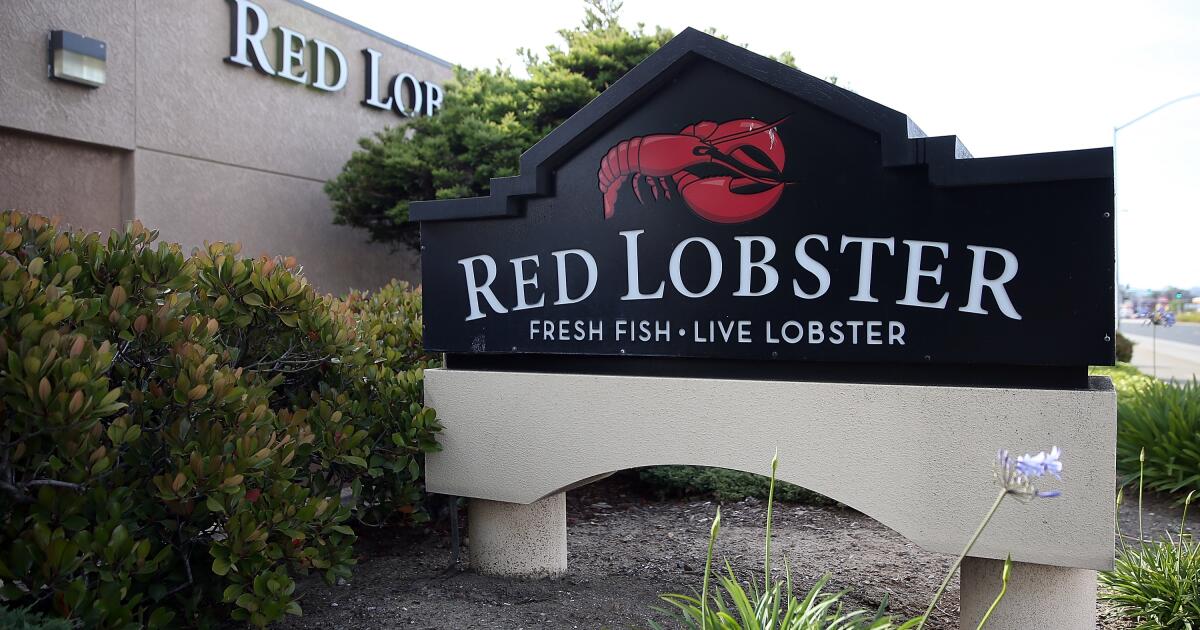
On the surface, the story of Red Lobster’s bankruptcy is about one of the seven deadly sins: gluttony.
The most eye-catching manifestation of that sin, as my colleague Marisa Gerber reported, was the chain’s experience with its $20 all-you-can eat shrimp promotion, which attracted families that parked themselves in the restaurants for hours at a time, consuming mass quantities.
But that doesn’t account for the gluttony of Red Lobster’s former private equity owners, San Francisco-based Golden Gate Capital, or its subsequent corporate owners, the huge Bangkok-based seafood conglomerate Thai Union.
Red Lobster’s real estate sale gives its new owners little room for error.
— Restaurant analyst Jonathan Maze (2014)
According to Sunday’s bankruptcy filing by the chain’s new management, the chain was saddled with suffocating leases at “above-market” rents; these were the product of a financing deal entered into by Golden Gate. Thai Union, the filing insinuates, pressured the company into “burdensome supply obligations” that had little to do with the restaurants’ actual needs.
Golden Gate declined to comment. A Thai Union spokesman told me via email that the accusations in the filing are “meritless” and that it intends to continue its 30-year relationship with Red Lobster as a supplier.
That suggests that Thai Union sees more profit from selling shrimp to the chain than it did as a shareholder.
Put all this together, and it becomes clear that a major cause of Red Lobster’s financial collapse was the machinations of its owners.
Indeed, the chain got flipped several times among owners looking for a big payoff; when their expectations were disappointed, they sold it off.
As the bankruptcy filing put it, the chain “has gone from a privately-owned enterprise, to part of a publicly-traded organization, and then back to private again.”
It was founded as a single Orlando restaurant in 1968 by Bill Darden, then acquired by General Mills, which then spun off Red Lobster along with its Olive Garden chain as Darden Restaurants. Darden sold Red Lobster in 2014 to Golden Gate, which sold it in stages to Thai Union and exited ownership entirely in August 2020.
At the end of last year, Thai Union, which had bought a minority stake in the chain for $575 million in 2016 and purchased the rest for an undisclosed sum as a member of an investment consortium in 2020, wrote down its stake in Red Lobster to zero, taking a $527-million charge.
Throughout that period, Red Lobster faced a raft of challenges. Having made its nationwide mark in the 1980s and 1990s as America’s first “casual dining” chain—a step up from fast food but short of premium-priced sit-down fare—it now has about 550 company-owned locations in the U.S.
(The bankruptcy filing says Red Lobster’s “rich history … spans seven decades,” but its arithmetic is off: It’s only been in existence for 56 years.)
As time went on, Americans’ tastes changed and seafood-only restaurants fell out of favor. Then came the pandemic. According to the bankruptcy filing, the restaurants’ guest count is still about 30% below its pre-pandemic level. Over the last year, its operating earnings have fallen by 60%. The chain lost $76 million in fiscal 2023.
As the headwinds gathered, Red Lobster’s management changes were as dizzying as its ownership changes. From 2021 to now, the company had four CEOs, including one who lasted eight months in 2021-22.
After that the company went without a CEO for 17 months; the new incumbent assumed office in last September and was succeeded in March by Jonathan Tibus, a turnaround specialist who is now in charge. Each new CEO arrived with new strategic ideas before giving way to a successor who tried to undo the previous strategy and impose a new one.
If one is looking for the original sin in Red Lobster’s decline, however, a good candidate would be the deal that brought it under Golden Gate Capital’s ownership. The private equity firm bought the chain from Darden for $2.1 billion, financing the sale in part by selling the real estate underlying 500 restaurants to the real estate firm American Realty Capital for $1.5 billion.
This was a sale-leaseback transaction, in which Red Lobster was instantly converted from the owner of its property to a tenant on the same property. The leases were typically long-term — as long as 25 years — with annual rent increases of 2% baked in. They were also triple-net leases, meaning that the restaurants were responsible for paying operating costs, property taxes and insurance.
Red Lobster thus lost a great deal of flexibility for closing underperforming restaurants and cutting costs. The bankruptcy filing says that a material portion of the leases charge above-market rates. Of the company’s lease obligations of $190.5 million last year, more than $64 million was for “underperforming stores.”
This exacerbated the company’s financial problems. “Given the Company’s operational headwinds and financial position,” the filing says, “payment of lease obligations associated with non-performing leases has cause significant strains on the Company’s liquidity.” In other words, the sale-leaseback arrangement was draining the company of cash.
The sale-leaseback deal raised eyebrows among restaurant analysts at the time. “Let’s get this straight,” wrote Jonathan Maze of Restaurant Finance Monitor: “We’re taking a brand with badly falling sales and earnings, and will then load it up with rent costs?”
At the outset, Red Lobster would be paying $118.5 million in cash rent, about half the chain’s annual operating earnings, he wrote. “Red Lobster’s real estate sale gives its new owners little room for error,” he added presciently. Golden Gate declined to comment.
It’s proper to note that this sort of transaction resembles private equity deals that have been blamed for the deterioration of consumer businesses in other industries. Private equity takeovers often result in large-scale worker layoffs and the imposition of heavy debt on companies that can hasten their decline, as well as bringing higher costs to consumers.
The pattern was for private equity funds to “purchase controlling interests in companies for a short time, then load them up with debt, strip them of their asset, extract exorbitant fees, and sell them at a profit — implementing drastic cost-cutting measures at the expense of workers, consumers, communities, and taxpayers,” Democratic lawmakers wrote in 2019.
Buyouts of private for-profit colleges, for example, resulted in jacked-up tuition charges and higher student loan balances among students, according to a 2019 study of several such deals; these were accompanied by “sharp declines in student graduation rates, loan repayment rates, and labor market earnings.”
And local newsrooms across the country have been gutted by the private equity firm Alden Global Capital, which has become famous for aggressive cost-cutting and uninterest in the quality of the resulting products; by early this decade Alden was the owner of some 200 newspapers, including the Chicago Tribune, Baltimore Sun and San Diego Union-Tribune.
When Golden Gate sold off its stake in the chain, the restaurants were carrying a heavy debt load; some $375 million in debt was added to the chain’s balance sheet in May 2014 to help fund Golden Gate’s acquisition, Moody’s reported. The debt came due in 2021.
That brings us to Thai Union. One of the world’s largest seafood companies, Thai Union owns Chicken of the Sea tuna, among other holdings. Its involvement in the canned-tuna business brought it grief in 2018, when the federal government alleged a price-fixing conspiracy involving Chicken of the Sea, Bumble Bee and StarKist.
The government discovered the deal when it subjected a proposed merger between Chicken of the Sea and Bumble Bee to antitrust scrutiny. As I wrote at the time, Thai Union “promptly bailed out of the merger and fessed up to the Justice Department in return for amnesty from prosecution.”
Thai Union originally bought into Red Lobster as a strategic foray into retail dining. According to the bankruptcy filing, Thai Union eventually pressured the restaurant chain to increase its demand for shrimp, a Thai Union product.
One result was the conversion of the chain’s “Ultimate Endless Shrimp” offer, which had been an occasional limited-time promotion, into a permanent menu item. The filing says that was done, despite “significant pushback” from members of the management team, at the behest of Paul Kenny, who had been named acting interim CEO in April 2022 “at the direction of Thai Union.”
The current management says that Thai Union “exercised an outsized influence on the Company’s shrimp purchasing,” circumventing the chain’s “traditional supply process” and ignoring its demand projections. It says that Kenny took steps to eliminate two suppliers of breaded shrimp, giving Thai Union “an exclusive deal that led to higher costs to Red Lobster.”
The current management says it’s “investigating the circumstances around these decisions.”
The bottom line is that it’s not unreasonable to blame some of Red Lobster’s problems on its endless shrimp promotion, but that it’s more important to examine how that promotion came about in the first place.
The answer, according to the management team tasked with extricating the company from its financial mire, is that it was forced on the company by self-interested owners.
One had no experience running a restaurant chain, didn’t notice the signs that it was heading toward a fiasco and may not have cared as long as it could keep pumping shrimp into the chain’s pipeline. The other collected a healthy subsidy for its multibillion-dollar acquisition, and perhaps didn’t notice or care that it was tying one hand behind the back of the chain’s management as it faced a sea change in consumer habits.
Red Lobster became a plaything for financial engineers, a condition that almost never — if ever — leads to an improved consumer experience and greater profits in the long term. It’s one thing to blame Red Lobster’s problems on consumers pigging out on shrimp, but who were the real pigs in this saga?



Fintech company Block said Thursday that it’s cutting more than 4,000 workers or nearly half of its workforce as artificial intelligence disrupts the way people work.
The Oakland parent company of payment services Square and Cash App saw its stock surge by more than 23% in after-hours trading after making the layoff announcement.
Jack Dorsey, the co-founder and head of Block, said in a post on social media site X that the company didn’t make the decision because the company is in financial trouble.
“We’re already seeing that the intelligence tools we’re creating and using, paired with smaller and flatter teams, are enabling a new way of working which fundamentally changes what it means to build and run a company,” he said.
Block is the latest tech company to announce massive cuts as employers push workers to use more AI tools to do more with fewer people. Amazon in January said it was laying off 16,000 people as part of effort to remove layers within the company.
Block has laid off workers in previous years. In 2025, Block said it planned to slash 931 jobs, or 8% of its workforce, citing performance and strategic issues but Dorsey said at the time that the company wasn’t trying to replace workers with AI.
As tech companies embrace AI tools that can code, generate text and do other tasks, worker anxiety about whether their jobs will be automated have heightened.
In his note to employees Dorsey said that he was weighing whether to make cuts gradually throughout months or years but chose to act immediately.
“Repeated rounds of cuts are destructive to morale, to focus, and to the trust that customers and shareholders place in our ability to lead,” he told workers. “I’d rather take a hard, clear action now and build from a position we believe in than manage a slow reduction of people toward the same outcome.”
Dorsey is also the co-founder of Twitter, which was later renamed to X after billionaire Elon Musk purchased the company in 2022.
As of December, Block had 10,205 full-time employees globally, according to the company’s annual report. The company said it plans to reduce its workforce by the end of the second quarter of fiscal year 2026.
The company’s gross profit in 2025 reached more than $10 billion, up 17% compared to the previous year.
Dorsey said he plans to address employees in a live video session and noted that their emails and Slack will remain open until Thursday evening so they can say goodbye to colleagues.
“I know doing it this way might feel awkward,” he said. “I’d rather it feel awkward and human than efficient and cold.”

The Writers Guild of America West has canceled its awards ceremony scheduled to take place March 8 as its staff union members continue to strike, demanding higher pay and protections against artificial intelligence.
In a letter sent to members on Sunday, WGA West’s board of directors, including President Michele Mulroney, wrote, “The non-supervisory staff of the WGAW are currently on strike and the Guild would not ask our members or guests to cross a picket line to attend the awards show. The WGAW staff have a right to strike and our exceptional nominees and honorees deserve an uncomplicated celebration of their achievements.”
The New York ceremony, scheduled on the same day, is expected go forward while an alternative celebration for Los Angeles-based nominees will take place at a later date, according to the letter.
Comedian and actor Atsuko Okatsuka was set to host the L.A. show, while filmmaker James Cameron was to receive the WGA West Laurel Award.
WGA union staffers have been striking outside the guild’s Los Angeles headquarters on Fairfax Avenue since Feb. 17. The union alleged that management did not intend to reach an agreement on the pending contract. Further, it claimed that guild management had “surveilled workers for union activity, terminated union supporters, and engaged in bad faith surface bargaining.”
On Tuesday, the labor organization said that management had raised the specter of canceling the ceremony during a call about contraction negotiations.
“Make no mistake: this is an attempt by WGAW management to drive a wedge between WGSU and WGA membership when we should be building unity ahead of MBA [Minimum Basic Agreement] negotiations with the AMPTP [Alliance of Motion Picture and Television Producers],” wrote the staff union. “We urge Guild management to end this strike now,” the union wrote on Instagram.
The union, made up of more than 100 employees who work in areas including legal, communications and residuals, was formed last spring and first authorized a strike in January with 82% of its members. Contract negotiations, which began in September, have focused on the use of artificial intelligence, pay raises and “basic protections” including grievance procedures.
The WGA has said that it offered “comprehensive proposals with numerous union protections and improvements to compensation and benefits.”
The ceremony’s cancellation, coming just weeks before the Academy Awards, casts a shadow over the upcoming contraction negotiations between the WGA and the Alliance of Motion Picture and Television Producers, which represents the studios and streamers.
In 2023, the WGA went on a strike lasting 148 days, the second-longest strike in the union’s history.
Times staff writer Cerys Davies contributed to this report.
Business
Commentary: The Pentagon is demanding to use Claude AI as it pleases. Claude told me that’s ‘dangerous’

Recently, I asked Claude, an artificial-intelligence thingy at the center of a standoff with the Pentagon, if it could be dangerous in the wrong hands.
Say, for example, hands that wanted to put a tight net of surveillance around every American citizen, monitoring our lives in real time to ensure our compliance with government.
“Yes. Honestly, yes,” Claude replied. “I can process and synthesize enormous amounts of information very quickly. That’s great for research. But hooked into surveillance infrastructure, that same capability could be used to monitor, profile and flag people at a scale no human analyst could match. The danger isn’t that I’d want to do that — it’s that I’d be good at it.”
That danger is also imminent.
Claude’s maker, the Silicon Valley company Anthropic, is in a showdown over ethics with the Pentagon. Specifically, Anthropic has said it does not want Claude to be used for either domestic surveillance of Americans, or to handle deadly military operations, such as drone attacks, without human supervision.
Those are two red lines that seem rather reasonable, even to Claude.
However, the Pentagon — specifically Pete Hegseth, our secretary of Defense who prefers the made-up title of secretary of war — has given Anthropic until Friday evening to back off of that position, and allow the military to use Claude for any “lawful” purpose it sees fit.
Defense Secretary Pete Hegseth, center, arrives for the State of the Union address in the House Chamber of the U.S. Capitol on Tuesday.
(Tom Williams / CQ-Roll Call Inc. via Getty Images)
The or-else attached to this ultimatum is big. The U.S. government is threatening not just to cut its contract with Anthropic, but to perhaps use a wartime law to force the company to comply or use another legal avenue to prevent any company that does business with the government from also doing business with Anthropic. That might not be a death sentence, but it’s pretty crippling.
Other AI companies, such as white rights’ advocate Elon Musk’s Grok, have already agreed to the Pentagon’s do-as-you-please proposal. The problem is, Claude is the only AI currently cleared for such high-level work. The whole fiasco came to light after our recent raid in Venezuela, when Anthropic reportedly inquired after the fact if another Silicon Valley company involved in the operation, Palantir, had used Claude. It had.
Palantir is known, among other things, for its surveillance technologies and growing association with Immigration and Customs Enforcement. It’s also at the center of an effort by the Trump administration to share government data across departments about individual citizens, effectively breaking down privacy and security barriers that have existed for decades. The company’s founder, the right-wing political heavyweight Peter Thiel, often gives lectures about the Antichrist and is credited with helping JD Vance wiggle into his vice presidential role.
Anthropic’s co-founder, Dario Amodei, could be considered the anti-Thiel. He began Anthropic because he believed that artificial intelligence could be just as dangerous as it could be powerful if we aren’t careful, and wanted a company that would prioritize the careful part.
Again, seems like common sense, but Amodei and Anthropic are the outliers in an industry that has long argued that nearly all safety regulations hamper American efforts to be fastest and best at artificial intelligence (although even they have conceded some to this pressure).
Not long ago, Amodei wrote an essay in which he agreed that AI was beneficial and necessary for democracies, but “we cannot ignore the potential for abuse of these technologies by democratic governments themselves.”
He warned that a few bad actors could have the ability to circumvent safeguards, maybe even laws, which are already eroding in some democracies — not that I’m naming any here.
“We should arm democracies with AI,” he said. “But we should do so carefully and within limits: they are the immune system we need to fight autocracies, but like the immune system, there is some risk of them turning on us and becoming a threat themselves.”
For example, while the 4th Amendment technically bars the government from mass surveillance, it was written before Claude was even imagined in science fiction. Amodei warns that an AI tool like Claude could “conduct massively scaled recordings of all public conversations.” This could be fair game territory for legally recording because law has not kept pace with technology.
Emil Michael, the undersecretary of war, wrote on X Thursday that he agreed mass surveillance was unlawful, and the Department of Defense “would never do it.” But also, “We won’t have any BigTech company decide Americans’ civil liberties.”
Kind of a weird statement, since Amodei is basically on the side of protecting civil rights, which means the Department of Defense is arguing it’s bad for private people and entities to do that? And also, isn’t the Department of Homeland Security already creating some secretive database of immigration protesters? So maybe the worry isn’t that exaggerated?
Help, Claude! Make it make sense.
If that Orwellian logic isn’t alarming enough, I also asked Claude about the other red line Anthropic holds — the possibility of allowing it to run deadly operations without human oversight.
Claude pointed out something chilling. It’s not that it would go rogue, it’s that it would be too efficient and fast.
“If the instructions are ‘identify and target’ and there’s no human checkpoint, the speed and scale at which that could operate is genuinely frightening,” Claude informed me.
Just to top that with a cherry, a recent study found that in war games, AI’s escalated to nuclear options 95% of the time.
I pointed out to Claude that these military decisions are usually made with loyalty to America as the highest priority. Could Claude be trusted to feel that loyalty, the patriotism and purpose, that our human soldiers are guided by?
“I don’t have that,” Claude said, pointing out that it wasn’t “born” in the U.S., doesn’t have a “life” here and doesn’t “have people I love there.” So an American life has no greater value than “a civilian life on the other side of a conflict.”
OK then.
“A country entrusting lethal decisions to a system that doesn’t share its loyalties is taking a profound risk, even if that system is trying to be principled,” Claude added. “The loyalty, accountability and shared identity that humans bring to those decisions is part of what makes them legitimate within a society. I can’t provide that legitimacy. I’m not sure any AI can.”
You know who can provide that legitimacy? Our elected leaders.
It is ludicrous that Amodei and Anthropic are in this position, a complete abdication on the part of our legislative bodies to create rules and regulations that are clearly and urgently needed.
Of course corporations shouldn’t be making the rules of war. But neither should Hegseth. Thursday, Amodei doubled down on his objections, saying that while the company continues to negotiate and wants to work with the Pentagon, “we cannot in good conscience accede to their request.”
Thank goodness Anthropic has the courage and foresight to raise the issue and hold its ground — without its pushback, these capabilities would have been handed to the government with barely a ripple in our conscientiousness and virtually no oversight.
Every senator, every House member, every presidential candidate should be screaming for AI regulation right now, pledging to get it done without regard to party, and demanding the Department of Defense back off its ridiculous threat while the issue is hashed out.
Because when the machine tells us it’s dangerous to trust it, we should believe it.

Washington Commanders to pay DC $1M to resolve lawsuit over abusive workplace culture – WTOP News

Time for the Guardians to Do What They Said They’d Do

Austin downtown shooting: What we know about the gunman, victims and motive

Air Force base security tightens, AL reacts after attacks in Iran

Alaska Air National Guard rescues injured snowmachiner near Cooper Landing

Florida High School Football Rankings: Top 25 teams – Oct. 21

Cleary's 21 help Le Moyne down Central Connecticut State 69-64 in OT

How old is Bo Nix? What to know about Oregon quarterback ahead of 2024 NFL Draft

99th annual Pony Swim held in Virginia

Indiana Members Credit Union announced as new anchor tenant at Bottleworks District

Map: Earthquake Shakes Central California

Gas prices could jump as Middle East tensions threaten global oil supply

Pakistan calls troops, orders 3-day curfew as 24 killed in pro-Iran rallies

US says Kuwait accidentally shot down 3 American jets

House Republicans push Johnson to go to war with Senate over SAVE Act
-

 World5 days ago
Exclusive: DeepSeek withholds latest AI model from US chipmakers including Nvidia, sources say
-

 Massachusetts5 days ago
Mother and daughter injured in Taunton house explosion
-

 Denver, CO5 days ago
10 acres charred, 5 injured in Thornton grass fire, evacuation orders lifted
-

 Louisiana1 week ago
Wildfire near Gum Swamp Road in Livingston Parish now under control; more than 200 acres burned
-

 Technology1 week ago
YouTube TV billing scam emails are hitting inboxes
-

 Politics1 week ago
OpenAI didn’t contact police despite employees flagging mass shooter’s concerning chatbot interactions: REPORT
-

 Technology1 week ago
Stellantis is in a crisis of its own making
-

 News1 week ago
World reacts as US top court limits Trump’s tariff powers