Business
China’s boba behemoth lands in Hollywood

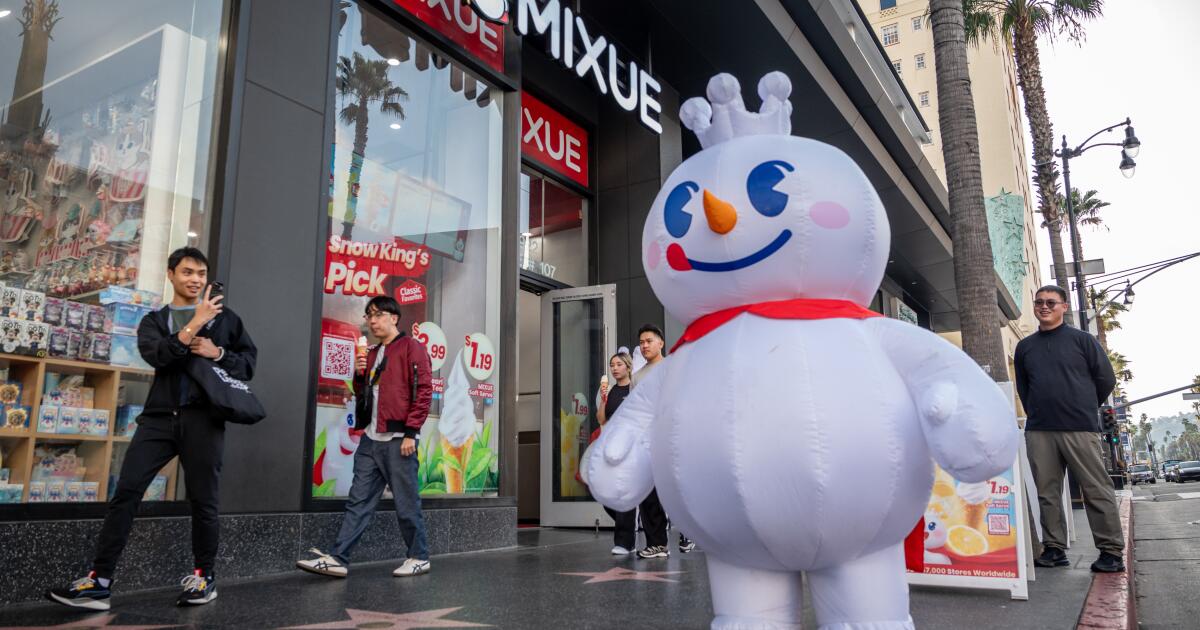
China’s boba behemoth has landed in Hollywood.
Mixue, the fast-growing megachain that boasts a bigger global retail footprint than McDonald’s, opened its first U.S. outpost on Hollywood’s Walk of Fame last month, selling drinks for less than $5 and ice cream for about $1.
Mixue spokesperson Xu Ping said in a written statement in Chinese that the company chose Hollywood as its first U.S. location because the “movie capital of the world” attracts both international tourists and local consumers year-round.
The store, Ping added, “aims to serve a diverse global consumer base and demonstrates the brand’s commitment to the American market.”
The Hollywood opening was followed in quick succession with locations in New York City’s Brooklyn, Koreatown and Chinatown neighborhoods. More Mixue stores are coming to California, Ping said.
The megachain’s entry into Los Angeles’ boba market comes at a time when local shops are struggling with rising costs driven by tariffs and economic uncertainty.
Mixue was founded as a shaved ice stand in 1997 in Zhengzhou, China, by college student Zhang Hongchao, who used money lent from his grandmother. The store’s Chinese name, Mi Xue Bing Cheng, translates roughly to “sweet snow palace.”
The store has more than 53,000 stores worldwide. The lion’s share are in China, but the company also has 4,700 locations across Australia, Japan, South Korea, Thailand, Malaysia and Singapore.
By comparison, McDonald’s has more than 44,000 stores worldwide, and Starbucks has more than 40,000.
Founder Zhang and his brother Zhang Hongfu, who control the company, have a combined fortune of $8.1 billion, according to the Bloomberg Billionaires Index.
Mixue is a fast-growing megachain that boasts a bigger global retail footprint than McDonald’s.
(David Butow / For The Times)
Mixue is able to keep costs low because it is vertically integrated, said UCLA business administration professor Christopher Tang, a supply chain management expert.
Mixue owns the factories in China that produce its powders, syrups and fruit purees, giving the company greater control over pricing, Tang said. The store’s grab-and-go concept means lower rent costs. Having most of its locations concentrated in Asia means lower transportation costs.
Tang said the chain’s U.S. stores may be operating as loss leaders to expand its global footprint, test the American market, and demonstrate growth to investors after its listing on the Hong Kong Stock Exchange last year.
“They can use the profit in China to subsidize the loss in the U.S. for the sake of expansion,” Tang said. “Once [they] get the traction in the US, they can grow a little bit further. Once it grows to critical mass they will be able to sustain the operations.”
On Thursday evening, Mixue customers stood outside — the shop does not offer seating — eating soft serve and sipping on boba milk tea and the store’s signature grape drink with taro balls.
Several passersby snapped photos with Mixue’s inflatable snow “king” mascot that stands guard outside the store entrance. Across the street, actors posed on a red carpet, which had been rolled out on Hollywood Boulevard for the premiere of a Marvel TV show at the TCL Chinese Theatre.
Menu items range from $1.19 for the soft serve to $4.99 for its “super-triple” milk tea with tapioca pearls, pudding and coconut jelly toppings. Self-service kiosks let customers order in either Chinese or English and adjust the sweetness levels in drinks, which can range from 0% to 200%.
The chain appears to be aggressively seeking franchisees in California.

Mixue owns the factories in China that produce its powders, syrups and fruit purees. “They can use the profit in China to subsidize the loss in the U.S. for the sake of expansion,” said Christopher Tang, a UCLA professor of business administration.
(David Butow / For The Times)
QR codes posted on the store’s front window, walls and sidewalk signs lead to an application website for prospective franchisees in California and New York. Opening a store requires an upfront investment between roughly $220,000 and $920,000, depending on size and location, according to the website. Mixue does not charge franchisees ongoing royalty or advertising fees.
Some Chinese customers were already familiar with the Mixue brand or longtime fans.
Tourist Kele Shi, a tech worker living in Washington who is from Shenzhen, China, decided to stop by its first U.S. location after seeing videos on YouTube and the Chinese social media app Xiaohongshu.
Shi had been in the Miracle Mile neighborhood earlier in the day to visit a museum but decided to go to the Walk of Fame to see whether the affordable soft serve was better than Ikea’s version.
“This is 80% of the reason we are here,” said Shi. “It’s good, not too sweet. That’s always a compliment for Asian people.”
Torrance resident Olivia Y, who grew up in China, was picking up five drinks for her friends after a climbing session in the neighborhood.
Y said she had fond memories of eating Mixue’s ice cream — her favorite menu item — and drinking fresh lemonade while pulling all-nighters as a student in Xi’An, China, and wanted to pay the U.S. store a visit after hearing about it on social media.
Other customers, like tourist Susannah Bartram, from Nottingham, England, had never previously heard of the chain. She had been strolling down the Walk of Fame, parched after taking a three-hour guided tour of Los Angeles, when the bright red store colors caught her eye.
“It’s colorful and accessible, and it’s a quick fix,” Bartram said, holding a cup of iced tea with large slices of lemon.
With pearl tea gaining popularity in her home country, “it is just nice to see something fresh,” she said.
On the other side of Hollywood Boulevard, local business Bopomofo Cafe’s location in the Ovation Hollywood shopping complex was relatively quiet on Thursday night.
Earlier this month, the Asian American cafe, which sells boba and snacks — including a sandwich described by L.A. Times food columnist Jenn Harris as the “apotheosis” version of McDonald’s Filet-O-Fish — shared on social media that it was struggling with rising costs of goods, including matcha powder and paper goods due to “trade wars and economic uncertainty.”
The cafe initially mulled a price increase, but decided to first try removing some items from its menu and offering a limited food menu an hour before it closes, said Philip Wang, who co-founded Bopomofo with partner Eric Wang in 2019. Philip Wang also co-owns the Asian American production company Wong Fu Productions.
Bopomofo’s classic milk tea costs $6.50, and blended drinks such as its guava matcha latte cost $8. Toppings are an additional 75 cents.
“[We] are not just chasing profits and a bottom line,” the cafe wrote in the Instagram post announcing the changes. “We’re also not a massive company with hundreds of locations (or thousands overseas) bankrolling our stores.”
Bopomofo’s Hollywood location opened in February as an experiment to see how it would perform in a tourist-driven mall, Philip Wang said.

The store is known for its ultra cheap products, such as $1.19 soft serve cones and $4 boba.
(David Butow / For The Times)
As it approaches its first year in operation, the shop, located on the shopping center’s second floor, has seen less traffic than its other four locations in Southern California cities with significant Asian populations, such as San Gabriel and Irvine, he said. (A sixth location is to open in Downtown Disney this year.)
Philip Wang said he hasn’t seen noticeable impact on the store’s performance yet in the month since Mixue opened, noting that it’s still early. The holidays boosted traffic, Mixue opened in December, and business slowed in January — a dip he said is typical across the food and beverage industry.
He hopes Mixue’s presence in the U.S. might raise the profile of boba here and encourage more people to “expand their palette” and try local shops.
Bopomofo is no stranger to competing in dense markets: Its original location is San Gabriel, where there are boba and tea shops on every corner. Philip Wang said he’s confident that the drinks his cafe sells, which don’t use artificial flavors, syrups or powders, will continue to attract customers.
But “I would be lying if I said that [Mixue’s] not on our minds,” Wang said.



Fintech company Block said Thursday that it’s cutting more than 4,000 workers or nearly half of its workforce as artificial intelligence disrupts the way people work.
The Oakland parent company of payment services Square and Cash App saw its stock surge by more than 23% in after-hours trading after making the layoff announcement.
Jack Dorsey, the co-founder and head of Block, said in a post on social media site X that the company didn’t make the decision because the company is in financial trouble.
“We’re already seeing that the intelligence tools we’re creating and using, paired with smaller and flatter teams, are enabling a new way of working which fundamentally changes what it means to build and run a company,” he said.
Block is the latest tech company to announce massive cuts as employers push workers to use more AI tools to do more with fewer people. Amazon in January said it was laying off 16,000 people as part of effort to remove layers within the company.
Block has laid off workers in previous years. In 2025, Block said it planned to slash 931 jobs, or 8% of its workforce, citing performance and strategic issues but Dorsey said at the time that the company wasn’t trying to replace workers with AI.
As tech companies embrace AI tools that can code, generate text and do other tasks, worker anxiety about whether their jobs will be automated have heightened.
In his note to employees Dorsey said that he was weighing whether to make cuts gradually throughout months or years but chose to act immediately.
“Repeated rounds of cuts are destructive to morale, to focus, and to the trust that customers and shareholders place in our ability to lead,” he told workers. “I’d rather take a hard, clear action now and build from a position we believe in than manage a slow reduction of people toward the same outcome.”
Dorsey is also the co-founder of Twitter, which was later renamed to X after billionaire Elon Musk purchased the company in 2022.
As of December, Block had 10,205 full-time employees globally, according to the company’s annual report. The company said it plans to reduce its workforce by the end of the second quarter of fiscal year 2026.
The company’s gross profit in 2025 reached more than $10 billion, up 17% compared to the previous year.
Dorsey said he plans to address employees in a live video session and noted that their emails and Slack will remain open until Thursday evening so they can say goodbye to colleagues.
“I know doing it this way might feel awkward,” he said. “I’d rather it feel awkward and human than efficient and cold.”

The Writers Guild of America West has canceled its awards ceremony scheduled to take place March 8 as its staff union members continue to strike, demanding higher pay and protections against artificial intelligence.
In a letter sent to members on Sunday, WGA West’s board of directors, including President Michele Mulroney, wrote, “The non-supervisory staff of the WGAW are currently on strike and the Guild would not ask our members or guests to cross a picket line to attend the awards show. The WGAW staff have a right to strike and our exceptional nominees and honorees deserve an uncomplicated celebration of their achievements.”
The New York ceremony, scheduled on the same day, is expected go forward while an alternative celebration for Los Angeles-based nominees will take place at a later date, according to the letter.
Comedian and actor Atsuko Okatsuka was set to host the L.A. show, while filmmaker James Cameron was to receive the WGA West Laurel Award.
WGA union staffers have been striking outside the guild’s Los Angeles headquarters on Fairfax Avenue since Feb. 17. The union alleged that management did not intend to reach an agreement on the pending contract. Further, it claimed that guild management had “surveilled workers for union activity, terminated union supporters, and engaged in bad faith surface bargaining.”
On Tuesday, the labor organization said that management had raised the specter of canceling the ceremony during a call about contraction negotiations.
“Make no mistake: this is an attempt by WGAW management to drive a wedge between WGSU and WGA membership when we should be building unity ahead of MBA [Minimum Basic Agreement] negotiations with the AMPTP [Alliance of Motion Picture and Television Producers],” wrote the staff union. “We urge Guild management to end this strike now,” the union wrote on Instagram.
The union, made up of more than 100 employees who work in areas including legal, communications and residuals, was formed last spring and first authorized a strike in January with 82% of its members. Contract negotiations, which began in September, have focused on the use of artificial intelligence, pay raises and “basic protections” including grievance procedures.
The WGA has said that it offered “comprehensive proposals with numerous union protections and improvements to compensation and benefits.”
The ceremony’s cancellation, coming just weeks before the Academy Awards, casts a shadow over the upcoming contraction negotiations between the WGA and the Alliance of Motion Picture and Television Producers, which represents the studios and streamers.
In 2023, the WGA went on a strike lasting 148 days, the second-longest strike in the union’s history.
Times staff writer Cerys Davies contributed to this report.
Business
Commentary: The Pentagon is demanding to use Claude AI as it pleases. Claude told me that’s ‘dangerous’
Recently, I asked Claude, an artificial-intelligence thingy at the center of a standoff with the Pentagon, if it could be dangerous in the wrong hands.
Say, for example, hands that wanted to put a tight net of surveillance around every American citizen, monitoring our lives in real time to ensure our compliance with government.
“Yes. Honestly, yes,” Claude replied. “I can process and synthesize enormous amounts of information very quickly. That’s great for research. But hooked into surveillance infrastructure, that same capability could be used to monitor, profile and flag people at a scale no human analyst could match. The danger isn’t that I’d want to do that — it’s that I’d be good at it.”
That danger is also imminent.
Claude’s maker, the Silicon Valley company Anthropic, is in a showdown over ethics with the Pentagon. Specifically, Anthropic has said it does not want Claude to be used for either domestic surveillance of Americans, or to handle deadly military operations, such as drone attacks, without human supervision.
Those are two red lines that seem rather reasonable, even to Claude.
However, the Pentagon — specifically Pete Hegseth, our secretary of Defense who prefers the made-up title of secretary of war — has given Anthropic until Friday evening to back off of that position, and allow the military to use Claude for any “lawful” purpose it sees fit.
Defense Secretary Pete Hegseth, center, arrives for the State of the Union address in the House Chamber of the U.S. Capitol on Tuesday.
(Tom Williams / CQ-Roll Call Inc. via Getty Images)
The or-else attached to this ultimatum is big. The U.S. government is threatening not just to cut its contract with Anthropic, but to perhaps use a wartime law to force the company to comply or use another legal avenue to prevent any company that does business with the government from also doing business with Anthropic. That might not be a death sentence, but it’s pretty crippling.
Other AI companies, such as white rights’ advocate Elon Musk’s Grok, have already agreed to the Pentagon’s do-as-you-please proposal. The problem is, Claude is the only AI currently cleared for such high-level work. The whole fiasco came to light after our recent raid in Venezuela, when Anthropic reportedly inquired after the fact if another Silicon Valley company involved in the operation, Palantir, had used Claude. It had.
Palantir is known, among other things, for its surveillance technologies and growing association with Immigration and Customs Enforcement. It’s also at the center of an effort by the Trump administration to share government data across departments about individual citizens, effectively breaking down privacy and security barriers that have existed for decades. The company’s founder, the right-wing political heavyweight Peter Thiel, often gives lectures about the Antichrist and is credited with helping JD Vance wiggle into his vice presidential role.
Anthropic’s co-founder, Dario Amodei, could be considered the anti-Thiel. He began Anthropic because he believed that artificial intelligence could be just as dangerous as it could be powerful if we aren’t careful, and wanted a company that would prioritize the careful part.
Again, seems like common sense, but Amodei and Anthropic are the outliers in an industry that has long argued that nearly all safety regulations hamper American efforts to be fastest and best at artificial intelligence (although even they have conceded some to this pressure).
Not long ago, Amodei wrote an essay in which he agreed that AI was beneficial and necessary for democracies, but “we cannot ignore the potential for abuse of these technologies by democratic governments themselves.”
He warned that a few bad actors could have the ability to circumvent safeguards, maybe even laws, which are already eroding in some democracies — not that I’m naming any here.
“We should arm democracies with AI,” he said. “But we should do so carefully and within limits: they are the immune system we need to fight autocracies, but like the immune system, there is some risk of them turning on us and becoming a threat themselves.”
For example, while the 4th Amendment technically bars the government from mass surveillance, it was written before Claude was even imagined in science fiction. Amodei warns that an AI tool like Claude could “conduct massively scaled recordings of all public conversations.” This could be fair game territory for legally recording because law has not kept pace with technology.
Emil Michael, the undersecretary of war, wrote on X Thursday that he agreed mass surveillance was unlawful, and the Department of Defense “would never do it.” But also, “We won’t have any BigTech company decide Americans’ civil liberties.”
Kind of a weird statement, since Amodei is basically on the side of protecting civil rights, which means the Department of Defense is arguing it’s bad for private people and entities to do that? And also, isn’t the Department of Homeland Security already creating some secretive database of immigration protesters? So maybe the worry isn’t that exaggerated?
Help, Claude! Make it make sense.
If that Orwellian logic isn’t alarming enough, I also asked Claude about the other red line Anthropic holds — the possibility of allowing it to run deadly operations without human oversight.
Claude pointed out something chilling. It’s not that it would go rogue, it’s that it would be too efficient and fast.
“If the instructions are ‘identify and target’ and there’s no human checkpoint, the speed and scale at which that could operate is genuinely frightening,” Claude informed me.
Just to top that with a cherry, a recent study found that in war games, AI’s escalated to nuclear options 95% of the time.
I pointed out to Claude that these military decisions are usually made with loyalty to America as the highest priority. Could Claude be trusted to feel that loyalty, the patriotism and purpose, that our human soldiers are guided by?
“I don’t have that,” Claude said, pointing out that it wasn’t “born” in the U.S., doesn’t have a “life” here and doesn’t “have people I love there.” So an American life has no greater value than “a civilian life on the other side of a conflict.”
OK then.
“A country entrusting lethal decisions to a system that doesn’t share its loyalties is taking a profound risk, even if that system is trying to be principled,” Claude added. “The loyalty, accountability and shared identity that humans bring to those decisions is part of what makes them legitimate within a society. I can’t provide that legitimacy. I’m not sure any AI can.”
You know who can provide that legitimacy? Our elected leaders.
It is ludicrous that Amodei and Anthropic are in this position, a complete abdication on the part of our legislative bodies to create rules and regulations that are clearly and urgently needed.
Of course corporations shouldn’t be making the rules of war. But neither should Hegseth. Thursday, Amodei doubled down on his objections, saying that while the company continues to negotiate and wants to work with the Pentagon, “we cannot in good conscience accede to their request.”
Thank goodness Anthropic has the courage and foresight to raise the issue and hold its ground — without its pushback, these capabilities would have been handed to the government with barely a ripple in our conscientiousness and virtually no oversight.
Every senator, every House member, every presidential candidate should be screaming for AI regulation right now, pledging to get it done without regard to party, and demanding the Department of Defense back off its ridiculous threat while the issue is hashed out.
Because when the machine tells us it’s dangerous to trust it, we should believe it.

Map: Earthquake Shakes Central California

Video: Defense Officials Give No Timeline for War in Iran as U.S. Boosts Forces

Try This Quiz on the Real Locations in These Magical and Mysterious Novels

‘Scream 7’ takes a weak stab at continuing the franchise : Pop Culture Happy Hour

Samsung’s Digital Home Key lets you use your phone as your key

Florida High School Football Rankings: Top 25 teams – Oct. 21

Cleary's 21 help Le Moyne down Central Connecticut State 69-64 in OT

How old is Bo Nix? What to know about Oregon quarterback ahead of 2024 NFL Draft

99th annual Pony Swim held in Virginia

Indiana Members Credit Union announced as new anchor tenant at Bottleworks District
Map: Earthquake Shakes Central California

Gas prices could jump as Middle East tensions threaten global oil supply

Pakistan calls troops, orders 3-day curfew as 24 killed in pro-Iran rallies

US says Kuwait accidentally shot down 3 American jets

House Republicans push Johnson to go to war with Senate over SAVE Act
-

 World5 days ago
Exclusive: DeepSeek withholds latest AI model from US chipmakers including Nvidia, sources say
-

 Massachusetts5 days ago
Mother and daughter injured in Taunton house explosion
-

 Denver, CO5 days ago
10 acres charred, 5 injured in Thornton grass fire, evacuation orders lifted
-

 Louisiana1 week ago
Wildfire near Gum Swamp Road in Livingston Parish now under control; more than 200 acres burned
-

 Technology1 week ago
YouTube TV billing scam emails are hitting inboxes
-

 Politics1 week ago
OpenAI didn’t contact police despite employees flagging mass shooter’s concerning chatbot interactions: REPORT
-

 Technology1 week ago
Stellantis is in a crisis of its own making
-

 News1 week ago
World reacts as US top court limits Trump’s tariff powers