Business
Cable giant Charter to buy Cox in a $34.5-billion deal, uniting providers that serve SoCal


Charter Communications and Cox Communications plan to merge in a $34.5-billion deal that would unite Southern California’s two major cable TV and internet providers to sell services under the Spectrum brand.
The proposed consolidation, announced Friday, comes as the industry grapples with accelerating cable customer losses amid the shift to streaming.
The companies could face even more cord-cutting after their long-time programming partner, Walt Disney Co., begins offering its ESPN sports channel directly to fans in a stand-alone streaming service debuting this fall.
If approved by Charter shareholders and regulators, the merger would end one of the longest TV sports blackouts.
Cox customers in Rancho Palos Verdes, Rolling Hills Estates and Orange County would finally have the Dodgers’ TV channel available in their lineups. For more than a decade, Cox has refused to carry SportsNet LA because of its high cost.
Charter distributes the Dodgers channel as part of a $8.35-billion television contract signed with the team’s owners in 2013. Charter has bled hundreds of millions of dollars on that arrangement and now offers the channel more widely via a streaming app.
The Atlanta-based Cox is the nation’s third-largest cable company with more than 6.5 million digital cable, internet, telephone and home security customers. Stamford, Conn.-based Charter has more than 32 million customers.
Charter dramatically expanded its Los Angeles presence in 2016 by acquiring Time Warner Cable for more than $60 billion.
The Charter-Cox combination would have 38 million customer homes in the country — a larger footprint than longtime cable leader, Philadelphia’s Comcast Corp.
“This transformational transaction will create an industry leader in mobile and broadband communication services and seamless video entertainment,” Charter Chief Executive Christopher Winfrey said in a conference call with analysts.
Winfrey would become the proposed entity’s CEO.
A major motivation for the deal was to be able to combine operations in Los Angeles, Orange and San Diego counties where both services currently operate and add attractive markets like Phoenix, Winfrey told analysts.
“Our network will span approximately 46 states passing nearly 70 million homes and businesses,” Winfrey said.
Cox is privately held. The billionaire Cox family, descendants of an Ohio press baron who bought his first newspaper in 1898, began acquiring cable systems in 1962 and has since held them with a tight grip. The Cox cable assets were long seen as a lucrative target.
Last year, Cox generated $13.1 billion in revenue and $5.4 billion in adjusted earnings before interest, taxes, depreciation and amortization.
“Cox was always the first name that would come up in consolidation conversations… and it was always the first name dismissed,” longtime cable analyst Craig Moffett wrote in a Friday research note. “Cox wasn’t for sale.”
Until it was.
In an unexpected twist, the name of the merged company would be changed to Cox within a year of the deal closing. However, its products would carry the Spectrum moniker.
The Cox family would be the largest shareholder, owning about 23% of the combined entity’s outstanding shares.
Charter shares got a slight bump on Friday’s news, climbing nearly 2% to $427.25.
“Cable is a scale business. [The] added size should help Charter compete better with the larger telcos, tech companies and [Elon Musk’s] Starlink,” said Chris Marangi, co-chief investment officer of value at the New York-based Gabelli Funds, a large media investor.
Adding the Cox homes will allow Charter to expand distribution for its El Segundo-based Spectrum News channel.
Charter said it would absorb Cox’s commercial fiber, information technology and cloud businesses. Cox Enterprises agreed to contribute the residential cable business to Charter Holdings.
Cox Enterprises would be paid $4 billion in cash and receive about $6 billion in convertible preferred units, which could eventually be exchanged into Charter shares. The Cox family would get about 33.6 million common units in the Charter Holdings partnership, worth nearly $12 billion.
The combined entity will absorb Cox’s $12 billion in outstanding debt.
Charter’s ability to navigate the challenged landscape was a factor in the family’s decision, said Cox Enterprises Chief Executive Alex Taylor, a great-grandson of the company’s founder, told analysts.
“Charter has really impressed us above all others with the way they have spent capital,” Taylor said. “In the last five years, they’ve spent over $50 billion investing” in internet infrastructure and building a wireless phone service.
“This deal starts with mobile,” cable analyst Moffett wrote. “Cox is relatively late to the wireless game. But that only means that the opportunity in [the combined companies’] footprint is that much larger.”
The companies said they could wring about $500 million a year in annual cost savings.
The combined company would have about $111 billion of debt.
Cox would have two directors on the 13-member board, including Taylor, who would serve as chairman.
Advance/Newhouse would keep its two board members. Advance/Newhouse would hold about 10% of the new company’s shares.
The transaction is expected to close at the same time as Charter’s merger with Liberty Broadband, which was approved by Charter and John Malone’s Liberty Broadband stockholders in February.
After the consolidation, Liberty Broadband will no longer be a direct Charter shareholder.
The Associated Press contributed to this report.



Business
Abandoned shops and missing customers: Fire-scarred businesses are still stuck in the aftermath

The charred remains of the historic Pacific Palisades Business Block cast a shadow over a once-bustling shopping district along West Sunset Boulevard.
Empty lots littered with debris and ash line the street where houses and small businesses once stood. A year since the Palisades fire roared through the neighborhood, only a handful of businesses have reopened.
The Starbucks, Bank of America, and other businesses that used to operate in the century-old Business Block are gone. All that remains of the Spanish Colonial Revival building are some arches surrounding what used to be a busy retail space. The burned-out, rusty remnants of a walk-in vault squat in the center of the structure.
Nearby, the Shade Store, the Free-est clothing store, Skin Local spa, a Hastens mattress store, Sweet Laurel Bakery and the Hydration Room are among the many stores still shuttered. Local barbershop Gornik & Drucker doesn’t know if it can reopen.
“We have been going back and forth on what it would take to survive,” co-owner Leslie Gornik said. “If we open, we have to start over from scratch.”
Hundreds gathered around Business Block on the anniversary of he fire on Wednesday to witness a military-style white-glove ceremony to pay respects to the families who lost loved ones. Photos of those killed from the neighborhood were placed at the Palisades Village Green next door.
The Palisades fire burned for 24 days, destroying more than 6,800 structures, damaging countless others and forcing most of the neighborhood’s residents to move elsewhere. About 30 miles northeast, the Eaton fire burned more than 9,400 structures. Combined, the fires killed 31 people.
Remnants of the the Pacific Palisades Business Block, which was completed in 1924 and burned in the Palisades fire.
The few businesses that are back in Palisades serve as a beacon of hope for the community, but owners and managers say business is down and customers haven’t returned.
Ruby Nails & Spa, located near the Business Block, was closed for eight months before reopening in September. Now business is only half of what it was before the fires, owner Ruby Hong-Tran said.
“People come back to support but they live far away now,” she said. “All my clients, their houses burned.”

Ruby Hong-Tran, owner of Ruby Nails & Spa in Pacific Palisades, says her business is half of what it was since reopening.
It took months to clean all the smoke damage from her shop. The front is still being fixed to cover up burn damage.
The firestorms destroyed swaths of other neighborhoods, including Malibu, Topanga, Sierra Madre and Altadena, where businesses and homeowners also are struggling to build back.
Some are figuring out whether it is worth rebuilding. Some have given up.
The Los Angeles Economic Development Corporation estimated last year that more than 1,800 small businesses were in the burn zones in Pacific Palisades, Malibu and Altadena, impacting more than 11,000 jobs.
Businesses say they often have been on their own. The Federal Emergency Management Agency tasked the U.S. Army Corps of Engineers to clean up debris at private residences, some public buildings and places of worship — but not commercial properties.
Business owners had to clean up the charred debris and toxic waste on their properties. Many had to navigate complicated insurance claims and apply for emergency loans to stay afloat.
Rosie Maravilla, general manager of Anawalt’s Palisades Hardware, said damage to her store was limited, and insurance covered the cleaning, so she was able to open quickly. The store reopened just one month after the fire.

Rosie Maravilla, general manager of Anawalt Palisades Hardware, in front of of the store in Pacific Palisades.
Still, sales are 35% lower than what they used to be.
“In the early days, it was bad. We weren’t making anything,” Maravilla said. “We’re lucky the company kept us employed.”
The customer base has changed. Instead of homeowners working on personal projects, the store is serving contractors working on rebuilding in the area.

An archival image of the area in Pacific Palisades hangs over the aisles in Anawalt Palisades Hardware, where business is down despite a customer base of contractors who are rebuilding.
Across the street from the Business Block, the Palisades Village mall was spared the flames and looks pristine, but is still closed. Shop windows are covered with tarps. Low metal gates block entry to the high-end outlets. The mall is still replacing its drywall to eliminate airborne contaminants that the fire could have spread.
All of its posh shops still are shut: Erewhon, Lululemon ,Bay Theater, Blue Ribbon Sushi, athletic apparel store Alo, Buck Mason men’s and Veronica Beard women’s boutiques.
Mall owner and developer Rick Caruso said he is spending $60 million to reopen in August.
The need to bring back businesses impacted by the fires is urgent, Caruso said, and not just to support returning residents.
“It’s critical to bring jobs back and also for the city to start creating some tax revenue to support city services,” he said. ”Leaders need to do more to speed up the rebuilding process, such as speeding up the approval of building permits and stationing building inspectors closer to burn areas.”

Pedestrians walk past the Erewhon market in Palisades Village that plans to reopen this year.
(Genaro Molina/Los Angeles Times)
Wednesday, on the anniversary of the fire, Caruso sent three light beams into the sky over the mall, which met in one stream to honor the impacted communities of Pacific Palisades, Altadena and Malibu.
The nighttime display will continue through Jan. 31.
Business Block’s history dates to 1924, when it served as a home for the community’s first ventures. In the 1980s, plans to tear it down and build a mall sparked a local uprising to save the historic symbol of the neighborhood’s vibrancy. It was designated a Los Angeles Historic-Cultural Monument in 1984.
Tiana Noble, a Starbucks spokesperson, said the landlord terminated the company’s lease when the building burned down. Bank of America said it secured a new lease to rebuild nearby.
Business Block’s fate is still unclear. Some people want to preserve its shell and turn it into a memorial.
This week, it was ringed by a fence emblazoned with the words “Empowering fresh starts together.”
Caruso said the ruins should be torn down.
“It needs to be demolished and cleaned up,” he said. “It’s an eyesore right now and a hazard. I would put grass on it and make it attractive to the community.”

Twisted and scorched remnants of the the Pacific Palisades Business Block still are there a year after the fire.
A short walk from the Business Block and near a burned-down Ralphs grocery store is the Palisades Garden Cafe, one of the few places in the neighborhood to get food and drink. The small, vibrant cafe was closed for two months after the fire, during which the employees went without pay.
Manager Lita Rodriguez said business is improving, but misses the regulars.
“We used to get tons of students and teachers who live and work here,” she said. “Our customers are mostly contractors now.”
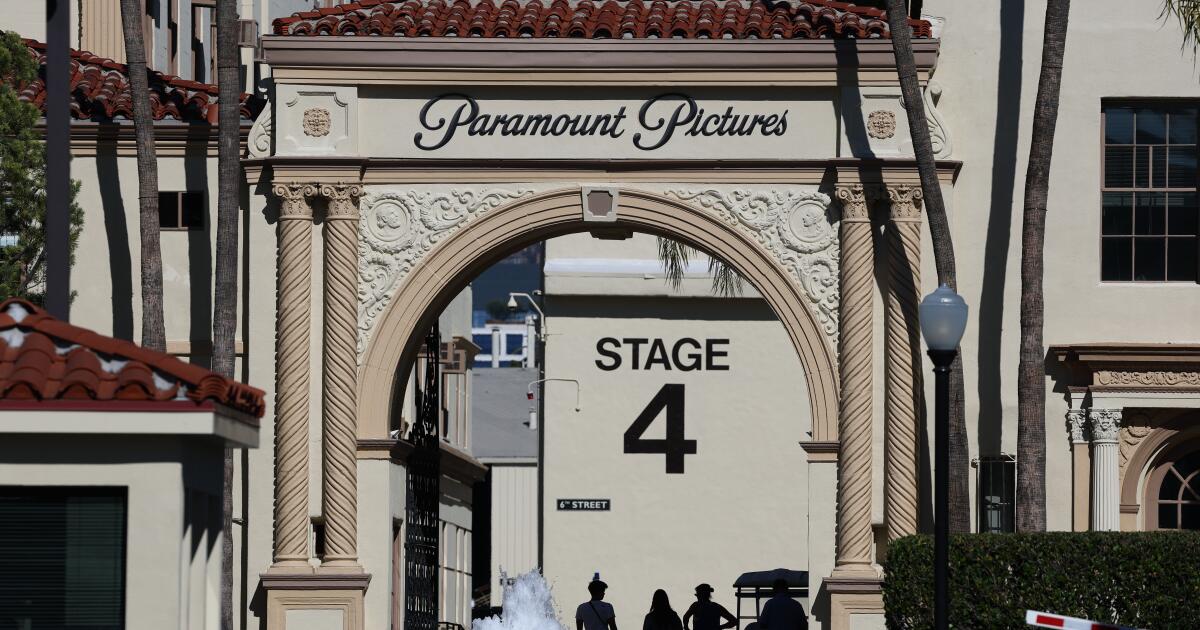
Buffeted by upheavals in the tech and entertainment industries, California led the nation in job cuts last year — but the pace of layoffs slowed sharply in December both in the state and nationwide as company hiring plans picked up.
State employers announced just 2,739 layoffs in December, well down from the 14,288 they said they would cut in November.
Still, with the exception of Washington, D.C., California led all states in 2025 with 175,761 job losses, according to a report from outplacement firm Challenger, Gray & Christmas.
The slowdown in December losses was experienced nationwide, where U.S.-based employers announced 35,553 job cuts for the month. That was down 50% from the 71,321 job cuts announced in November and down 8% from the 38,792 job cuts reported the same month last year.
That amounted to good news in a year that saw the nation’s economy suffer through 1.2 million layoffs — the most since the economic destruction caused by the pandemic, which led to 2.3 million job losses in 2020, according to the report.
“The year closed with the fewest announced layoff plans all year. While December is typically slow, this coupled with higher hiring plans, is a positive sign after a year of high job cutting plans,” Andy Challenger, a workplace expert at the firm, said in a statement.
The California economy was lashed all year by tumult in Hollywood, which has been hit by a slowdown in filming as well as media and entertainment industry consolidation.
Meanwhile, the advent of artificial intelligence boosted capital spending in Silicon Valley at the expense of jobs, though Challenger said the losses were also the result of “overhiring over the last decade.”
Workers were laid off by the thousands at Intel, Salesforce, Meta, Paramount, Walt Disney Co. and elsewhere. Apple even announced its own rare round of cuts.
The 75,506 job losses in technology California experienced last year dwarfed every other industry, according to Challenger’s data. It attributed 10,908 of the cuts to AI.
Entertainment, leisure and media combined saw 17,343 announced layoffs.
The losses pushed the state’s unemployment rate up a tenth of a point to 5.6% in September, the highest in the nation aside from Washington, D.C., according to the U.S. Bureau of Labor Statistics data released in December.
September also marked the fourth straight month the state lost jobs, though they only amounted to 4,500 in September, according to the bureau data.
Nationally, Washington, D.C., took the biggest jobs hits last year due to Elon Musk’s initiative to purge the federal workforce. The district’s 303,778 announced job losses dwarfed those of California, though there none reported for December.
The government sector led all industries last year with job losses of 308,167 nationwide, while technology led in private sector job cuts with 154,445. Other sector with losses approaching 100,000 were warehousing and retail.
Despite the attention focused on President Trump’s tariffs regime, they were only cited nationally for 7,908 job cuts last year, with none announced in December.
New York experienced 109,030 announced losses, the second most of any state. Georgia was third at 80,893.
These latest figures follow a report from the Labor Department this week that businesses and government agencies posted 7.1 million open jobs at the end of November, down from 7.4 million in October. Layoffs also dropped indicating the economy is experiencing a “low-hire, low-fire” job market.
At the same time, the U.S. economy grew at an 4.3% annual rate in the third quarter, surprising economists with the fastest expansion in two years, as consumer and government spending, as well as exports, grew. However, the government shutdown, which halted data collection, may have distorted the results.
Still, December’s announced hiring plans also were positive. Last month, employers nationwide said they would hire 10,496 employees, the highest total for the month since 2022 when they announced plans to hire 51,693 workers, Challenger said.
The December plans contrasted sharply with the 12-month figure. Last year, U.S. employers announced they would hire 507,647 workers, down 34% from 2024.
The Associated Press contributed to this report.
That shrill, high-pitched squeal you’ve been hearing lately? Don’t bother trying to adjust your TV or headphones, or calling your doctor for a tinnitis check. It’s just America’s beleaguered billionaires keening over a proposal in California to impose a one-time wealth tax of up to 5% on fortunes of more than $1 billion.
The billionaires lobby has been hitting social media in force to decry the proposed voter initiative, which has only started down the path toward an appearance on November’s state ballot. Supporters say it could raise $100 billion over five years, to be spent mostly on public education, food assistance and California’s medicaid program, which face severe cutbacks thanks to federal budget-cutting.
As my colleagues Seema Mehta and Caroline Petrow-Cohen report, the measure has the potential to become a political flash point.
The rich will scream The pundits and editorial-board writers will warn of dire consequences…a stock market crash, a depression, unemployment, and so on. Notice that the people making such objections would have something personal to lose.
— Donald Trump advocating a wealth tax, in 2000
Its well-heeled critics include Jessie Powell, co-founder of the Bay Area-based crypto exchange platform Kraken, who warned on X that billionaires would flee the state, taking with them “all of their spending, hobbies, philanthropy and jobs.”
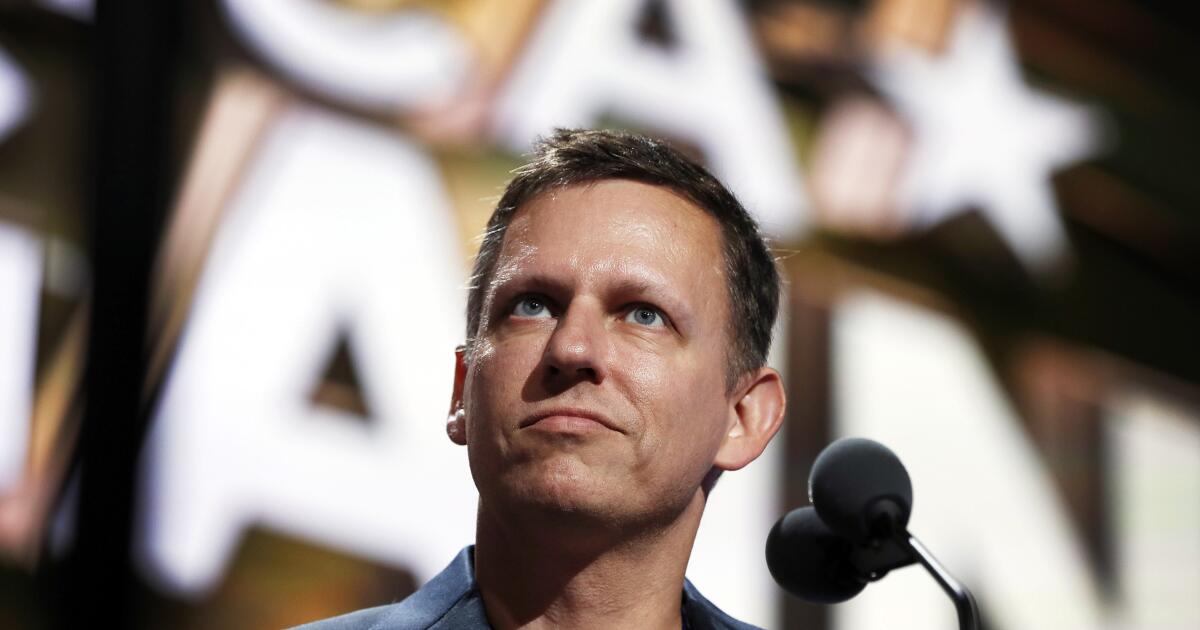
Venture investor Chamath Palihapitiya claimed on X that “$500 billion in wealth has already fled the state” but didn’t name names. San Francisco venture investor Ron Conway has seeded the opposition coffers with a $100,000 contribution. And billionaire Peter Thiel disclosed on Dec. 31 that he has opened a new office in Miami, in a state that not only has no wealth tax but no income tax.
Already Gov. Gavin Newsom, a likely candidate for the Democratic nomination for president, has warned against the tax, arguing that it’s impractical for one state to go it alone when the wealthy can pick up and move to any other state to evade it.
On the other hand. Rep. Ro Khanna (D-Fremont), usually an ally of Silicon Valley entrepreneurs, supports the measure: “It’s a matter of values,” he posted on X. “We believe billionaires can pay a modest wealth tax so working-class Californians have Medicaid.”
Not every billionaire has decried the wealth tax idea. Jensen Huang, the CEO of the soaring AI chip company Nvidia — and whose estimated net worth is more than $160 billion — expressed indifference about the California proposal during an interview with Bloomberg on Tuesday.
“We chose to live in Silicon Valley and whatever taxes, I guess, they would like to apply, so be it,” he said. “I’m perfectly fine with it. It never crossed my mind once.”
And in 2000, another plutocrat well known to Americans proposed a one-time tax of 14.25% on taxpayers with a net worth of $10 million or more. That was Donald Trump, in a book-length campaign manifesto titled “The America We Deserve.”
“The rich will scream,” Trump predicted. “The pundits and editorial-board writers will warn of dire consequences … a stock market crash, a depression, unemployment, and so on. Notice that the people making such objections would have something personal to lose.” (Thanks due to Tim Noah of the New Republic for unearthing this gem.)
Trump’s book appeared while he was contemplating his first presidential campaign, in which he presented himself as a defender of the ordinary American. His ghostwriter, Dave Shiflett, later confessed that he regarded the book as “my first published work of fiction.”
All that said, let’s take a closer look at the proposed initiative and its backers’ motivation. It’s gaining nationwide attention because California has more billionaires than any other state.
The California measure’s principal sponsor, the Service Employees International Union, and its allies will have to gather nearly 875,000 signatures of registered voters by June 24 to reach the ballot. The opposition is gearing up behind the catchphrase “Stop the Squeeze” — an odd choice for a rallying cry, since it’s hard to imagine the average voter getting all het up about multibillionaires getting squoze.
The measure would exempt directly held real estate, pensions and retirement accounts from the calculation of net worth. The tax can be paid over five years (with a fee charged for deferrals). It applies to billionaires residing in California as of Jan. 1, 2026; their net worth would be assessed as of Dec. 31 this year. The measure’s drafters estimate that about 200 of the wealthiest California households would be subject to the tax.
The initiative is explicitly designed to claw back some of the tax breaks that billionaires received from the recent budget bill passed by the Republican-dominated Congress and signed on July 4 by President Trump. The so-called One Big Beautiful Bill Act will funnel as much as $1 trillion in tax benefits to the wealthy over the next decade, while blowing a hole in state and local budgets for healthcare and other needs.
California will lose about $19 billion a year for Medi-Cal alone. According to the measure’s drafters, that could mean the loss of Medi-Cal coverage for as many as 1.6 million Californians. Even those who retain their eligibility will have to pay more out of pocket due to provisions in the budget bill.
The measure’s critics observe that wealth taxes have had something of a checkered history worldwide, although they often paint a more dire picture than the record reflects. Twelve European countries imposed broad-based wealth taxes as recently as 1995, but these have been repealed by eight of them.
According to the Tax Foundation Europe, that leaves wealth taxes in effect only in Colombia, Norway, Spain and Switzerland. But that’s not exactly correct. Wealth taxes still exist in France and Italy, where they’re applied there to real estate as property taxes, and in Belgium, where they’re levied on securities accounts valued at more than 1 million euros, or about $1.16 million.
Switzerland’s wealth tax is by far the oldest, having been enacted in 1840. It’s levied annually by individual cantons on all residents, at rates reaching up to about 1% of net worth, after deductions and exclusions for certain categories of assets.
The European countries that repealed their wealth taxes did so for varied reasons. Most were responding at least partially to special pleading by the wealthy, who threatened to relocate to friendlier jurisdictions in a continent-wide low-tax contest.
That’s the principal threat raised by opponents of the California proposal. But there are grounds to question whether the effect would be so stark. For one thing, notes UC Berkeley economist Gabriel Zucman, an advocate of wealth taxes generally, “it has become impossible to avoid the tax by leaving the state.” Billionaires who hadn’t already established residency elsewhere by Jan. 1 this year have missed a crucial deadline.
The initiative’s drafters question the assumption that millionaires invariably move from high- to low-tax jurisdictions, citing several studies, including one from 2016 based on IRS statistics showing that elites are generally unwilling to move to exploit tax advantages across state lines.
As for the argument that billionaires could avoid the tax by moving assets out of the state, “the location of the assets doesn’t matter,” Zucman told me by email. “Taxpayers would be liable for the tax on their worldwide assets.”
One issue raised by the burgeoning controversy over the California proposal is how to extract a fair share of public revenue from plutocrats, whose wealth has surged higher while their effective tax rates have declined to historically low levels.
There can be no doubt that in tax terms, America’s wealthiest families make out like bandits. The total effective tax rate of the 400 richest U.S. households, according to an analysis by Zucman, his UC Berkeley colleague Emmanuel Saez, and their co-authors, “averaged 24% in 2018-2020 compared with 30% for the full population and 45% for top labor income earners.” This is largely due to the preferences granted by the federal capital gains tax, which is levied only when a taxable asset is sold and even then at a lower rate than the rate on wage income.
The late tax expert at USC, Ed Kleinbard, used to describe the capital gains tax as our only voluntary tax, since wealthy families can avoid selling their stocks and bonds indefinitely but can borrow against them, tax-free, for funds to live on; if they die before selling, the imputed value of their holdings is “stepped up” to their value at their passing, extinguishing forever what could be decades of embedded tax liabilities. (The practice has been labeled “buy, borrow, die.”)
Californians have recently voted to redress the increasing inequality of our tax system. Voters approved what was dubbed a “millionaires tax” in 2012, imposing a surcharge of 1% to 3% on incomes over $263,000 (for joint filers, $526,000). In 2016, voters extended the surcharge to 2030 from the original phase-out date of 2016. That measure passed overwhelmingly, by a 2-to-1 majority, easily surpassing that of the original initiative.
But it may be that California’s ability to tax billionaires’ income has been pretty much tapped out. Some have argued that one way to obtain more revenue from wealthy households is to eliminate any preferential rate on capital gains and other investment income, but that’s not an option for California, since the state doesn’t offer a preferential tax rate on that income, unlike the federal government and many other states. The unearned income is taxed at the same rate as wages.
One virtue of the California proposal is that, even if it fails to get enacted or even to reach the ballot, it may trigger more discussion of options for taxing plutocratic fortunes. One suggestion came from hedge fund operator Bill Ackman, who reviled the California proposal on X as “an expropriation of private property” (though he’s not a California resident himself), but acknowledged that “one shouldn’t be able to live and spend like a billionaire and pay no tax.”
Ackman’s idea is to make loans backed by stock holdings taxable, “as if you sold the same dollar amount of stock as the loan amount.” That would eliminate the free ride that investors can enjoy by borrowing against their holdings.
The debate over the California wealth tax may well hinge on delving into plutocrat psychology. Will they just pay the bill, as Huang implies would be his choice? Or relocate from California out of pique?
California is still a magnet for the ambitious entrepreneur, and the drafters of the initiative have tried to preserve its allure. Those who come into the state after Jan. 1 to pursue their ambitious dreams of entrepreneurship would be exempt, as would residents whose billion-dollar fortunes came after that date. There may be better ways for California to capture more revenue from the state’s population of multibillionaires, but a one-time limited tax seems, at this moment, to be as good as any.

How Nebraska men’s basketball’s historic start to the season could end its NCAA tournament drought

Man struck, killed by work truck on I-15 ramp near Las Vegas Strip, police say

Man killed in NH snowmobile crash

Police investigate fatal stabbing in Mercer County

New Mexico Public Education Department faces $35 million shortfall

Florida High School Football Rankings: Top 25 teams – Oct. 21

Cleary's 21 help Le Moyne down Central Connecticut State 69-64 in OT

How old is Bo Nix? What to know about Oregon quarterback ahead of 2024 NFL Draft

99th annual Pony Swim held in Virginia

Video: ‘It Didn’t Have to Happen This Way:’ U.Va. Faculty Call for Review of Police Response to Protests

AOC accuses Vance of believing ‘American people should be assassinated in the street’
Mercosur: How Macron’s domestic weakness undercut his Brussels clout

National Park Service will void passes with stickers over Trump’s face

Trump plans to meet with Venezuela opposition leader Maria Corina Machado next week

Trump says meeting Iran’s ‘Crown Prince’ Pahlavi would not be appropriate
-

 Detroit, MI6 days ago
2 hospitalized after shooting on Lodge Freeway in Detroit
-

 Technology3 days ago
Power bank feature creep is out of control
-

 Dallas, TX4 days ago
Defensive coordinator candidates who could improve Cowboys’ brutal secondary in 2026
-

 Health5 days ago
Viral New Year reset routine is helping people adopt healthier habits
-

 Iowa3 days ago
Pat McAfee praises Audi Crooks, plays hype song for Iowa State star
-

 Nebraska3 days ago
Oregon State LB transfer Dexter Foster commits to Nebraska
-
 Nebraska3 days ago
Nebraska-based pizza chain Godfather’s Pizza is set to open a new location in Queen Creek
-

 Oklahoma1 day ago
Neighbors sift debris, help each other after suspected Purcell tornado