Business
Boeing sent two astronauts into space. Now NASA says it may need SpaceX to go get them

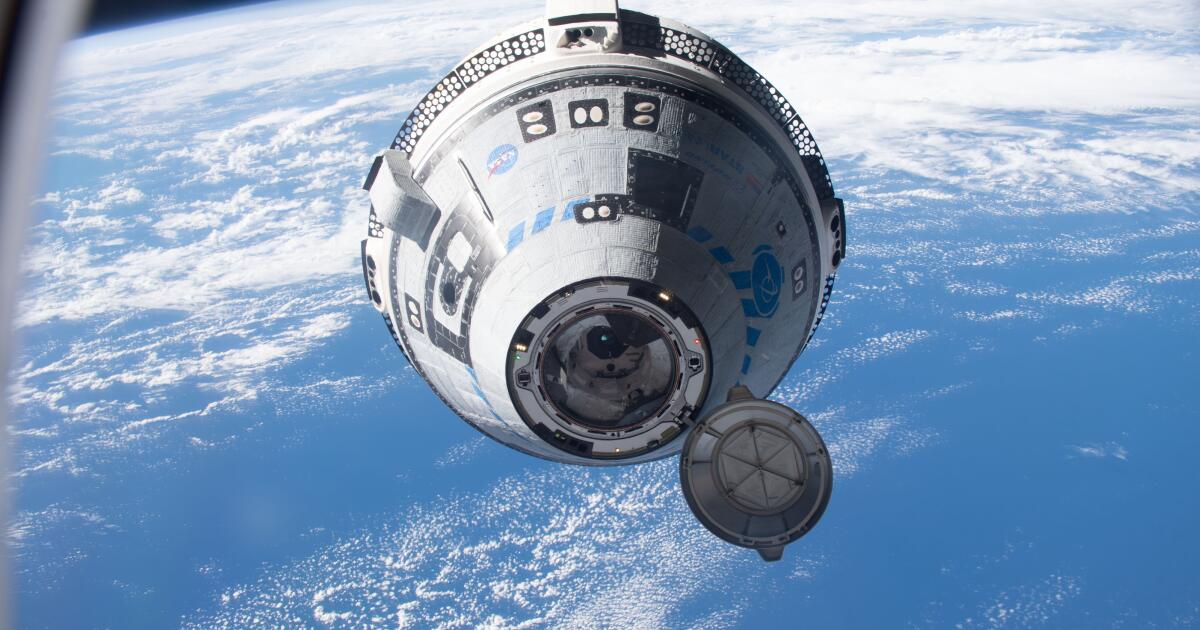
NASA officials conceded Wednesday that the agency might have to rely on SpaceX to return two American astronauts to Earth from the International Space Station due to problems with Boeing’s Starliner spacecraft.
Astronauts Suni Williams and Butch Wilmore were launched on June 5 to the orbiting lab in the Starliner’s first manned trip to space after years of delays. What was expected to be a roughly one-week mission, however, has turned into an open-ended odyssey with the pair stuck on the station for two months as NASA and Boeing officials investigate malfunctions with Starliner’s propulsion system.
The Starliner may still be able to return the astronauts to Earth, but NASA officials said during a news conference that they are developing alternate plans that would have SpaceX’s Crew Dragon spacecraft bring them down. If SpaceX is needed to transport the astronauts, it is possible the return flight wouldn’t occur until February, meaning Wilmore and Williams would have to remain at the space station for six more months.
“Our prime option is to return Butch and Suni on Starliner. However, we have done the requisite planning to make sure we have other options open and so we have been working with SpaceX to ensure they are ready to respond,” said Steve Stich, program manager for NASA’s Commercial Crew Program.
The announcement by NASA is a blow to the troubled aerospace company, as Boeing grapples with an investigation into the cause of a door plug blowing out during a 737 Max 9 flight this year — as well as the continuing repercussions from the two crashes of its 737 Max 8 jets several years ago.
Boeing and SpaceX were given multibillion-dollar contracts in 2014 to develop spacecraft to transport crew and cargo to and from the orbiting space station after the ending of the Space Shuttle program, which forced NASA to rely on Russia’s Soyuz spacecraft to send American astronauts to the station.
Since then, Elon Musk’s Hawthorne company has ferried more than half a dozen crews to the station, whereas the current Starliner mission was its first crewed test flight.
Marco Caceres, an aerospace analyst at Teal Group, said the mission has become a debacle for Boeing as it grapples with Starliner’s myriad problems.
“They are three, four, five years behind SpaceX with this program. The only reason NASA really has been giving Boeing chance after chance after chance is because it really does want to have backup capability so that it never has to rely on the Russians,” he said.
Just last week, Boeing wrote off an additional $125 million in expenses related to the program after previously booking some $1.5 billion in cost overruns.
The June mission had been delayed for weeks after a helium leak in Starliner’s propulsion system was detected on the launch pad, but NASA gave approval for the launch after determining it did not pose a risk to the astronauts and would not prevent the capsule from reaching the space station.
On the ascent to the station, however, the helium leak worsened, and during docking the thrusters that propel the craft in space malfunctioned. NASA said last month that testing at its White Sands Test Facility in New Mexico found that Teflon seals that control the flow of fuel in a valve were one cause of the malfunction.
On Wednesday, officials provided additional detail, saying the seals had swelled during the ground testing, although a test of Starliner’s engines in space on July 11 indicated they were performing to specifications, indicating the Teflon had returned to its original form.
NASA officials have said that Starliner has 10 times more helium than it needs to return Starliner to Earth. The gas is used to pressurize the craft’s propulsion system. But Stich said Wednesday that engineers were analyzing the possibility that on a return flight there would be a simultaneous leak of the helium and a malfunctioning of the thrusters.
“The worst case would be some integrated failure,” Stich said.
He acknowledged there was disagreement over the safety of returning the astronauts on the Starliner.
Last week, Boeing issued a statement that cited all the testing that had been conducted and concluded, “Boeing remains confident in the Starliner spacecraft and its ability to return safely with crew.”
Boeing officials did not attend the news conference, unlike previous NASA updates on the Starliner mission. A decision on whether to return the astronauts on Starliner is expected to be made in the next few weeks, he said, with NASA Administrator Bill Nelson ultimately responsible for the call.
If the agency decides that it is too risky to return the astronauts aboard Starliner, it would bring them down on the next flight of SpaceX’s Crew Dragon capsule. That mission had been scheduled to blast off this month but has been delayed until no earlier than Sept. 24 to give the agency time to make its decision, he said.
Under that scenario, the Crew Dragon would blast off with two crew members and come back with Williams and Wilmore and two other astronauts when it returns sometime in February 2025. The Starliner, meanwhile, would remotely undock and return to Earth without a crew.
The first two test flights of the Starliner in 2019 and 2022 were conducted without a crew. Stich said that returning Starliner this time would only require that the control software be set for an uncrewed mission


The electric vehicle company Slate Auto set out in 2022 to make the most affordable electric truck in the country. This week, it unveiled the price tag: $24,950.
At a time when demand for new electric vehicles is cooling and cars are getting harder to afford, Slate’s customizable truck could bring a fresh wave of excitement to the industry.
Deliveries will begin later this year and accelerate in 2027, the company said. Slate’s vehicle is built around a simple concept — pay only for what you actually want.
Buyers will start with a basic truck without power windows or even paint and can then customize it however they like. They can tailor-make their “blank slate” by paying extra for smart phone-compatible screens, speakers, colored wrap or paint. A $5,000 kit even converts the truck into an SUV.
Slate’s design team is based in Los Angeles County and recently moved into a new space in Carson, which employs about 50 workers. The company’s headquarters are in Troy, Mich., and its vehicles will be produced in Warsaw, Ind.
Squeezing out as much cost as possible while making it as easy as Legos to snap on different options has required complex engineering, which is why the company decided to set up its design studio in Southern California. The region is full of experts.
“Slate has done something smart,” said auto industry analyst Brian Moody. “Their EV isn’t only about price, there’s also a strong personalization element. In Southern California, the boxy, retro look will earn it a lot of attention.”


Slate is an EV startup that makes electric trucks and SUVs. Customers buy only the features they want. Photographed on Friday, Dec. 19, 2025. (Myung J. Chun/Los Angeles Times)
The company is building a marketplace of accessories for customers to choose from, including 54 basic wraps that cost less than $500 each. In contrast, a paint job on a car can cost thousands of dollars. The marketplace also offers roof stacks, zip-on seat covers and stereos.
For just under $30,000 total, customers can get a basic SUV in a fastback or squareback style. Whether it’s configured as a truck or SUV, the EV will have an estimated range of 205 miles and will be compatible with Tesla chargers.
“This is the first time in automotive history that consumers are going to get to choose,” said Slate Chief Executive Peter Faricy, who joined the company in March after 13 years with Amazon.
“It started with design, then engineering, and eventually manufacturing, and we figured out innovations in all three of those phases that make the vehicle less expensive,” he said.
For example, Slate vehicles were designed from the beginning to be wrapped instead of painted. The company will offer more than 100 colors of wrap at its launch, or customers can choose a custom color.
Slate did not disclose financial information or how much the vehicles cost to produce. However, Faricy said the company will generate a positive gross margin on its vehicles, meaning they are selling for more than what they cost to make.
“Whether Slate succeeds or fails, it has already influenced the conversation … forcing the industry to ask why affordable vehicles have become so rare,” said Jesse Toprak, an industry analyst and founder of OptiCar.ai. “They are betting on making higher profit margins on the accessories and do-it-yourself angle.”
Slate says it has already received more than 180,000 reservations. The earlier a customer placed their reservation, the sooner they’ll get their vehicle. Pre-orders opened Wednesday for $300, or $250 if the customer has already paid a $50 reservation fee.
Despite the hype, Slate is still a startup that has yet to prove itself in the market. The company has about 750 employees and has raised more than $700 million from Amazon’s Jeff Bezos and others.
“For the vehicle itself, the concept is brilliant,” Toprak said. “I think the execution risk is enormous.”
The EV industry has been under fire from the Trump administration, which has removed incentives for ownership and clean-car goals. Major automakers including Ford and Stellantis have pared back their EV offerings, and other startups have struggled to turn a profit.
The Irvine-based EV company Rivian, which hasn’t reached profitability since its founding in 2009, recently laid off hundreds of workers. It launched its highly anticipated R2 SUV earlier this month, which will eventually be available for less than $45,000.
Lucid, the luxury electric vehicle maker based in Newark, Calif., announced this week that it’s reducing its workforce by 18%. The cuts come just months after it laid off 319 Bay Area employees in February.
Faricy, Slate’s chief executive, said the company’s vehicle will appeal to a wide range of customers.
“There will be a lot of people that are attracted to the affordability but have never had an EV before,” he said.
According to Cox Automotive, the average transaction price for a new EV in the U.S. is $55,000, compared with $49,000 for a gas-powered vehicle.
“The EV market at this point doesn’t have a technology problem anymore,” Toprak said. “It has an affordability problem. Slate is one of the first companies built entirely around solving that.”

Sony Pictures will invest $100 million and take a minority stake in virtual reality venue operator Cosm, as the studio continues to build a business in communal experiences.
As part of the investment, Sony Pictures Chief Executive Ravi Ahuja will also join Cosm’s board of directors, the studio said Wednesday. The size of Sony’s minority stake was not disclosed.
The El Segundo-based Cosm currently operates three venues — one at Hollywood Park in Inglewood, and the others in Dallas and Atlanta. The company plans to open additional venues in Detroit and Cleveland.
Cosm bills itself as a “shared reality venue,” and its facilities center around a massive, wraparound screen that is intended to envelop viewers with additional digital effects. The company has largely focused on sports, though it has also shown Cirque du Soleil shows and done several collaborations with Warner Bros., including recent screenings of 2001’s “Harry Potter and the Sorcerer’s Stone” in honor of the film’s 25th anniversary.
“Cosm sits at the intersection of several trends shaping the future of entertainment,” Ahuja said in a statement. “We’ve followed Cosm since before launch and have been impressed with the quality of the experience and the enthusiasm it’s generating with audiences.”
The investment is Sony’s latest venture into experiential entertainment. In 2024, the Culver City-based studio acquired dine-in theater chain Alamo Drafthouse Cinema.

The Los Angeles City Council on Tuesday unanimously advanced an ordinance to halt new oil and gas drilling and phase out all existing production over the next 20 years. L.A. is home to more than 2,000 active oil wells.
The measure revives a similar ban passed in 2022, which was struck down by a judge following legal challenges from the oil and gas industry.
It must pass a second vote before final adoption later this summer, and would make L.A. the largest city in the United States to phase out existing oil wells.
“Today, Los Angeles is making a decision that aligns with our need to turn the page on urban oil drilling,” Councilmember Katy Yaroslavsky said during Tuesday’s council meeting. “The absence of an enforceable oil ordinance has had real consequences for our communities.”
The ban in 2022 was seen as a historic move for a region built on the petroleum industry.
But in 2024, a Los Angeles County Superior Court judge invalidated the law, ruling that the state, not the city, has jurisdiction over petroleum production. The legal challenge was brought by oil companies including Warren Resources, which operates a large oil field in Wilmington. Much of the field is beneath the city of Long Beach, but it also extends under Los Angeles.
Shortly after that, state legislators advanced Assembly Bill 3233, which reaffirmed city and county authority to regulate oil and gas activity. It was largely seen as the missing piece that made the original ordinance vulnerable.
“It’s now unequivocal that cities have the authority to regulate, limit and prohibit oil and gas operations within our jurisdiction,” Yaroslavsky said.
The new ordinance, written by the Department of City Planning, prohibits new oil and gas extraction, including drilling, redrilling or deepening existing oil wells for the purposes of production. It also designates all existing and active idle wells as “nonconforming uses,” meaning they may only operate during the phaseout period and are no longer compliant with current zoning.
Warren Resources, which led the lawsuit against the previous ban, did not immediately respond to a request for comment. The company previously argued that the 2022 ban was rushed and would lead to more oil imports to the area, causing increased emissions from tankers and trucks and other environmental consequences.
Many wells in the city operate near schools, homes and parks. Most are concentrated in low-income areas and communities of color, such as Wilmington and the harbor district, West L.A. and South L.A., where residents have long reported respiratory issues, headaches, throat irritation and other health problems. Studies have found oil wells can emit carcinogens and are linked to adverse health effects.
“This ordinance is such an important step toward giving every frontline community in Los Angeles access to clean air,” Silvia Esparza, a South L.A. resident and member of environmental justice group Stand-L.A., said in a news conference ahead of Tuesday’s vote.
Ashley Hernandez, a Wilmington resident and organizer with the nonprofit Communities for a Better Environment, said bloody noses and noxious fumes were a regular part of life in the neighborhood growing up.
She noted that in addition to oil drilling, L.A. residents continue to face other environmental hazards, such as the recent oil pipeline rupture that sent crude into the L.A. River or the ongoing cold storage warehouse fire in Boyle Heights that is spewing toxic smoke.
“I’m here to remind L.A. city and these toxic neighbors that Wilmington residents are more important than any ‘black gold’ under their homes,” Hernandez said. “We need our city to protect our families now and to stop the oil industry’s reign of power in our city. A passage of the oil phaseout ordinance today gives the city a chance to correct this wrong.”
Times staff writer Dakota Smith contributed to this report.
-

 Massachusetts5 minutes ago
Gas prices in Massachusetts dip below $4 a gallon for first time in 2 months
-

 Minnesota8 minutes ago
Minnesota sends time capsule photos to US Capitol for America’s 250th birthday
-

 Mississippi13 minutes ago
Where to see fireworks and celebrate Fourth of July in, near Jackson
-
Missouri20 minutes ago
Missouri Lottery Powerball, Pick 3 winning numbers for June 24, 2026
-

 Montana23 minutes ago
‘Hannah Montana’ Alum Mitchel Musso Reveals Why He Missed 20th Anniversary Special With Miley Cyrus
-

 Nebraska28 minutes ago
Scattered severe storms bring large hail, heavy rain to parts of Nebraska
-

 Nevada35 minutes ago
Nevada Secretary of State calls court ruling on Trump election order a ‘big victory’
-

 New Hampshire38 minutes ago
New Hampshire has highest share of adults who identify as atheists

