Business
Defying Trump, California continues to bet big on offshore wind

While the Trump administration takes extraordinary measures to halt the development of offshore wind power in the United States, Southern California is advancing a $4.7-billion plan to deploy hundreds of towering wind turbines in waters off the state’s coast.
The proposed Pier Wind project at the Port of Long Beach is a 400-acre terminal for the positioning, storage and assembly of some of the world’s largest offshore wind turbines, which would be towed north to federal wind lease areas some 20 miles off Morro and Humboldt bays.
Offshore wind is a key climate solution and officials say the project is crucial to helping California reach its goal of 25 gigawatts of offshore wind power by 2045. The Port of Long Beach is one of only two areas primed for the assembly work; the other is Humboldt Harbor near Eureka. The port will create the land for the project through a massive dredge-and-fill operation in the water.
This is the second in an occasional series on the state of the energy transition in California amid opposition from the Trump administration.
California’s approach is to push forward with offshore wind preparations that fall within its jurisdiction, readying the ports and the power grid to eventually take on electricity from 1,000 turbines in federal waters. The aim is to wait out the current administration, which is notoriously hostile toward a form of renewable energy that is booming elsewhere in the world.
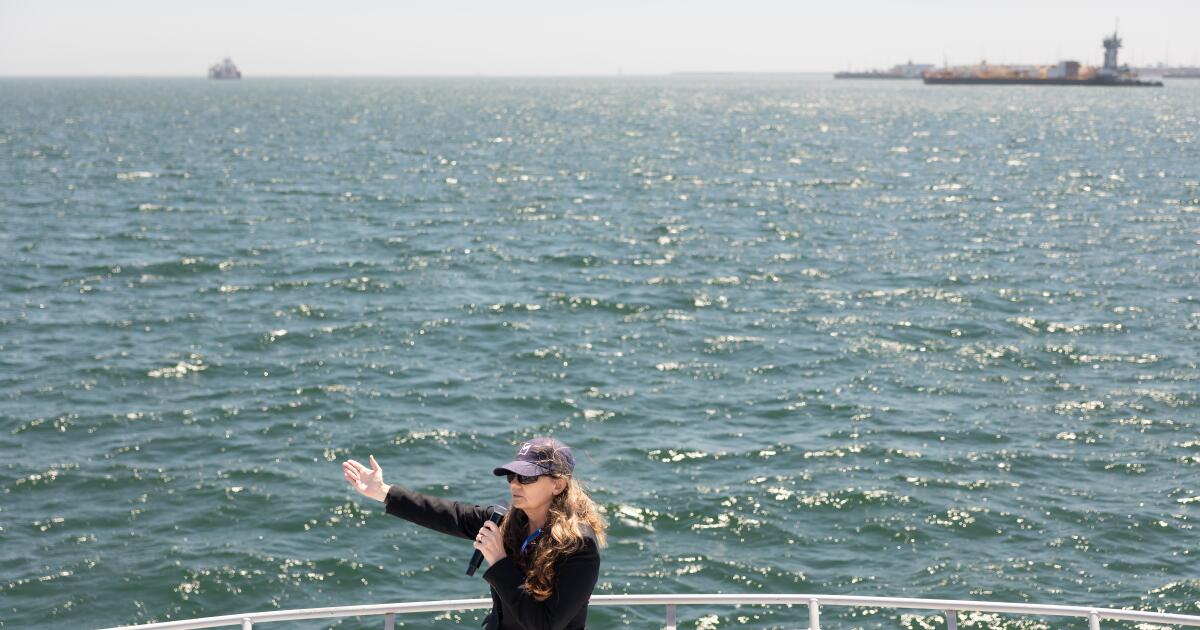
“We’re just moving forward with all the things in our control because the port infrastructure has a long lead time,” said Suzanne Plezia, managing director of engineering services with the Port of Long Beach, on a recent catamaran ride around the harbor’s cranes and cargo towers. The work is supposed to be completed within a decade.
“We’re in it for the long haul because we do believe offshore wind is part of our energy future,” she said.
The state’s work is in some way an act of defiance against the Trump administration, which has taken more than two dozen actions against offshore wind power since the president’s second term began in January 2025, including canceling half a billion dollars in funding for port preparations in Humboldt.
Most recently, the White House struck a series of unprecedented deals with energy companies that held offshore wind leases in federal waters, paying them nearly $2 billion to abandon their plans and instead invest in U.S. oil and gas projects. Wind lease areas are stretches of ocean designated by the U.S. government for potential offshore wind development.
One of those deals was with Golden State Wind, which held one of the five leases off the coast of California. State officials are investigating that deal, including a subpoena from the California Energy Commission seeking details about the payout.
“The operative word is not ‘resist’ — it’s ‘create,’ ” California Energy Commission Chair David Hochschild told hundreds of attendees at the Pacific Offshore Wind Summit in Long Beach recently.

A rendering of the proposed Pier Wind project at the Port of Long Beach.
(Port of Long Beach)
Among them were regulators, lawmakers, investors and industry representatives from the U.S. and abroad who said they remain optimistic about offshore wind’s prospects and vowed to keep to their plans. They point to the United Kingdom, where nearly one-fifth of electricity generation now comes from offshore wind.
But the question of whether President Trump’s actions are succeeding at slowing California and U.S. progress also percolated throughout the summit.
Much of the uncertainty surrounds financing, whether investors still see offshore wind as a smart place to put money.
“We are asking ourselves, do we want to do offshore wind at all?” said Sean Boyd, executive director of EY Parthenon, an arm of Ernst & Young that advises investors and companies, during a panel discussion.
While California is still moving toward its 2045 target, it is not on track to meet its 2030 goal of 2 to 5 gigawatts of offshore wind.
Last year, Gov. Gavin Newsom released about half of a $475-million tranche of Proposition 4 funding for offshore wind projects, but has so far not released the rest. The latest draft of Newsom’s 2026-27 budget would defer the remaining $241 million to a future year — and by default, a future governor.
But California’s efforts are also unprecedented. While much of the world’s offshore wind power is affixed to the seafloor, including off the East Coast of the U.S., the turbines off California will need to float because the ocean here is much deeper. The state’s planned lease areas are between 1,600 and 4,200 feet, far deeper than any other floating wind farms in the world.
“There’s an awful lot of risk in first-of-a-kind technology,” said Boyd. “But the single biggest fundamental risk that runs through all of this is the market risk. Is there a long-term floating offshore wind market in California?”
Many state officials say the answer is unequivocally yes.
“California cannot allow this instability in Washington to derail our long-term climate and energy goals,” said Assemblyman Rick Chavez Zbur (D-Los Angeles). “We have to continue planning, we have to continue investing, we have to continue building, because offshore wind remains one of the most important tools we have.”
The Trump administration has turned offshore wind into a political football, describing the technology as “doomed” and a threat to national security that is restricting U.S. energy dominance. Trump argues offshore wind is costly and intermittent because it relies on the wind to blow.
But experts say it is meant to be part of a robust clean energy portfolio, complementing other renewable sources, such as solar power and battery energy storage. Many supporters are biding their time until the next election.
“Will offshore wind exist in California and the United States?” asked Jim Lanard, co-founder and chief executive of developer Magellan Wind. “I say resoundingly yes — and it will take off very quickly in 2029.”
Some of the state’s residents are opposed, however, including members of the San Luis Obispo-based REACT Alliance, which sees offshore wind as a threat to coastal communities and the marine environment. The group said it lobbied the Trump administration to make its deal with Golden State Wind, and it is now urging Equinor, another of the leaseholders, to strike a similar agreement and walk away from its plans off the Central Coast.
Other groups, including local tribes and environmental justice organizations, are watching the state’s efforts closely for potential effects such as sediment disruption and erosion, changes in whale migration and pollution from construction. Wilmington, Carson and other communities around the Port of Long Beach already face some of the worst air quality in the region.
But many offshore wind believers say the train has already left the station. Globally, the market is continuing to grow rapidly, led by China, which installed 6.6 gigawatts of new offshore wind capacity in 2025, bringing its cumulative total to 48.4 gigawatts, according to the Global Wind Energy Council.
Some said the need for the technology will only increase as artificial intelligence data centers drive energy demand, along with soaring electricity costs and constrained oil supplies from the war with Iran.
“This is a pivotal moment for energy,” said Noel Hacegaba, chief executive of the Port of Long Beach. “Rising fuel costs are sharpening the case for domestically produced power and for energy independence. … This is renewable energy’s moment.”
The enthusiasm was apparent as the catamaran bobbed around the future site of Pier Wind, which recently received a $20-million grant from the California Energy Commission. The plans include a large wharf with a staging area for the turbine components, plus a “wet storage” area for the assembled units in the water waiting to be towed away, among other elements.
Depending on the final specifications, Pier Wind would be able to assemble one or two turbines per week, each as tall as the Eiffel Tower and capable of generating 20 to 25 megawatts of wind power. Once towed to the lease areas up the coast, their electricity would flow back to land via floating underwater cables and, ultimately, tied into the state’s main grid.
“The world is watching to see what California does next,” Hacegaba said.



SpaceX stock dropped below its initial public offering price for the first time on Wednesday, signaling dwindling hype around the Elon Musk company.
Shares dipped below their IPO price of $135 on Wednesday morning for the first time since listing, a humbling loss for the stock, which had skyrocketed more than 50% in its first days of trading last month.
The shares regained some ground later in the day, closing at $135.27.
The initial offering gave the company a market cap of $2.2 trillion, making it one of the world’s most valuable public companies. For a short period, the IPO also made owner Elon Musk the world’s first trillionaire, though his net worth now is about $800 billion.
On July 7, the company was added to the Nasdaq-100 after a rule change allowed companies to join 15 days after their IPOs.
SpaceX raised a total of $86 billion after underwriters exercised their right to sell additional shares, on top of the $75 billion initially raised. It was the largest IPO in history.
SpaceX, based near Austin, Texas, is the leading launch services company in the world, with its Falcon 9 rocket accounting for the vast majority of satellites launched last year.
It is also the leading satellite-based broadband provider with its Starlink service. The extraordinary interest in the IPO was driven by Musk’s plans to make the company an AI leader — including plans to launch orbiting satellite data centers powered by the sun that crunch AI data.
The company’s headquarters moved from Hawthorne to Texas in 2024, but it retains large operations in the South Bay city and blasts off regularly from Vandenberg Space Force Base in Santa Barbara County.
Since the IPO, SpaceX has used its newfound wealth to expand in the AI space.
It announced last month that it was acquiring the AI coding startup Cursor for $60 billion, with the deal expected to close in the third quarter. The San Francisco company, founded in 2022, enables engineers to instruct software in English to run coding tasks autonomously.
Musk also merged his xAI artificial intelligence company into SpaceX earlier this year. The combined entity recently announced it was leasing computing power to rivals Anthropic and Google at two terrestrial data centers it has constructed.
Since the IPO, investors have expressed concerns about the company’s spending plans and debt load.
Even with the volatility of the last month, there’s still more uncertainty to come.
The stock could fall further as locked-up shares held by current and former employees are released.
At least 20% of the shares will be released after second-quarter results are disclosed sometime in the coming months, with all the lockups expiring in December.
But Space X isn’t the only megacap stock to experience ups and downs early on.
Shares of Meta, then named Facebook, fell significantly below the IPO price of $38 before recovering. After its May 2012 launch, shares plummeted by nearly 50% and hit a record low of $19.69 in August 2012.
The company took more than 14 months to rebound, finally surpassing its $38 IPO price in July 2013.

In the latest lawsuit against Paramount Skydance, a corporate shareholder has alleged corruption at the highest levels of the company, which is battling to complete its $111-billion takeover of rival Warner Bros. Discovery to create a new media behemoth.
Controlling shareholders Larry Ellison and his son David have presided over a firm that allegedly made “illegal promises and payments to secure regulatory approval,” for the Ellison family’s Paramount purchase last summer, according to the shareholder lawsuit filed this week in Delaware court.
Larry Ellison allegedly discussed with President Trump how Paramount’s pending Warner Bros. acquisition would result in a shake-up at CNN, states the lawsuit filed by Paramount shareholder Paul Robbins.
“The Ellisons [won] the bidding war for Warner Bros. by promising sweeping changes at CNN and other personal benefits to President Trump,” according to the 59-page complaint.
The case was brought on Robbins’ behalf by the nonprofit Public Integrity Project and the advocacy group Freedom of the Press Foundation, which has been critical of the Trump administration‘s policies toward the media.
The complaint noted that Netflix withdrew from the bidding in February — the same day Co-Chief Executive Ted Sarandos met at the White House with then-Atty. Gen. Pam Bondi and another top official.
The lawsuit suggests Netflix dropped out after recognizing the challenges of dealing with the Trump administration and that Trump always wanted to see the prize go to Paramount because of his close ties to the Ellison family, who have ushered in more favorable news coverage of Trump and the departure of late-night comedian Stephen Colbert.
Robbins does not appear to have firsthand accounts supporting his claims, which are based on public documents and media reports about dealings between the Ellisons and Trump. He has owned Paramount stock since 2021, but the lawsuit does not say how many shares he owns.
He could not be reached for comment.
Paramount, in a statement, pushed back against his claims, saying the “lawsuit recycles allegations that have already been reported and already addressed.”
“As we’ve said consistently: No commitments from either David or Larry Ellison have been made to any government body, state AG or federal agency regarding the future of CNN or any other news property, other than the goal to deliver truth-based journalism,” Paramount said.
It’s the third lawsuit lobbed at Paramount this week. On Monday, California Atty. Gen. Rob Bonta led a coalition of 12 Democratic state attorneys general that filed a federal antitrust lawsuit seeking to block the Paramount-Warner merger due to concerns about consolidation in movie distribution and cable channels.
The Writers Guild of America added another antitrust lawsuit against Paramount on Tuesday, alleging the massive merger would result in fewer jobs and lower pay for writers.
Many in Hollywood are opposed to the deal due to fears that another studio consolidation would bring more layoffs, programming cutbacks and a fragile business environment due to the heavy debt burden — nearly $80 billion — that Paramount would have to take on to buy Warner Bros.
The shareholder lawsuit noted that Paramount participated in a raucous event with UFC fighters on the White House lawn in June to celebrate Trump’s 80th birthday and the nation’s 250th anniversary. Paramount has UFC broadcast rights.
The event came two days after Trump’s Justice Department wrapped its regulatory review of Paramount’s Warner Bros. proposal, giving the merger a key green light.
Justice Department investigators reportedly did not have a chance to express potential antitrust concerns when high-level Justice Department officials closed the inquiry — a major win for Paramount and the Ellisons, the lawsuit states.
“There have been some line attorneys in the DOJ that have reviewed this [merger] and have some concerns,” New York Atty. Gen. Letitia James said Tuesday during a virtual town hall with opponents of the merger. “Their analysis of this particular case was ignored by the front office, if you will, at 1600 Pennsylvania Ave. [the White House] That’s the front office.”
Ellison’s Skydance Media emerged with its deal to buy Paramount two years ago. Previous controlling shareholder Shari Redstone was desperate for an exit and Trump was mounting his White House comeback by battling then-President Biden, then Vice President Kamala Harris.
Trump declined an invitation to appear on CBS’ “60 Minutes,” then under Redstone control. He became infuriated by an October 2024 interview with Harris on “60 Minutes.”
Trump filed a $10-billion lawsuit against CBS (he later upped it to $20 billion). After Trump won the election, he had considerable sway over Paramount because it needed his administration’s approval for the sale to the Ellisons.
Paramount agreed to pay Trump $16 million to end his “60 Minutes” lawsuit, allowing the sale to go forward. The Ellisons acquired Paramount in August, then set their sights on Warner Bros. Discovery, which owns CNN.
“The Ellisons proceeded to remake CBS in the President’s image, bought properties he enjoyed, and even hosted events to honor him,” the lawsuit said. “This helped the Ellisons, but it appears to have hurt Paramount and its media outlets.”
On Wednesday, Paramount said Ellison and other high-level executives had dealings with administration officials but “throughout … the review of the proposed acquisition of Paramount, Skydance has fully complied with all applicable laws, including our nation’s anti-bribery laws.”
In late April, David Ellison hosted an elaborate dinner in Washington to honor the “Trump White House,” according to invitations to the event, “even though President Trump continually insulted journalists at CBS and elsewhere,” the lawsuit said.
On Wednesday, during a confirmation hearing on Capitol Hill, Sen. Cory Booker (D-N.J.) blasted acting Atty. Gen. Todd Blanche for his attendance at the dinner while his agency was reviewing the Paramount deal.
Also on Wednesday, the nonprofit news site ProPublica reported Federal Communications Commission Chairman Brendan Carr has accepted $63,000 in free tickets from CBS in recent years — while Paramount mergers were pending.
Times staff writer Ben Wieder contributed to this report.

Grocery Outlet is opening new locations across California, rebuilding its network in the Golden State after closing stores early this year.
A new branch in Ontario Ranch is scheduled to open July 23, and more openings are planned for later this summer.
The location will be operated by independent owners Gloria and Jason Pineda. By the end of August, the discount grocery retailer plans to open stores in Ramona, San Francisco, Clovis and Petaluma as well.
The Emeryville, Calif.-based chain announced the closure of 36 stores in March, including nine California locations. The closures were an attempt to roll back an overexpansion in the wrong markets, resulting in a loss in 2025. Grocery Outlet did not announce which locations would be closed at the time, but they were listed for sublease by advisory firm Gordon Bros.
Among those listed was an Ontario location closer than seven miles from the soon-to-open site.
Five other Southern California locations were marked for closing in Azusa, Brawley, El Cajon, La Habra, Ontario and Poway. In Central California, the Kerman, Patterson and Ridgecrest stores were also listed for sublease. Outside of California, stores in Idaho, New Jersey, Maryland, Ohio and Pennsylvania also were listed.
In an earnings call in May, Grocery Outlet Chief Executive Jason Potter said the restructuring was helping boost the company’s profit.
“These closures are now complete and have improved fleet quality and will strengthen the earnings profile of the business over time,” he said.
Grocery Outlet was founded in San Francisco in 1946 as a discount grocery store chain selling overstock of limited-time or holiday food items. There are about 280 Grocery Outlet locations in California, accounting for more than half of its total store count.
Though Grocery Outlet has cultivated a dedicated consumer base on TikTok and other social media posts from grocery bargain hunters, it faces fierce competition from other budget grocery chains, including Aldi, which is set to open 180 stores in 2026. It also competes with Trader Joe’s, Walmart and Amazon, which have steadily gained customers.
Last year it was also hurt by the lapse in federal food assistance during the 43-day government shutdown.
In the wake of rising grocery prices and economic anxiety, some low-income customers who would once have shopped at budget grocery chains such as Grocery Outlet are turning to food banks instead. According to Los Angeles Regional Food Bank, 1.2 million people visit its food banks per month.
Grocery Outlet’s net sales rose 4% in the first quarter from a year earlier to $1.17 billion. It recorded a net loss of $180 million for the period.
It said it had closed locations as part of its optimization plan. It also underwent a store refresh program, changing products and is clustering locations to boost profit and customer traffic.
“Our value-oriented product offering continues to resonate with consumers. While we’re encouraged by the progress we’re beginning to see, we’re not satisfied with our current level of performance and are focused on the work we have in front of us,” Potter said on the earnings call.
Grocery Outlet shares have fallen more than 25% over the last 12 months. The Dow Jones industrial average has climbed more than 15% during the same period.
-
Lifestyle12 minutes ago
Apache chef Nephi Craig says cooking Native food saved his life
-

 Technology24 minutes ago
Google is better at playing the AI regulations game
-

 World30 minutes ago
Iran calls on Houthis to prepare to cut off Red Sea gateway — can the terror group do it?
-

 Politics36 minutes ago
Todd Blanche roasts Adam Schiff in heated hearing: ‘You’re a lawyer, you know the rules’
-

 Health42 minutes ago
Game-changing cholesterol pill wins FDA approval after cutting LDL nearly 60%
-

 Sports48 minutes ago
2026 AL, NL MVP Odds: Ohtani Favored; Alvarez Holding Off Challengers
-

 Technology54 minutes ago
Tesla helped save a driver. Is your car ready?
-
Business60 minutes ago
SpaceX stock erases all its gains and slides below IPO price in intraday trading

