Wyoming
Statewide candidates split on Wyoming GOP’s plans to defy state law and make endorsements


by Maggie Mullen, WyoFile
After the Wyoming GOP voted to defy a state law prohibiting the party from backing one Republican over another before the primary election, statewide candidates are split on whether they would accept such an endorsement.
Some told WyoFile they agree with the party’s decision and will seek out an endorsement, while others said they oppose a political party breaking election law. A few said they were taking a wait-and-see approach.
“Jury’s still out on this one for me,” Wyoming State Auditor Kristi Racines said Wednesday.
For years, the Wyoming Republican Party has argued that because it is a private organization, state laws that govern its organizational structure and prohibit it from endorsing or financially backing candidates in opposed primary election races are unconstitutional.
At its convention in Douglas last weekend, the party took things into its own hands, voting to adopt bylaws establishing a process for vetting, endorsing and spending money to support candidates ahead of the primary.
Supporters of the new bylaws point to a U.S. Supreme Court ruling from 1989, which struck down California’s ban on political party endorsements, ruling that the law violated the First Amendment’s guarantees of free speech and association. Opponents, meanwhile, raised concerns at the convention about the bylaws breaking the law, litigation costs and unintended consequences.
The new bylaws are widely expected to spark lawsuits, while the Wyoming Republican Party has said it plans to file its own legal challenge against the state.
In the meantime, the new bylaws lay out a process for evaluating candidates based on “commitment to the Wyoming Republican Party Platform, demonstrated loyalty to the Party’s principles, legal eligibility to hold office, and for incumbents, their voting record.”
The state party will consider candidates running for Wyoming’s state-elected officials — including governor, secretary of state, superintendent of public instruction, treasurer and auditor — as well as congressional candidates. Otherwise, county parties “may vet all other races on their respective County Ballots,” according to the new bylaws.
The state party, as well as each county party, “shall each create and oversee a Candidate Vetting Committee empowered to review and recommend approval or disapproval of candidates based on established criteria,” the bylaw states. “The Committee shall provide candidates an opportunity to respond to concerns prior to issuing a recommendation.”
Candidates
Brent Bien, who is running for governor, told WyoFile the bylaw changes are “a long time coming,” pointing back to the 1989 ruling.
“I think we just got to make sure we get those folks that truly believe on the Republican side of the equation, who truly believe in the platform and what Wyoming stands for,” Bien said. “And I just don’t think there’s been any enforcement mechanism to do that.”
At the convention, Bien was a clear favorite among many attendees who wore his campaign buttons and t-shirts. Still, Bien said he wouldn’t be surprised if he didn’t get the party’s endorsement.
“I didn’t get Trump’s endorsement,” Bien said. “And some of these legislators around the state, you know, they haven’t endorsed me.”
Bien’s take isn’t shared by all the gubernatorial candidates.
“Contested primaries should be decided by voters,” Gillette Sen. Eric Barlow wrote in a statement. “The role of the state party is to unite Republicans around shared values and help grow the party, not decide elections before voters have had their say.”
“Under current law, the state party should not choose sides in Republican primaries, and I will not ask them to start now,” he wrote. “My job,” running for governor, “is to earn the trust of Wyoming voters directly.”
At the convention, supporters of the bylaws said the party had tried to get the Legislature to change state statute. Barlow directly pushed back on that argument.

“As a legislator for the past 14 years, this issue has never come before us,” Barlow said. “If it had, it would have ensured all Wyomingites could weigh in and decisions would have been made openly and transparently — not in the courts and not a few months before an election.”
Secretary of State Chuck Gray, who is running for U.S. House, told WyoFile he supports the new bylaws.
“I will participate in the Party’s vetting process and will seek their support because I’m the only candidate in this race with a proven record of standing up for conservative principles — even when it wasn’t popular with the media and the insiders,” he wrote in a statement.
As secretary of state, Gray is Wyoming’s chief election officer and oversees statewide election administration. Asked if he wanted to comment in his official capacity on the Wyoming Republican Party’s decision to defy state law, Gray did not respond by publishing time.
U.S. House candidate David Giralt took a more cautious approach when asked for his opinion on the new bylaws.
“I trust Wyoming Republicans to make good decisions for our party, and I’ll let the process play out,” Giralt said. “I’m focused on getting in front of as many Wyoming voters as possible and making the case for why I’m the right person to represent this state in Congress.”
Kevin Christensen, another U.S. House candidate, said he wanted to see how fair, transparent and consistent the process played out before weighing in.
“The Wyoming people are the ones that make the determination in the primary, not the party,” he said. “That being said, if this is about supporting candidates and determining who is really a Republican and who’s just putting an ‘R’ next to their name, that seems like that would be consistent with being the Republican Party.”
Jillian Balow, yet another candidate for U.S. House and former superintendent of public instruction, said she “would be honored to accept an endorsement and money from the state party only if it is in accordance with Wyoming and federal law.”
“The contingency of our party at the convention knew the changes they made defied state law and they curtailed delegate discussion to pass new by-laws anyway,” Balow wrote in a statement. “Some delegates were appalled, some were gleeful, and many were silent, because they were silenced. This is not the way Wyoming does business.”
U.S. House candidate Reid Rasner also pushed back on the new bylaws.
“As a pro-Trump conservative, I always expected the political establishment to try and stop our campaign,” he wrote in a statement. “But, after making over 200 stops across our communities, one thing is clear: people are tired of the political games.”

Sheridan Republican Rep. Tom Kelly, who is running for superintendent, said while he opposes “the idea of parties having the power to disallow anyone from running under their banner,” he thinks “parties should be able to express publicly which people they would like to represent them.”
Though he’s not actively seeking endorsements, Kelly said he would accept support from the state party.
“Financial backing? Absolutely,” Kelly said. “Contrary to a popular false narrative, I have no wealthy D.C. donors bankrolling me.”
And if the party endorsed one of his opponents, Kelly said he would tell them, “Congrats. I should have done a better job presenting myself.”
WyoFile reached out to other statewide Republican candidates, including those running for governor, secretary of state, superintendent, U.S. House and U.S. Senate. They did not respond by publishing time.
This article was originally published by WyoFile and is republished here with permission. WyoFile is an independent nonprofit news organization focused on Wyoming people, places and policy.
Related

Wyoming
Wyoming Cultural Trust Fund awards $529K in grants, including several Fremont County projects


CHEYENNE, Wyo. — Wyoming is a state known for cowboys, rodeos, and beautiful plains, but is also known for being the first territory to grant women the right to vote, something historian Jennifer Helton explored in her Suffrage Stories presentation.
Helton was invited to highlight Wyoming’s remarkable role in the fight for women’s suffrage as part of the museum’s special America 250 Discover & Discuss series on Jun 18, but the recorded version was just released. This is a part of Cheyenne Frontier Days Old West Museum’s goal of exploring Cheyenne and the greater state of Wyoming’s history.
Helton’s presentation not only celebrates Wyoming’s role in suffrage, but also how the state’s pioneering women helped shape the future of voting rights across the nation.
Born and raised in Wyoming, Jennifer Helton left the state at age 18 to attend college, “which left a giant, Wyoming-sized hole in my heart,” Helton said, “and the way that I fill that hole is by conducting research on women’s suffrage.”
Upon realizing that most people outside of the state of Wyoming did not know the West’s progressive role in suffrage, she became obsessed with bridging this knowledge gap and researching the history of suffrage.
“My kids would tell you it’s an obsession, not just an interest or a hobby,” Helton said. “They always joke that I have three kids, the two of them and then Esther Morris.”
During her presentation, Helton’s admiration for Esther Morris was apparent due to her trailblazing nature as suffragist, her courage to stand up to torch-bearing mobs, and abolitionist activities.
Interestingly enough, her sons were also instrumental in shaping Wyoming’s history. E.A. Slack is known as the “Father of Frontier Days” and citizens of Wyoming can thank Robert C. Morris for Cheyenne’s public library, as he brought the Carnegie Public Library System to Wyoming.
.
” data-large-file=”https://i0.wp.com/capcity.news/wp-content/uploads/2026/06/image-2.png?fit=780%2C863&ssl=1″ alt=”” class=”wp-image-170117″ style=”aspect-ratio:0.90332473687879;width:464px;height:auto” srcset=”https://i0.wp.com/capcity.news/wp-content/uploads/2026/06/image-2.png?resize=925%2C1024&ssl=1 925w, https://i0.wp.com/capcity.news/wp-content/uploads/2026/06/image-2.png?resize=271%2C300&ssl=1 271w, https://i0.wp.com/capcity.news/wp-content/uploads/2026/06/image-2.png?resize=768%2C850&ssl=1 768w, https://i0.wp.com/capcity.news/wp-content/uploads/2026/06/image-2.png?resize=780%2C864&ssl=1 780w, https://i0.wp.com/capcity.news/wp-content/uploads/2026/06/image-2.png?resize=400%2C443&ssl=1 400w, https://i0.wp.com/capcity.news/wp-content/uploads/2026/06/image-2.png?resize=706%2C782&ssl=1 706w, https://i0.wp.com/capcity.news/wp-content/uploads/2026/06/image-2.png?w=960&ssl=1 960w, https://i0.wp.com/capcity.news/wp-content/uploads/2026/06/image-2-925×1024.png?w=370&ssl=1 370w” sizes=”auto, (max-width: 780px) 100vw, 780px”/><figcaption class=) Photo of Esther Morris, the first female justice of the peace (Cheyenne Frontier Days Old West Museum). Credit: Cheyenne Frontier Days Old West Museum (Jennifer Helton Presentation) / Cheyenne Frontier Days Old West Museum
Photo of Esther Morris, the first female justice of the peace (Cheyenne Frontier Days Old West Museum). Credit: Cheyenne Frontier Days Old West Museum (Jennifer Helton Presentation) / Cheyenne Frontier Days Old West Museum
Throughout the course of her presentation, Helton revealed the results of her research by tracing the course of American history in order to highlight the intersection between Wyoming, women, and winning the right to vote.
The talk also highlighted incredible Black women such as Lucy Phillips and Nancy Phillips, some of the first Black women to vote.
As America celebrates its 250th anniversary, the museum invites visitors to explore the stories of trailblazers like the nation’s first woman justice of the peace Esther Morris, the first woman governor, the first Black women to vote, and many other extraordinary leaders who made history.
The museum is hosting its special America 250 exhibit and allows visitors to discover the stories, artifacts, and moments that connect the community to the nation’s history. The exhibit even features six U.S. presidents who visited Cheyenne or Cheyenne Frontier Days, and is currently running at the museum. For those who cannot attend, lectures such as this are filmed and provided online.
As Helton closed her lecture, she read the words of Esther Morris, “I say do all the good you can while you do live.”
“Because women like Esther Morris, like Theresa Jenkins, had the courage to stand up and do all the good that they could in their lives we are all able to live the lives that we are living today,” Helton said.
“So, we should be grateful to them, and I think we should also be asking ourselves what is it that we need to be doing so that future generations can preserve the same opportunities we have, and perhaps more.”
Watch Jennifer Helton’s full presentation at the link provided here.
To learn more about historian Jennifer Helton visit jenniferhelton.org.
.
” data-large-file=”https://i0.wp.com/capcity.news/wp-content/uploads/2026/06/image-3.png?fit=780%2C519&ssl=1″ alt=”” class=”wp-image-170141″ srcset=”https://i0.wp.com/capcity.news/wp-content/uploads/2026/06/image-3.png?resize=1024%2C681&ssl=1 1024w, https://i0.wp.com/capcity.news/wp-content/uploads/2026/06/image-3.png?resize=300%2C200&ssl=1 300w, https://i0.wp.com/capcity.news/wp-content/uploads/2026/06/image-3.png?resize=768%2C511&ssl=1 768w, https://i0.wp.com/capcity.news/wp-content/uploads/2026/06/image-3.png?resize=1536%2C1022&ssl=1 1536w, https://i0.wp.com/capcity.news/wp-content/uploads/2026/06/image-3.png?resize=1200%2C799&ssl=1 1200w, https://i0.wp.com/capcity.news/wp-content/uploads/2026/06/image-3.png?resize=780%2C519&ssl=1 780w, https://i0.wp.com/capcity.news/wp-content/uploads/2026/06/image-3.png?resize=400%2C266&ssl=1 400w, https://i0.wp.com/capcity.news/wp-content/uploads/2026/06/image-3.png?resize=706%2C470&ssl=1 706w, https://i0.wp.com/capcity.news/wp-content/uploads/2026/06/image-3.png?w=1605&ssl=1 1605w, https://i0.wp.com/capcity.news/wp-content/uploads/2026/06/image-3-1024×681.png?w=370&ssl=1 370w” sizes=”auto, (max-width: 780px) 100vw, 780px”/><figcaption class=) Jennifer Helton’s information (Cheyenne Frontier Days Old West Museum).
Jennifer Helton’s information (Cheyenne Frontier Days Old West Museum).
Related
Wyoming
At 6,000-year-old crossing, Gov. Gordon OKs Wyoming’s first-ever designated pronghorn migration route – WyoFile

SUBLETTE COUNTY—Gov. Mark Gordon heralded Wyoming’s first-ever designation to protect a pronghorn migration corridor — a more than 2 million-acre web of habitat — at Trapper’s Point, which he called a “wonderful passageway.”
“How incredibly valuable it is that you are standing here today,” Gordon told the crowd, “to witness this remarkable moment.”
Gordon commemorated the moment with his feet planted on the narrow bulge of high country that splits the Green and New Fork rivers. Thousands of years ago, the site was a well-used hunting ground for Native Americans — it’s the earliest known killing and processing site for pronghorn in North America. Now it boasts a wildlife overpass.
No pronghorn were to be seen during the especially windy Friday afternoon gathering, which attracted 75 attendees from nearby Pinedale and other western Wyoming communities.
Now Trapper’s Point is officially classified as a “bottleneck” for the Sublette Pronghorn Herd — one of 13 such bottlenecks. That classification is supposed to prevent any surface-disturbing activity, with the intent that pronghorn can keep passing through Trapper’s Point for generations to come.

Protecting the ability of the fleet-footed, tawny-and-white ungulates to migrate is a “key factor” in sustaining their population, Wyoming Game and Fish Director Angi Bruce said.
“This becomes even more important in severe winters or extreme droughts,” Bruce said. “Pronghorn are long overdue for recognition.”
Pronghorn in Sublette, Teton, Sweetwater and Lincoln counties travel a long road — some migrate more than 200 miles to escape harsh winters, trekking south into the lower Green River Basin, a semi-arid sweep of sagebrush steppe between Pinedale and Rock Springs. Then in the spring, they retrace those paths, returning to summer ranges, lush with verdant vegetation, even going as far as Grand Teton National Park.
There was also a long road of bureaucracy to get to this point.
Nearly three decades of effort preceded the formal designation of the migration routes used by the Sublette Pronghorn Herd, which is the farthest-traveling and among the largest pronghorn herds in the West.
Jackson Hole biologists long knew that the valley’s pronghorn left in the winter. But details were hazy on where they went and how they got there until around the turn of the century. Using data from tracking collars, biologists like Joel Berger, Steve Cain, Hall Sawyer and Doug Brimeyer helped delineate the route.

In 2008, a Bridger-Teton National Forest plan amendment established a portion of the path as the nation’s first designated wildlife migration corridor.
Popularized by its branding as the “Path of the Pronghorn,” the route has received press in national publications like High Country News and the New York Times.
But the southern reaches of the migration through the energy-rich Green River Basin have faced major political opposition since the early 2000s. Wyoming first attempted to protect those travel corridors in 2019, under a policy administered by the Wyoming Game and Fish Department. That effort was halted after a coalition of industry trade groups and counties protested.
Then, in early 2020, Gordon revamped the migration policy with an executive order. Still, the Sublette Pronghorn Herd proposal gathered dust, even as development threatened the route.
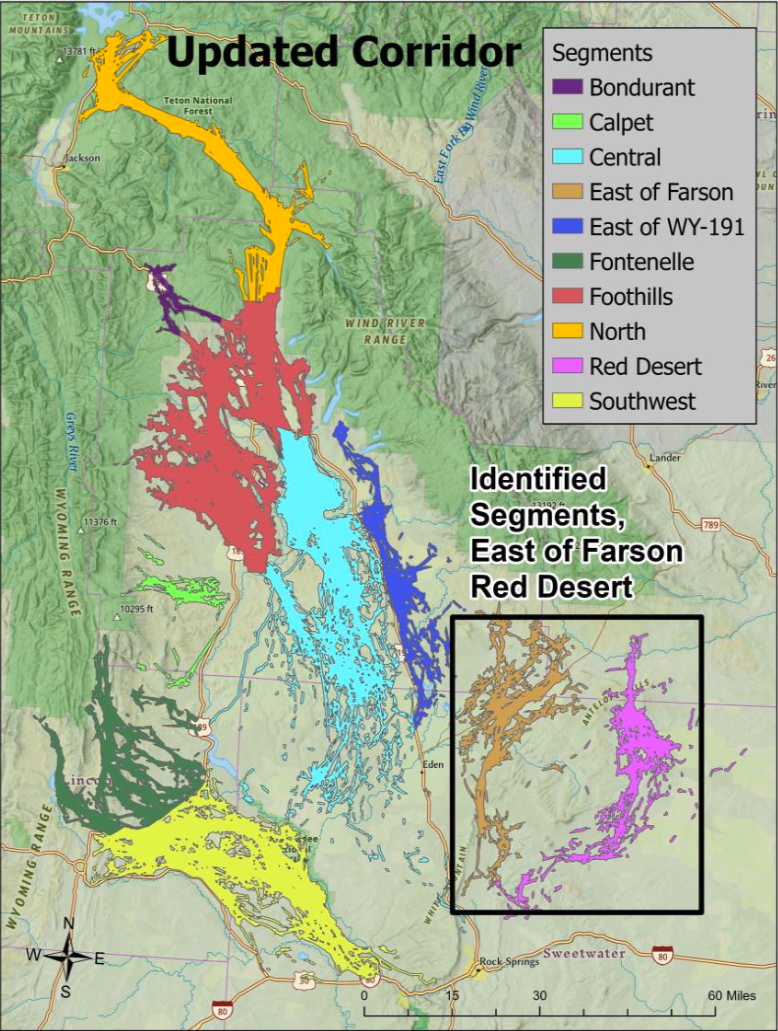
Game and Fish revived efforts to protect the migration in late 2023 and early 2024. Biologists pulled together one of North America’s most comprehensive migration datasets, benefiting from approximately two decades of GPS collar information collected from more than 400 pronghorn.
Some controversy followed the process until near the end. There was a debate about whether to designate the migration’s two easternmost segments, in the Red Desert and east of Farson. The Game and Fish Department proposed excluding the routes, but was overridden by its commission. Then Gordon upended that decision, excluding the two segments.
Vetting the migration corridor through a Gordon-appointed working group was the second-to-last step in the designation process.
“Today’s designation demonstrates that voluntary, locally driven conservation works,” said Robb Slaughter, who chaired the group, during the commemoration at Trapper’s Point.
Time will tell if that’s the case. Wyoming’s migration policy is, by design, permissive of development. Private land is exempt from protections, and designation is not an assurance that new stressors won’t be added to the landscape.

“Today is not the end of the process,” Slaughter said. “It’s the beginning of the next chapter. Continued monitoring, adaptive management, research, and cooperation will ensure these recommendations remain effective as conditions change.”
But Friday was the end of the migration designation process. The governor’s informal OK — no signature was needed — was the last step, said Sara DiRienzo, the governor’s deputy policy advisor.
Wildlife advocates celebrated the moment.
“This is historical,” Bruce said. It’s the first effort to protect the full length of a pronghorn migration corridor in the nation, she said.
-

 South Dakota2 minutes ago
Another South Dakota secretary of state bounced after four years by GOP delegates
-

 Tennessee9 minutes ago
Big Truck Day held at Bristol Tennessee City Hall
-

 Texas12 minutes ago
Search for missing man at Benbrook Lake slowed by high winds, rough water, officials say
-

 Utah17 minutes ago
Eight fires sparked by lightning overnight near Utah border, growing Jones Fire billowing smoke
-

 Vermont24 minutes ago
Rockwell was ‘At Home in Vermont’ – VTDigger
-

 Washington27 minutes ago
The Washington Capitals Select Tyus Sparks | Washington Capitals
-

 Virginia27 minutes ago
Southwest, Central Virginia Weather | 6 p.m. – June 27, 2026
-

 Wisconsin39 minutes ago
These natural attractions in Wisconsin are worth a visit this summer

