Minneapolis, MN
Minneapolis police audit: Officers feared entering shooter’s home after Moturi attack


MINNEAPOLIS (FOX 9) – A Minneapolis city audit is raising new questions about how police responded when Davis Moturi was shot in the neck by his neighbor in 2024.
Audit findings raise concerns about police response
What we know:
The audit found Minneapolis police officers appeared to misunderstand whether they could legally enter the home of Moturi’s neighbor, John Sawchak, after the shooting. Some officers argued “the risk to officer safety was too great” to justify going inside for what they believed was a misdemeanor offense.
It took police five days to arrest Sawchak, who was later deemed mentally ill in court. The audit also noted that many of its recommendations are already being addressed by the department, and it specifically recognized the police for their situational awareness, empathy and professionalism with victims.
Moturi, who was shot in the neck, told FOX 9, “If they’re too scared to do anything, how does how do they think I feel? How do they think I’m supposed to exist? Or what about the rest of the community, if they can’t take the heat, get out of the kitchen. That’s why we hired you to risk your life, to go in and put yourself in front of the citizens. What happened to serve and protect?”
The audit also pointed out that Police Chief Brian O’Hara initially appeared to blame Moturi in part for the shooting, using language the auditor described as harmful.
Moturi said, “I’m glad they highlighted the chief victim-blaming, and I know he claimed he received the wrong information. That begs the question, OK, well, where’s the information coming from?”
Chief O’Hara’s response and department changes
What they’re saying:
Minneapolis Police Chief Brian O’Hara addressed the audit’s findings, saying, “Escalating neighbor disputes can leave people feeling trapped in their own homes, living with ongoing fear and uncertainty. No matter the circumstance, those who reach out for help deserve the very best from the City of Minneapolis and our police department.”
O’Hara later said in October 2024 that police failed Moturi and has since apologized publicly.
However, Moturi told FOX 9 he has not received a direct apology from the chief.
The audit has led to ongoing changes within the Minneapolis Police Department, with leadership expressing support for its recommendations and after-action review.
The audit’s findings have sparked a broader conversation about police protocols and how officers respond to dangerous situations in the community.



A retrospective look meant to counter hindsight bias pertaining to the Bicentennial era, presented in the manner of Leonard Michaels (“I Would Have Saved Them If I Could”; “The Men’s Club”) and his short story “In the Fifties.“
In the seventies, my family moved to Minnesota from Vermont. I also started school that same year. That was the year everything changed for the worse. I attended six different elementary schools: two red-brick bastions of stale white bread conformity, three inner-city schools, and one school overseas.
In the seventies, I spent whole days exploring wooded and riverine areas, skating and sledding in the winter, riding my bike around the parkways and lakes ringing Minneapolis, or at the beach, where I would swim as far out as I could without the lifeguards getting mad. Given that my family put the “diss” in dysfunctional, being a free-range kid saved my sanity.
In the seventies, my mother commandeered the TV set during the summer of 1973 to watch the Watergate hearings when my brother and I wanted to watch cartoons and situation comedy reruns. We didn’t understand exactly what Nixon had done, but being deprived of entertainment gave us a tangible reason to hate him.
Because home delivery of the Sunday New York Times was not yet an option in the seventies, some of my fonder childhood memories are of going to a suburban news outlet after Sunday school at the First Unitarian Society, where my brother and I would browse the comic books and paperbacks until our mother pried us out of there or the store manager shooed us out.
Because of the 1973 and 1979 energy crises, gas tripled in price during the seventies.
The price of nearly everything increased. I look back wistfully now at my mother maintaining that Big John Baked Beans were too expensive at forty-nine cents a can.
Racist, sexist, ethnocentric and homophobic jokes became less acceptable during the seventies but were still very much a part of the culture.
Corporal punishment and shaming (especially body shaming) were regarded as acceptable parenting methods in the seventies.
In 1973, the American Psychological Association stopped categorizing homosexuality as a mental illness. However, therapists and clinicians wasted no time finding other ways of pathologizing difference. Oppositional defiant disorder, anyone?
The 1970s also saw the rise of the so-called New Right (many of them old-time reactionaries in new clothing), the growth of megachurches and increasing political clout of the religious right, exemplified by Anita Bryant and Jerry Falwell.
Every other news cycle seemed to yield new scarehead articles and more unsettling stories: Killer bees, encephalitis-bearing mosquitoes, the Glensheen Mansion murders, Son of Sam, the Church Committee revelations concerning the FBI and CIA’s misdeeds; to name just a few.
Last but not least, nostalgia became a mass phenomenon in the 1970s with K-Tel’s compilation albums of bygone musical hits, movies like American Graffiti, and TV shows such as “Happy Days” which painted a picture of 1950s in roseate colors for all those yearning for a simpler place and time, or imbued with selective memories. The more things change, the more things stay the same.
We’ll get straight to the point: The financial hardships that Daily Kos is facing this year are tough.
We continue to be paywall-free. We continue to be supported by our readers, not billionaires or corporations. But we need to bring in more revenue. We are leaning on our community more than ever to help make ends meet.
Minneapolis, MN
Minneapolis closes three beaches ahead of 4th of July weekend due to high e. coli levels


A stretch of Interstate 94 in Minneapolis has reopened after a fatal crash closed it for hours Wednesday morning.
The Minnesota State Patrol said the crash occurred on westbound I-94 near Interstate 35W around 2:30 a.m. The patrol said the crash was fatal, but did not say how many people or vehicles were involved.
The Minnesota Department of Transportation said the road was cleared just before 6:15 a.m., and a WCCO crew at the scene saw traffic moving through.
This story will be updated.
-

 Technology6 minutes ago
Booking a summer trip? Here’s what you’re giving scammers
-
 Business9 minutes ago
NBCUniversal spin marks new era of Hollywood moguls
-
 Entertainment14 minutes ago
When, unlike our upcoming 250th anniversary, a bicentennial mattered to orchestras
-
 Lifestyle21 minutes ago
DLTA’s former Ace Hotel is reborn as a ‘creative hub’ — and yes, you can still sleep there
-
 Politics24 minutes ago
Trump wants to show off D.C. for the Fourth. His construction is in the way
-
 Science29 minutes ago
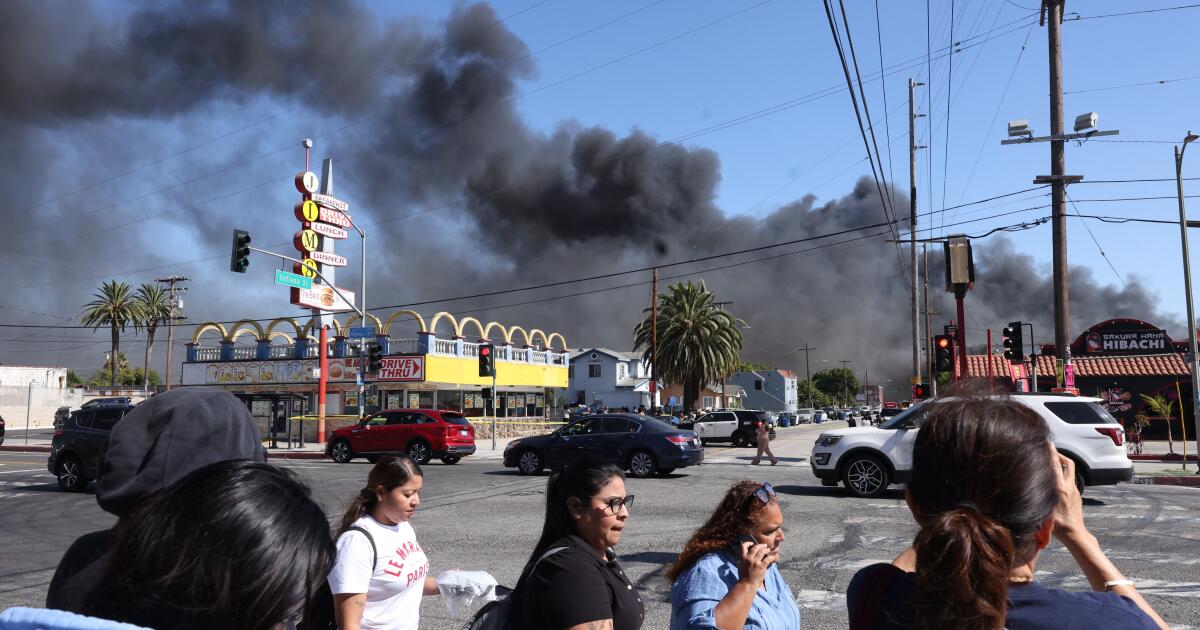
Boyle Heights blaze choked L.A. with astronomical soot pollution
-
 Sports36 minutes ago
Lakers announce summer league schedule, roster
-
World44 minutes ago
How the Entry-Exit System is becoming a nightmare for Europe's summer travellers

