Lifestyle
Fela Kuti is the first African artist to enter the Rock & Roll Hall of Fame

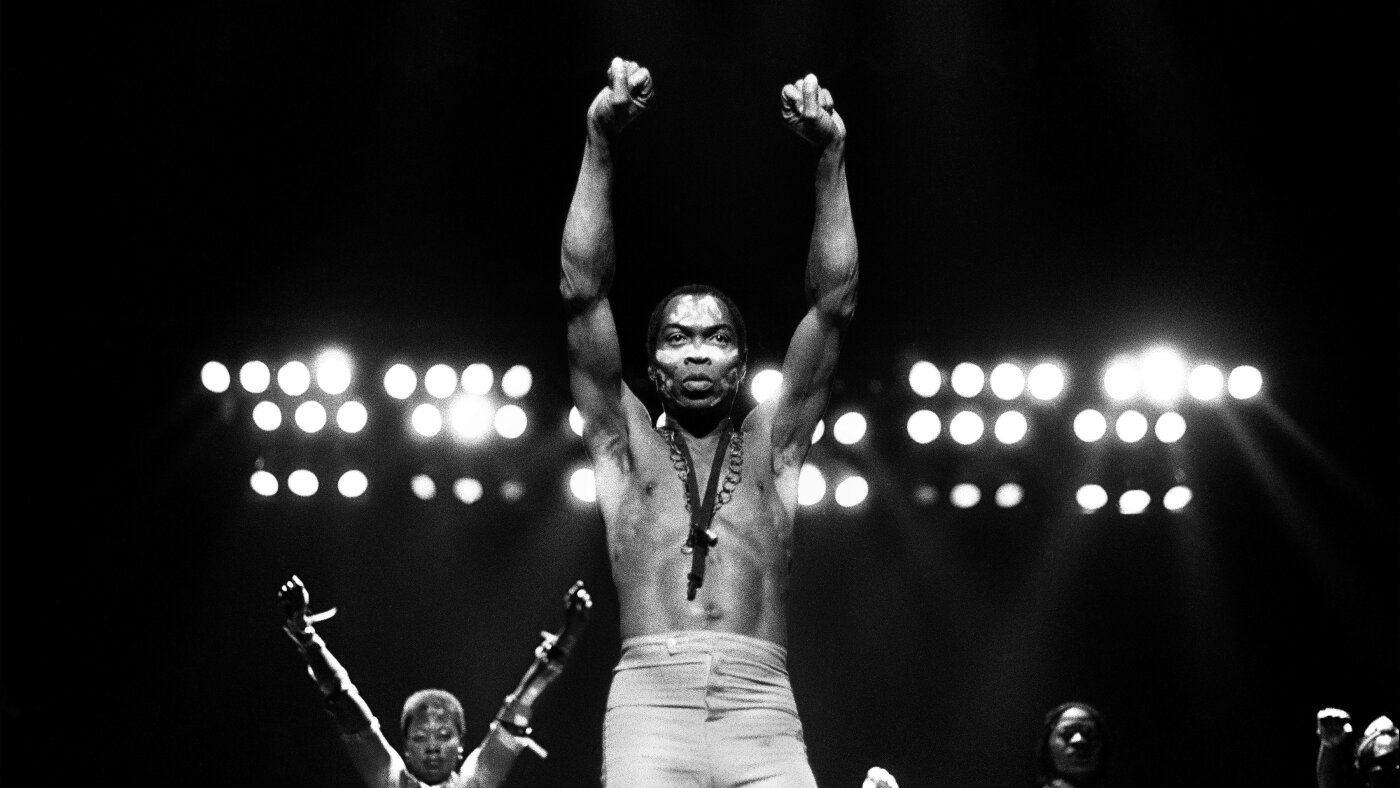
Nigerian superstar Fela Kuti performs at Orchestra Hall in Detroit, Michigan, in 1986. In the past year, the late musician has received two historic honors: the first African artist to receive a Grammy Lifetime Achievement Award and to be named for induction into the Rock & Roll Hall of Fame.
Leni Sinclair/Getty Images/Michael Ochs Archives
hide caption
toggle caption
Leni Sinclair/Getty Images/Michael Ochs Archives
Editor’s note: This is an update of the profile published in December of the great African musician Fela Kuti. The original post was published when it was announced that Kuti would become the first African musician ever awarded a Grammy Lifetime Achievement Award. Now this week, he is on the list of Rock and Roll Hall of Fame inductees and again is a historic “first” — the first African musician to be inducted into the hall.
Fela Kuti, the Afrobeat pioneer and activist who died in 1997, is now holds two landmark honors.
On December 19, he became the first African musician ever awarded a Grammy Lifetime Achievement Award, joining an elite group of legends like The Beatles, Johnny Cash, Aretha Franklin, Bob Marley and Frank Sinatra — all recognized for making “creative contributions of outstanding artistic significance to the field of recording.”
This week it was announced that he is one of the musicians who will be inducted into the Rock & Roll Hall of Fame in 2026. He is being honored in the category of “musical influence.” The Hall of Fame paid this tribute: “Fela Kuti was a revolutionary voice who spoke out against injustice through his innovative music — provoking political change while infusing jazz, West African and soul music to pioneer the Afrobeat genre.”
He has long been acclaimed by his fellow African artists. “Fela Kuti’s music was a fearless voice of Africa — its rhythms carried truth, resistance and freedom, inspiring generations of African musicians to speak boldly through sound,” says the legendary Senegalese singer Youssou N’ Dour.
Nicknamed the “Black President” for his role as a political and cultural leader, Fela is one of the rarified artists who’s recognized by a single name. He saw huge success as a pioneer of the Afrobeat genre, with its multilayered and shifting syncopation, psychedelic horns and chants. He was never nominated for a Grammy during his lifetime — although his musician sons, Femi and Seun, and grandson Made, have received eight nominations collectively.
A really big sound
Fela embraced a massive sound. His band often swelled to more than 30 members (including backup singers and dancers) and featured two bass guitars and two baritone saxophones. He himself played saxophone, keyboards, guitar, drums and trumpet (his first instrument as a child). His emphasis on complex polyrhythms and the inclusion of traditional African instruments like the talking drum were revolutionary at the time — a rebellion against the dominance of Western pop and a marked effort to forge a post-colonial African identity.
YouTube
From the start of his career, Fela aimed to reach a larger and Pan-African audience by singing almost exclusively in Nigerian Pidgin English (rather than his mother tongue, Yoruba, which doesn’t translate throughout most of the continent).
He did not play by the rules of the music biz. He expressed disdain for party tunes and love songs. He’d release as many as seven albums in a single year. And he refused to perform songs live once they’d been recorded.
His music broke new ground with songs that could stretch to 45 minutes. One of his most famous albums, Confusion, was composed of a lone tune broken into two sides, Confusion Pt. I and Confusion Pt. II — the first half entirely instrumental.
BCUC (Bantu Continua Uhuru Consciousness) from Soweto, South Africa, the incendiary live band and 2023 winner of the WOMEX Artist Award, sent a statement to NPR: “Fela is our spiritual muse and if he didn’t pursue music without boundaries of song length and speaking his truth — even when it was putting his life in danger — we wouldn’t have had the guts to be ourselves without fear or favor.”
A political awakening — and repercussions
During a 10-month stay in Los Angeles in 1969, Fela befriended members of the Black Panther Party. Afterward, his music grew political. He became an outspoken opponent of Nigeria’s military dictatorship and of South African apartheid.
The year following his 1976 album Zombie’s scathing indictment of the Nigerian government, The New York Times reported that a force comprising 1,000 Nigerian military members burned Fela’s Lagos home and recording compound (including all his instruments and master recording tapes). Fela was beaten unconscious, and his mother, Funmilayo Ransome-Kuti, was thrown from an upstairs window and later died from the resulting injuries.
That album, Zombie, was inducted into the Grammy Hall of Fame last year, becoming only the fourth record by an African artist among the 1,165 releases.
In 1979, Fela unsuccessfully ran for president of Nigeria. His political activism added to his high profile — and controversial history. He was arrested many times by Nigerian President Muhammadu Buhari’s military junta, including at Lagos airport while departing for a U.S. tour. He was sentenced to five years in prison and held for over a year. Amnesty International classified him as a “prisoner of conscience.” Fela was freed only after the Buhari regime was overthrown in August 1985.
Musical life after death
Fela succumbed to complications from AIDS in 1997. His older brother, Olikoye Ransome-Kuti, a pediatrician and AIDS activist who served as health minister for Nigeria, spread the word that Fela’s death was AIDS-related. According to Ransome-Kuti, Fela had believed that “all doctors were fabricating AIDS, including myself.”
Following that news, one of the nation’s largest daily papers reported that condom sales surged in Nigeria. Fela’s passing marked a turning point in bringing greater consciousness about the epidemic across Africa. It is estimated that over one million people attended his funeral.
Since his death, his music has carried on. A tribute album, Red Hot + Riot: The Music and Spirit of Fela Kuti, was released in 2002, featuring such artists as Sade, D’Angelo, Nile Rodgers, Questlove and Taj Mahal. Profits went to organizations working to raise AIDS awareness. And in 2009, Jay-Z and Will Smith produced Fela!, a Broadway musical about Fela’s life that earned 11 Tony Award nominations.
For today’s African musicians and worldwide, he is both a legend and an inspiration.
Tunde Adebimpe, the Nigerian American actor (Rachel Getting Married, Twisters) and lead singer for Grammy-nominated band TV on the Radio, told NPR: “Fela for me is the chapter heading in my musical education. He is the originator who showed us music as a power move calling out corruption. Music that questions your psyche and health, worries for your ecosystem, gut checks your self-worth and pride, and keeps you lifted. And it moves nyash [ass].”
Four-time Grammy-nominated Malian singer Salif Keita puts it this way: “Brother Fela was a great influence for my music. I loved him very much. He was a brave man. His legacy is undisputed.”
Ian Brennan is a Grammy-winning music producer (Tinariwen, Parchman Prison Prayer, The Good Ones, West Virginia Snake Handler Revival) who has recorded over 50 records by international artists across five continents. He is the author of 10 books. His latest is Missing Music: Voices From Where the Dirt Roads End.


NEW YORK, NEW YORK – APRIL 21: Laverne Cox attends the “Animal Farm” New York Premiere at Regal Theater on April 21, 2026 in New York City.
Jamie McCarthy/Getty Images
hide caption
toggle caption
Jamie McCarthy/Getty Images
In 2013, when the Netflix series Orange Is the New Black came out, the world met the character Sophia Burset — a Black trans woman serving as the resident hairstylist in prison.
For much of the audience, it was also the first time they met actress Laverne Cox — who landed the role of Sophia at the age 40, just when she was thinking of quitting acting altogether.
In her new memoir Transcendent, Cox talks about the challenges she faced long before Netflix came knocking: a mother who withheld love, a father who was never around and the brutal denigration she encountered growing up Black and trans in the deep South.
To unlock this and other bonus content — and listen to every episode sponsor-free — sign up for NPR+ at plus.npr.org. Regular episodes haven’t changed and remain available every weekday.
Email us at considerthis@npr.org.

Scott Simon talks with author Judy Blume at the Santa Fe International Literary Festival in May.
Tira Howard Photography./Courtesy Santa Fe International Literary Festival
hide caption
toggle caption
Tira Howard Photography./Courtesy Santa Fe International Literary Festival
Judy Blume is the legendary writer of books for young adults including Are You There God It’s Me Margaret, Deenie, Tiger Eyes, Tales of a Fourth Grade Nothing and Blubber.
Her last book, 2015’s In The Unlikely Event, was published more than a decade ago. Blume now spends her time reading children’s books behind the counter at her bookstore in Key West, Florida. Though she says she is done writing, her books remain beloved; her readers numerous and devoted.
Judy Blume spoke with NPR’s Scott Simon at the Santa Fe International Literary Festival in May. Here are excerpts from that conversation, edited in parts for clarity and length.
Scott Simon: How did you begin to write? What do you think made you a writer?
Judy Blume: I was a reader. And, you know, I meet so many kids and they say, “I want to be a writer when I grow up, but I don’t like to read.” And I say, “You know what? Forget being a writer.” Because I think every writer — that I know anyway — grew up a reader. And certainly that was true for me.
Simon: What was the spark that set it in motion from reading to writing, do you think?
Blume: I was married young. I had two kids young. And I was desperate for a creative outlet. I loved taking care of babies, but I needed something else and it could have been anything.
Simon: I have read that at one point in your life you made felt art pieces?

Scott Simon with Judy Blume in Santa Fe in May.
Tira Howard Photography/Courtesy Santa Fe International Literary Festival
hide caption
toggle caption
Tira Howard Photography/Courtesy Santa Fe International Literary Festival
Blume: Oh God, my first career. You know, I stopped because the Elmer’s glue — I’m an allergic person — started to give me funny things on the tips of my fingers. I made $300 selling those. And I bought myself a small electric typewriter. And the rest is history.
But I always had stories inside my head — when I was 9 years old. I bounced a rubber ball against the side of my house for hours. But really what was going on were stories. Fabulous stories, very melodramatic. I never told anybody. I never asked a friend, “Hey, do you have stories inside your head all the time?” Because I thought they’d think I was weird, which I might have been. So the stories were always there.
Simon: When you were writing, what was the process like for you?
Blume: Well, I kept a notebook for each book and I scribbled everything in it. Everything, everything, everything for a long time. For months.
And then on the day that I feel ready to start, well, that’s either the scariest part of writing or the best. Because, you know, when you have a good day — I mean, I had kids, and I would sit down at the dinner table and I would say, like, “You will never believe what Tony did today.” Because they’re real. They’re real to you. And you’re living with them for months, sometimes years. And you’re locked up in a little room all day with them. That’s why 50 years is enough. I was ready to come out into the world.
But I have found another career that I love dearly. I have a bookstore and I love that.

Tira Howard Photography/Courtesy Santa Fe International Literary Festival
Simon: I get the idea that you, at least for the moment, don’t miss writing right now.
Blume: I don’t miss writing but I’m very glad that I wrote. I mean, writing changed my life. But it was time to let it go. Could I have come up with more ideas and written more books? Yes. But I’m really happy that I found something else that I love to do.
Simon: Do characters ever come calling on you?
Blume: No. They know better. They’re quiet.
You know how many letters I get? “We need Judy to write a book — Margaret In Menopause.”
Margaret is always going to be 12. She’s not knocking, saying, “Let me out. I’m in menopause!”
They are what they are. They stay in the book. They stay in the book. They live for me in the book. And then I have to let them go.

Director James Burrows attends the “Will & Grace” start of production kick off event and ribbon cutting ceremony at Universal City Plaza on August 2, 2017 in Universal City, California.
Jason LaVeris/Getty Images
hide caption
toggle caption
Jason LaVeris/Getty Images
LOS ANGELES — James Burrows, who helped create volumes of laughter as director of more than a thousand episodes of such classic television comedies as “Cheers,” “Taxi,” “Friends” and “Will and Grace,” died Friday. He was 85.
His family confirmed his death in a statement to People, saying he “passed away peacefully today surrounded by his family.” No location or cause of death was provided.
Burrows spent his career behind the camera specializing in situation comedies. Few viewers recognized him or knew his name, other than to see it flash quickly on the screen in the opening credits. But they knew his work.
Burrows got his start in television relatively late at age 35 in 1974, directing episodes of “The Mary Tyler Moore Show,” “The Bob Newhart Show,” and “Laverne & Shirley.”
He co-created “Cheers,” directing 243 of the 273 episodes, as well as all 246 episodes of “Will and Grace.”
He also helmed multiple episodes of such hits as “Frasier,” “Friends” and “Mike & Molly,” and the pilots of “Two and a Half Men” and “The Big Bang Theory.”
“When I direct a television show, I try to reach that sweet spot where the best script meets the best performance and the best chemistry between performers,” Burrows wrote in his 2022 memoir “Directed by James Burrows.” “Hitting that exact moment, where these factors land in combination, results in the sweetest and most enduring laugh.”
His family said, “Burrows understood that great comedy was never simply about laughter. It was about humanity, connection, and truth. That understanding became the foundation of a career that forever changed television.
“But beyond his remarkable achievements, Burrows will be remembered for something even greater: his kindness, generosity, and unwavering belief in the people around him. He possessed a rare ability to make everyone better and was known for remembering every person he met by name, making colleagues at every level feel seen, valued, and appreciated,” the family statement said.
Born James Edward Burrows on Dec. 30, 1940, in Los Angeles, he moved to New York when he was 5 years old. He spent five years in the Metropolitan Opera Children’s Chorus until his voice started to change. He attended LaGuardia High School of Music & Art.
His father was writer, director and producer Abe Burrows, whose Broadway hits included “Guys and Dolls” and “Can-Can.” The elder Burrows also mentored Larry Gelbart, future creator and producer of the TV show “M(asterisk)A(asterisk)S(asterisk)H.”
The younger Burrows spent hours of his youth in theaters and studios watching his father work, dining with him at such famed New York haunts as Sardi’s and Gallagher’s and meeting celebrities who attended his father’s New Year’s Eve parties.
After earning a bachelor’s degree from Oberlin College, Burrows attended the graduate program of the Yale School of Drama, where his classmates included actor-comedian Robert Klein, playwright John Guare and film director John Badham.
At Yale, he was required to take directing classes and he got hooked.
Burrows’ first sitcom experience was as Burl Ives’ dialogue coach on “O.K. Crackerby!” which was directed by his father and ran for one season on ABC in 1965.
From there, he was an assistant on “The Patty Duke Show.” He moved back to New York and worked for Broadway producers Lee Guber, Frank Ford and Shelly Gross. He first met actor Moore while working on the Broadway production of “Holly Golightly,” an adaptation of “Breakfast at Tiffany’s” that was directed by his father.
Burrows eventually worked as a stage manager for various road productions, where he met such actors as Hugh O’Brien, Zsa Zsa Gabor and Julie Harris.
By 1974, after working in dinner theater and summer stock, he turned on his television and saw Moore’s eponymous TV show. He wrote her a letter asking if there was any opening “small or smaller” at her production company that he could fill, according to his memoir.
Moore’s husband and business partner, Grant Tinker, invited Burrows to Los Angeles to direct an episode of the comedy. He apprenticed for MTM Enterprises, which had four sitcoms on the air at the same time.
Burrows cited his theater background for learning how to give actors direction and block out scenes. He’s credited for being one of the first sitcom directors to increase the typical multi-camera television shoot from three to four cameras.
The common thread between Burrows’ shows were the bonds between friends and unrelated families, whether it was the motley crew of regulars meeting at the bar in “Cheers” or the drivers working toward a better life in “Taxi” or the 20-somethings sharing the same apartment building in “Friends.”
“The best sitcoms transcend the screen and reach out and grab the audience by the throat and by the heart,” Burrows wrote in his memoir.
He relished discovering new acting talent while directing more than 75 pilots that were picked up as series.
“Having directed over a thousand shows means that almost any night you can turn on your television or go online and find a show that I directed. I’m very proud of that,” he wrote in his memoir.
In 2019, Burrows was an executive producer on live productions of “All in the Family” and “The Jeffersons” with famous actors re-creating episodes of those 1970s comedies.
Burrows was married in 1997 to Debbie Easton, whom he met when she worked as a hairstylist on “Frasier.” Daughters Kat Schatzow, Ellie Gluck and Maggie Burrows, who followed her father into directing, are from his first marriage to Linda Solomon, who died in 2004. His stepdaughter Paris is from his wife’s previous marriage. He has a sister, Laurie Burrows Grad, and seven grandchildren.
-
Lifestyle30 minutes ago
How actress Laverne Cox became the woman of her dreams (CT+) : Consider This from NPR
-

 Technology40 minutes ago
The Atlantic created a searchable database of the music used to train AI
-

 World45 minutes ago
Keir Starmer reportedly considering stepping down as PM and could announce timetable for departure
-

 Politics52 minutes ago
Pope Leo sends unmistakable message on immigrants during visit honoring America’s first saint
-

 Health55 minutes ago
Male breast cancer survivor shares warning after unexpected diagnosis
-

 Sports1 hour ago
Jazz Chisholm explains why he still won’t wear a cup after fouling a pitch into his own groin
-

 Technology1 hour ago
Travel mistake puts phone, laptop and streaming accounts at risk
-
 Business1 hour ago
Tractor-trailer crosses center divider in Irwindale, killing 1 and injuring 30

