Business
The tale of L.A.’s iconic hot sauce and how Ozempic is making it even hotter

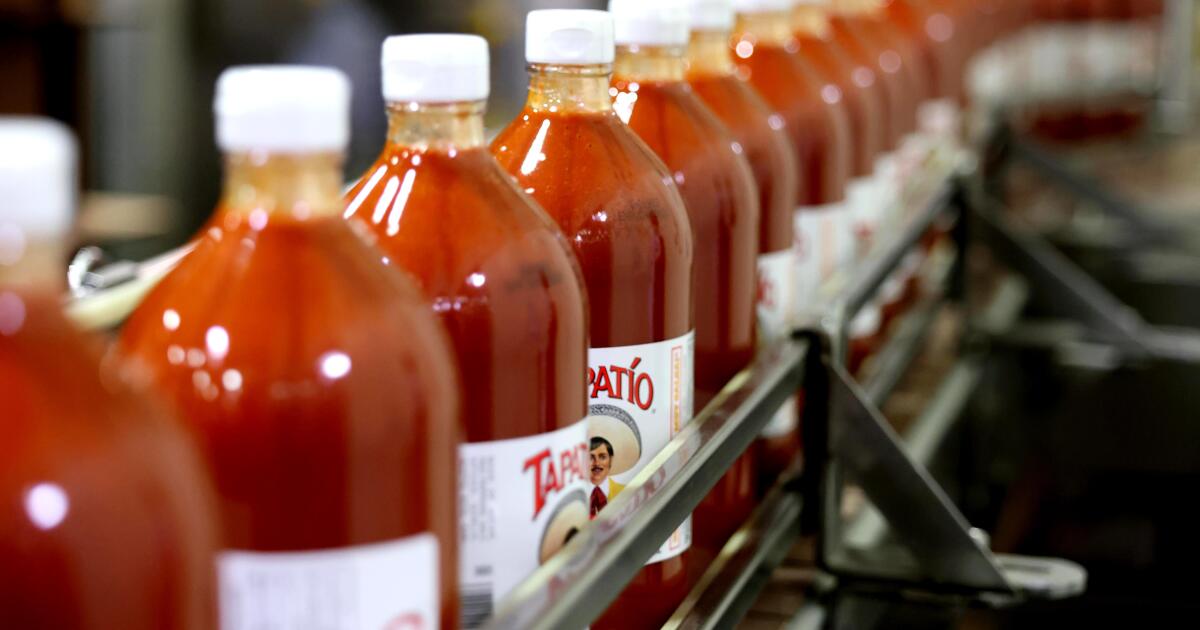
For 55 years, the family behind Tapatío has refused to even write down the recipe for Los Angeles’ iconic hot sauce, passing its secret formula for success only from lip to ear in closed rooms.
The Saavedra family put the ingredients on paper for the first time earlier this year as they sold the beloved brand to backers who plan to make their salsa picante even bigger beyond California’s borders. It is a weight off the shoulders of Luis Saavedra, the founder’s son and one of the few people who knew the recipe.
“We didn’t want anyone to know what we were using,” he told The Times in an interview at Tapatío’s factory in Vernon. “That always scared my sisters, because what if something happens?”
Demand for hot sauces had taken off for unexpected reasons just as the Saavedras were looking to sell. The millions of people on Ozempic and other powerful weight-loss drugs often have cravings for more flavor. The values of some sauce companies have skyrocketed. Bachan’s, a Japanese barbecue sauce brand, was acquired in February for $400 million.
While the Dallas private investment firm that bought Tapatío, Highlander Partners, wouldn’t share the terms of the deal, the company’s new chairman, Jeff Partridge, said it hopes to capitalize on the growing appetite for more heat to splash on proteins.
“Whether it’s GLP-1 or desire for proteins, Tapatío and hot sauces enhance that experience,” he said. “Consumers are increasingly seeking flavors.”
Red peppers drive Tapatío’s taste, though the company won’t share which exact peppers are used. The thin sauce uses garlic, salt and other spices for a tangy, peppery punch. It has a mild heat that doesn’t linger.
Luis Saavedra, right, former chief executive officer of Tapatío Foods and son of company founder Jose-Luis Saavedra, speaks with Eric Beatty, the current chief executive, at the company’s manufacturing facility on Wednesday.
(Genaro Molina / Los Angeles Times)
The big acquisition is a long way from the brand’s birth in founder Jose-Luis Saavedra’s kitchen more than 50 years ago.
Saavedra, originally from Mexico City, long dreamed of making his way north. He landed in Chicago in his late 20s, working as a Spanish translator. He met his wife and moved to Southern California.
He worked at an aerospace parts manufacturer in Los Angeles. The homemade hot sauce he brought for lunch was a hit with co-workers who asked for more. When he was laid off in the late ’60s during an oil recession, he started selling bottles.
As sales rose, he rented a small space for production in Maywood and it officially became a business in 1971. The whole family pitched in. His son, Luis, remembers twisting on caps and attaching labels to bottles when he was 13.

Bottles are filled with Tapatío hot sauce before being labeled at the Tapatío manufacturing facility on Wednesday. The hot sauce company was recently acquired by Dallas-based private investment firm Highlander Partners.
(Genaro Molina / Los Angeles Times)
Saavedra and his son would drive a van up and down Los Angeles, manually packing and unloading the product to local corner stores. Many of the first bottles were stocked in East Los Angeles stores.
About five years in, the company made enough for Saavedra to quit the two part-time jobs he had picked up to keep the business afloat. Operations remained in Maywood for 14 years before they expanded to a 7,000-square-foot building in Vernon.
In 1996, the company made its boldest bet, splurging on a 30,000-square-foot building.
In the same facility today, the strong aroma of spices tickles visitors’ noses. The precise portioning of the secret ingredients, matching the ratios of the founder’s original formula, happens in a room locked off from employees. The magic mix is then rapidly poured into a long line of empty bottles that march along a conveyor belt like soldiers.
It’s the legacy of the founder, who refused to be deterred by naysayers or obstacles to growth, said Saavedra’s son.
“Let’s go around it,” the younger Saavedra said, quoting his father’s mantra in the face of problems. “Let’s go under. Let’s go above it.”
His father’s stubbornness paid off in court as the company was sued for its name. It was once called Cuervo — his wife’s original last name — and tequila giant Jose Cuervo came after it. Saavedra had already trademarked the name in California, so it got a big payout to give up the name.
Saavedra briefly entertained the name “Charro,” a reference to Mexican cowboys, before landing on Tapatío, a nickname used for people born in Guadalajara, Jalisco, where all three of his children were born. Its logo evolved into a beaming cowboy with bright blue eyes in a wide-brimmed hat.
The Tapatío name was also challenged. Del Monte Foods sued Saavedra in the ’80s, claiming the name was too similar to its brand “Patio.” Saavedra won that case.
The founding father’s hardheadedness could also sometimes cause trouble.

Luis Saavedra, son of company founder Jose-Luis Saavedra, shows the original Tapatío label, left, compared to the current version.
(Genaro Molina / Los Angeles Times)
The younger Saavedra battled with his father in the late ’90s about changing the brand’s label to help it stand out on crowded shelves. The old bottles were largely black and white and looked a little outdated. Eventually, the senior Saavedra gave in. Sales skyrocketed.
Today, Tapatío is shaken over meals around the globe, though its dominance is strongest in California. It has been used in collaborations with other companies to spike mashed potatoes, protein powder, pickles and ramen.
Tacked to a wall at the Vernon factory is an old photo of the dozen people who were there to launch the brand’s new facility 30 years ago. Some of the employees still work there, including Jorge Cuervo, the production supervisor, and Fabian Diaz, who mans the forklift.
Diaz, who moves countless pallets of product, jokes he was born at the factory, having spent almost his entire adult life working for the company.
Under the new ownership, all 25 current employees were retained, and the firm has committed to hiring more.
“They’ve been doing this for a long time,” Luis Saavedra said. “They have a passion for it.”
The family began exploring options for a sale in late 2024, right after the founder, now 97, suffered a stroke.
Jose-Luis Saavedra had remained closely involved in day-to-day operations despite his age, often spending from sun-up to sun-down at the factory.
As he took on all his father used to do as well as his own workload, the younger Saavedra was getting burnt out and started to worry that keeping the company family-owned could be hurting the brand.
“Work was really devouring me,” Luis Saavedra said. “It was a tough decision, very difficult. We cried together as a family, then we said, ‘In the long run, it’s better.’”

“It was a tough decision, very difficult. We cried together as a family, then we said, ‘In the long run, it’s better,’” Luis Saavedra said of the decision to sell the company.
(Genaro Molina / Los Angeles Times)
Once it let potential suitors know the company was in play, the offers poured in. The family considered offers from around 40 companies before choosing Highlander Partners.
In a few years, the company’s new leaders hope to use the growing demand for flavor triggered by weight-loss drugs to bring California’s top sauce to many more markets east of the Rockies, said Eric Beatty, the company’s current chief executive.
“We believe that we’ve got these sector tailwinds behind us,” Beatty said. “It’s going to be a really good story.”

Eric Beatty, current chief executive officer of Tapatío Foods LLC, stands next to boxes of the hot sauce that are ready for shipping at the Tapatío manufacturing facility on Wednesday.
(Genaro Molina / Los Angeles Times)
New leadership has grand plans for the brand, hoping to build more facilities and add new products.
“We’ll always be a California company,” Beatty said. “This will always be the center of the Tapatío universe.”
Meanwhile, the Saavedra family still has a minority stake in the company and will continue to help manage it.
“They are the essence of the brand, and really understand the heartbeat of the brand,” said Partridge, Tapatío’s new chairman. “We certainly want to make sure that they always have a voice.”


Tired of the same old dating apps like Bumble and Hinge, Marie Lansley tried talking to an artificial intelligence matchmaker.
For roughly 15 minutes, she chatted with an AI voice on the dating app Known, answering questions about her upbringing, personality, education, lessons from past relationships and whether she’s looking for a serious relationship or something more casual.
“Divorced at 36. Yea, you’re not here to waste time. The way you build your days matter,” the AI voice told her after Lansley replied she was looking for a serious relationship.
Weeks later, the San Francisco resident got a match along with a written summary of why the pair could be compatible. But the stranger wasn’t her type and she wasn’t keen on paying $15 to meet up.
Startups like Known are roping in new users by hosting in-person dating events in San Francisco.
“I want to be able to use AI to improve efficiency in dating and to help navigate a pretty frustrating dating landscape. But there are just some things that are so deeply human that AI technology cannot capture,” said Lansley, who has posted about her dating experience on social media.
Singles like Lansley are dipping their toes into the wacky world of AI dating but they’re also skeptical if it will make it easier to find love. Online dating is ripe for disruption, and tech companies big and small are turning to AI as a potential solution to find people better matches more quickly and help them improve their chances of landing a date.
For years, people have been frustrated and exhausted by the seemingly endless amount of swiping and small talk that go nowhere on dating apps. They’re turning to in-person options such as running clubs, pickleball and speed dating but finding the right partner is still tough.
Online dating remains a popular way people search for a partner but some are dumping the platforms. Tinder’s monthly active users in March dropped 7% year-over-year, though its parent company Match Group noted that the rate of decline has been slowing as it revamps the app.
West Hollywood-based Tinder, which has roughly 50 million monthly users, has been experimenting with using AI to analyze a user’s camera roll and recommend better matches.

Known, an AI dating app, has its branding plastered on a storefront in the Marina District in San Francisco.
Its rival Bumble — an app that initially stood out for having women message their matches first — saw its paying users drop 21% to 3.2 million in the first quarter this year compared to 2025. The company has been working on AI matchmaking and plans to ditch swiping in the last three months of the year in select markets.
Even dating services that have grown users such as West Hollywood-based Grindr, an app for the LGBTQ+ community, and Facebook Dating, which is included in the main social network, are also leveraging AI more.
And new AI dating startups are popping up in California, New York and other states that could change the way people find a partner online. Former Hinge co-founder and Chief Executive Justin McLeod is working on an AI dating app called Overtone, stating on its website that “AI, if used correctly, can help us invent an entirely new way for people to find their partners that is far more personal, far more efficient, and far more effective.”
Some of those startups started in the San Francisco Bay area, where AI dating apps are hosting parties, speed dating, coffee meet-ups and other in-person events to rope people into using their new service.

Singles who downloaded the Known dating app mingle over drinks at Left Door, a cocktail lounge in San Francisco, on Thursday.
On one recent Thursday night, dating app startup Known hosted a dating event at a swanky San Francisco cocktail lounge for people who completed their matchmaking call on the app. The event’s description said attendees would be greeted with “champagne, caviar bumps, and a mysterious envelope” that reveals who the AI matchmaker paired them up with.
Known Chief Executive and co-founder Celeste Amadon, who dropped out of Stanford University to create the AI dating app, said Americans are spending more time alone at home as online services have made it more convenient to do everything from getting food delivered, online shop and date. Young people complain about traditional dating apps yet they’re also still on them.
“The more I understood today’s dating apps, the more clear it became that they have been for the better part of two decades now, designed, tweaked, redesigned, rebuilt, to not work,” she said.
1

2

3

1. A sign that reads, “I love my AI boyfriend” hangs in a San Francisco window. 2. Known, an AI-driven dating app, has their branding plastered on a store front in the Marina District in San Francisco. 3. Celeste Amadon, CEO of Known, poses for a portrait.
The company charges per date to ensure people show up but the startup also has a business incentive to find people a match they actually want to meet, she said. Known plans to expand to San Diego in July, she said. Amadon said she expects the AI matching technology to become more accurate over time.
Known hasn’t shared its user numbers or revenue figures. Founded in 2025, the startup launched the dating app in February and has raised roughly $10 million from investors such as Coelius Capital, Forerunner Ventures and NFX, according to PitchBook.
Grindr is learning more about how much users are willing to use and pay for AI features.
The company has been testing a subscription tier called “Edge” in Australia, New Zealand, the United States and Canada that includes AI tools that recap meaningful chats, display personalized profile recommendations and show users who they’re likely to match with.
Unlike other dating apps, Grindr users don’t swipe through profiles. The app displays a grid of people who are nearby that they’re able to chat with. Grindr has expanded beyond casual dating, allowing people to find friends, travel companions and others in the LGBTQ+ community.
Grindr’s Chief Product Officer AJ Balance said the company is still testing subscription pricing for Edge but some users are willing to pay $350 per month because they’re “seeing a lot of value” and saving time.
“We view AI and new paradigm shifts like it as opportunities to build great, new product experiences that haven’t been developed before,” he said. “Our approach is really to leverage AI, like we did with mobile, to facilitate better conversations, deeper connections, ultimately more success in dating in the real world.”
Other popular dating services aren’t charging for AI matchmaking features. On Facebook Dating, which has more than 21.5 million daily users worldwide, users can use AI to write their profile intro and chat with an dating assistant for free.

AI dating startups are popping up in California, New York and other states that could change the way people find a partner online.
The AI assistant can recommend people looking for a serious relationship, someone with common hobbies or even above a certain height or age. Roughly 1 million people use Facebook Dating’s AI assistant daily in the United States and Canada, Meta said.
Facebook Dating product manager Neha Kumar said AI can help combat “swipe fatigue” facing online dating users.
“You’re sifting through a bunch of profiles. It’s really hard to understand and find somebody that’s compatible for you based on your specific types of preferences,” she said. “We really wanted to think about leveraging AI to solve this growing pain point.”
Technology is also a double-edged sword. The rise of AI tools means people can use technology to easily manipulate photos and craft messages on dating apps that might make them seem much more attractive or charismatic than they are in person. Some people are even turning to AI chatbots for companionship.
“How do we maintain human authenticity and human connection through an AI world? I don’t have a perfect answer to that. I think we’re still figuring it out,” Kumar said.
Lansley, the online dating user, said apps do make dating more convenient but it’s much more interesting to meet people face-to-face. She worries people will rely too much on AI as a “crutch” to replace human intimacy or emotional judgment.
“Chemistry,” she said, “is always going to be analog.”

Los Angeles County saw job gains in May, likely driven in part by rebuilding after the January 2025 wildfires, which destroyed or damaged more than 18,000 structures.
Construction added 2,300 jobs since April, while postings for new jobs in the industry jumped 45% over a year ago —indicating rebuilding in Pacific Palisades, Altadena and nearby is helping boost the local economy, according to a report by the Los Angeles County Economic Development Corp.
“This is consistent with the possibility that wildfire rebuilding activity is increasing construction labor demand in the area,” Max Chomas, an economist at the LAEDC Institute for Applied Economics, said at a presentation this week based on California Employment Development Department and other data.
Motion picture and sound recordings also added 2,800 jobs during the month, despite a deep downturn in Hollywood caused by a reduction in streaming filming, runaway production and other factors. The industry lost 6,700 jobs compared with a year ago.
Still, the job growth since April in construction and Hollywood were among the highlights of a month that saw total county payroll jobs — excluding agriculture and certain other sectors — grow by 9,000 jobs, to 4,618,400. Employment was virtually flat from the same time a year ago.
“May was a relatively good month for employment growth,” Chomas said.
The biggest monthly job gainers were the hotel and restaurant industries, which added 3,700 jobs.
Manufacturing, which has been hit by job losses over recent years, added 400 jobs since April. It also saw a 15% increase in job postings compared with a year ago.
That could reflect the resurgence in Southern California’s aerospace and defense industries, which have seen a sharp rise in startups.
Postings for all new jobs were up 1,134, or 2.4%, since a year ago. Chomas noted that May was only one of five months over the last three years that saw year-over-year growth in job postings.
The gains helped stabilize the county’s unemployment rate at 5.2%, matching April’s rate and down from 5.4% in May 2025.
Still, that is higher than May’s 4.3% national unemployment rate, and it masked some weakness in the local economy.
The rate is calculated by a household survey to determine which members are working, looking for work or no longer seeking employment.
It found 18,000 workers had dropped out of the county labor force in May, artificially driving down the unemployment rate, according the California EDD.
Similarly, California recorded a 5.3% unemployment rate in May, on par with April, despite a drop in the labor force.
That rate is higher than every state other than Delaware. In May, California only added 3,100 non-farm jobs month-over-month — a job growth rate that lags behind the nation, according to an analysis by the Inland Empire Economic Partnership and the Lowe Institute of Political Economy at Claremont McKenna College.
The LAEDC’s report also examined the potential effects the growth in artificial intelligence has been having on L.A. County jobs “exposed” to AI, meaning they are vulnerable to AI replacement.
California has been hit hard by thousands of AI-related layoffs in Silicon Valley as the software has been integrated into the tech workplace — even though there is fierce competition for software engineers with skills and expertise in the field.
The report found that since July 2023, job listings in Los Angeles County for AI-exposed positions — such as clerical and translation positions — have lagged behind other jobs. However, it is unclear whether businesses have replaced or are waiting to replace those workers with AI.
It may be that employers overhired for those positions during the COVID-19 pandemic and are now shedding them, since there is a correlation between AI-exposed positions and those jobs that can be completed from home, Chomas said.
The report also examined macroeconomic trends and policy decisions affecting the national, state and Los Angeles County economies — which have been hit by tariffs, the crackdown on immigrant labor and high energy costs, among other factors.
Nevertheless, consumers continue to spend despite affordability strains, and employers continue to hire selectively amid higher interest rates to battle inflation, said institute economist Shannon Sedgwick.
“During the previous decade, we experienced extraordinarily low inflation, near zero interest rates, relatively stable globalization, and abundant capital. So those conditions may have conditioned us to think that environment was normal,” she said.
“But historically speaking, today’s world of higher rates, greater geopolitical uncertainty and tighter labor markets, they may actually be closer to that long-run average,” Sedgwick noted.

A proposal to build a truck parking lot near the Port of Los Angeles is facing backlash from nearby residents.
Port officials say the parking lot would provide much-needed designated space for cargo trucks waiting to pick up loads from the port, helping to ease congestion in the area.
But some neighborhood groups say the proposed staging area would only increase traffic and air pollution in Wilmington.
Gina Martinez, chair of the executive board of the Wilmington Neighborhood Council, said the land in question provides a vital buffer between port activity and residential communities.
“It’s been a bad deal from the beginning,” Martinez said in an interview. “We want open space because we’ve been promised for decades a clear separation from port activities.”
The Los Angeles Harbor Commission signed off on the project in a meeting on June 11, but it was vetoed by the Los Angeles City Council this week.
The veto does not permanently ban the project, but allows for more time to discuss the implications for stakeholders and the community.
Los Angeles City Councilmember Tim McOsker, who introduced a special motion to halt the truck plans, said he was acting on behalf of community residents. McOsker represents Harbor City, Harbor Gateway, San Pedro, Watts, and Wilmington.
“Generally, folks in the community would say, ‘we don’t want the port industrial properties to creep into neighborhoods. We want them to retract or hold the line,’” McOsker told The Times.
The John S. Gibson Truck & Chassis Parking Lot, which was originally proposed in 2023 by the Port of Los Angeles, would cover 18 acres of privately owned land and include 393 truck and chassis parking stalls.
The land is currently designated as open space, though it’s undeveloped and not available for any recreational use. The completion of the parking lot would require a Port of Los Angeles master plan amendment to switch the land’s designation from open space to maritime support.
Martinez said the land should have never been sold to private developers because it’s included in the California State Lands Commission’s tidelands trust, which says certain land near the ocean must be available for public enjoyment.
Building a truck and chassis waiting lot on that space would increase congestion on the freeways and in Wilmington neighborhoods, add particulate matter into the air and increase already-problematic noise pollution from the port, she said.
“Of all the things Wilmington needs, it is not another parking lot for trucks,” Martinez said at a Los Angeles Harbor Commission meeting earlier this month. “It is not the responsibility of our community to take on every single truck that runs through the port.”
At the same meeting, Noel Gould of the Coastal San Pedro Neighborhood Council said the council is supporting the project after working closely with the developers to reach compromises.
The parking lot would prevent port-bound trucks from idling near schools and parks, he said. The lot would also include landscaping with native coastal plants.
“We didn’t start out in a position of support, but we worked very closely with them to get to a place where we felt it was really something that would benefit the community,” Gould said at the meeting.
In an interview, McOsker said there is already space set aside for trucks to wait to access the port.
At the Los Angeles City Council meeting Wednesday, the council unanimously approved what’s known as a 245 motion, which gives the council authority to temporarily veto certain actions taken by city boards and commissions.
“The 245 gives us the opportunity to meet and confer and see if there are revisions or additions or mitigation that can better protect the full community,” McOsker said.
The motion sends the project proposal back to the Harbor Commission for further review.
Supporters of the parking lot say the land is currently uninhabited and requires consistent police presence to deter criminal activities.
The Port of Los Angeles also clashed with coastal communities last year over the possible raising of the Vincent Thomas Bridge. The bridge was already slated to be redecked by the California Department of Transportation, but Port of Los Angeles executive director Gene Seroka proposed raising the bridge height as well.
Raising the bridge would allow larger cargo ships to pass under its deck, helping create jobs and keep the port relevant, Seroka said at the time. Most painfully for local commuters and businesses, it would mean the bridge will be closed for around 28 months rather than the originally planned 16 months.
Last December, the California State Transportation agency rejected the proposal to raise the bridge.
-

 Missouri16 seconds ago
UPDATE: Well-known mid-Missouri attorney charged after sting expected to request home detention | 93.9 The Eagle
-
 Montana5 minutes ago
Montana nurse and Guard member earns national Air Force recognition
-

 Nebraska13 minutes ago
Former OSU, Nebraska wrestler AJ Ferrari arrested after police pursuit in Nebraska
-

 Nevada15 minutes ago
Officials elevate response efforts to combat eastern Nevada wildfires
-

 New Hampshire20 minutes ago
U.S. Forest Service Reorg Talk | Films | Stories In A Park: Week Ahead Events On Concord Patch
-

 New Jersey28 minutes ago
Missing New Jersey teens found safe after vanishing from train station | Fox News Video
-

 New Mexico30 minutes ago
New Mexico wrestling standouts give back at Raton High School camp
-

 North Carolina36 minutes ago
Duke’s Grayson Allen returns to North Carolina after trade from Suns

