Lifestyle
Shortlisted for an Oscar, ‘Homebound’ is a daring movie about two dear friends


Mohammad Saiyub (above, in a Mumbai quarter on a February day) appeared in a photo that went viral in the early days of the pandemic. He and his childhood buddy Amrit Kumar were hitching home, a journey of nearly 1,000 miles. Kumar, who is a Hindu Dalit, fell ill. Saiyub, a Muslim, cradled his friend by the roadside. Their different religious identities drew attention in a country where communal relations have been polarized after a decade of Hindu nationalist rule. The photo and the story behind it inspired the award-winning movie Homebound.
Diaa Hadid/NPR
hide caption
toggle caption
Diaa Hadid/NPR
DEVARI, India — The legendary Martin Scorsese was the movie’s executive producer although his role was kept secret to ensure the film crew could keep working without attracting media attention. He was even assigned a code name: “elder brother.”
That’s because Neeraj Ghaywan, director of Homebound, didn’t want to go public with his movie until it was ready. He worried its central story might be received with hostility by Indian media — by a country — profoundly changed by a decade of rule by the e Prime Minister Narendra Modi and his Hindu nationalist Bharatiya Janata Party, known as the BJP.
He need not have worried.
Homebound, is based on a true story: a tender friendship between two boys from a dusty village, one a Muslim; the other a Dalit, a South Asian caste once known as “untouchables.” The movie revolves around their failed attempts to push through the discrimination they face in today’s India as their lives are upturned and imperiled by the Indian government’s response to the COVID pandemic.
“I treaded that path very, very carefully. Like we didn’t disclose about the story for a long time. We were being very cautious,” Ghaywan tells NPR. “I thought: Let the film speak for itself.”
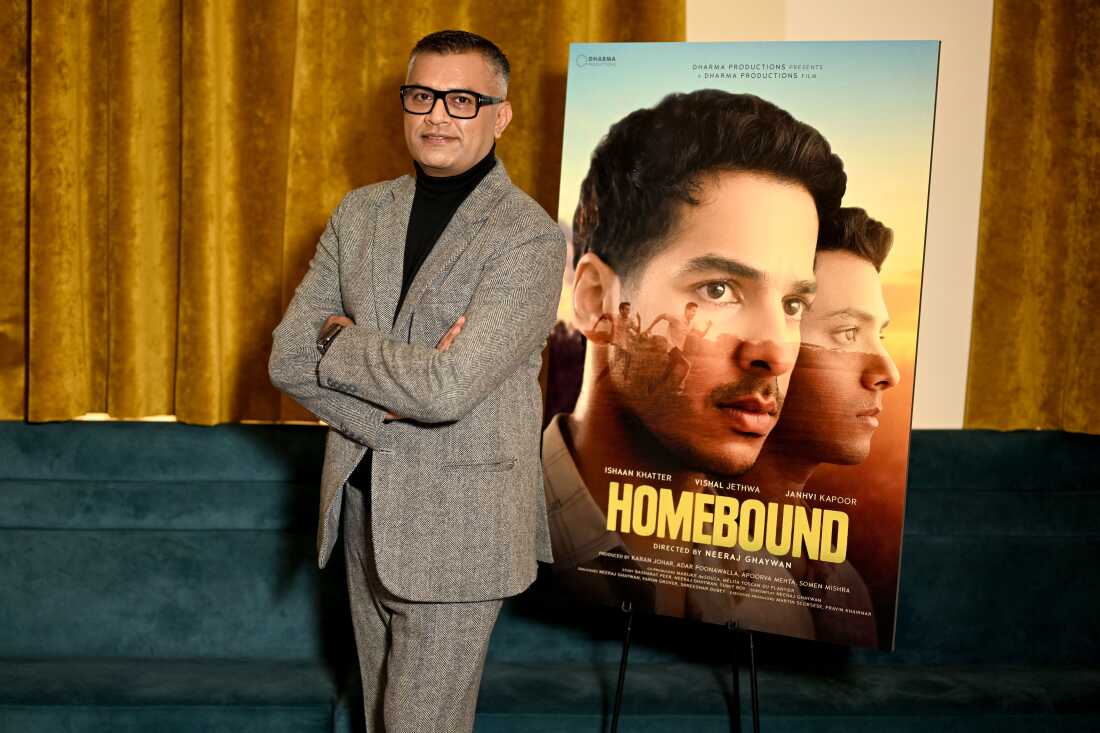
Neeraj Ghaywan is the director of Homebound.
Kate Green/Getty Images/Getty Images Europe
hide caption
toggle caption
Kate Green/Getty Images/Getty Images Europe
The film has spoken for itself — helped of course, by the megaphone that is the backing of one of the world’s most prominent directors.
Cannes loved it — a nine-minute standing ovation. Homebound made the rounds of film festivals, gathered up medals along the way, then was selected by India for consideration for an Oscar in the foreign film category. It even made it to the prestigious shortlist — a rare feat for any Indian movie.
Based on a true story
Homebound is based on a New York Times essay from 2020 by writer Basharat Peer. It tells the backstory of a photograph that went viral during the early days of the pandemic in India. The image shows one man cradling another in his lap in the dirt, by the roadside. And that man is clearly unwell.
“Just the care and the dignity, the photograph moved me immensely,” says Peer. “It was a great act of friendship.”
Then Peer discovered the men were Hindu and Muslim, and it drew him in, because of the context of “everything that had come before that in the past 10 years,” he says, referring to the routine vilification of Muslims by Hindu nationalists, including members of the ruling BJP party, and the prime minister himself. Perhaps most prominently this year, in February, the chief minister of the northeastern state of Assam, Himanta Biswa Sarma, generated an AI video of himself shooting Muslims. It was shared by his party and only taken down after a backlash, and a member of the state’s BJP social media team was fired.)
The two men in the image are garment factory workers: Mohammad Saiyub, a Muslim and Amrit Kumar, a Dalit.
That image captured them as they were trying to get home after the Modi government shut down most industries and transport to prevent the spread of the virus.
But with no work, migrant workers, who survive off low wages, began going hungry — and trying to leave. Economist Jayati Ghosh, who researched India’s COVID response, estimates some 80 million migrant workers tried to return home, walking and hitching rides in searing summer heat.
Peer says it reminded him of the Dust Bowl exodus of the ’30s in the United States. “I was thinking about Steinbeck and the Dust Bowl migrants, which led him to write Grapes of Wrath,” says Peer — except in India: “They’re not running from their Dust Bowl villages. They’re running from the Californias to their villages.”
Migrants died enroute — including the man in that viral photo, Amrit Kumar. “He died of heat exhaustion,” his friend Mohammad Saiyub tells us in a tiny tea house in a crowded Mumbai quarter, where workers sat at stainless steel tables to down steaming cups of chai, boiled in a giant, blackened pot manned by a teenager whose face was largely buried in his phone. Saiyub was in the port city to look for work.
Saiyub says the day that photo was taken, he and Kumar had paid a truck driver the equivalent of $53 for a ride. The cargo was crammed with other migrant workers, desperate to return home. But Kumar developed a fever, and the driver booted him off. “They worried he had corona,” Saiyub recalled.
So Saiyub helped his friend off the truck. Then, he says, “the driver told me, you get on the truck and let’s go.” Saiyub refused to abandon his friend. They sat by the roadside, waiting for help. That’s when someone took their photo. As the image spread online, an ambulance raced to find them.
Too late.
Saiyub ultimately returned home with his friend’s body. He dug his best friend’s grave. “My blood is Kumar’s,” he says. “And Kumar’s blood is mine. We were friends like that.”
A personal connection
Director Ghaywan read the essay, drawn in by that tender friendship between a Muslim and a Dalit Hindu.
There was also a very personal reason that Ghaywan was so affected: He was born into a Dalit family but concealed that information for much of his life, fearing rejection by his upper-caste peers if he told them the truth about who he was.
Ghaywan also happens to be a celebrated wunderkid in Bollywood. He got the backing of a major production studio to make Homebound.
He drew on his own experiences of fear and shame as a Dalit-in-hiding to draw Kumar’s character. “In the film, I poured in a lot of my own shame.” And he hoped to humanize a story rarely told, about India’s downtrodden workers. “I felt there is a strong springboard to talk about contemporary India,” Ghaywan said.
Film critic and curator Meenakshi Shedde said the decision to put money on a movie like Homebound spoke to Ghaywan’s talents as a director, and yet remained, something of a “miracle.”
“In today’s India, you can imagine how daring it is of a producer to put money on a film that’s going against the grain,” Shedde said. The grain she refers to is the stuff that Bollywood is increasingly churning out: films that reflect the Indian government’s Hindu nationalist ideology – with macho Hindu men fighting evil Muslims and proud Indians battling enemy Pakistan.
India’s notoriously prickly censors approved the film for screening in the country, although they insisted on changes that diminished the intensity of the caste and faith discrimination that the protagonists faced. Still, Ghaywan says, “the soul of the film remained intact.”
And then, it was selected as India’s official entry for the Oscars.
It was a striking choice to represent India. Just last year, an Indian movie that critics globally tipped as an Oscar winner was passed over by the same selection committee. Critics suggested that was because it featured a steamy Hindu-Muslim romance.
(NPR sought to speak to the Indian selection committee but received no response.)
Film curator Shedde said she, like many of her peers, were dumbstruck. “How did they end up being India’s submission? OK, so those are, I think, mysteries of the universe,” says Shedde.
Ultimately, Homebound made it to the Oscar shortlist for best foreign film but not the final five.
A very personal screening
After all the excitement died down, Ghaywan set about screening the movie in the one place that really mattered: in Devari, the dusty hamlet that Kumar and Sayoub came from.
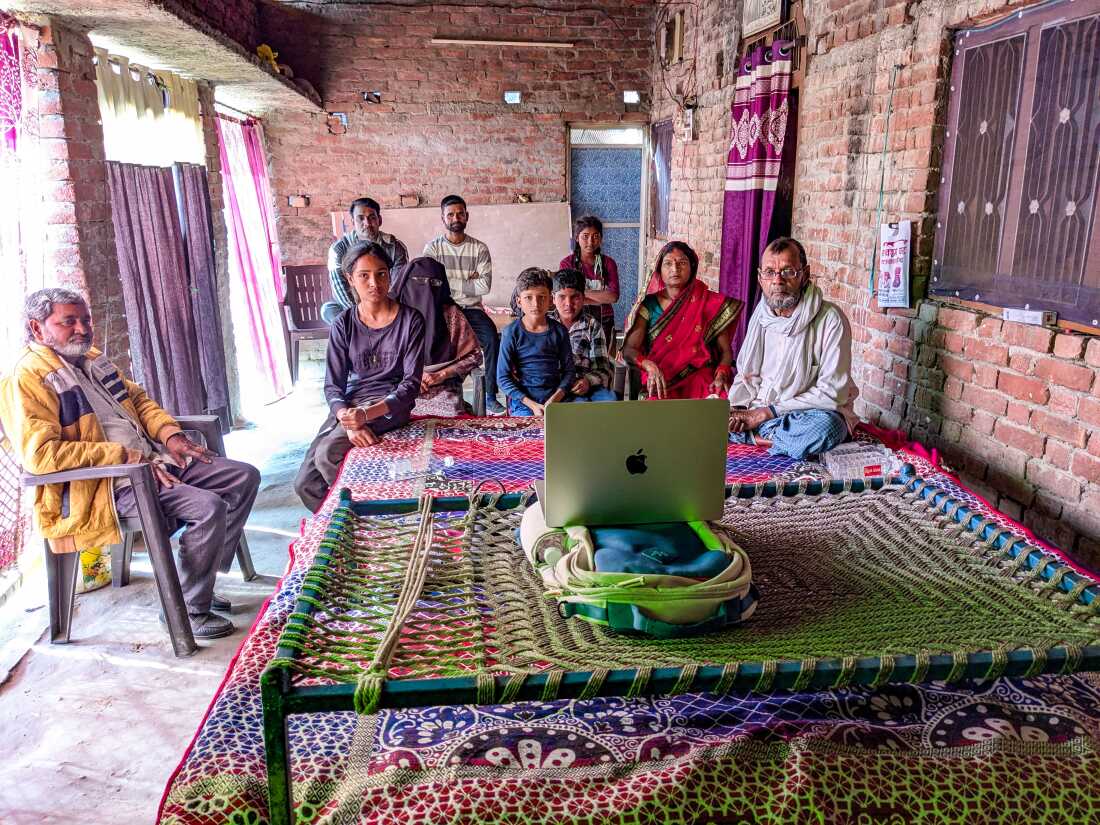
The families of two young men whose friendship inspired the movie Homebound gather for a makeshift screening on the balcony of the home of Mohammad Saiyub.
Diaa Hadid/NPR
hide caption
toggle caption
Diaa Hadid/NPR
That day, Gaywan hugged the fathers of Saiyub and Kumar, who were waiting to meet him. Both men, elderly and unable to work, sat on the same wooden bench.
Kumar’s mother Subhawati arrived later, dressed in her best, brightly colored sari, gifted by her daughter. Subhawati, hunched and sunburnt, stood quietly outside, until Ghaywan insisted she sit with the menfolk on the porch. Saiyub is from a conservative Muslim family. His sisters and mother stayed inside the house, his mother only poked her head outside to pass on plates of food for lunch.
After the meal, Ghaywan lined up plastic chairs on the Saiyoub family porch. Hung up sheets to block the light. Set up his laptop. Curious villagers piled in. Saiyub’s mother even drew up a chair.
But one person refused to watch: Kumar’s mother, Subhawati.
Ghaywan pleaded with her. “Your son’s story,” he said, “inspired millions of people.” Maybe if she watched the movie, she would see how big he had become in people’s hearts, and “maybe this will help you in some way to heal.”
Kumar’s mother asks us: “What good will it do me to watch this movie?”
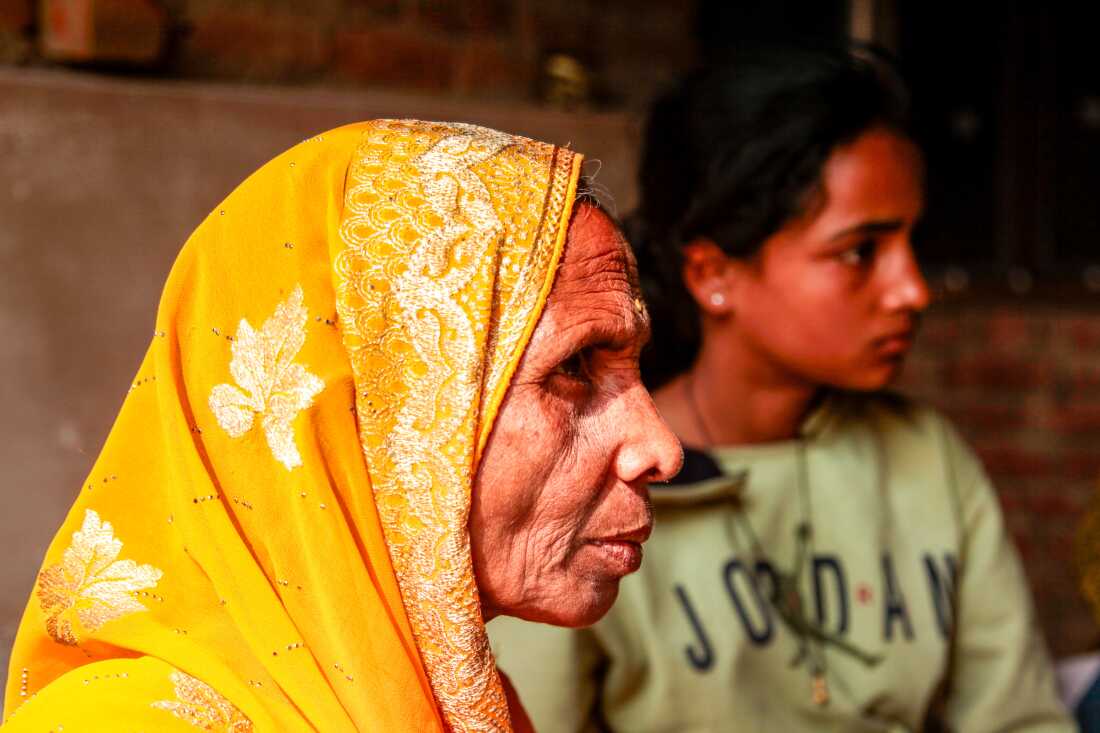
Subhawati is the mother of Amrit Kumar, who was on a 1,000-mile journey home with his childhood friend Mohammad Saiyub. Kumar fell ill and later died. Their story inspired the movie Homebound. When the director arranged a screening for the families of the two young men, Kumar’s mother could not bear to watch.
Diaa Hadid/NPR
hide caption
toggle caption
Diaa Hadid/NPR
It was her son Amrit who kept their bellies full with his garment factory work. Now she works on construction sites for a few dollars a day.
“Amrit used to see my sorrow and my happiness. He took my troubles away. If I watch this film — and Amrit doesn’t speak to me, what is the point?”
So as the opening score wafted from the porch, of a movie about her son’s life and death, she walked away.



Author Julia Elliott won for her short story collection Hellions.
Forrest Clonts/Tin House
hide caption
toggle caption
Forrest Clonts/Tin House
Writer Julia Elliott has won this year’s Carol Shields Prize for Fiction for her short story collection Hellions. The award honors work by women and nonbinary authors in the U.S. and Canada.
Elliott, who also authored the novel The New and Improved Romie Futch and the short story collection The Wilds, is known for blending elements of Southern gothic horror, surrealism and fairy tale. Hellions, published in 2025, includes stories set against backdrops like a plague-stricken medieval convent, a feminist art colony, and small Southern towns.
“This eerie, eclectic, genre-leaping collection takes no half-measures; every sentence of Hellions crackles or crawls,” wrote the prize jury in a statement. “Here, human folly moves against a backdrop of horror and magic … But for all its wildness, there is tremendous control.”
The prize, named after a Pulitzer Prize-winning novelist, awards $150,000 to one winner each year. Novels, short story collections, and graphic novels by women and nonbinary authors are eligible.
This year’s finalists included Quiara Alegría Hudes (The White Hot), Lee Lai (Cannon), Megha Majumdar (A Guardian and a Thief), and Sonya Walger (Lion). They will each receive $12,500.
The Carol Shields Prize went to writer Canisia Lubrin in 2025.
You can listen to actor Donna Lynne Champlin read Elliott’s story “Hellion” on the Death, Sex & Money podcast here.

new video loaded: The Fashion References in ‘Cats: The Jellicle Ball’

By Helen Shaw, Vanessa Friedman, Léo Hamelin, Laura Salaberry and Sutton Raphael
June 2, 2026

At around 1 in the morning at the Sassafras Saloon in Hollywood, four masc lesbians in cowboy hats and chaps were dancing on top of the bar while bartenders attempted to continue making espresso martinis beneath them.
One performer crawled into the crowd and between the spread legs of an audience member, licking the air between their thighs. Another wrapped a belt around their girlfriend’s neck while thrusting against her to Bon Jovi’s “You Give Love a Bad Name.” The ravenous audience, almost entirely women, fluttered dollar bills all around, while easily filling the saloon’s 300-person capacity.
Across Los Angeles, countless strip clubs and revue shows were unfolding at that same hour, though none quite like this and likely few provoking this level of frenzy. The night had all the riotous energy of a scene from “Coyote Ugly,” with the choreographed masculinity of “Magic Mike.” Playing on the latter’s name, this was the doing of Magic Mascs, an all-masc lesbian and translesbian revue, by sapphics for sapphics.
Skye Valentinez, from left, Alexa Legend, Daddii Syd and King Captain are members of Magic Mascs, an all-masc lesbian and translesbian collective, that started in February.
“Our idea was to give lesbians what men get all the time at a strip club, but instead of just sitting around and singing ‘Pink Pony Club,’ actually going wild,” said group founder Daddii Syd, a.k.a. Syd Latimore.
The performers, self-described “daddies” — Daddii Syd, Alexa Legend, Skye Valentinez and King Captain — formed Magic Mascs in February. The performance at the Saloon was their third overall, but the group has already become an institution within lesbian nightlife in Los Angeles. They will make their debut during a Pride Month performance on Friday at Womxn Pride’s rooftop party in downtown L.A.
The members come from professional dance backgrounds. King Captain entered dance school at age 12 and taught dance for nearly a decade. Daddii Syd has danced since childhood. Alexa Legend spent years go-go dancing across clubs in the city before joining the troupe. Skye Valentinez, the baby of the group — cherub-faced, smiling through braces — is the newest to performing, though she steps into it naturally, exhibiting the same living, breathing caricature of masculinity as the rest of them.
“No one’s trying to be cisgender,” King Captain makes clear. “We’re not trying to be the kind of men who are born into and fed by patriarchy,” Daddii Syd added. “We’re redefining masculinity.”

King Captain gets their underwear stuffed with dollar bills from the crowd.
Magic Mascs’ success follows a broader trend of lesbians confidently stepping into masculinity before hungry eyes. In the past year, performative masc competitions have appeared across the country, with lesbians — hair slicked back and carabiners dangling from their Carhartt jeans — showing off in front of leering crowds. Magic Mascs feels like a more professionalized version of that phenomenon, less tongue-in-cheek — just tongue.
“We always knew there was a huge hunger for this,” Daddii Syd said.
Their first performance, in San Diego, sold out fast.
“I knew right away we were onto something special,” Daddii Syd said.
Videos of the troupe traveled far across sapphics’ algorithms, especially clips of King Captain, whose devoted fan base — known collectively as “The Castle” — make arduous trips just to see them in the flesh. One fan drove more than 20 hours from Dallas to San Diego to see Magic Mascs. Another sent an edible fruit bouquet from Australia.
Backstage, every gesture from the troupe was ultra-confident. Captain, wearing briefs stuffed with a sock full of rice, talked to me with a leg cocked on the footrest of my stool. Daddii Syd, Alexa Legend and Skye Valentinez stood pelvis-forward, hands behind their heads, flexing ropey muscles. They loved the camera, eyeing it like prey while tipping the brims of their cowboy hats. (“You guys are like the modern-day Beatles,” our photographer said.)

King Captain gets the Hollywood crowd into a frenzy during a recent show.
Everything in the show revolved around their hips. The performers rolled and glided before delivering sudden, mechanical thrusts powerful enough to rattle nearby glasses. Their bodies were taut with effort and exaggerated lust. Daddii Syd performed with her girlfriend Jamie in matching plaid, not leaving much to the imagination as they licked whipped cream off each other.
Alexa Legend, who described herself as shy offstage, eventually stripped down to nipple pasties and a cowboy hat, firing confetti from her crotch into the crowd. King Captain swerved their hips like a powerful mechanical bull. “Oh, Captain, my captain,” someone in the crowd said, hand pressed dramatically to her forehead.
They paid particular attention to a woman in a wheelchair in the crowd — typical of their performances — asking if they could sit on the wheelchair. They received keen consent. “That was, um, very nice,” she told me after, still a little lost for words.
“We’re huge on consent,” Daddii Syd said. At the start of the show, they told the crowd to cross their arms in a Wakanda Forever pose if they didn’t wish to be touched. They checked in constantly while moving through the crowd, leaning close to ask questions like, “Is this OK?” and “Anywhere you don’t like to be touched?”
Captain learned these habits through work in intimacy coordination and under the mentorship of Tonia Sina, among the first professional intimacy coordinators in Hollywood. That ethos of care extended beyond their interactions with the audience and into the way they interacted with one another offstage.

“We want everyone in the crowd to feel gorgeous,” King Captain said before the recent show at Sassafras Saloon in Hollywood.

King Captain, left, and Lauren Henson, a stage kitten for the Magic Mascs, perform together on the bar.
Forming a sanctuary for themselves was just as important to the troupe as emboldening others’ desire. “It’s hard to find other masc friends,” Daddii Syd said. “Everybody’s weirdly competitive and trying to sabotage each other.” King Captain agreed, asking: “Why can’t we all be daddies at the same time?”
Daddii Syd and King Captain, who are both in their 30s, had little butch representation or friendship growing up and they have now become something like father figures to Alexa Legend and Skye Valentinez, who are in their 20s.
“We have to protect each other,” King Captain said. “We have to look out for each other.”
Daddii Syd put her arm around Skye Valentinez and said: “Look at this beautiful baby we have.”
That tenderness carried straight into the night. There was a striking seriousness to the whole performance, which spanned from just past 10 p.m. to 2 a.m. Unlike a bachelorette party or the typical male revue, there was no giggling in the room, and no wink of camp from the performers. Here was a rare claim to unabashed public sapphic desire; it was given the scale and seriousness routinely afforded to heterosexual display, like the gleeful bravado of a man striding into Hooters.
By the end of the night at Sassafras Saloon, the performers had stripped down nearly to nothing, pouring water over themselves while the audience roared. The atmosphere felt like one of collective release, a recognition that masculinity and desire don’t belong only to men — that a group of four masc lesbians can be horny, inspire horniness and ultimately stir a hysteria that once greeted Channing Tatum or even the Beatles.
It was the magnitude of the response that night at the Saloon, as on every other night they’ve performed, that’s inspiring their next moves: total domination in sum. The troupe is already planning a national tour through Florida, Dallas and Sacramento, though Daddii Syd’s ambitions extend much further.
“The idea,” she told me, “is to go global. Like a boy band.”
-

 Milwaukee, WI48 seconds ago
MPS staffer who got plea deal in slapping case had earlier incident
-

 Atlanta, GA8 minutes ago
19 new metro Atlanta restaurants opened in May, but 11 closed
-

 Minneapolis, MN11 minutes ago
Motorcyclist seriously injured in north Minneapolis hit-and-run
-

 Indianapolis, IN16 minutes ago
New stores in Indianapolis include indoor kid’s playground, cafe
-

 Pittsburg, PA23 minutes ago
Blanche says DOJ
-
Augusta, GA26 minutes ago
Amy Elizabeth Black Obituary May 29, 2026 – Platt’s Funeral Home
-
Washington, D.C26 minutes ago
Sherry Abedi has been appointed as General Manager at LINE DC
-

 Cleveland, OH38 minutes ago
Man shot on Cleveland’s West Side


