Fitness
We can’t all be astronauts, but the Artemis II crew has fitness lessons for everyone


The Artemis II crew — Christina Koch (left), Jeremy Hansen, Victor Glover and Reid Wiseman — have to share tight quarters aboard the Orion spacecraft on their way home. But even with limited space, they can still get a solid workout in — thanks to a very special piece of equipment.
NASA
hide caption
toggle caption
NASA
Even a few days away from Earth can significantly alter the human body. Without the constant pull of gravity on the skeleton, muscle and bone can quickly atrophy. To combat this immediate physical decline, the four astronauts aboard Orion on the Artemis II mission are using a specially designed machine known as the flywheel.

In a video blog posted before the crew launched, Canadian astronaut Jeremy Hansen compares the flywheel to a rowing machine. “Like a cardiovascular workout where you row at a lower resistance and a fast pace,” Hansen explains as he demonstrates the flywheel’s functionality. Astronauts strap their feet onto a small platform and pull on a handle connected to a cable. Pulling spins a flywheel. It works like a yo-yo, according to NASA — astronauts get as much resistance as they put into it.
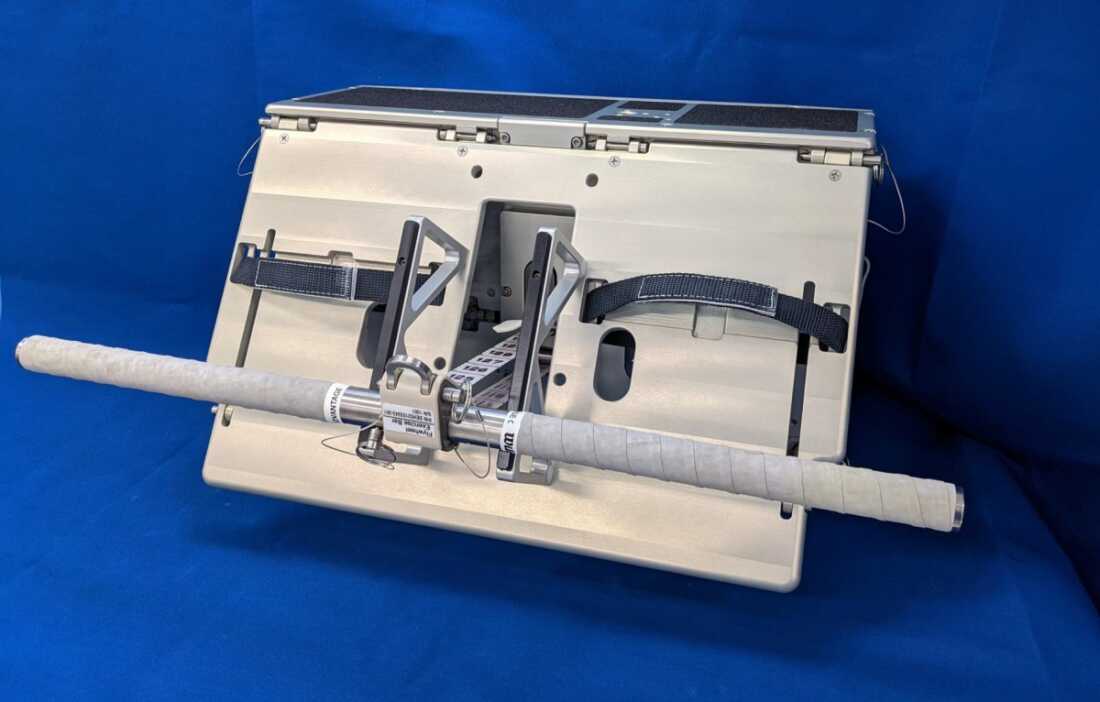
The Artemis II crew exercises on Orion using a flywheel, a simple cable-based device for aerobic and resistance workouts.
hide caption
toggle caption
The flywheel is small, not unlike an extra large shoebox. Working in Orion’s tight quarters — only 316 cubic feet , about the size of a smallish bedroom — engineers had to design this device to perform with utmost efficiency, so that it can both provide a cardiovascular workout and resistance exercises up to 400 pounds. Astronauts can use it to do weightlifting moves like squats, deadlifts and curls.
Before the astronauts, there were the pillownauts
The flywheel has been years in the making. Jessica Scott, an exercise physiologist at Memorial Sloan Kettering Cancer Center, worked on early prototypes for NASA, anticipating that astronauts would be vulnerable to rapid muscle atrophy without physical exertion.

Scott compares ten days in space to ten days in bed. Atrophying for that amount of time, says Scott, “You would feel very weak and your muscles start to lose size very quickly.” The heart, she stresses, is especially vulnerable with this decline in strength.
When recruiting people to study these early flywheel prototypes, says Scott, researchers looked for 30 subjects willing to lie in bed for 70 days. She and her colleagues weren’t sure they would be easy to recruit.
Turns out, people were eager to spend hours a day reclining in the name of science.

“We had over 10,000 people apply for 30 positions,” says Scott.
They called themselves the “pillownauts.”
Researchers divided these participants into different groups. Some stayed in bed all day. Some of them broke their bed rest in order to work out on a more traditional suite of exercise equipment, and some of them used the flywheel. The goal was not to improve fitness, but to prevent declines.
The flywheel, says Scott, delivered the results researchers were hoping.
“What was really exciting was that the small device could prevent the declines, the same amount that a full gym could do,” she says.
Other missions — like those aboard the International Space Station — have full suites of exercise equipment. The flywheel has not yet been tested for longer durations, but Scott says she’s hopeful it could also provide fitness for astronauts in longer periods of gravity deprivation.
Not everyone’s an astronaut, but everyone ages
Even for people who are not planning on orbiting the moon — this research has important implications, says Thomas Lang, a radiologist who studies bone and muscle loss and has worked with NASA on exercise science for previous missions.
“You start childhood and then as you grow your bone density and mass reach a peak,” says Lang, “in your late twenties or early thirties.”
Those who are lucky to live to old age, he says, will experience hormonal changes that lead to bone loss over time. For women, that escalates sharply in menopause. “That’s a big whopping decline,” says Lang.
Men’s decline may not be as dramatic, says Lang, but they are also vulnerable, especially as they live into their 70s and 80s.
NASA researcher Jessica Scott is also hopeful this work could have broader applications for the general public. Few of us will travel to space, but many of us can relate to dealing with time and space constraints when it comes to exercise, says Scott.
“One day we could all be having our own flywheel,” she says — something small enough to fit under a desk at work, or in the corner of an office.
After his first 30-minute aerobic session with the device, astronaut Reid Wiseman said he was happy to report that in addition to providing a good workout, he was pleased the flywheel didn’t drive his roommates too crazy. No one had to wear ear plugs to block out the sound.
“ It is a really good piece of gear and we can actually get a nice workout,” says Wiseman. “I look forward to the next time I get to try a resistance workout.”


For Hobart teacher Mary Holton, health means everything.
She started feeling the squeeze from cost-of-living pressures when fuel prices spiked again.
“Going out for just fitness alone was a bit much,”
she said.
Mary Holton says since joining the group, her fitness across the board has improved. (ABC News: Jake Grant)
Many Tasmanians are feeling cost-of-living pressures in a very physical way, with locals saying exercise routines are being dropped, health appointments delayed and wellbeing pushed to the bottom of the list as budgets tighten.
Ms Holton relies on multiple physiotherapy sessions each week, but says paid fitness classes simply are not an option.
“That costs … so to actually go to other classes as well, it’s out of my budget really.“

Ollie Mathewson conducts a free workout session. (ABC News: Jake Grant)
National data shows that almost half of Australians already fall short of minimum physical activity guidelines, and rising prices are making even basic care unaffordable for many.
Consultant clinical psychologist academic Kimberley Norris says this is exactly how unhealthy patterns begin.
“We tend to focus on the most stressful thing first … and health is one of those things we don’t think about until things go wrong,”
Professor Norris said.
Kimberley Norris says humans tend to focus on alleviating stress first and foremost, and warns de-prioritising health can become a cycle. (ABC News: Jake Grant)
For Ms Holton, going to a free workout group in her local community was a game-changer.
“Came down and absolutely loved it. It’s really nice to have a group and it just keeps growing,” she said.
Finding a free exercise group has drastically improved her health, as noted by her GP, and she is part of a growing trend.
Free exercise classes become a lifeline
At a community exercise class in South Arm, south-east of Hobart, the mood is upbeat, with laughter, movement, and a sense of relief.
Participation has more than doubled in the past year, with more than 100 Tasmanians now involved.
Trainer Ollie Mathewson said the surge was unmistakable.
“It’s free of charge for everybody … and over the last 12 months I’ve noticed a lot more people starting to come along,”
he said.
Ollie Mathewson says attendance at his classes has almost doubled over the past year. (ABC News: Jake Grant)
Across greater Hobart, free and low-cost alternatives are multiplying and include walking groups, community-run circuits, and morning and afternoon fitness meet-ups.
Tasmanians are increasingly organising their own solutions.
Mr Mathewson said connections drive outcomes.
“A lot of people talk about weight and strength, which are obviously insanely important, having other people there to push you single every week makes it a hundred times easier.“
Professor Norris said one’s health can be prioritised for free.
“What we know about health is, it’s more about sustainable wellbeing, it’s about quality of life,” she said.
“So rather than focusing on how much you can deadlift, how far you can run, it’s about how your life has improved and how close your life is to the way you want to live it.”
She said free options were vital because once people stop moving, it becomes harder to start again.
“If we develop routines in which health is not a priority, then we almost get stuck in this cycle of health always being last.“
Health appointments being delayed or dropped
For some Tasmanians, the financial pressure is forcing even tougher choices.
Amy Dakin says she can’t even think about getting a gym membership with all the other costs of living on her mind. (ABC News: Jake Grant)
Amy Dakin, who lives with a compromised immune system, often has no choice but to delay essential care.
“My health needs to be prioritised, but your bills come first, really,” she said.
Jordyn Rowbottom says she’s not the only one changing her hobbies to save on costs. (ABC News: Jake Grant)
Jordyn Rowbottom has seen the same pattern around her.
“People are being forced to cut what they can access,”
she said.
Professor Norris warns that these short-term decisions can create long-term harm, not just for individuals, but for the broader health system.
She said the combination of financial pressure and reduced physical activity would create a public health challenge.
Trainers adapting to shrinking budgets
Personal trainer Nickola Orr works with clients across different income levels, ages and needs.
She said affordability now shapes almost every program she designs.
“You want to make sure they can get as much help as they can within their price range,”
she said.
Nickola Orr is concerned about access to fitness and health services in the face of rising cost pressures. (ABC News: Jake Grant)
With the median individual spend on fitness in Tasmania sitting at almost $600 last year, Ms Orr said the warning signs were already visible.
“We’re going to see more results of long-term neglect; higher injuries, more need for mental health assistance. It’s going to snowball.”
Her concerns echo Professor Norris’s academic findings that once healthy routines break down, the consequences ripple for years.
“The changes are very small … while they add up over time, there is no immediate impact,”
Ms Orr said.
Calls for more free and low-cost options
Mr Mathewson hopes the success of free community classes will inspire governments and private operators to expand accessible fitness programs.
“More free options would be a great thing. There are a few now, but there should be more,” he said.
The Tasmanian government has said it will release its 20-year preventive health strategy this month, titled The Health Revolution.
A Department of Health spokesperson said the strategy “will address the broader social, economic, and environmental factors that influence health and wellbeing”.
“Specific issues about access to health services and programs are being considered through the Access to Health Services project, a Commonwealth-State partnership.
“The Health Revolution will complement that project by addressing the root causes of poor health and the underlying conditions to make it easier for Tasmanians to live well.“

If you’ve been faithfully logging your 30 minutes of moderate exercise most days of the week, you’re getting the recommended weekly about of cardio. But a new study1 suggests that for women in midlife, that standard benchmark may not be moving the needle on cardiovascular fitness as much as we’ve assumed. Here’s what you need to know.

EL MONTE, Calif. (KABC) — A boutique fitness gym in the San Gabriel Valley is focused on women’s empowerment, offering everything from dance fitness to pilates, yoga, zumba and circuit training. It’s called “Beastin Beauties” in El Monte.
“ Boutique fitness spaces here, it doesn’t exist here, so I needed to have this for the people in my community here, where I grew up,” said owner Jay Armada.
Members love working on their health and fitness alongside other women.
“You walk in and you feel like you’re able to let loose and inhibit it in a way that you don’t find in other places,” said member Esmeralda Cabral.
“It takes away the stresses of being in a space where you may feel judgment from others. And there’s a certain level of comfort as a woman that you wanna be able, especially if you’re starting a health journey or you’re reigniting it, you wanna have the comfort of being around under supportive women,” said member Ruby Rose Yepez, who also teaches yoga at the studio.
Women empowerment has been the theme all along, from Jay’s humble beginnings…
“ I want people to feel what I felt when I was going through my own journey. I had lost ninety-three pounds in a whole year and I just wanted everyone to feel that,” said Armada.
…to a huge setback in 2020 when the gym’s previous location burned down in a fire.
“ I thought I didn’t wanna do it anymore. Maybe it was a sign from God that you should just quit. But my community held me up and they just really made me believe in it again,” said Armada.
Now, her business is thriving, and she was just named the city’s Woman of the Year!
“ Community and connection here in this space is super, super important. Jay is not just about bringing people here for health. She brings people here to build the connections so that they feel that they’re part of a community,” said Yepez.
“You build a connection without even really trying. You’re all experiencing the same moments together. There’s always just so much fun happening,” said Cabral.
Copyright © 2026 KABC Television, LLC. All rights reserved.
-

 Kansas5 minutes ago
Bat Cats defeat Kansas Cannons, 4-1
-
 Kentucky12 minutes ago
UK Healthcare prepares to become Kentucky’s only Level 2 special pathogen treatment center
-

 Louisiana15 minutes ago
Heart of Louisiana: Civilian Conservation Corps
-
 Maine20 minutes ago
Opinion: Owen McCarthy offers Maine Republicans real change
-

 Maryland27 minutes ago
Maryland Dem lawmaker runs taxpayer-funded nonprofit with audit struggles
-

 Michigan30 minutes ago
Residents in Taylor, Michigan, fight against possible rezoning
-

 Massachusetts35 minutes ago
Massachusetts high school under investigation after teachers diagnosed with breast cancer
-

 Minnesota42 minutes ago
Medical services in limbo for thousands of providers amid Minnesota fraud crisis

