Business
Cascade of A.I. Fakes About War With Iran Causes Chaos Online


A.I. A.I.

A torrent of fake videos and images generated by artificial intelligence have overrun social networks during the first weeks of the war in Iran.
The videos — showing huge explosions that never happened, decimated city streets that were never attacked or troops protesting the war who do not exist — have added a chaotic and confusing layer to the conflict online.
The New York Times identified over 110 unique A.I.-generated images and videos from the past two weeks about the war in the Middle East. The fakes covered every aspect of the fighting: They falsely depicted screaming Israelis cowering as explosions ripped through Tel Aviv, Iranians mourning their dead and American military vessels bombarded with missiles and torpedoes.
Collectively, they were seen millions of times online through networks like X, TikTok and Facebook, and countless more times within private messaging apps popular in the region and around the world.
The Times identified the A.I. content by checking for both obvious signs — such as depictions of buildings that do not exist, garbled text and behaviors or movements that defy expectations — and for invisible watermarks embedded within the files. The posts were also checked with multiple A.I. detector tools and compared with reports from news organizations.
A sophisticated new wave of A.I. tools makes the fakes possible, enabling nearly anyone to create lifelike simulations of war that can deceive the naked eye for little to no cost. Similar content has spread in other conflicts, including the war between Ukraine and Russia. But this war has multiple fronts, and that has led to a proliferation of fake content since the United States and Israel first attacked Iran, according to experts.
“Even compared to when the Ukraine war broke out, things now are very different,” said Marc Owen Jones, an associate professor of media analytics at Northwestern University in Qatar. “We’re probably seeing far more A.I.-related content now than we ever have before.”
Overall, the A.I. fakes included …
A.I.
A.I. A.I.
A.I.
A.I.
A.I.
A.I.
A.I. A.I.
A.I.
A.I.
A.I.
A.I. A.I.
A.I.
A.I.
A.I.
A.I. A.I.
A.I.
A.I.
A.I.
A.I. A.I.
A.I.
A.I.
A.I.
A.I. A.I.
A.I.
A.I.
A.I.
A.I. A.I.
A.I. A.I.
A.I.
A.I.
A.I.
A.I. A.I.
A.I.
A.I.
A.I.
A.I. 37 fake images and videos falsely depicting active war
5 fake images and videos falsely depicting war preparation
8 fake images and videos falsely depicting destruction
5 fake images and videos falsely depicting crying soldiers
43 memes and overt uses of A.I.
13 other fake images and videos
The content has become a potent informational weapon for Tehran as it seeks to shake the public’s tolerance for war by depicting scenes of devastation and destruction across the region. The majority of A.I. videos about the war push pro-Iranian views, often to falsely demonstrate its military superiority and sophistication, according to a study of online activity by Cyabra, a social media intelligence company.
“The use of A.I. images of places in the Gulf — being burnt or damaged — becomes more important in Iran’s playbook,” Mr. Jones said, “because it allows them to give a sense that this war is more destructive and maybe more costly for America’s allies than it might actually be.”
In one of the most circulated fake videos found online, a shaky handheld scene seemingly shot from an apartment balcony in Tel Aviv shows the skyline pounded with missiles as an Israeli flag sits in the foreground. The video was viewed millions of times across platforms and was picked up by social media influencers and fringe news websites, according to a review of social media activity by The Times.
The Israeli flag in the foreground was one telltale sign that the video was A.I.-generated, experts said. To generate such videos, creators who use A.I. tools will typically write simple text instructions describing, for example, a shaky handheld video of a missile strike on Israel. The A.I. tools will then often include an Israeli flag or the Star of David to fulfill such a request. Several other A.I. videos included the flag.
There is ample genuine footage of the war being shared online, too, with cellphones and social platforms giving a real-time view of the conflict. Many of those images and videos are more subdued than the scenes made by A.I. tools.
Real footage of missile strikes was often shot from far away, typically at night, with missiles visible as little more than bright lights in the distance. Explosions in real videos are more often shown as plumes of smoke, not as fireballs, with bystanders rushing to film the scene only after the munitions meet their target.
Some A.I. videos and images, by contrast, have falsely depicted war like an over-the-top Hollywood action movie, with enormous explosions resulting in mushroom clouds, sonic booms that ripple across unnamed cities and supposed hypersonic missiles that leave glowing streaks in the sky. Real footage is sometimes enhanced by A.I. tools to make explosions appear larger and more devastating, further blurring the line between what is real and fake.
The A.I. footage has essentially created an alternate reality more suited to social media, experts said, where the exaggerated footage is more likely to find an audience.
In one instance, the A.I. fakes played an outsize role in the debate online and between governments over the fate of the U.S.S. Abraham Lincoln, an aircraft carrier deployed to the region. Iran’s Islamic Revolutionary Guards Navy initially suggested on March 1 that they had successfully attacked the ship, possibly sinking it. That led to a deluge of A.I.-generated fakes depicting the ship or those like it on fire. Iranian users celebrated the footage online as evidence that their country’s counteroffensive was rattling the U.S.-Israeli alliance.
The United States later said that the attack was unsuccessful and that the ship was unharmed.
A.I.
Dozens of other A.I. images and videos made no effort to hide that they were fake, acting instead as a new form of digital propaganda that brought to life the political arguments typically made by governments or their propaganda arms. Those included flattering depictions of world leaders as powerful men, or dehumanizing depictions of opposition leaders.
One collection of clearly fictional videos offered a view of the Shajarah Tayyebeh elementary school, which was destroyed by the United States in an apparent errant missile strike on Feb. 28, according to a preliminary inquiry. At least 175 people were killed, most of them children, according to Iranian officials.
The A.I.-generated videos unfolded like short films, showing school girls playing outside before an American fighter jet launches missiles.
Social media companies have done little to combat the scourge of A.I. videos that overwhelmed their platforms last year after OpenAI released Sora, a video-generating app that allowed anyone to create realistic fakes through a simple app. (The New York Times sued OpenAI and Microsoft in 2023, accusing them of copyright infringement of news content related to A.I. systems. The two companies have denied those claims.)
Though videos generated by many A.I. tools can include both visible and invisible watermarks labeling them as fake, those are easy to remove or obscure. Only a few of the videos identified by The Times contained such watermarks.
Elon Musk’s X, which has taken a broadly permissive approach to allowing misinformation on its platform, announced last week that it would suspend accounts from receiving revenue from the platform for 90 days if they posted A.I.-generated content of “armed conflict” without labeling it as such, in a bid to stop users from profiting off the falsehoods.
But many of the Iranian-linked accounts identified by Cyabra appeared far more focused on spreading its messages than making money.
“This is a natural front for Iran to try and exploit and it feels like this is one of the reasons it is so voluminous,” said Valerie Wirtschafter, a fellow at the Brookings Institution studying foreign policy and A.I. “It’s actually a tool of war.”



Ethics experts sounded the alarm Wednesday after new financial disclosure reports revealed that President Trump’s income ballooned to $2.2 billion in 2025, with $1.4 billion coming from various new cryptocurrency-related businesses.
“It’s bribery. It’s graft. It’s exploitation of public power for private financial gain,” said Kathleen Clark, a law professor at Washington University and an expert in government ethics. “Trump has — with the acquiescence of a somnolent, GOP-controlled Congress and the active assistance of John Roberts’ Supreme Court — transformed the presidency into a massive corruption racket.”
Trump reported income of over $600 million in 2024. But after he entered the White House in 2025, he reported that his income had soared to more than $2.2 billion.
The 2025 annual disclosure report filed with the Office of Government Ethics shows that Trump ramped up his real estate business in countries across the globe, particularly in the Middle East, at a time when his government was negotiating over vital issues of military aid and economic tariffs. The president also expanded his dealings in the relatively new realm of cryptocurrency.
According to the 927-page report, Trump made $635 million in royalties from Celebration Coins and more than $500 million from his World Liberty Financial crypto firm. He drew in millions from a raft of Trump-branded merchandise including God Bless the USA Bibles and sneakers depicting him with his hand raised in a fist. He also brought in $10.4 million from a property in the United Arab Emirates and $9 million from a property in Saudi Arabia.
Noah Bookbinder, an ethics expert and former president of Citizens for Responsibility and Ethics, a nonprofit watchdog group in Washington, described Trump’s business dealings while in the White House as “entirely unprecedented, certainly in modern history, but I think by most ways of measuring, in all of American history.”
“This is corruption,” Bookbinder said. “You have a president who has been quite transparently using the presidency in ways that benefit his business interests and intertwining the presidency and business interests.”
But the president and the White House brushed aside ethics concerns about the money Trump is making.
Trump told reporters Wednesday that he made a lot of money before he came to the White House, he had “big institutions” run his money, and that he had benefited, like every other American, as the stock market went up.
“We’re all profiting,” he said. “I’m profiting because I have a lot of money and a lot of cash.”
In a statement, White House spokesperson Anna Kelly said: “Neither the President nor his family has ever engaged — or will ever engage — in conflicts of interest. … All actions by President Trump and his administration are taken in the best interest of the American people.”
Although the report does not show exactly how much Trump is earning — it provides details of revenue, rather than profit — the scale of the president’s cryptocurrency dealings elevated ethics watchdogs’ long-standing concerns.
Jordan Libowitz, a vice president at Citizens for Responsibility and Ethics, said the most concerning detail of the new report is the hundreds of millions of dollars coming in from various crypto ventures partnered with companies that the American public knows little about.
“At a time when his own administration itself is setting regulation for these types of companies,” Libowitz said, “there’s just this massive opportunity for corruption when foreign governments and foreign nationals can pour tens of millions of dollars into the president’s pocket.”
As a real estate mogul, Trump has long invested in hotels, condominiums and golf courses. But cryptocurrency, Libowitz said, offers vastly more potential for corruption.
“There’s only so many hotel rooms you can book, so many rounds of golf, but there’s no limit with crypto,” Libowitz said. “You can just buy his meme coin and he gets a cut, so you kind of take out the middleman, but also the cap or the amount of money you can funnel to the president.”
Libowitz said it was also problematic for Trump to expand his real estate empire in foreign countries, particularly in the Middle East.
“Now it seems that almost all his new developments are in foreign countries, and that opens up, if you’re building this giant resort, you’re going to need help from the local government, whether it’s tax breaks or utility issues, or building a road, or speeding up permits,” Libowitz said. “These are ways that foreign governments can do favors for the American president.”
In the half a century before Trump was elected, ethics experts say, presidents from Nixon to Obama publicly released their tax returns, sold properties or put the proceeds in a blind trust managed by someone they did not know.
“They weren’t doing it because they legally had to, but because they thought it was the right thing to do,” Libowitz said.
Ever since Trump was first elected in 2016 and opted to not sell his businesses or put them in blind trusts, ethics experts have urged Congress to impose more aggressive financial oversight over money in politics.
“Congress needs to update the law, and basically, mandate blind trusts and sale of assets and disclosure of tax returns,” Libowitz said.
Noting that the Constitution’s Emoluments Clause explicitly states that the president cannot accept things of value from foreign or domestic governments, ethics experts say Trump is flouting the law and Congress has chosen to not enforce it.
Richard Painter, a law professor at the University of Minnesota and former White House ethics lawyer under President George W. Bush, said Congress needed to close loopholes that exempt presidents from federal conflict of interest laws as well as enforce the Foreign Emoluments Clause.
“Nobody holding a position of trust with the United States government can accept emoluments, profits and benefits from foreign governments, and that is flatly prohibited under the United States Constitution,” Painter said. “Now, if the United Arab Emirates put money into Liberty Financial, as I understand they did … and then Trump makes money off Liberty Financial, that’s a Foreign Emoluments Clause problem.”
Congress, he said, should empower an independent prosecutor to investigate such conflicts.
“The problem with the Foreign Emoluments Clause is how do we enforce it?” Painter said. “The founders and head of the Congress enforced it by impeaching anybody who took a bunch of foreign government money, but I guess that system’s not working. That’s a serious problem.”
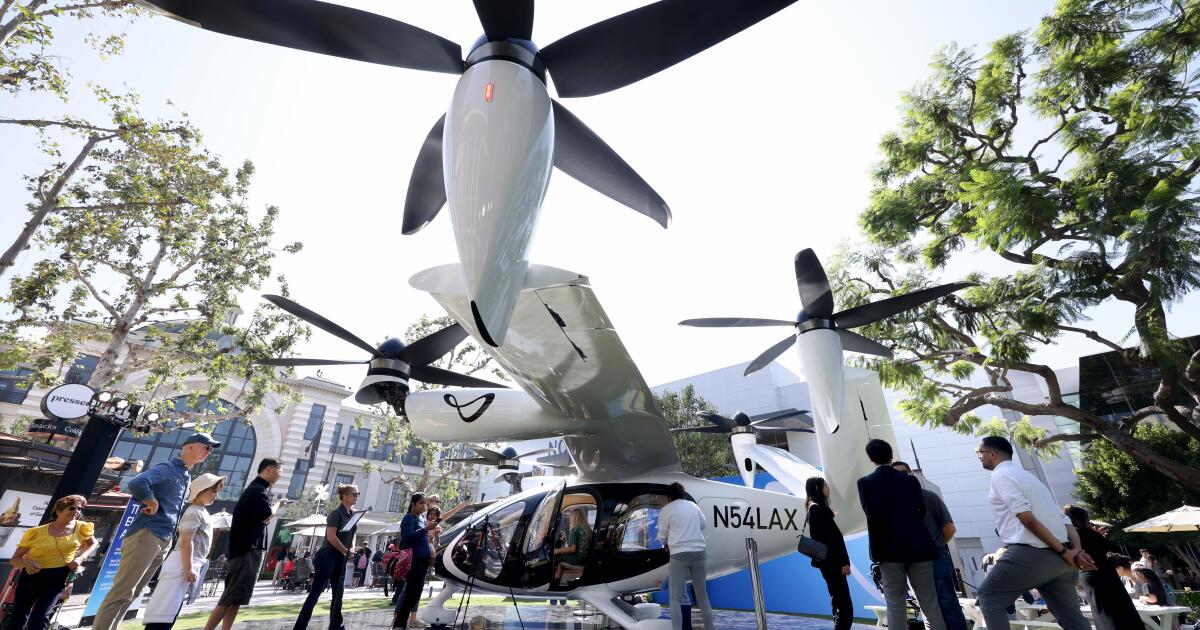
The race to bring air travel to the sky is heating up as Santa Cruz-based Joby Aviation and Toyota launch a joint venture to commercially produce air taxis.
The companies said in a news release Tuesday that they will work together on productivity, quality and costs and move toward mass production of Joby’s electric vertical takeoff aircraft. Joby and Toyota were first linked when Toyota made a nearly $400-million investment in the company in 2020. It has since increased its backing of the company to $900 million.
“It’s really meaningful for us to take on this challenge together with Joby, a partner that shares the same vision,” Toyota Chair Akio Toyoda said. “We believe this strengthened relationship is an important step forward in realizing the future mobility society.”
Joby‘s all-electric vertical takeoff vehicles are designed to hold four passengers and a pilot and can travel at up to 200 mph. The vehicle uses six tilting propellers to achieve vertical takeoff before switching to forward flight.
In February, Joby announced a partnership with Uber to start service in the United Arab Emirates this year, bringing on-demand air taxi rides to the country. It plans to expand to the U.S. after the completion of its final stage of Federal Aviation Administration testing.
Prior to its full FAA certification, Joby is hoping to launch early flight operations later this year as part of a White House program that will bring flights to several states, including New York, Texas and Arizona. Flights in California will not begin until after obtaining FAA certification.
Joby has been in a fierce battle to be the first with taxis in the sky with its Northern California competitor Archer Aviation. The two companies are involved in overlapping lawsuits, with Joby alleging corporate espionage against Archer, and Archer filing a suit alleging dubious ties to China that sparked an investigation into Joby by the U.S. International Trade Commission.
“Toyota has been by Joby’s side for nearly a decade, providing invaluable guidance and support as we built the foundation for manufacturing our aircraft,” JoeBen Bevirt, Joby’s chief executive and founder, said in the news release. “Together, we share a vision of making aerial mobility an everyday reality, and we look forward to delivering on that promise together.”
Joby Aviation’s shares, which have fallen more than 30% this year, climbed 3% on Tuesday to $8.92.

Disneyland Resort in Anaheim will offer $59 tickets for select evening admission to either theme park as part of a new promotion.
The one-day, one-park evening ticket offer will allow attendees to enter Disney California Adventure at 5 p.m. or Disneyland at 7 p.m. Park reservations are still required, as has been the case since the COVID-19 pandemic.
The offer only applies for admission from July 12 through Aug. 5 on Sundays to Wednesdays.
Disneyland Resort is commemorating its 70th anniversary through Aug. 9, and has introduced new shows and additions to rides as part of the occasion.
Walt Disney Co.’s theme parks and experiences business are a crucial boost to its finances, making up about 56% of the company’s operating income last fiscal year.
During the Burbank-based company’s most recent earnings call in May, Disney executives said attendance at its U.S.-based parks was down 1% compared with the prior year, a shift they attributed to “continued softness” in international visitations. However, the company said at the time that it was starting to move past those issues.
Disney’s experiences division reported $9.5 billion in revenue in that fiscal second quarter, up 7% compared with the same period a year ago, something executives said was due to higher guest spending domestically and more capacity on its cruise line.
-

 Louisiana4 minutes ago
Louisiana State Police introduce two new K-9 officers
-

 Maine7 minutes ago
Lil Wayne Apologizes After Failing to Appear at His Own Concert: ‘I’m So Sorry’
-

 Maryland12 minutes ago
Maryland’s $48 million purchase of Laurel Park approved by state’s Board of Public Works
-

 Michigan19 minutes ago
Michigan ‘defined’ by waves of immigration that keep shifting
-

 Massachusetts22 minutes ago
Massachusetts state police use robotic dog and drone in highway standoff
-

 Minnesota27 minutes ago
Luverne, Minnesota’s 65-foot nutcracker, may be the tallest in the world
-

 Mississippi34 minutes ago
Mississippi Lottery Mississippi Match 5, Cash 3 results for July 1, 2026
-
Missouri37 minutes ago
Missouri Lottery Powerball, Pick 3 winning numbers for July 1, 2026

