
Connect with us

Finance

UNO restructures finance team, announces changes to campus

Published

on

UNO restructures finance team, announces changes to campus

Editor’s note: WWNO is licensed to the University of New Orleans but is funded independently and reports on the university like any other school.

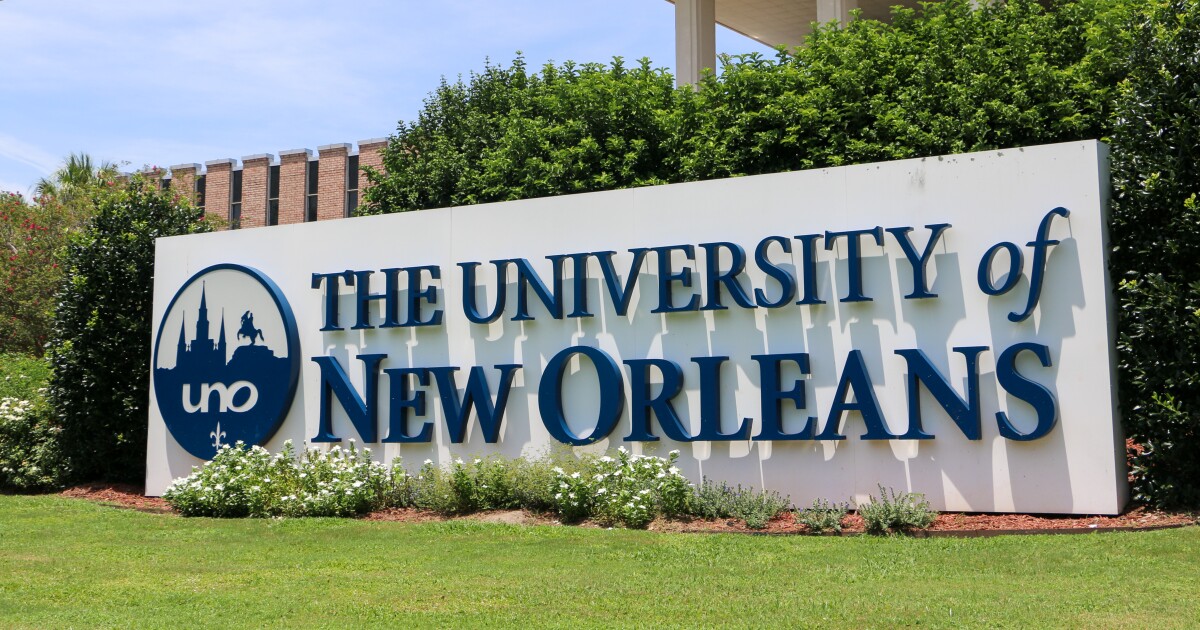
The University of New Orleans is making changes to its financial structure and campus as it prepares to transition back to the LSU System on July 1.

UNO, which officials have already started referring to as LSU New Orleans, has hired Jeanette Weiland as its interim chief administrative officer, a reconfigured role the school’s president says will strengthen its finances.

Weiland previously served as chief business officer of Tulane University’s School of Science & Engineering. She started on a contract basis in January and was hired as an employee on March 1.

In an email to staff this week, President Kathy Johnson said Weiland’s position will span more departments than before, making forecasting and budgeting easier.

Advertisement

“For many years, some of our financial challenges have stemmed from the way separate revenue sources have operated in parallel rather than in alignment,” Johnson said.

The university eliminated its vice president for finance and administration as part of the restructuring, Johnson said, and will hire an interim chief financial officer to work under Weiland.

Arlean Wehle had been serving in both roles, on an interim basis, after Edwin Litolff left for the University of Louisiana at Lafayette last summer. Johnson thanked Wehle for her “tireless work ethic, her steady leadership, and her unwavering commitment to our mission.”

UNO has struggled financially in recent years, which officials have attributed to low enrollment and poor management. The school currently enrolls fewer than 6,000 students, down from more than 17,000 at its peak before Hurricane Katrina.

While faculty and staff have specific concerns about the transition, according to a survey conducted by LSU, more than 60% of students, alumni and faculty support the move.

Advertisement

Officials have promised to revive the university by sharing system resources, eliminating some programs, expanding those it says are unique and successful — like UNO’s naval architecture and marine engineering school — and rebranding the campus as part of the LSU family.

In the same email, Johnson said UNO will lease a building to its neighbor, Benjamin Franklin High School, starting in June, and plans to close its oldest academic building at the end of the semester.

Franklin has been looking for room to expand, rather than cap its enrollment. The school plans to take over the Human Performance Center.

Johnson said the lease will strengthen the existing partnership between the two, “while generating revenue” that UNO needs. Franklin will move out of the classrooms it uses in a campus building that’s farther away, freeing those up.

The terms of the lease with Franklin are still being negotiated, Johnson said in an email to WWNO. It will likely go before the University of Louisiana System board in April, which UNO remains part of until July 1.

Advertisement

The Liberal Arts Building, the facility slated to close, houses the following departments: English, foreign languages, philosophy, history and elements of anthropology.

Johnson said the decision was reached based on UNO’s financial standing and a facility analysis by an outside firm.

“This is not a decision made lightly,” she said in the email. “We simply do not have the resources required to restore it to acceptable standards.”

Departments housed in both impacted buildings will be relocated to other parts of the campus.

Advertisement

Continue Reading
Click to comment

Leave a Reply

Your email address will not be published. Required fields are marked *

This site uses Akismet to reduce spam. Learn how your comment data is processed.

Finance

Inside Italy’s secret ‘Cheese Bank,’ where Parmigiano Reggiano becomes financial gold | CNN Business

Published

on

Inside Italy’s secret ‘Cheese Bank,’ where Parmigiano Reggiano becomes financial gold | CNN Business

In the heart of Emilia‑Romagna, northern Italy, vast climate‑controlled warehouses hide one of the country’s most valuable assets. Towering shelves hold hundreds of thousands of wheels of Parmigiano Reggiano aging slowly, quietly and becoming more valuable with every passing month.

To outsiders, it looks like a cathedral of cheese. To Italy’s dairy producers, it is a lifeline.

Parmigiano Reggiano is one of the world’s most tightly regulated foods. It can only be produced in a small, designated area using three ingredients — milk, salt and rennet — and it must age for at least 12 months before it can be sold. Many wheels mature for 24, 36, or even 40 months.

That long wait creates a financial bottleneck. Farmers must be paid every 30 days. Staff, feed and energy costs accumulate daily. But revenue doesn’t arrive for a year or more. For more than a century, Credem Bank has stepped in to bridge that gap — accepting cheese as collateral.

Giancarlo Ravanetti, the boss of the bank’s cheese warehouse business, explains: “In Italy about 4 million wheels of Parmigiano Reggiano are made, and we keep 500,000… and allow customers to use the wheels as collateral to obtain financing.” The warehouse handles “about 2,300,000 wheels a year,” he adds. Inside these vaults, the value is staggering: “About 325 million euros ($382 million) worth of Parmigiano Reggiano.”

Advertisement

When a wheel of Parmigiano Reggiano arrives at the warehouse, it enters a tightly controlled system perfected over generations. Each wheel is scanned and logged into a digital system, a kind of passport that records its production date, dairy of origin and current status. Only then can it officially enter the vault.

The wheels are placed on long wooden shelves. Temperature, humidity and airflow are carefully controlled. Warehouse staff walk the aisles daily, checking wheels for cracks, swelling or moisture issues. Any irregularity is flagged.

At 12 months, the Parmigiano Reggiano Consortium performs the traditional tapping test — striking each wheel with a hammer and listening for internal defects. Only wheels that produce a clean, uniform sound earn the fire‑branded seal. The warehouse handles millions of wheels a year, moving them in and out for dairies, processors, exporters and companies that buy wheels for grating or long aging.

Once wheels are registered and aging, they can be pledged as collateral. The warehouse becomes a secure vault guaranteeing the bank that the wheels exist, are in good condition and match the pledge register. Ravanetti notes that this system has operated for more than a century and the bank has never lost a single euro on these loans.

The Consortium oversees the entire ecosystem, which unites roughly 300 producers and more than 2,000 dairy farmers. Spokesperson Fabrizio Raimondi describes it as an organization representing “approximately 50,000 people” and a sector with “a turnover over 4 billion.” Its expert team enforces strict production rules, promotes the brand globally, fights counterfeits and certifies every wheel. “These sealers can assure the consumer that this is the real one and the quality is good,” Raimondi says.

Advertisement

The Parmigiano Reggiano supply chain is built on cooperatives, a structure that Paolo Ganzerli of Granterre says is both a strength and a vulnerability.
Granterre, one of Italy’s largest dairy groups, is technically a stock company but owned by cooperatives of milk and cheese producers. This means the company must support hundreds of small farmers who rely on stable milk payments to survive.

Ganzerli explains that dairies must pay farmers immediately, even though the cheese they produce won’t generate revenue for at least a year. “Without this system of leverage, the world of Parmigiano Reggiano cannot exist,” he says.

Ganzerli describes a production system that is both artisanal and extremely expensive. Parmigiano Reggiano can only be made in a small geographic area, and the cows must be fed with locally produced forage. Different microclimates from mountain pastures to valley farms influence the milk’s characteristics. But the cost of producing that milk has soared in recent years, driven by inflation and global instability.

As Ganzerli puts it, “The cost to produce the feeding for the cows, the cost for everything, increased a lot… energy, transport, logistics — everything is more expensive now.” Even large companies like Granterre feel the strain, he says, because every increase in energy or feed prices ripples through the entire supply chain.

In 2025, the Protected Designation of Origin crossed a historic threshold: exports exceeded half of total sales for the first time, reaching 50.5% of all Parmigiano Reggiano sold worldwide.

Advertisement

International demand grew +2.7%, even as the domestic Italian market contracted sharply. France fell slightly (–0.3%, 14,800 t.), Germany remained stable (+0.1%, 10,400 t.), Spain grew (+2.5%, 1,850 t.), Sweden surged (+8.8%, 2,500 t.), and the United Kingdom rose strongly (+7.8%, 8,400 t.). Outside Europe, the United States grew +2.3% (16,800 t.), Canada +8.3% (3,900 t.), with Japan and the Middle East showing smaller but rising demand.

The United States is the largest foreign market for Parmigiano Reggiano — but also the most volatile. In late 2025, new duties raised the total tariff burden to 25%, with the possibility of further increases. Combined with rising shipping costs, inflation, and geopolitical tensions, the U.S. market has become increasingly unpredictable.

Raimondi notes: “There is regulatory uncertainty, and many operators are waiting before placing new orders.” The beginning of 2026 confirmed this trend as US importers paused purchases to assess the impact of tariffs and economic pressures.

Italy, meanwhile, saw a 10% drop in volumes sold in 2025. Higher consumer prices led Italians to buy Parmigiano Reggiano less frequently and in smaller portions, though the number of households purchasing it remained stable. Prices rose sharply: 12‑month wheels reached €13.22/kg (+20.6%), 24‑month wheels €15.59/kg (+24.8%). Production climbed to 4.19 million wheels (+2.7%).

Ganzerli notes that Parmigiano Reggiano is naturally lactose‑free, high in protein and free of additives — qualities that have helped it gain traction as a “superfood.” But he also warns that if prices rise too high, consumers may shift to cheaper cheeses like Grana Padano.

Advertisement

Producers typically receive 60–80% of a wheel’s value upfront when they use cheese as collateral. Blockchain technology now allows wheels to be pledged even while stored in producers’ own facilities, doubling Credem’s lending capacity. The Consortium is also investing in tourism, aiming to grow dedicated Parmigiano‑focused visits from 85,000 to 300,000 by 2029.

Parmigiano Reggiano is a €4 billion ($4.7 billion) industry sustained by some 300 certified dairies. Its survival depends on a delicate balance of tradition, regulation, and financial innovation.

Inside the cheese bank’s vast aisles, the wheels sit quietly, slowly transforming into one of Italy’s most prized exports. Each one represents months of labor, generations of expertise, and a financial system built on patience.

Advertisement
Continue Reading

Finance

Bessent wants Americans to avoid easy-money traps and invest in financial literacy

Published

on

Bessent wants Americans to avoid easy-money traps and invest in financial literacy
Treasury Secretary Scott Bessent meets with members of the Association of Mature American Citizens (AMAC), about financial literacy, Wednesday, April 29, 2026, at the Treasury Department, in Washington. (AP Photo/Jacquelyn Martin)

WASHINGTON — Treasury Secretary Scott Bessent winces at the allure of easy money — whether it’s lottery tickets, buy now, pay later loans or the promise of a crypto windfall — warning that the get-rich-quick mindset often leads Americans farther from financial stability, not closer to it.

“There are a lot of young people, mostly young men, going to blue-collar construction jobs, playing the lottery. It drives me crazy,” Bessent said in an interview.

”The best thing you can do is not play the lottery,” he said — rather, people should invest and “then watch it grow.”

Bessent spoke to The Associated Press about the basics of building a workable budget and saving for the future at the tail end of Financial Literacy Month, an initiative the billionaire hedge fund manager has made a priority since joining President Donald Trump’s administration, driven by a childhood marred by poverty.

Former Treasury Secretaries Hank Paulson and Tim Geithner were known for helping navigate the U.S. out of the global financial crisis. Steven Mnuchin made his mark designing and promoting the Tax Cuts and Jobs Act of 2017, and Janet Yellen was the only person to also head the Federal Reserve and the Council of Economic Advisers. But Bessent’s passion for meeting with community bankers, retirees and schoolchildren to talk about how to budget, save and manage debt is what he hopes, in part, defines his legacy.

Advertisement

His push to promote financial literacy comes as Americans grapple with the cost of housing, groceries, energy and everyday items and are skeptical about the Republican administration’s performance on the issue. The latest AP-NORC poll data shows Trump’s approval rating on the economy dropped from 38% in March to 30% in April.

The nation is enmeshed in record levels of debt, which surpassed $39 trillion in March, and critics wonder how Bessent can persuade Americans to save for their futures when the government itself is drowning in debt.

“The Trump administration in particular has a problematic record on cutting taxes without offsets and growing spending,” said Maya MacGuineas, president of the Committee for a Responsible Federal Budget.

A billionaire with humble beginnings

Bessent, 63, made his money through a long career in hedge funds, including working with George Soros, a financier and philanthropist whom Trump and other Republicans have vilified. Bessent was famously involved in the Soros firm’s 1992 currency speculation against the British pound tied to Black Wednesday, which generated massive profits. Bessent later launched his own hedge fund called the Key Square Group.

But he often talks about his humble beginnings in rural South Carolina, not far from Myrtle Beach, where at the age of 9 he got his first jobs as a busboy at a cafeteria and hustling to set up chairs and umbrellas on the beach. His father, a real estate developer, had lost generations of Bessent family wealth by overleveraging his obligations.

Advertisement

Bessent wanted to attend the U.S. Naval Academy in 1979 but was barred as an openly gay applicant. That also shut the door to joining the foreign service.

He went to Yale University, where his former professor David Darst recalled teaching him about new financial instruments in capital markets. Darst described Bessent as a “guy who’s working at the highest levels, but he’s interested in people learning the ABCs of finance.”

In 2025, Bessent became the nation’s first openly gay treasury secretary. “I sit here knowing that President Trump chose me because he believes I’m the best candidate, not because of my sexual preference, not because treasury secretaries with green eyes do better,” Bessent said at his confirmation hearing.

After reaching public office, one of Bessent’s first actions was relaunching Financial Literacy Month at the agency.

“Wall Street has grown wealthier than ever before, and it can continue to grow and do well,” Bessent has peppered into various speeches over the past year, insisting that his work in the Trump administration is “focused on Main Street.”

Advertisement

During a roundtable with community financial institutions at the department — one of several such events Bessent hosted last month — he listened to bankers express concerns about the a surge in sophisticated fraud schemes targeting customers and their efforts to get high schoolers interested in saving.

“It could be as simple as a 14-year-old starting a savings account and watching interest compound at 4% a year,” said Thomas Fraser, CEO of First Mutual Holding Co. in Lakewood, Ohio, who attended that roundtable.

Promoting financial literacy to young people

Bessent is not a newcomer to preaching financial literacy. Geoff Canada, president of Harlem Children’s Zone, has known Bessent for 30 years and said the treasury secretary has mentored one of the program’s scholars for more than a decade. Canada said Bessent has a “deep understanding that financial literacy is essential for fostering real social and economic mobility for America’s children.”

He said Bessent “has championed this issue long before joining the administration, and I know it remains a top priority.”

A conversation with Bessent about financial literacy inevitably turns to Trump Accounts — the financial vehicle meant to give $1,000 to babies born during the Trump administration. That money is then invested in the stock market by private firms, and the children can access the money when they turn 18.

Advertisement

Bessent said he thinks it will encourage a generation of young people to care more about investing as it shows them “the power of compounding, because that money is locked up for 18 years.”

But Bessent said people of all ages and income brackets could be better at managing their money. “There’s a narrative that doctors are famously terrible at finance,” Bessent said.

Critics of the treasury secretary’s approach argue that the problem is less about Americans not knowing how to invest and more about people not having enough spare income to do so, as the cost of living has steadily increased and the war in Iran has driven energy prices higher.

“You cannot preach penny-pinching while making it harder for Americans to pay their grocery, utility and healthcare bills,” said Emily DiVito, senior adviser for economic policy at the left-leaning Groundwork Collaborative. “If Secretary Bessent is serious about advancing financial literacy, he should focus on lowering the cost of living for working families.”

Rising debt in the foreground

Bessent’s desire to see Americans invest wisely comes as the U.S. debt has reached record levels — and the trajectory of those increases is a cause for concern for budgeting experts.

Advertisement

The U.S. national debt hit $37 trillion in August and then $38 trillion just two months later. Now, it’s at $39 trillion and has surpassed the size of the economy.

Budget advocate MacGuineas warned that the long-term trend of borrowing more and paying more in interest will force Americans to face tougher fiscal tradeoffs ahead.

She praised Bessent for having the goal to cut deficits in half and bring them down to 3% of gross domestic product but said ”it’s going to take a combination of spending reductions, revenue increases and economic growth” to get there.

The Treasury argues that the federal deficit decreased during Trump’s first year back in office and that the provisions in Republicans’ tax cuts law have put money back in Americans’ pockets.

“It’s hard to disagree with the fact that we need more financial literacy in this country,” MacGuineas said. “The bigger picture, of course, is that we should also probably give a financial literacy class to our lawmakers.”

Advertisement

Continue Reading

Finance

San Jose high school first in nation to pilot new AP financial literacy courses

Published

on

San Jose high school first in nation to pilot new AP financial literacy courses

A San Jose high school is taking a leading role in redefining vocational education as one of the first schools in the nation to pilot a new suite of Advanced Placement courses focused on real-world financial and professional skills.

Closing workforce readiness gap

Dig deeper:

Advertisement

The East Side Union High School District has partnered with the College Board to launch the AP Career Kickstart program. The initiative currently features two primary courses: AP Business and Personal Finance and AP Cybersecurity. Unlike traditional AP classes that focus primarily on academic theory, these courses are designed to blend academic rigor with practical professional skills, allowing students to earn college credit alongside industry-recognized credentials.

Students at Silver Creek High School will be among the first to test the program out. which arrives at a time of growing concern regarding student readiness for the modern economy. According to “The New Hire Readiness Report 2025,” a study conducted with the U.S. Chamber of Commerce, 84% of hiring managers say most high school students are not prepared to enter the workforce. Furthermore, 96% of those managers identified financial literacy as an essential skill for young professionals.

“Every day I hear, ‘How are we going to use this in the real world?’” said Jeff Smith, a teacher at Silver Creek High School. “Everything that we teach [in this program] has real-world applications.”

Advertisement

Student innovation

Why you should care:

Students involved in the field test are already seeing tangible results. Senior Ethan Nguyen has used the curriculum to work with multiple businesses on website and mobile application development. Another student, Celina Tran, developed a financial literacy app called “Revenue,” which uses a gamified experience to teach teens money management. That work has already earned both statewide and national awards.

Advertisement

“It creates just a generous amount of pride in seeing the kids apply what they’re learning,” said Imani Butler, a business design and technology teacher at the school. Butler noted that the curriculum addresses a long-standing gap in secondary education, adding that many adults often wish such practical financial training had been available during their own school years.

National expansion

Big picture view:

Advertisement

The AP Career Kickstart courses will be available to students nationwide over the next year. Parents and students interested in the program are encouraged to visit the College Board website for more details on local availability.

The Source: Interviews with College Board team and Silver Creek High School staff. 

Advertisement
EducationSan JoseMoney
Continue Reading
Advertisement

Trending
