South-Carolina
South Carolina Closed Primary Debate: New Bill Introduced – FITSNews


by MARK POWELL
***
For the second time this year, a bill requiring closed state primary elections has dropped in the South Carolina House of Representatives. The bill – H. 5183 – is currently residing in the chamber’s judiciary committee, where it faces an uncertain future.
This latest proposal, sponsored by state representative Mike Burns, fixes a flaw in a previously introduced version.
“It’s very similar to 3310,” explained state representative Jordan Pace, referencing a previous closed primary bill. “It’s virtually the same, with the exception of when you can register or affiliate for 2026 – and only in 2026 – the first time that a voter votes in a primary, they can sign the affiliation form when they vote.”
Pace is chairman of the S.C. Freedom Caucus, a group of conservative lawmakers who have been working for years to close partisan primary elections in the Palmetto State. Their objective? Limiting Democrat influence/interference in the selection of GOP representatives.
Under the previous version of the bill, critics expressed concern that some voters might not have time to qualify to cast their ballots in the upcoming Democratic and Republican primary elections on June 9, 2026.
***
Current election law provides for an open primary. Any registered voter can request the partisan ballot of their choice on primary day (although they must pick one party or the other; they cannot vote for both).
For Pace and his fellow conservatives, that’s a big problem.
“Right now we have Democrats crossing over and voting in Republican primaries,” Pace explained. “And in some cases, we have Republicans crossing over to vote in Democrat primaries in a few spots around the state. There’s been like four ballot questions over the last decade on primary voting questions. And they all have come back with eighty percent or so saying, ‘crossing over into the other party’s primary is not what we want’. That’s what November (the general election) is for. It’s not what the primaries are for.”
Each state devises its own system for holding elections, and they vary widely across the country. South Carolina is one of fifteen states with an open primary. Nine others, plus the District of Columbia, hold closed primaries. The remainder have various hybrid formats – with the exception of five: Alaska, California, Louisiana, Nebraska, and Washington. These states have so-called “jungle primaries,” electoral free-for-alls with multi-party, nonpartisan voting.
***
RELATED | DONALD TRUMP’S DISAPPROVAL SURGES POST-EPSTEIN
***
The latter is exactly the kind of political food fight that supporters of the traditional partisan system wish to avoid with closed primaries.
Many independent voters say they would feel left out with a closed primary. As one told us recently, “I don’t want my choices dictated to me by the political parties – I want to have a say in who appears on the ballot in November.”
According to Pace, that view misses the point of holding primaries in the first place.
“The reality is that the two parties are private organizations,” he said. “They’re private political organizations. Look at it this way: It’s like outsiders showing up at a lodge or some other social club or somebody else’s church and demanding to vote in their business meeting about whether to hire or fire a pastor or club president. If you’re not part of that organization, if you’re not affiliated with it, then you shouldn’t be allowed to make its decisions. Your vote is in November.”
***
NEW LIVE SHOW WEDNESDAYS @ 7:00 P.M.

***
Pace also had this assessment of the current balloting situation: “Democrats shouldn’t be voting in Republican primaries, and Republicans shouldn’t be voting in Democratic primaries.”
Asked about the response to the new bill among House members, Pace was frank.
“Tepid would probably be the nicest way to say it,” he said. “There are several people in high-level positions who don’t seem to want this.”
The Freedom Caucus supports the measure, though, and Pace noted closing primaries “has been a Republican Party priority for the last 20 years.”
“When it comes to passing conservative policies, South Carolina is always dead last among Republican states,” Pace said. “Open primaries are a major contributor to that. And if we were to actually do this (enact closed primaries), as the people have said repeatedly they want, I think we would get better conservative policy passed in Columbia on a regular basis.”
***
ABOUT THE AUTHOR…

J. Mark Powell is an award-winning former TV journalist, government communications veteran, and a political consultant. He is also an author and an avid Civil War enthusiast. Got a tip or a story idea for Mark? Email him at mark@fitsnews.com.
***
WANNA SOUND OFF?
Got something you’d like to say in response to one of our articles? Or an issue you’d like to address proactively? We have an open microphone policy! Submit your letter to the editor (or guest column) via email HERE. Got a tip for a story? CLICK HERE. Got a technical question or a glitch to report? CLICK HERE.


STARKVILLE — Mississippi State baseball landed a potential starting infielder from the transfer portal.
Will Craddock, who played one season at South Carolina, committed to the Bulldogs on June 26.
“Hail State,” Craddock wrote on Instagram.
The freshman batted .260, leading the Gamecocks in home runs (10) and runs (36) while ranking third with 29 RBIs. In SEC play, his average dipped to .172 with two home runs, six RBIs and 14 runs.
Craddock primarily played first base, but also made starts at second base, third base and designated hitter. He started all three games against Mississippi State in April, batting 3-for-14 with a walk, no RBIs but two runs.
He was a standout player for T.L. Hanna in Anderson, South Carolina, and was the state’s 5A Player of the year in 2025. He hit .442 that season with eight doubles, 10 home runs and 10 stolen bases while ranked as the No. 26 player in South Carolina.
Mississippi State’s starting first baseman, Reed Stallman, is out of eligibility.
The transfer portal opened June 1 and closes June 30.
Mississippi State baseball transfer portal class
Craddock is the 10th transfer to commit to Mississippi State and the second South Carolina player, joining relief pitcher Zach Russell.
Other position players who are transferring to MSU include Georgia Southern catcher/outfielder Brady Christman, Samford outfielder Jake Souders, Army utility player Josiah Overbeek, South Dakota State third baseman Nolan Grawe, Oregon catcher Burke-Lee Mabeus and North Florida outfielder Carter White.
Twelve Mississippi State players have entered the transfer portal as of June 26, including relief pitcher Tyler Pitzer who committed to South Carolina.
Sam Sklar is the Mississippi State beat reporter for The Clarion Ledger. Email him at ssklar@usatodayco.com and follow him on X @sklarsam_.

USA TODAY 250th anniversary travel guides and American stories
USA TODAY marks America’s 250th with travel guides, culture, history, and local stories.
As the nation prepares for its 250th anniversary, one of the efforts underway is America’s Time Capsule.
The time capsule project is led by America250 and meant to bring together carefully selected artifacts and documents from all 50 states, five U.S. territories, the District of Columbia, and each branch of the federal government.
This national project is designed to capture the story of the United States at this historic 250th birthday, according to America250.
Here’s what South Carolina contributed to the national project.
What did South Carolina put in the America250 time capsule?
South Carolina is marking the nation’s 250th anniversary by contributing two historic items to the national America’s Time Capsule project, according to America250.
As part of the SouthCarolina250, which is the state’s initiative for the U.S.’s 250th celebration, commemoration effort, the state has provided a commemorative challenge coin and an official SC250 lapel pin.
Both will be buried inside the capsule on July 4, along with items from other states. And it is set to be reopened 250 years later in 2276.
Where will the Americ250 time capsule be buried?
The ceremonial burial of America’s Time Capsule is set to take place at Independence National Historical Park, located at 599 Market Street in Philadelphia, Pennsylvania, on July 4, according to america250.org.
What else is in America’s 250th anniversary time capsule
As America’s 250th anniversary approaches, the national time capsule has been filled with items meant to capture the character and diversity of the country in this moment.
The collection spans a range of items, from archival letters and state proclamations to student work from the America’s Field Trip contest, uncirculated currency, and even pieces of national sports memorabilia.
Time capsule engineered to last centuries
As planners work to ensure America’s Time Capsule endures for the next two and a half centuries, engineers and archivists have focused heavily on long‑term preservation.
The capsule itself is a cylinder‑shaped stainless‑steel vessel, precision‑designed by the National Institute of Standards and Technology in partnership with archival scientists at the Library of Congress, according to the Institute.
Travis Jacque Rose is the trending news reporter for the Greenville News, part of the USA TODAY Network. Reach him at trose@gannett.com.

In Laurens County, a dual-sided historic marker stands next to a mailbox off the side of the road. The name Jonathan Downs was commemorated on one side, while the other side was signed with the story of Lindley’s Fort in the American Revolution.
The Battle of Fort Lindley took place July 15, 1776, some 1,800 feet away from the modern-day historic marker. Private farmland now sits where the battle ensued, but physical pieces of history and oral retellings of the battle have continued to propel the story in Laurens County lore.
Loyalists to the British crown and Cherokee citizens planned an attack on a group stationed at the fort. The Little River Regiment used the fort as their base. Loyalist Capt. David Fanning described the scene as a “fort built with logs” in his autobiographical retelling of the Revolutionary War.
Cherokee land had continually been encroached on, which pushed members of the tribe to retaliate.
The loyalists who joined in the attack were dressed as Native Americans. They – along with other South Carolina backcountry loyalists – were referred to as Scopholites. The group took action at midnight for what became a two-hour fight in one of the first conflicts of the Cherokee War of 1776.
Historian Durant Ashmore said the crux of the battle was a clash of culture and a fundamental lack of understanding among the groups.
“One thing that has been very important to understand is the conflicts between cultures – the misunderstandings between cultures – and the deadly consequences that can result from that,” he said.
Luis-Alfredo Garcia
/
South Carolina Public Radio
Troops at the fort had at first not believed word of the upcoming attack when informed by a group of soldiers, according to a pension application of Matthew Brown, who was a 16-year-old boy stationed at a fort about 20 miles away from Fort Lindley. The men were drunk from a night of indulging in rum, which Ashmore said was a common occurrence during the war.
“The Little River Regiment did not believe them. They actually even leveled their guns at them, saying, ‘Who’s telling you such lies as this?’” he said.
Maj. Downs, however, prepped the troops for defense. Downs was a previous member of the First Provincial Congress, Second Provincial Congress, and South Carolina General Assembly.
A sizable chunk of the Patriot troops had already experienced fighting Cherokee citizens during the Anglo-Cherokee War that lasted from about 1758-1761. Soldiers at Fort Lindley responded to the attack by sending out troops in lines of 10. Eventually, the loyalists and Cherokee citizens retreated.
The patriot victory boosted local morale and belief in their cause, but for some unscathed loyalists and Cherokee citizens, the aftermath’s impact trumped the actual battle loss in consequences.
The morning after the battle, troops from the fort found about 30 horses at a campsite. One saddlebag contained the commission papers of Capt. James Lindley. Lindley was a staunch loyalist and the eponymous owner of Fort Lindley.
Six months prior to the battle, he had been captured at the Battle of Great Cane Break. Lindley had promised to not take up arms against patriot forces again, or he would face death. Although he was not captured in the midnight battle, he did succumb to patriot troops at the Battle of Kettle Creek and was hanged for breaking his parole.
As for the Cherokee citizens, their land was further encroached upon and people killed; about 2,000 were killed during the Cherokee War of 1776.
Ashmore said the consequences from escalating conflict were terrible.
“Patriots gathered together with the idea of a plan, the goal of eliminating the Cherokees. Genocide,” he said. “That’s what was preached to the backcountry settlers along with the ability to make their own decisions. A primary motivating factor in the American Revolution is the right of self-determination.”
Luis-Alfredo Garcia
/
South Carolina Public Radio
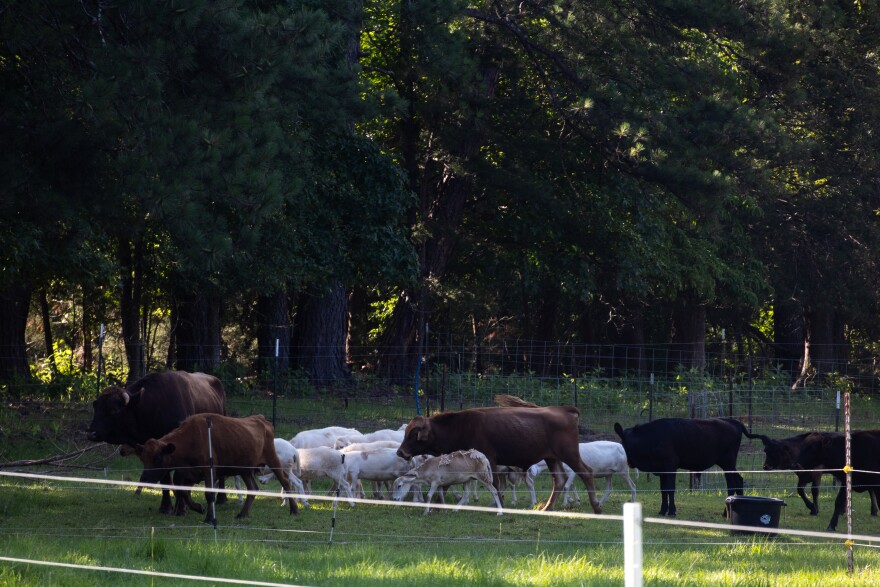
Now, private land with cows and sheep sits on the area where the fort once stood. Ashmore said he gives tours just during the winter to avoid the risk of ticks. The area where trenches once helped shield soldiers are still visible.
Some remnants from the fort now reside at the Laurens County Museum in the city of Laurens’ downtown area. The objects, although not individually labeled, will be part of an upcoming opening collection.

Luis-Alfredo Garcia
/
South Carolina Public Radio
Museum docent Julia Sermons said being informed of local history helps shape modern decisions.
“You have to know where you’re coming from to know where you’re going,” she said.
Ashmore, too, saw the same value.
“We are all in the middle of this,” he said. “This history – the important role that South Carolina played in the Revolution.”
An estimated 14 battles took place in Laurens County, according to Ashmore. He has been keeping track of local history for about 6 years. He said the county has set a 50-year plan to help with future record keeping.

Luis-Alfredo Garcia
/
South Carolina Public Radio
-

 News11 minutes ago
Utah County declares State of Emergency as wildfires ‘ravage’ the state
-

 Los Angeles, Ca1 hour ago
Man found guilty of sex trafficking victim along L.A.’s Figueroa Corridor
-

 Detroit, MI2 hours ago
No. 23 overall pick in the 2026 NHL draft | Detroit Red Wings
-

 San Francisco, CA2 hours ago
San Francisco Pride kicks off with rainbow lasers, ValQueeries celebrate at Valkyries Pride Night
-

 Dallas, TX2 hours ago
How to buy Egypt vs. Australia World Cup soccer tickets
-

 Miami, FL2 hours ago
Helping Venezuela: Miami search-and-rescue team prepares to deploy
-

 Boston, MA2 hours ago
How to buy Paraguay vs. Germany 2026 World Cup tickets in Boston
-

 Denver, CO2 hours ago
Denver Broncos Roster Breakdown: Center—The Depth Question

