News
Immigrant whose skull was broken in 8 places during ICE arrest says beating was unprovoked

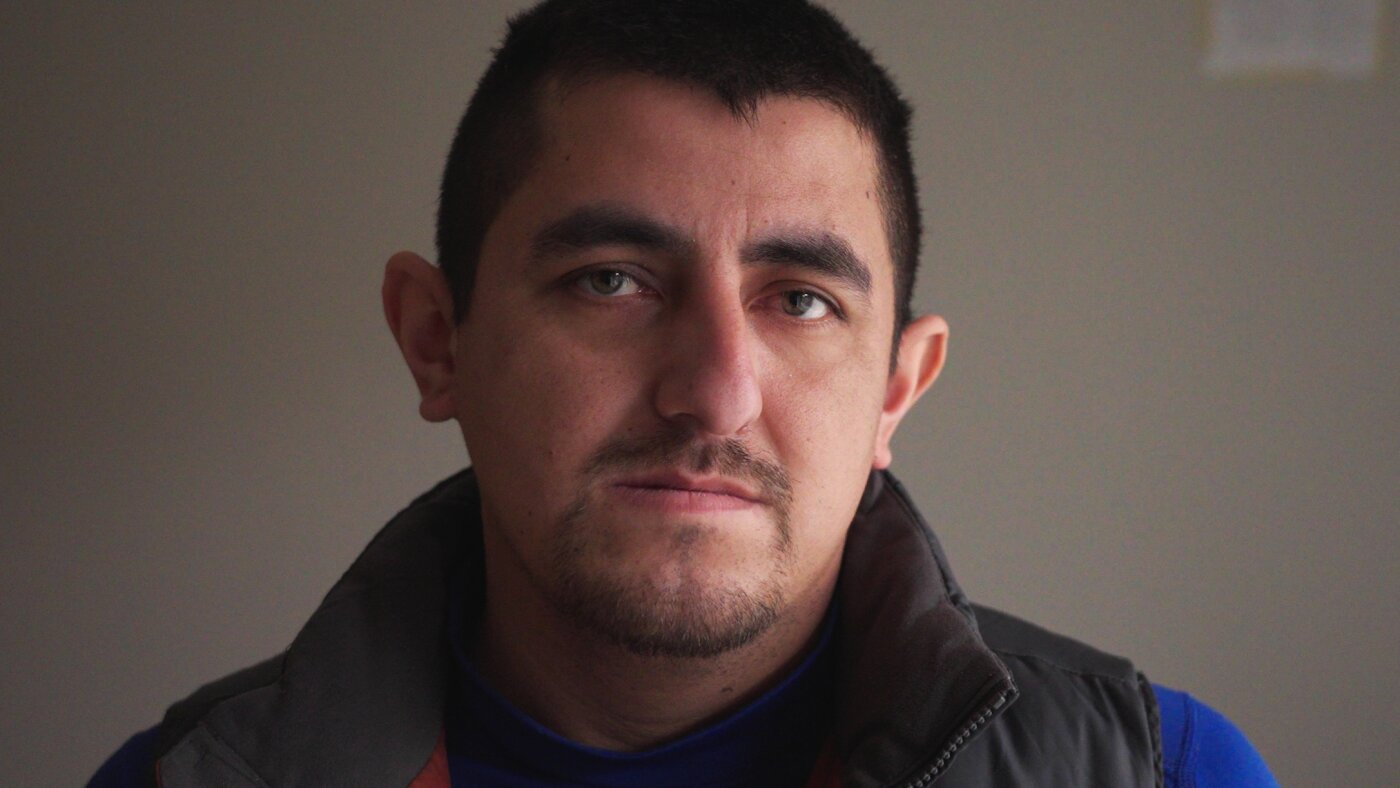
Alberto Castañeda Mondragón poses for a portrait at an apartment on Feb. 4, 2026, in St. Paul, Minn.
Mark Vancleave/AP
hide caption
toggle caption
Mark Vancleave/AP
MINNEAPOLIS — Alberto Castañeda Mondragón says his memory was so jumbled after a beating by immigration officers that he initially could not remember he had a daughter and still struggles to recall treasured moments like the night he taught her to dance.
But the violence he endured last month in Minnesota while being detained is seared into his battered brain.
He remembers Immigration and Customs Enforcement agents pulling him from a friend’s car on Jan. 8 outside a St. Paul shopping center and throwing him to the ground, handcuffing him, then punching him and striking his head with a steel baton. He remembers being dragged into an SUV and taken to a detention facility, where he said he was beaten again.
He also remembers the emergency room and the intense pain from eight skull fractures and five life-threatening brain hemorrhages.
“They started beating me right away when they arrested me,” the Mexican immigrant recounted this week to The Associated Press, which recently reported on how his case contributed to mounting friction between federal immigration agents and a Minneapolis hospital.
Castañeda Mondragón, 31, is one of an unknown number of immigration detainees who, despite avoiding deportation during the Trump administration’s enforcement crackdown, have been left with lasting injuries following violent encounters with ICE officers. His case is one of the excessive-force claims the federal government has thus far declined to investigate.
He was hurt so badly he was disoriented for days at Hennepin County Medical Center, where ICE officers constantly watched over him.
Officers claimed he ran headfirst into a wall
The officers told nurses Castañeda Mondragón “purposefully ran headfirst into a brick wall,” an account his caregivers immediately doubted. A CT scan showed fractures to the front, back and both sides of his skull — injuries a doctor told AP were inconsistent with a fall.
“There was never a wall,” Castañeda Mondragón said in Spanish, recalling ICE officers striking him with the same metal rod used to break the windows of the vehicle he was in. He later identified it as an ASP, a telescoping baton routinely carried by law enforcement.
Training materials and police use-of-force policies across the U.S. say such a baton can be used to hit the arms, legs and body. But striking the head, neck or spine is considered potentially deadly force.
“The only time a person can be struck in the head with any baton is when the person presents the same threat that would permit the use of a firearm — a lethal threat to the officer or others,” said Joe Key, a former Baltimore police lieutenant and use-of-force expert who testifies in defense of police.
Once he was taken to an ICE holding facility at Ft. Snelling in suburban Minneapolis, Castañeda Mondragón said officers resumed beating him. Recognizing that he was seriously hurt, he said, he pleaded with them to stop but they just “laughed at me and hit me again.”
“They were very racist people,” he said. “No one insulted them, neither me nor the other person they detained me with. It was their character, their racism toward us, for being immigrants.”
The Department of Homeland Security, which includes ICE, did not respond to repeated requests for comment over the last two weeks on Castañeda Mondragón’s injuries.
It is unclear whether his arrest was captured on body-camera footage or if there might be additional recordings from security cameras at the detention center.
In a recent bid to boost transparency, DHS announced a broad rollout of body cameras for immigration officers in Minneapolis as the government also draws down ICE’s presence there.
ICE deportation officer William J. Robinson did not say how Castañeda Mondragón’s skull was smashed in a Jan. 20 declaration filed in federal court. During the intake process, it was determined he “had a head injury that required emergency medical treatment,” he wrote in the filing.
The declaration also stated that Castañeda Mondragón entered the U.S. legally in March 2022, and that the agency determined only after his arrest that he had overstayed his visa. A federal judge later ruled his arrest had been unlawful and ordered him released from ICE custody.
Video shows him stumbling during arrest
A video posted to social media captured the moments immediately after Castañeda Mondragón’s arrest as four masked men walk him handcuffed through a parking lot. The video shows him unsteady and stumbling, held up by ICE officers.
“Don’t resist,” shouts the woman who is recording. “Cause they ain’t gonna do nothing but bang you up some more.”
“Hope they don’t kill you,” she adds.
“And y’all gave the man a concussion,” a male bystander shouts.
The witness who posted the video declined to speak with AP or provide consent for the video’s publication, but Castañeda Mondragón confirmed he is the handcuffed man seen in the recording.
At least one ICE officer later told staff at the medical center that Castañeda Mondragón “got his (expletive) rocked,” according to court documents filed by a lawyer seeking his release and nurses who spoke with AP.
AP interviewed a doctor and five nurses about Castañeda Mondragón’s treatment at HCMC and the presence of ICE officers inside the hospital. They spoke on condition of anonymity because they were not authorized to discuss patient care and feared retaliation. AP also consulted an outside physician, who affirmed the injuries were inconsistent with an accidental fall or running into a wall.
Minnesota state law requires health professionals to report to law enforcement any wounds that could have been perpetrated as part of a crime.
An HCMC spokeswoman declined to say this week whether anyone at the facility had done so. However, following the Jan. 31 publication of AP’s initial story about Castañeda Mondragón’s arrest, hospital administrators opened an internal inquiry seeking to determine which staff members have spoken to the media, according to internal communications viewed by AP.
Minnesota Gov. Tim Walz posted a link to AP’s prior story about Castañeda Mondragón, but his office has not said whether state authorities would pursue answers.
“Law enforcement cannot be lawless,” Walz wrote in the post on X. “Thousands of aggressive, untrained agents of the federal government continue to injure and terrorize Minnesotans. This must end.”
Castañeda Mondragón’s arrest came a day after the first of two fatal shootings of U.S. citizens in Minneapolis by immigration officers, triggering widespread public protests.
Elected officials call for accountability
Minnesota congressional leaders and other elected officials, including St. Paul Mayor Kaohly Her, called this week for an investigation of Castañeda Mondragón’s injuries.
The Ramsey County Attorney’s Office, which oversees St. Paul, urged Castañeda Mondragón to file a police report to prompt an investigation. He said he plans to file a complaint. A St. Paul police spokesperson said the department would investigate “all alleged crimes that are reported to us.”
While the Trump administration insists ICE limits its operations to immigrants with violent rap sheets, Castañeda Mondragón has no criminal record.
“We are seeing a repeated pattern of Trump Administration officials attempting to lie and gaslight the American people when it comes to the cruelty of this ICE operation in Minnesota,” Sen. Tina Smith, a Minnesota Democrat, said in a statement.
Rep. Kelly Morrison, another Democrat and a doctor, recently toured the Whipple Building, the ICE facility at Ft. Snelling. She said she saw severe overcrowding, unsanitary conditions and an almost complete lack of medical care.
“If any one of our police officers did this, you know what just happened in Minnesota with George Floyd, we hold them accountable,” said Democratic Rep. Betty McCollum, whose district includes St. Paul.
A native of Veracruz, Mexico, Castañeda Mondragón came to Minnesota nearly four years ago on a temporary work visa and found jobs as a driver and roofer. He uses his earnings to support his elderly father, who is disabled and diabetic, and his 10-year-old daughter.
On the day of his arrest, he was running errands with a friend when they suddenly found themselves surrounded by ICE agents. They began breaking the windows and opening the doors of the vehicle. He said the first person who hit him “got ugly with me for being Mexican” and not having documents showing his immigration status.
About four hours after his arrest, court records show, Castañeda Mondragón was taken to an emergency room in the suburb of Edina with swelling and bruising around his right eye and bleeding. He was then transferred to the Minneapolis medical center, where he told staff he had been “dragged and mistreated by federal agents,” before his condition deteriorated, court records show.
A week into his hospitalization, caregivers described him as minimally responsive. As his condition slowly improved, hospital staff handed him his cellphone, and he spoke with his child in Mexico, whom he could not remember.
“I am your daughter,” she told him. “You left when I was 6 years old.”
His head injuries erased past experiences that for his daughter are unforgettable, including birthday parties and the day he left for the U.S. She’s been trying to revive his memory in daily calls.
“When I turned 5, you taught me how to dance for the first time,” she reminded him recently.
“All these moments, really, for me, have been forgotten,″ he said.
He showed gradual improvement and, to the surprise of some who treated him, was released from the hospital on Jan. 27.
Long recovery lies ahead
He faces a long recovery and an uncertain future. Questions loom about whether he will be able to continue to support his family back in Mexico. “My family depends on me,” he said.
Though his bruises have faded, the effects of his traumatic brain injuries linger. In addition to the problems with his memory, he also has issues with balance and coordination that could prove debilitating for a man whose work requires going up and down ladders. He said he is unable to bathe himself without help.
“I can’t get on a roof now,” he said.
Castañeda Mondragón, who does not have health insurance, said doctors have told him he needs ongoing care. Unable to earn a living, he is relying on support from co-workers and members of the Minneapolis-St. Paul community who are raising money to help provide food, housing and medical care. He has launched a GoFundMe.
Still, he hopes to stay in the U.S. and to provide again someday for his loved ones. He differentiates between people in Minnesota, where he said he has felt welcome, and the federal officers who beat him.
“It’s immense luck to have survived, to be able to be in this country again, to be able to heal, and to try to move forward,” he said. “For me, it’s the best luck in the world.”
But when he closes his eyes at night, the fear that ICE officers will come for him dominates his dreams. He is now terrified to leave his apartment, he said.
“You’re left with the nightmare of going to work and being stopped,” Castañeda Mondragón said, “or that you’re buying your food somewhere, your lunch, and they show up and stop you again. They hit you.”


Note: Map shows the area with a shake intensity of 3 or greater, which U.S.G.S. defines as “weak,” though the earthquake may be felt outside the areas shown. The New York Times
A moderately strong, 5.1-magnitude earthquake struck in the North Pacific Ocean on Wednesday, according to the United States Geological Survey.
The temblor happened at 5:45 a.m. Pacific time about 40 miles west of Petrolia, Calif., data from the agency shows.
As seismologists review available data, they may revise the earthquake’s reported magnitude. Additional information collected about the earthquake may also prompt U.S.G.S. scientists to update the shake-severity map.
Subsequent quakes have been reported in the same area. Such temblors are typically aftershocks caused by minor adjustments along the portion of a fault that slipped at the time of the initial earthquake.
Aftershocks detected
Quakes and aftershocks within 100 miles
Aftershocks can occur days, weeks or even years after the first earthquake. These events can be of equal or larger magnitude to the initial earthquake, and they can continue to affect already damaged locations.
The New York Times
When quakes and aftershocks occurred
Sources: United States Geological Survey (epicenter, aftershocks, shake intensity); LandScan via Oak Ridge National Laboratory (population density) | Notes: Shaking categories are based on the Modified Mercalli Intensity scale. When aftershock data is available, the corresponding maps and charts include earthquakes within 100 miles and seven days of the initial quake. All times above are Pacific time. Shake data is as of Wednesday, June 3 at 6:03 a.m. Pacific time. Aftershocks data is as of Wednesday, June 3 at 8:01 a.m. Pacific time.

Xavier Becerra, Democratic gubernatorial candidate for California, and Steve Hilton, Republican gubernatorial candidate for California, shake hands while arriving for a gubernatorial debate at KRON Studios in San Francisco in April.
Jason Henry/Getty Images North America
hide caption
toggle caption
Jason Henry/Getty Images North America
SAN FRANCISCO — The primary election for California governor is too close to call, with vote counting continuing Wednesday. Democrat Xavier Becerra and Republican business executive Steve Hilton lead the field with Democrat Tom Steyer in third place.
In California’s unusual primary system, all candidates, regardless of party, appear on a single ballot open to any registered voter. The top two candidates then move on to the general election, even if they’re from the same party. This year, voters had 60 names for governor to choose from.
The winner will lead the country’s most populous state, where leaders often take on national political prominence. Incumbent Gov. Gavin Newsom is at his two-term limit and could be a Democratic contender for president.
Becerra, former Health and Human Services secretary under President Joe Biden, pitched himself to voters as an experienced political leader who isn’t afraid of President Trump, but his lead caps one of the most surprising and dramatic comebacks in recent state political history. As recently as April, polls were showing Becerra — also a former member of Congress and California attorney general — languishing in single digits in a crowded field.
In his remarks at his watch party in Los Angeles, Becerra noted his underdog status.
“Here in Hollywood’s hometown, we love a good underdog success story,” he said, drawing parallels between his campaign and his immigrant parents’ success story in California. “Guess what? The underdog stayed in the fight. Like my parents, I never gave up. Never stopped putting one foot in front of the other. Never stopped believing in the beacon-like goodness of California. And thankfully, neither did you.”
Hilton is a former Fox News commentator who also served as a political adviser to former British Prime Minister David Cameron. He was endorsed by President Trump in April, helping him to pull ahead of Riverside County Sheriff Chad Bianco, the other major Republican in the race. Hilton has campaigned on the idea that California needs change after 16 years under total Democratic control.
The race is narrowing down after a tumultuous campaign
At his watch party in Huntington Beach, the British-born candidate — who became an American citizen five years ago — said it was the “honor of his lifetime” to receive over 1 million votes so far.
“Change is coming to California and it’s long overdue,” Hilton said. “We’re not there yet, but it’s looking good. It looks very much as if Californians really will have the chance to vote for change in November and take our state in a new direction.”
Democratic billionaire activist Steyer spent more than $213 million of his own money to boost his candidacy and push a progressive, populist message. While he was trailing Becerra and Hilton on Tuesday night, he said at his watch party in San Francisco that he remains confident he can close the gap in the days ahead.
“Together, we’ve scared the hell out of the corporate interests used to getting their way,” Steyer said. “It might take some time to figure out where this is going. We’re going to wait until every ballot is counted. We’re gonna give democracy a time to work. And we know we finished really strong.”
The early results are not certain to hold, in part because of unusual voting patterns in this primary election: Ballot-tracking data heading into Tuesday evening showed that Republicans were more likely to vote early by mail, while Democratic voters in this deep-blue state held onto their mail-in ballots or chose to vote in person. That’s the reverse of recent elections, which saw more Democrats voting by mail and Republicans tending to vote in person on Election Day.
The uncertainty on election night capped a race that remained crowded and unsettled to the end. To some extent, the race was defined by who wasn’t running.
Some of the state’s most high-profile Democrats — former Vice President Kamala Harris, U.S. Sen. Alex Padilla and California Attorney General Rob Bonta — all passed on a potential bid to succeed Newsom.
The race was disrupted in April when then-U.S. Rep. Eric Swalwell’s campaign for governor imploded amid allegations of sexual assault and harassment. Swalwell resigned from Congress shortly after the accusations surfaced and has denied assault allegations.
Swalwell had been gaining in polls and racking up high-profile endorsements, and his exit seemed to primarily benefit Becerra, who had been stuck in single digits in many polls. Ultimately, it quieted fears among Democrats who worried that the messy Democratic field could result in Bianco and Hilton winning the top spots in the June primary.
Marisa Lagos covers California politics at KQED and co-hosts the Political Breakdown show and podcast.

The U.S. Supreme Court
Tasos Katopodis/Getty Images
hide caption
toggle caption
Tasos Katopodis/Getty Images
The Supreme Court on Tuesday cleared the way for Alabama to use a congressional district map favored by Republicans.
The court, in an unsigned order, overturned a three-judge district court panel that found that the map is “tainted by intentional race-based discrimination.” The court’s three liberals publicly dissented.
The ruling means that Alabama’s 2026 midterm elections will feature six Republican-leaning districts and one Democratic-leaning one, as opposed to a map with only five safe Republican seats. Democrat Shomari Figures, who represents Alabama’s Second District, will likely lose his seat as a result of the high court’s ruling.
The story of Alabama’s congressional map is long and tortured. It began in 2021, when the state implemented a new map to account for population changes in the census. The map featured only one majority-black district out of seven, even though the state is more than one-quarter Black.
Voters immediately sued, claiming the map illegally diluted minority votes in violation of the Voting Rights Act and the Constitution. Lower court judges agreed, ruling that the state must draw a map with two districts where Black voters have a realistic chance of electing their candidate of choice. The Supreme Court more than once has ordered Alabama to draw a compliant map.
But the state has refused and instead continued to litigate the case. On Tuesday, that tactic paid off.
What changed? In April, the Supreme Court’s conservative supermajority all but gutted what remains of the Voting Rights Act, ruling that states cannot purposefully draw districts that are majority-minority.
Alabama then asked the high court to reinstate the state’s old map, under the theory that this new ruling meant that it was permissible to use a map with only one majority-Black district. In an unsigned, unexplained order in May, the high court essentially reversed its previous opinions, and allowed Alabama to use the old map for the upcoming midterm elections.
This set off a flurry of activity in Alabama. By the time the Supreme Court issued its May order, absentee balloting had already begun, using the court-drawn map. So Republican Governor Kay Ivey cancelled elections and scheduled a special primary for August for the affected congressional races.
The case, however, was not over.
In its ruling, the Supreme Court had ordered a lower court panel to continue evaluating Alabama’s map in light of its recent Voting Rights Act decision. And just 15 days after that order, the panel, composed of three Republican judges—two of them Trump appointees—concluded unanimously that even under the Supreme Court’s new standards, the plan for a single black district was “intentionally discriminatory.”
So, once again, Alabama returned to the Supreme Court, arguing that the map was partisan, not racially discriminatory. In short, that the Republican legislature simply drew the map to elect more Republicans. And that under the Supreme Court’s new interpretation of the Voting Rights Act, the GOP map should be allowed to stand.
The court’s conservative agreed, writing that the lower court “did not heed the presumption of legislative good faith.”
The court’s three liberals publicly dissented, castigating the conservative majority for failing to abide by its 2006 decision in the case of Purcell v. Gonzalez. That decision declared that courts should not change election rules too close to an election.
Justice Sonia Sotomayor, in her dissent, said the court “debases the democratic process” and “corrodes the rule of law by rewarding Alabama’s gamesmanship and outright defiance of court orders.”
Tuesday’s decision is the latest in a series of Supreme Court rulings that could well reshape the 2026 midterm elections, making it much harder for Democrats to prevail.
-

 Nevada1 minute ago
Country artist Caleb Montgomery performing at State Fair of Nevada
-

 New Hampshire4 minutes ago
12 beautiful hikes this season in Mass. and NH
-

 New Jersey9 minutes ago
Dramatic video shows ferocious flames shooting from row house in Camden, NJ
-

 New Mexico16 minutes ago
Cumbres & Toltec to begin summer season June 9
-

 North Carolina19 minutes ago
‘Bonsai in the Blue Ridge’ exhibit brings dozens of displays to North Carolina Arboretum
-

 North Dakota24 minutes ago
And he’s off
-

 Ohio31 minutes ago
The purge? Ohio moves to downgrade non-domiciled CDLs
-

 Oklahoma34 minutes ago
What Oklahoma Does Better Than Texas and Why It Matters

