West
DOJ official fact-checks California Democrat after he falsely claims ICE mask ban is in effect

NEWYou can now listen to Fox News articles!
A Department of Justice official took a jab at a California state senator on Friday after the lawmaker, a Democrat running to succeed retiring Rep. Nancy Pelosi, D-Calif., erroneously claimed his state began enforcing a mask ban against federal immigration officers.
Jesus Osete, the No. 2 official in the DOJ Civil Rights Division, pointed out that Gov. Gavin Newsom’s administration agreed in court to temporarily hold off on enforcing the ban while a lawsuit over it plays out.
Osete’s remark came in response to San Francisco-based state Sen. Scott Wiener, who posted a video Thursday boasting that the ban was active.
“That’s not what @CAgovernor told a federal judge, my man,” Osete wrote on X.
CALIFORNIA LAUNCHES MISCONDUCT PORTAL FOR REPORTING FEDERAL AGENTS DURING ICE DEPORTATION OPERATIONS
Democratic California Gov. Gavin Newsom (Justin Sullivan/Getty Images)
The Trump administration sued California in November, arguing that two bills, including the No Secret Police Act introduced by Wiener, violated the Constitution’s supremacy clause, which says that when federal and state laws conflict with one another, federal laws win out.
U.S. federal agents working for Immigration and Customs Enforcement detain immigrants and asylum seekers reporting for immigration court proceedings in an immigration court in New York, N.Y., July 24, 2025. (Dominic Gwinn/Middle East Images/AFP via Getty Images)
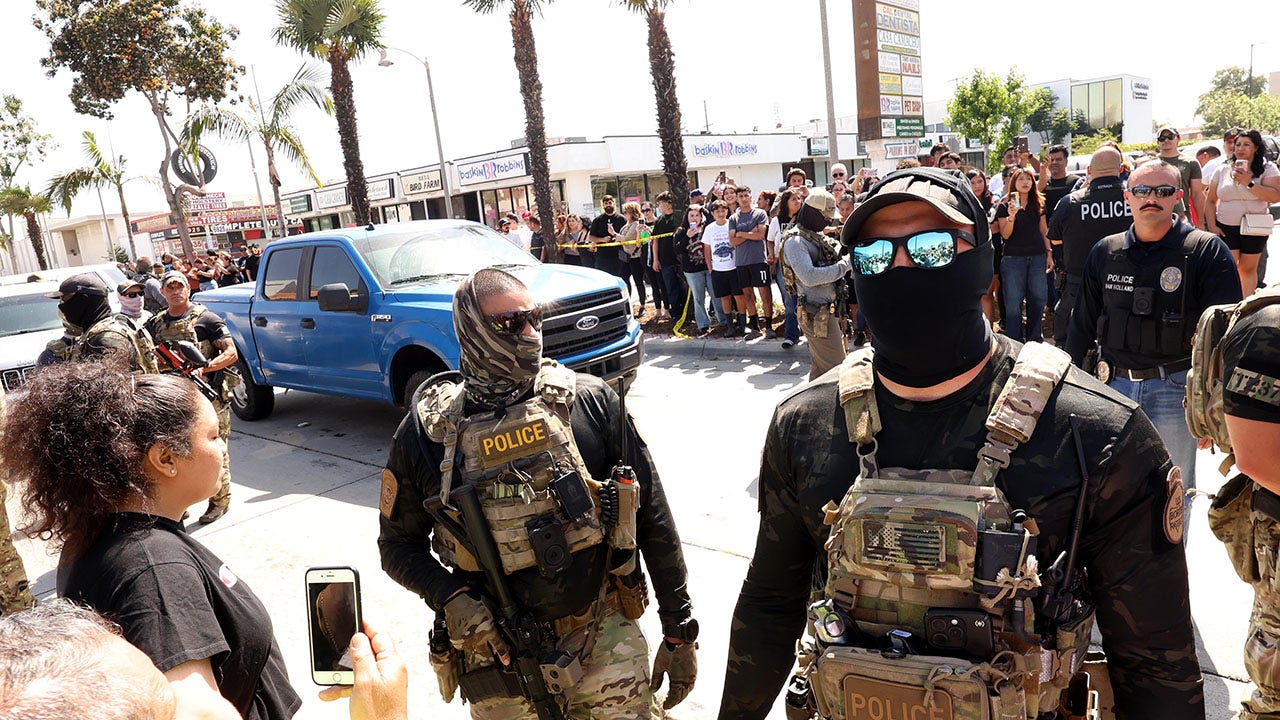
The No Secret Police Act attempted to bar ICE officers from wearing masks in certain circumstances after a series of high-profile immigration raids in the state that involved some officers fully concealing their faces with ski masks.
As part of the lawsuit, California officials agreed in December to hold off on enforcing the mask ban against ICE agents until the court could hear arguments in the case.
Wiener claimed the mask ban went into effect on Jan. 1 in a video he shared online, contradicting what California’s attorneys told the court.
NEWSOM ON COURTROOM COLLISION COURSE WITH TRUMP OVER ICE MASK BAN
State Sen. Scott Wiener of California (California Sen. Scott Wiener)
“It’s now illegal for ICE and other law enforcement to cover their faces in the state of California. Starting today, my new anti-masking law goes into effect,” Wiener said.
A federal judge is weighing whether to grant the Trump administration’s request for a preliminary injunction against the mask ban. But the briefing schedule stretches through next week, and a hearing on the matter is set for Jan. 12.
The judge could make a decision soon after the hearing, and if he were to rule in favor of California, the state could begin enforcing its ban at that point.
Bill Essayli, the first assistant U.S. attorney in central California, also chided Wiener for his claim that the state law was enforceable.
“This isn’t true. California has no authority to regulate federal agents. This state law violates the federal Supremacy Clause. … California has agreed to put the law on hold and not enforce its unconstitutional mask ban, which is designed to allow radical leftists to dox federal agents enforcing immigration laws,” Essayli said.
Wiener doubled down on his remarks in a statement to Fox News Digital, saying Essayli was a “clueless Trump Administration lackey” making a “meaningless royal decree.”
“While the agents of the state did agree to hold off on enforcing the law until the injunction hearing, the No Secret Police Act is still very much in effect, and ICE agents who appear masked in California are still subject to civil suits for violating the laws of our state,” Wiener said.
California attorneys have been fighting the lawsuit, arguing in court papers that “armed, masked individuals” carried out arrests of alleged illegal immigrants and, in doing so, “caused terror throughout California, with the public unsure whether they were interacting with legitimate law enforcement or impostors.”
The Trump administration’s lawsuit “ignores [the] careful balance of power between the federal and state governments, seeking to invalidate two California laws. … Each law exercises the State’s historic and long-established police power,” state attorneys wrote.
Read the full article from Here



VALENCIA COUNTY, N.M. — Multiple earthquakes sent tremors through communities just south of Albuquerque, the U.S. Geological Survey reported Sunday morning.
The USGS reported a 3.9-magnitude earthquake happened at 11:41 a.m., just three minutes after a 3.7-magnitude earthquake. They were both in the Jarales and Rio Communities area.
Two other earthquakes were reported on the other side of the Rio Grande: A 3.2-magnitude earthquake Saturday at 8:30 p.m. and a 2.6-magnitude earthquake Saturday at 11:51 p.m., near Abeytas.
There have been reports of no damage or injuries, according to the Valencia County Fire Department. The Department received reports of an earthquake in the Jarales and Rio Communities area.

LOGSDEN, Ore. (KATU) — A late-evening swim in a remote stretch of the Siletz River gorge ended with an 18-year-old Newport man drowning.
Emergency responders, including the Lincoln County Sheriff’s Office, were dispatched at about 6:33 p.m. June 13 to a report of a missing swimmer in the Siletz River gorge near Logsden. The location was described as about two miles upstream of Moonshine Park.
SEE ALSO | St. Helens city administrator reported dead after going missing in river
Bystanders reported seeing a male swimmer jump off rocks and then struggle to return from the river. Attempts were made to locate and rescue him, but they were unsuccessful, Lincoln County Sheriff’s Office said.
At about 7:09 p.m., after the swimmer had been missing for about an hour, emergency personnel reported seeing his body in 10 to 12 feet of water just downstream from where he was last seen. The Lane County Search and Rescue Dive Team was requested to assist with recovering the swimmer from what authorities described as a challenging location.
Just after midnight, 18-year-old Dallas Davis of Newport was recovered from the river.
The incident is being investigated as a drowning, and next of kin was notified.
The Lincoln County Sheriff’s Office was assisted by the Siletz Fire Department, Lane County Search and Rescue and the Lincoln County Medical Examiner’s Office.

For most people familiar with the Utah Jazz, the answer to who the Jazz will select with the No. 2 overall pick comes down to whoever the Washington Wizards don’t select: AJ Dybantsa or Darryn Peterson.
But one prominent NBA media figure seems dead set in his stance that the Jazz will select Duke big man Cameron Boozer. For Bill Simmons, it’s not if the Jazz take Boozer, it’s when.
“I would bet anything AJ (Dybantsa) is the first pick… and I think Boozer goes two,” Simmons said on “The Bill Simmons Podcast” on Saturday night.
This wasn’t the first time that Simmons expressed his confidence in the Jazz selecting Boozer. On a June 8 episode of his podcast, Simmons expressed his hunch that Boozer would end up in Utah.
“I think Danny (Ainge) is such a wildcard at second,” Simmons said. “He did it with (Jayson) Tatum, he did it with (Jaylen) Brown, he did it when he was going to take Durant, he over and over again looks at the high end talent guys and is able to project them. You would think it’s going to happen with Peterson, but I think there’s too many red flags. I think he’s going to stay away from Peterson. I could see him taking Boozer at two. That would be my minus-130 bet right now. I might be wrong, but I really think they’re gonna take Boozer, I do. I can’t explain it.”
Later on, Simmons explained that the Jazz’s front office knows the families of Dybantsa and Boozer incredibly well, know that the two like playing in Utah — something that should never be taken for granted — and that Peterson is too much of a wildcard to take a swing on.
J. Kyle Mann, an NBA draft analyst for The Ringer who was Simmons’ guest on the June 8 episode did not echo this sentiment.
“I think the Jazz will take Peterson. I’ve heard they like Peterson, I’ve heard Danny likes Peterson,” Mann said.
Boozer was the national player of the year in his lone collegiate season at Duke, averaging an insane freshman stat line of 22.5 points, 10.2 rebounds and 4.1 assists per game. Boozer’s high IQ and rebounding are two of his biggest strengths, while his defense and perceived lower athletic ability leave some teams hesitant on drafting the former Blue Devil.
The NBA Draft will be held on June 23 at 8 ET in Brooklyn, N.Y.
-

 New Hampshire11 minutes ago
Investigation underway after man dies while swimming in pond in NH – Boston News, Weather, Sports | WHDH 7News
-

 New Jersey14 minutes ago
Inside New Jersey’s World Cup-ready performance center (photos)
-

 New Mexico20 minutes ago
Earthquakes reported south of Albuquerque
-
North Carolina27 minutes ago
North Carolina gains inside track to College World Series finals with 5-2 win over West Virginia
-

 North Dakota29 minutes ago
Century’s Peyton Seil commits to NDSU
-
 Ohio35 minutes ago
Storms cause widespread power outages across Northeast Ohio
-

 Oklahoma41 minutes ago
Plans for Oklahoma City’s Legends Tower still alive, but developer says demand is biggest hurdle
-

 Oregon44 minutes ago
18-year-old drowns after late-evening swim river near Logsden, Oregon


