Business
Erewhon and others shut by fire set to reopen in Pacific Palisades mall


Fancy grocer Erewhon will return to Pacific Palisades in an entirely rebuilt store, as the neighborhood’s luxury mall, owned by developer Rick Caruso, undergoes renovations for a reopening next August.
Palisades Village has been closed since the Jan. 7 wildfire destroyed much of the neighborhood. The outdoor mall survived the blaze but needed to be refurbished to eliminate contaminants that the fire could have spread, Caruso said.
The developer is spending $60 million to bring back Palisades Village, removing and replacing drywall from stores and restaurants. Dirt from the outdoor areas is also being replaced.
Demolition is complete and the tenants’ spaces are now being restored, Caruso said.
“It was not a requirement to do that from a scientific standpoint,” he said. “But it was important to me to be able to tell guests that the property is safe and clean.”
Erewhon’s store was taken down to the studs and is being reconfigured with a larger outdoor seating area for dining and events.
When it opens its doors sometime next year, it will be the only grocer in the heart of the fire-ravaged neighborhood.
The announcement of Erewhon’s comeback marks a milestone in the recovery of Pacific Palisades and signals renewed investment in restoring essential neighborhood services and supporting the community’s long-term economic health, Caruso said.
A photograph of the exterior of Erewhon in Pacific Palisades in 2024.
(Kailyn Brown/Los Angeles Times)
“They are one of the sexiest supermarkets in the world now and they are in high demand,” he said. “Their committing to reopening is a big statement on the future of the Palisades and their belief that it’s going to be back stronger than ever.”
Caruso previously attributed the mall’s survival to the hard work of private firefighters and the fire-resistant materials used in the mall’s construction. The $200-million shopping and dining center opened in 2018 with a movie theater and a roster of upmarket tenants, including Erewhon.
“We’re honored to join the incredible effort underway at Palisades Village,” Erewhon Chief Executive Tony Antoci said in a statement. “Reopening is a meaningful way for us to contribute to the healing and renewal of this neighborhood.”
Erewhon has cultivated a following of shoppers who visit daily to grab a prepared meal or one of its celebrity-backed $20 smoothies.
The privately held company doesn’t share financial figures, but has said its all-day cafes occupy roughly 30% of its floor space and serve 100,000 customers each week.
Erewhon has also branched out beyond selling groceries.
Its fast-growing private-label line now includes Erewhon-branded apparel, bags, candles, nutritional supplements and bath and body products.
Erewhon will also open new stores in West Hollywood in February, in Glendale in May and at Caruso’s The Lakes at Thousand Oaks mall in July 2026.
About 90% of the tenants are expected to return to the mall when it reopens, Caruso said, including restaurants Angelini Ristorante & Bar and Hank’s. Local chef Nancy Silverton has agreed to move in with a new Italian steakhouse called Spacca Tutto.
In May, Pacific Palisades-based fashion designer Elyse Walker said she would reopen her eponymous store in Palisades Village after losing her 25-year flagship location on Antioch Street in the inferno.

Fashion designer Elyse Walker announced the reopening of her flagship store at the Palisades Village in May.
(Myung J. Chun/Los Angeles Times)
“People who live in the Palisades don’t want to leave,” Walker said at the time. “It’s a magical place.”
Caruso carried on annual holiday traditions at Palisades Village this year, including the lighting of a 50-foot Christmas tree for hundreds of celebrants Dec. 5. On Sunday evening, leaders from the Chabad Jewish Community Center of Pacific Palisades gathered at the mall to light a towering menorah.
A total of 6,822 structures were destroyed in the Palisades fire, including more than 5,500 residences and 100 commercial businesses, according to the California Department of Forestry and Fire Protection.
Caruso said he hopes the shopping center’s revival will inspire residents to return. His investment “shows my belief that the community is coming back,” he said. “Next year is going to be huge.”

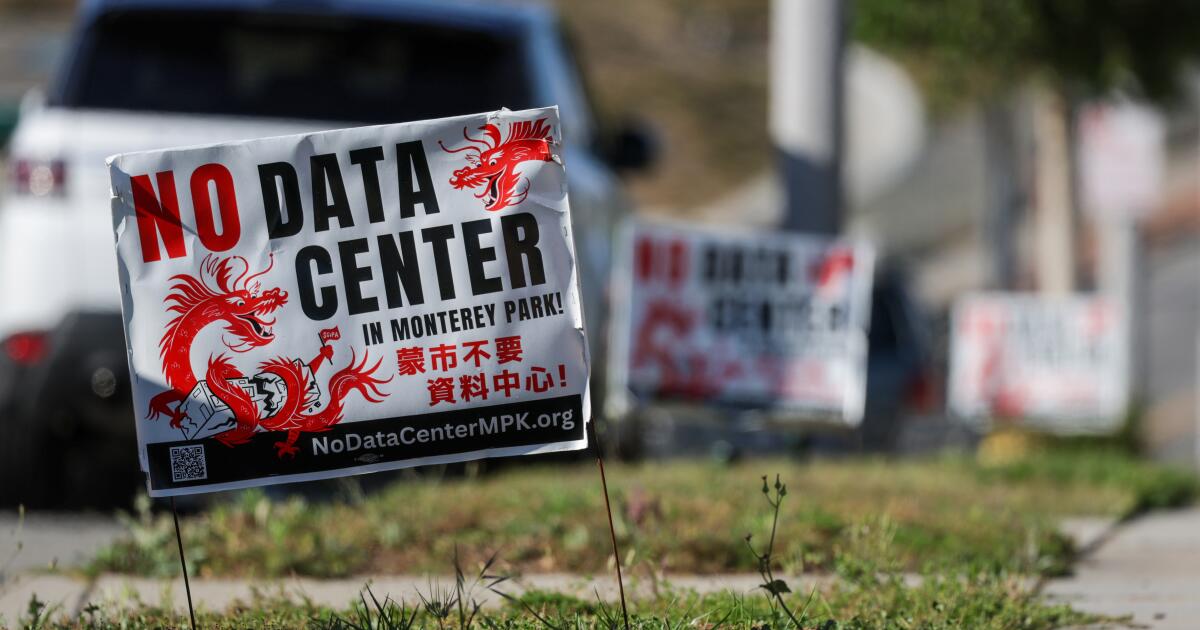
Residents in the city of Monterey Park will be the first in the nation to vote on a permanent ban on data centers Tuesday.
If approved, Measure NDC would prohibit data centers within the city limits and could only be overturned by another vote.
Yard signs saying “No Data Center” in English and Chinese with images of dragons line sidewalks in the San Gabriel Valley city.
As a wave of data center opposition sweeps the country, numerous towns and counties across the U.S. have instituted temporary moratoria and other restrictions on the facilities. But only a handful have instituted indefinite bans, and just four other towns have sent related matters to the ballot.
Supporters are hoping the vote will set a precedent for the rest of the region, where residents are fighting proposals in Vernon and City of Industry.
“This is about as permanent a ban as we can get,” said Steven Kung, co-founder of the group No Data Center Monterey Park. “Winning Measure NDC would send a huge message to the rest of the San Gabriel Valley about how residents don’t want data centers.”
The ballot measure emerged from the fight against a 247,000-square-foot center proposed in 2024 by the Australian-owned investment firm HMC StratCap for a residential area in Monterey Park.
The facility would have sat less than 500 feet away from the nearest home and used three times the electricity of the 60,000-person, predominantly Asian American city.
While the developer touted the potential for jobs and tax revenue, residents expressed concerns about noise and air pollution, rising electricity rates and a potential to lower property values.
The company pulled its plans in late March following public outcry and a March 4 city council vote to extend a temporary data center moratorium and place a ban on Tuesday’s ballot.
In a letter to the city council, HMC StratCap said it would pursue a different use for the land and would not engage in a ballot measure fight.
The city council later banned data centers indefinitely, the first in California to do so, said Mayor Elizabeth Yang. But she’s still been out campaigning for the measure with all four other council members.
“If a council puts in an ordinance, a future council can reverse it too,” said Yang. “With the ballot measure, unbanning it is a lot harder because you need the entire city to vote on it.”
The measure proposes the ban “to protect air quality, drinking water resources, and public health” and “prevent impacts to electricity and water rates.”
While California places third in the country for existing data centers with about 300 facilities, it hasn’t been a hot spot in the recent AI-driven data center boom. High electricity rates, expensive land and regulatory hurdles mean that fewer, and smaller, facilities are currently planned than in Virginia, Texas, Georgia, Illinois or Arizona.
“Most of California’s data centers are small by today’s standards,” said Shaolei Ren, an engineering professor at UC Riverside who studies how to reduce the environmental impacts of data centers. “Ten years ago, they would be medium-sized, but the power demand for new AI data centers has increased a lot.”
The average operating data center demands 45 megawatts, according to the Washington Post, while the average planned one would draw 430 MW. The one proposed for Monterey Park would have required about 50 MW at peak demand.
As proposals crop up in SoCal, they’re met with fierce opposition. Montebello, El Monte and Baldwin Park have all enacted temporary moratoria, and Alhambra recently banned data centers as part of a zoning code update. City of Industry, Vernon, City of Commerce and Santa Fe Springs are moving in the other direction, trying to court developers and streamline data center approvals. Community groups are fighting that.
Outside the San Gabriel Valley, residents of Coachella and Imperial County are showing up in droves to protest local proposals.
Matthew Shaw, a volunteer with the Coalition for Responsible Data Center Development, who recently published a report on opposition to AI data centers, said a vote to ban them in Monterey Park “would lead to copycats, partially because so many groups are just opposed to any data center development at all.”
While there is no formal opposition to Measure NDC, some building trades like Ironworker Local 433 supported the Monterey Park data center when it was still live before city council. Those in the data center industry are lamenting the state of public opinion.
“These are multi-billion-dollar assets that are built by multi-trillion-dollar companies. These things will get done,” said Mehdi Paryavi, chairman of the International Data Center Authority. “My biggest problem is that our industry does not invest enough in community engagement.”
Paryavi said towns that seek to limit data centers are missing out on thousands of jobs generated by data center construction, operations and customers, as well as faster artificial intelligence speeds and better performance.
Kung said local community organizers are “looking at the empirical evidence” and seeing a ban as a win.
“We’ve never seen a city that embraces a data center and is like, ‘Look how our quality of life has increased, look how all the revenue has gone into citywide improvements,’” he said. “That just doesn’t exist.”
Business
Company wants to revive Primm, the gambling spot turned ghost town. Owners say: Not so fast

A once-popular gambling mecca at the California-Nevada border that faded into obscurity could get a second life.
A Las Vegas-based truck-stop company is reportedly hoping to revive Primm to its former glory. But the would-be comeback faces a hurdle: striking a deal with the landowners, the Primm family.
In an interview with the Las Vegas Review-Journal, LV Petroleum Chief Executive Kris Roach shared his plans for the state-line ghost town.
“We would like to operate everything at the exit, the hotels, the casinos, the truck stop, the stores, pretty much from farm to table,” Roach told the Review-Journal. “We would like to revive the whole exit.”
But Cory Clemetson, president of Primm and grandson of founder Ernie Primm, said in a statement shared with The Times: “Recent reports suggesting that an agreement with any specific potential partner may be imminent are overstated and premature.”
LV Petroleum is an active operator of convenience stores and travel centers with more than 80 locations across the United States, according to its LinkedIn page.
In May, Affinity Gaming, which currently operates several businesses on behalf of the Primm family, announced a plan to close most properties it had been leasing by July 4.
Whiskey Pete’s, which along with its companion resorts at Primm drew in visitors with low prices and deals, closed in 2024. Buffalo Bill’s, which featured a 209-foot-tall roller coaster, concluded its operations in 2025.
Primm Valley Resorts, the sole operating casino in Primm, remains open until the July deadline. Other stores affected by the closure include the Primm Center, the Flying J, and the Primm Lotto Store, according to KSNV NBC Las Vegas.
Primm, an alternative to Vegas for Southern Californians that cut 45 minutes off the drive, suffered a decline in tourism after the COVID-19 pandemic and saw increased competition from tribal casinos in California.
Roach told the Las Vegas Review-Journal that he did not want to see the businesses go dark, adding that 344 employees would lose their jobs following the closure. Roach said, among his plans, would be reopening Whiskey Pete’s.
But the Primm family says a deal is far from done.
“Our family is currently considering opportunities involving multiple well-established operators that have successfully operated similar hotel-casino properties in Nevada,” Clemetson said. “We will continue to explore all viable options as we work toward the best possible solution especially for the hundreds of Primm employees and their families dealing with this difficult situation.”
Modern-day Primm began in the 1950s when Ernie Primm established a motel and coffee shop at the state-border location. In the 1970s, he and son Gary expanded operations to build Whiskey Pete’s. Once called State Line, the area was renamed Primm in 1996 after Ernie’s death.

Anthropic, the company behind the powerful artificial intelligence chatbot Claude, has filed to get ready to list its shares.
The development comes days after it raised $65 billion, valuing it at $965 billion.
The company, founded in 2021 by a breakaway faction from OpenAI, was viewed as an upstart that tailored its chatbots to the needs of businesses and developers, rather than consumers.
Late last year, the release of its agentic coding assistant propelled it ahead in the AI race, as the company’s annualized revenue skyrocketed from $9 billion at the end of 2025 to more than $47 billion in May.
“This gives us the option to go public after the SEC completes its review. The proposed initial public offering will depend on market conditions and other factors,” the company said in a statement, announcing the confidential filing on its website.
The number of shares to be offered and the price have not yet been set, the company said. Last week, Anthropic released its latest model, Claude Opus 4.8, to the public.
The upstart began gaining ground against its larger rival OpenAI late last year with the release of its Claude Opus 4.5, which became a huge hit among developers and enthusiasts who were able to merely describe an app or website or online dashboard or research problem in English, and have the coding agent complete the task. .
As adoption of Claude grew, OpenAI has been juggling numerous big bets, including the shuttered text-to-video model Sora, agentic shopping and an AI-native browser, with mounting challenges to monetize its base of 800 million users. The company has since streamlined its operations, focusing on its coding product, Codex, and continues to invest in image generation and robotics.
The announcement puts Anthropic ahead of OpenAI, which reportedly hired bankers Goldman Sachs and Morgan Stanley in the race to go public. Anthropic now eclipses its rival, which was valued at $852 billion in March.
Elon Musk’s xAI, which operates the chatbot Grok, is a part of SpaceX that is gearing up to go public next week. It will be the largest initial public offering of stock in history, and a successful listing will make Musk the first trillionaire.
The blockbuster year for Silicon Valley IPOs will test people’s appetite to invest in the promise of artificial intelligence, amid worries and warnings of an AI bubble. .
Nasdaq introduced a rule change this year, shortening the three-month waiting period for stocks to be included in the index to 15 days.
It was done to accommodate monster listings such as SpaceX. The cooling-off period allows newly listed stocks to stabilize before passive index funds pick them up, but indices said it’s a much-needed update, as companies stay private longer, are more mature and have much larger valuations than in the past.
Dario Amodei, co-founder of Anthropic, has been outspoken about the risks of artificial intelligence wiping out half of all entry-level jobs and driving unemployment up by 20%. Some in the Trump administration have criticized his views as alarmist and accused his advocacy of AI safety of being an attempt at regulatory capture to create onerous compliance barriers that would restrict AI development to a handful of large companies, locking out smaller competitors.
In March, the company sued the Pentagon after it was designated as a “supply chain risk” for refusing to allow the use of its AI model for domestic mass surveillance or fully autonomous weapons.
The White House softened its posture against Anthropic in May, after the release of its AI model Claude Mythos, which proved itself adept at finding critical software bugs. The incident prompted a U-turn in the Trump administration’s laissez-faire approach to AI regulation and led to the consideration of safety testing before broader public release.
Anthropic’s Mythos model has now become a tool of geopolitical advantage for the U.S., as governments across the globe, including the European Union, have requested access to the powerful tool to identify and patch vulnerabilities in the banking and financial system that could be exposed to hacking.
The explosive demand has increased Anthropic’s need for AI chips, causing previous outages and forcing the company to set usage limits for users. To secure access to vital hardware, the company signed agreements with Amazon, Google, Broadcom and SpaceX in April for new computing capacity.
-

 Montana4 minutes ago
Western Montana Food and Farm launches new agritourism trail – Bitterroot Star
-

 Nebraska7 minutes ago
Nebraska Public Service Commission approves controversial transmission line through the Sandhills
-

 Nevada12 minutes ago
Judge blocks Polymarket from operating in Nevada
-
 New Hampshire19 minutes ago
As Nottingham prepares to address backlash to a data center proposal, where does NH stand on data centers?
-

 New Jersey22 minutes ago
Shooting in Atlantic City, New Jersey, leaves suspect dead, 2 police officers injured, mayor says
-

 New Mexico27 minutes ago
LIVE BLOG: New Mexico 2026 semi-open primary elections
-

 North Carolina34 minutes ago
The Real Reason North Carolina’s GOP Is Proposing the Most Radical Anti-Abortion Bill Yet
-

 North Dakota37 minutes ago
10 Small Towns In North Dakota Were Ranked Among US Favorites

