Movie Reviews
Book Review: The “Night” Movies of Film Critic A.S. Hamrah – The Arts Fuse


By Peter Keough
Once again, critic A.S. Hamrah sheds perceptive light on our cinematic malaise.
The Algorithm of the Night: Film Criticism 2019-2025 by A.S. Hamrah. n + 1. 554 pages. $23
If film criticism – and film itself – survive the ongoing cultural, political, economic, and technological onslaughts they face, it will be due in part to writers like A. S. Hamrah. His latest collection (there are two, in fact; I have not yet read Last Week in End Times Cinema, but I am sure that it will also be the perfect holiday gift for the dystopic cinephile on your list) picks up where his previous book The Earth Dies Streaming left off, unleashing his savage indignation on today’s fatuous, lazy critical conversations and the vapid studio fodder that sustains it.
Not that it is all negativity. This inexhaustibly illuminating and entertaining assortment of reviews, essays, mordant Oscar roundups, and freewheeling, sui generis bagatelles first seen in such publications as n+1 (for which he is the film critic), The Baffler, the New York Review of Books, and the Criterion Collection is filled with numerous laudatory appreciations of films old and new — all of which you should watch or watch again. I was impressed with his eloquent, insightful praise for Debra Granik’s Leave No Trace (2018), his shrewd analysis of Abbas Kiarostami’s masterpiece A Taste of Cherry (1997) and its mixed critical reaction, and his reassessment of John Sayles’s neglected epic of class warfare Matewan (1987), among many others.
Also not to be missed are Hamrah’s absurdist ventures into his personal life, many in theaters (or not in theaters, as when Covid shut them down in 2020), such as the time he observed a menacing attendee at a screening of 2010’s Joker. “It would be best to see [Joker] in a theater with a potential psychopath for that added thrill of maybe not surviving it,” he concludes. One strikingly admirable characteristic of Hamrah’s criticism is that he consciously avoids writing anything that could be manipulated by a studio into a banal blurb. You will find no “White knuckle thrill ride” or “Your heart will melt” or “A monumental cinematic experience” here.
The book does boast a bounty of blurbable bits, but they are not the kind that any publicist will put in an ad. These are laugh-out-loud takedowns of bad movies, vain filmmakers, and vapid performers. Some of my favorites among these beautiful barbs include his description of The Banshees of Inisherin (2022) as “[S]horter than Wakanda Forever by a whopping 47 minutes but still too long,” his dismissal of Jojo Rabbit (2019) as “combining Quentin Tarantino and Wes Anderson in the worst, cop-out ways,” and his exasperated take on Edward Berger’s 2022 remake of All Quiet on the Western Front (“What happened to the German cinema?”).

Film critic A. S. Hamrah — another inexhaustibly illuminating and entertaining assortment of writings on film. Photo: n+1 benefit.
He also displays the rare critical ability to reassess a director and give him his due. In his review of Berger’s 2024 Conclave, he admits that “Berger directs [it] like he is a totally different filmmaker than the one who made the 2022 version All Quiet on the Western Front. Unlike that film, this one is highly burnished and tightly wound.” (Watch out – close to blurb material there!)
The book ends with an apotheosis of the listicle called “Movie Stars in Bathtubs: 48 Movies and Two Incidents” in which Hamrah summarizes nine decades of cinema. It ranges from Louis Feuillade’s 1916 silent crime serial Les Vampires (“‘It is in Les Vampires that one must look for the great reality of our century’ wrote the surrealists Aragon and Breton”) to Brian De Palma’s 2002 neo-noir Femme Fatale (“There is a picture book called Movie Stars in Bathtubs, but there aren’t enough movie stars in bathtubs. De Palma’s Femme Fatale, which stars Rebecca Romijn, does much to correct that.”)
Around the volume’s midpoint, Hamrah includes one of the two “incidents” of the title. In “1951: The first issue of Cahiers du Cinema” he celebrates the astonishing cadre of cinephiles, many of whom are depicted in Richard Linklater’s recent film Nouvelle Vague, who put out the publication that reinvented an art form. “Unlike critics today,” Hamrah points out, “these writers did not complain that they were powerless. They defended the movies they loved and excoriated the ones they hated. For them film criticism was a confrontation, its goal to change how films were viewed and how they were made.” It’s a tradition that Hamrah, who combines the personal point of view and cultural literacy of James Agee with the historical, contextualizing vision of J. Hoberman, triumphantly embraces.
Peter Keough writes about film and other topics and has contributed to numerous publications. He had been the film editor of the Boston Phoenix from 1989 to its demise in 2013 and has edited three books on film, including Kathryn Bigelow: Interviews (University Press of Mississippi, 2013) and For Kids of All Ages: The National Society of Film Critics on Children’s Movies (Rowman & Littlefield, 2019).


NEW YORK (OSV News) – As America’s Catholic bishops prepare to mark the semiquincentennial by consecrating the nation to the Sacred Heart of Jesus, a French docudrama that can aid viewers in understanding the full significance of such an action makes its timely appearance.
A Fathom Entertainment presentation, “Sacred Heart: His Reign Has No End” will have a limited theatrical run June 9-11 and June 14. The version screening on June 10 will be dubbed in Spanish.
Following its initial release in France last fall, the film proved to be phenomenally popular, with ticket sales reaching the half-million mark in a country usually regarded as deeply secular. This unusual development clearly indicates that the movie resonated with audiences in a way that even its creators may not have expected.
Filmmakers Sabrina and Steven J. Gunnell examine the origins, meaning and enduring relevance of devotion to the Sacred Heart. They begin their exploration even before the landmark revelations received in the 1670s by St. Margaret Mary Alacoque, a Burgundian Visitation nun, showing that earlier saints had focused on the subject in medieval times.
Using reenactments, interviews and archival images, the Gunnells also highlight the theological connection between the Sacred Heart and the Eucharist. This is done, in part, by recounting a few of the many Eucharistic miracles granted to the Church over the centuries.
By profiling contemporary devotees of the Sacred Heart, including formerly inactive Catholics, the picture demonstrates the impact the insights given to St. Margaret Mary continue to have on the lives of people around the world. Locations visited range from the gang-infested streets of a Parisian suburb to the once war-torn Central American country of El Salvador.
An excellent and enjoyable catechetical resource, the feature is also both moving and uplifting. It can be recommended for all but the youngest kids.
For theater locations and showtimes, go to: sacredheartfilm.us
Dubbed into English.
The film contains gory images of the Crucifixion. The OSV News classification is A-II — adults and adolescents. Not rated by the Motion Picture Association.
Read More Movie & Television Reviews
Copyright © 2026 OSV News

There’s a photo of me (below) from the mid-1980s, when I was around age 5, standing on the hood of an old Plymouth in the overgrown field behind my childhood home. I’m holding He-Man’s shield in one hand and his sword, made of yellow plastic, in the other. (Unrelatedly, I’m also wearing an Incredible Hulk shirt in the picture.) And I’m grinning with pride because I have thoroughly conquered the jalopy. The vehicle never ran again, probably because I fucking destroyed it with my sword and shield. Around that time, I also had a He-Man birthday cake and a sizable collection of Mattel’s Masters of the Universe action figures. They were my first foray into toys of this kind, later replaced by G.I. Joe, Teenage Mutant Ninja Turtles, and X-Men. However, my nostalgia for He-Man remains almost nonexistent today, perhaps because, looking back at the material, the mythology remains at once weird and unmemorable, and neither the popular animated series nor the 1987 film, Masters of the Universe, starring Dolph Lundgren and Frank Langella, holds up well.
Over the years, Mattel has tried to revive the toy line and cartoon, but the company’s biggest effort thus far is the new feature from Amazon MGM Studios, which reportedly spent upwards of $200 million on a blockbuster-sized Masters of the Universe. If the 1980s versions of this franchise unabashedly targeted the preadolescent boy demographic, the new iteration has been reconfigured (by a sausage fest of credited screenwriters: Chris Butler, Aaron Nee, Adam Nee, and David Callaham) to adopt a more conventional mold. The movie also incorporates the last three decades of ironic reassessment: the series’ very 1980s obsession with bulging muscles; the loincloth-centric costumes, all of which look like rejected designs from Zardoz (1974); the vague eroticism between He-Man and several characters, including his nemesis, Skeletor; and the eccentricities of the cartoon, from the many heads thrown back in laughter to the bizarre characters—all of which started first as action figures (Stinkor, Mantenna, etc.), around which the writers built a lame storyline.
Despite its origins, Masters of the Universe sets out to become a four-quadrant feature, appealing to everyone, and in that, no one in particular. The story is too bloated for little children, with a 142-minute runtime that challenged the attention spans of the kids in my prescreening, who became restless after an hour. Admittedly, so did I. The material’s self-awareness and humor aren’t memorable enough to distinguish it from other, better examples in this genre, such as Dungeons & Dragons: Honor Among Thieves (2023)—a movie that I enjoy more with each subsequent viewing. And director Travis Knight can’t decide whether the audience should take these characters seriously or laugh at their inherent silliness. He attempts both and does neither very well. The result did not rekindle my nostalgia for this chapter of my childhood; it didn’t create an exciting new take for audiences of all ages, either.
A protracted opening establishes the distant realm called Eternia, where sword-and-sandal heroes stand alongside robots and flying ships with laser guns. Eternia’s resident baddie, Skeletor (voiced by Jared Leto, doing an R-rolling master-thespian thing), wants the Sword of Power, which imbues its wielder with, as you might guess, power. But it’s kept in Castle Grayskull, home of King Randor (James Purefoy), who’s disappointed by his son, Adam (Artie Wilkinson-Hunt), a young boy more interested in goofing around than learning to fight. When Skeletor attacks the castle and proves victorious, the Enchantress (Morena Baccarin), the magically inclined protector of Grayskull, sends Adam away to Earth along with the coveted sword. What happens then? Did a couple of farmers adopt him à la Superman? Or did he grow up in the foster system? The writers ignore such practical questions, picking up the story years later, when the adult Adam (now a hulking Nicholas Galitzine) works in corporate human resources. After Adam finally locates his sword, which was lost when he was transported from Eternia to Earth, he eventually finds his way home with the help of his childhood friend, Teela (Camila Mendes), to retake Grayskull from Skeletor.
Knight’s main source of inspiration, besides the cartoon and earlier movie, seems to be the similarly themed cult classic Flash Gordon (1980). Masters of the Universe’s music features identical-sounding Howard Blake-style guitar riffs and, to echo the original songs Queen wrote for Flash Gordon, the production uses Queen’s “Princes of the Universe” on the soundtrack. In other areas, Knight directs a conventional franchise movie with choppily edited and CGI-heavy battle scenes full of anonymous violence, lifeless chase sequences, digital backdrops resembling video-game environments, and shameless product placements for Coca-Cola and Amazon. The VFX sometimes look impressive; at other times, they look cheap and generic. Fortunately, Knight’s production also offers practical effects and prosthetics for some characters, most memorably the cyborg Trap Jaw. Knight’s secret weapon is costume designer Richard Sale, who visualizes the inherently absurd look of these characters, for better or worse, in tangible garb. The actors inhabiting the excellent costumes don’t have much to do, though. Ask yourself why they hired Kristen Wiig to voice Roboto, a bland robot character whose dialogue could have easily been performed by anyone else, or even just replaced with the beeps and boops of a Star Wars droid. When you have Kristen Wiig, use her.

Elsewhere, Masters of the Universe attempts to be self-aware in its irony and sexually suggestive underpinnings. There’s a running gag about how practically everyone can’t keep their eyes off Adam after he becomes his heroic alter-ego, He-Man, given his oiled-up muscles and blonde locks. But under Adam’s pink shirt, he still looks buff, making his eventual Hulk-like transformation into a muscle-bound barbarian unremarkable. Elsewhere, I liked the detail of Adam growing up on Earth and forgetting everyone’s names on Eternia, so he makes up their names based on their physical characteristics. A man with a big metal hand becomes Fisto (Jóhannes Haukur Jóhannesson), and another with a metal head-butting helmet becomes Ram-Man (Jon Xue Zhang). The writers take advantage of this with veiled dirty jokes about fisting and Ram-Man “giving head” to Skeletor’s goons. That’s about as clever as the movie gets. As for character development, there’s almost none. Skeletor, for instance, wants to be bad for the sake of being bad. His motivations are nonexistent, resulting in an obvious, uninteresting, and one-dimensional villain.
A key series in the conservative, Reagan-era 1980s, the Masters of the Universe cartoon and previous movie valued strength and power, muscles and might. Today, that message has negative, regressive associations with the political right, which often looks at this period from a fond standpoint. To avoid alienating any part of their audience, the filmmakers desperately try to please everyone with a mild progressive commentary to counter the franchise’s original themes. Adam’s character must learn to “be a man” to please his father, King Randor, and his makeshift father figure, Man-at-Arms (Idris Elba, in a chummy reformed drunk role). But there’s also a half-hearted message that Adam, having worked in human resources, knows the value of empathy and emotional intelligence. For a while there, the movie even claims you can’t solve every problem with muscles—that is, until He-Man resolves the conflict by pummeling Skeletor with his fists. The movie’s message is ultimately nonexistent. The committee making this movie has carefully avoided any line-in-the-sand worldview, all in an attempt to manufacture a box-office hit that will please everyone and offend no one.
That’s exactly the problem with Masters of the Universe. It’s so afraid to have a perspective or be about something that nothing onscreen has an impact. This is not to say every movie must have a substantive message. Sometimes, a mindless adventure is enough. However, even on those terms, there’s no tension or danger here because Skeletor is never all that menacing, and Adam alternates between self-parody and earnest heroism. None of the emotional beats land, not the many father-son dynamics nor the hero’s journey. And the production’s competing tones, from its intentional camp to its sword-swinging adventure, lack the balance of wit and scope that Dungeons & Dragons: Honor Among Thieves so delightfully captured. For much of the runtime, I felt bored and, aside from a few chuckles at the childish humor, disengaged from everything happening. Perhaps Roboto describes the movie best when referring to life as “a series of absurdities leading to infinite nothingness.”
Photo: Brian the Barbarian

Movie Reviews
‘Masters of the Universe’: What Critics Are Saying About the He-Man Movie Starring Nicholas Galitzine and Jared Leto

He-Man lands in theaters Friday, and reviews for Masters of the Universe are now in.
The film, a live-action adaptation of the Mattel franchise from director Travis Knight, follows Prince Adam of Eternia, who crash-lands on Earth as a child and is separated from his Sword of Power. Raised as an ordinary man named Adam Glenn, he eventually recovers the sword and returns to save his homeland, where he faces off against Skeletor.
Nicholas Galitzine stars as He-Man/Prince Adam/Adam Glenn, while Jared Leto plays the villain Skeletor. The cast also includes Idris Elba as Man-at-Arms, Camila Mendes as Teela, Alison Brie as Evil-Lyn, Morena Baccarin as Sorceress and Kristen Wiig as Roboto.
Masters of the Universe celebrated its Los Angeles premiere last month, where the original He-Man from the 1987 film, Dolph Lundgren, praised Galitzine’s performance while speaking with The Hollywood Reporter: “You need a guy who is a leading-man type, and the muscles and the strength are secondary. You can always create that, and I think Nicholas did that. He built himself up. When I did it, it was a little more like I had the physique and had to access my boyish side to find the character.”
As of Tuesday, the movie holds a 74 percent score on Rotten Tomatoes. To find out what critics are saying, read on.
THR’s Frank Scheck wrote, “The film winds up feeling so much like one of those fringe festival musical theater parodies that you find yourself waiting for the characters to burst into song … Masters of the Universe touches all the fan-serving bases, with a fun cameo by a certain star of a previous film incarnation and enough post-credit sequences to guarantee several sequels. But it all comes off as terribly forced, as if everyone involved was already trying to figure out exactly how much they’ll earn signing autographs at future Comic-Cons.”
IGN’s Clint Gage wrote, “Masters of the Universe is so much funnier than I expected, and the fight scenes are choreographed and photographed in a way that gives the sequences just enough flair to make them stand out (even if they’re not revolutionizing superhero style fisticuffs on screen). While Nicholas Galitzine and Idris Elba provide the thematic structure to the film, Jared Leto’s Skeletor gives a delightfully weird and cartoonish energy to every scene he’s in.”
YouTube critic Jeremy Jahns also highlighted Leto’s performance in his review, “Standout performance and character in Masters of the Universe: Jared Leto’s Skeletor,” Jahns said. “He was the most fun happening on screen at any given time.” He also added, “It does feel like a few different movies crushed into one. A few different ideas of what a Masters of the Universe movie should or would be. And most importantly, it had these moments of heart and life lessons that I actually liked that didn’t always land because sometimes the comedy is just there to eclipse it.”
Inverse’s Ryan Britt wrote, “The idea of navigating your childhood hopes and fears, and incorporating those things into your adult life, is — somewhat appropriately for a movie based on an old cartoon — at the heart of the film. Not everyone who goes to see Masters of the Universe will have grown up with He-Man, but this film will make you wish that you did. And, at the same time, it’ll make you feel grateful that he’s back and quite literally, better than ever.”
The Guardian’s Benjamin Lee had a less favorable take on the film, writing in his review, “Amazon’s head-scratching $200m-budgeted misfire fails to explain why so much time, money and effort has been wasted on a movie based on a toy that kids just don’t play with any more … There’s just too much distracting confusion here — from Galitzine’s unsure performance to the script’s swirl of competing tones to the very question of why this needed to exist — for it to transport us as we both hope and expect.”
-
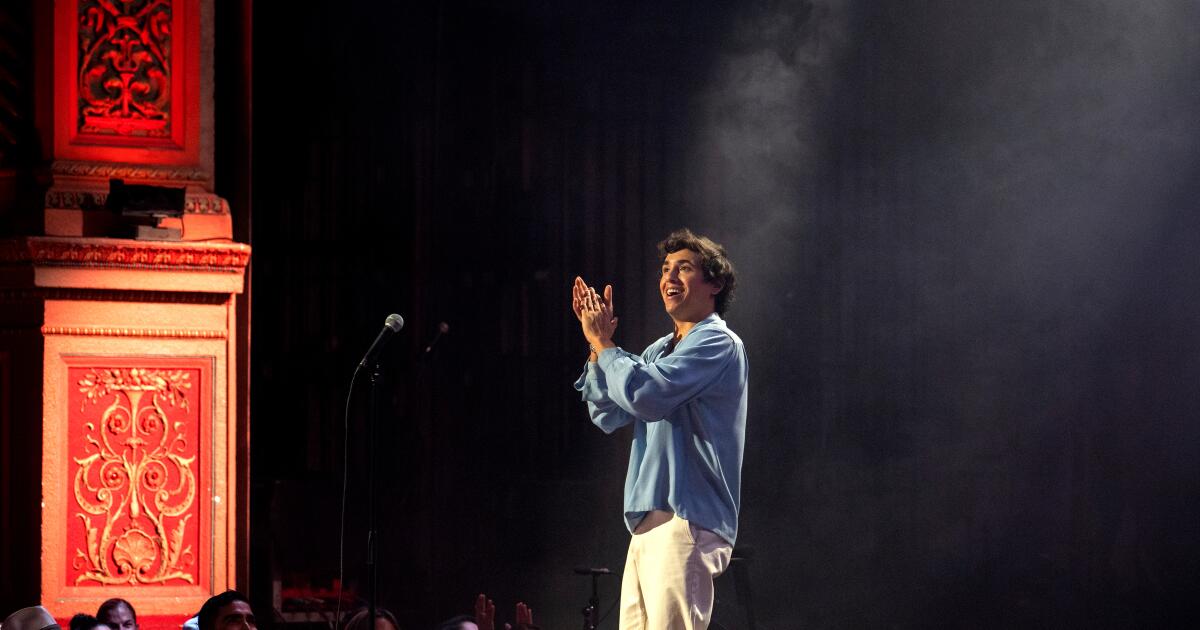 Sports5 minutes ago
‘SNL’ star Marcello Hernández to host 2026 ESPYs as show leaves L.A. for New York
-

 World15 minutes ago
US House passes Iran war powers resolution in rare moment of Trump backlash
-

 News42 minutes ago
House votes to rein in Trump on Iran as war loses GOP support
-

 Los Angeles, Ca2 hours ago
Police investigate deadly stabbing in Tarzana; suspect in custody
-

 Detroit, MI2 hours ago
Detroit Tigers sweep Tampa Bay Rays in win as Dillon Dingler stays hot
-

 San Francisco, CA3 hours ago
Retired San Francisco firefighter dies from lung cancer after Blue Shield denies treatment claims
-

 Dallas, TX3 hours ago
Trackdown: Dallas 7-Eleven robbery suspect wanted
-

 Miami, FL3 hours ago
This new Italian restaurant in Brickell only has 10 items on the menu

