Midwest
Blue city suspect with numerous prior arrests federally charged after allegedly setting woman ablaze on train

NEWYou can now listen to Fox News articles!
The suspect with a lengthy criminal history and who was released after being accused in a violent August attack, has been federally charged after allegedly lighting a young woman on fire Monday on the Chicago Blue Line train and yelling “burn b—-.”
Lawrence Reed, 50, is charged with committing a terrorist attack or violence against a mass transportation system, according to a recently filed criminal complaint.
Federal prosecutors allege Reed intentionally used gasoline and a lighter to set a woman on fire aboard a CTA Blue Line train at about 9:30 p.m. Monday.
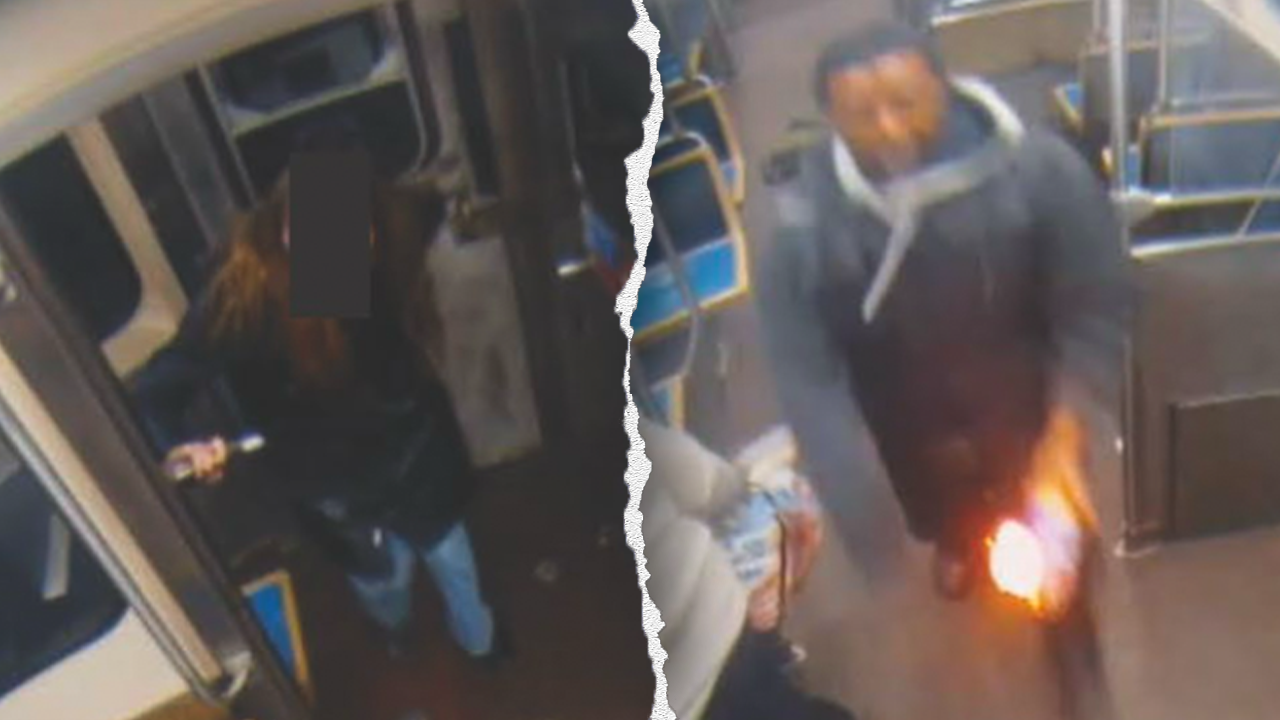
A photo from train security footage showed the suspect allegedly following the woman to the back of the train car before lighting her on fire. (U.S. District Court documents)
AMERICA’S COMMUTERS UNDER SIEGE AS VIOLENT TRANSIT CRIMES ENDANGER BLUE CITIES
U.S. District Attorney for the Northern District of Illinois Andrew Boutros said the woman was “minding her own business and reading her phone” while seated in the middle of the train car, when Reed approached her from the back of the car, doused her head and body with gasoline, and attempted to ignite the liquid.
The woman ran to the back of the car, as he ignited the rest of the liquid in the bottle and then used it to light her on fire, according to the complaint.
Footage allegedly showed Reed watching the woman, engulfed in flames, as she tried to put out the fire by rolling on the floor.
Train footage shows the suspect allegedly coming up behind the woman and pouring the liquid on her head and body. (U.S. District Court documents)
Boutros said as the woman was rolling on the ground, desperately trying to put out the fire, no one came to her aid.
When the train stopped at Clark and Lake, the complaint noted the victim, who was still on fire, managed to exit before collapsing on the platform.
“When she finally stumbled down, two Samaritans came and put out the blaze that was all consuming her,” Boutros said.
Graphic video footage captured at the scene showed Chicago Fire and EMS workers attempting to load the woman into an ambulance.
She suffered severe burns to her face and body and remains in critical condition, according to authorities.
Train footage showed the suspect allegedly purchasing the items used in the attack from a nearby gas station. (U.S. District Court documents)
SEE IT: VIDEO SHOWS CHARLOTTE TRAIN STABBING SUSPECT BEFORE ATTACK AND MINUTES BEFORE ARREST
Prosecutors obtained photos showing Reed at a gas station about 20 minutes before the attack, where he was seen entering the store, paying the cashier and filling a small container with gasoline.
Other images showed Reed inside the train holding a flaming bottle as he approached the victim.
Reed allegedly exited the train after setting the woman on fire and walked away.
He was arrested Tuesday morning, still wearing the same clothing from the attack, and had burns on his right hand, according to the complaint.
Officers noted he repeatedly yelled “burn b—-” and “burn alive b—-,” while being taken to the detective division.
Investigators recovered a partially melted bottle, lighter and clear liquid from the victim’s train seat, along with the remains of some of her clothing.
Photos from the train show the moment the suspect allegedly doused the woman in gasoline. (U.S. District Court documents)
CHICAGO WOMAN SET ON FIRE DURING ARGUMENT ON CTA TRAIN, POLICE SAY
During Reed’s first appearance in federal court Wednesday, he allegedly shouted, “I plead guilty, I plead guilty, I plead guilty.”
U.S. Magistrate Judge Laura McNally asked him if he knew the maximum sentence was life in prison, to which he responded, “It’s cool, it’s cool, it’s cool.”
Following the hearing, ATF Special Agent in Charge Chris Amon commented on Reed’s “violent” criminal history and pending criminal cases, adding he “had no business being on the streets.”
Footage showed the suspect allegedly purchasing the items used in the attack from a nearby gas station. (U.S. District Court documents)
“Reed had plenty of second chances by the criminal justice system, and as a result, you have an innocent victim in the hospital fighting for her life,” Amon said. “Because of the swift action of CPD, ATF and our law enforcement partners, there will be no other chances for Mr. Reed.”
McNally suggested a mental and medical evaluation, though Boutros noted Reed had not been declared mentally incompetent in connection with any of his prior charges.
Lawrence Reed, 50, is charged with committing a terrorist attack or violence against a mass transportation system, according to officials. (Chicago Police Department)
Who is Chicago train attack suspect Lawrence Reed?
Records show Reed has a lengthy criminal history, including a charge of felony aggravated arson from April 2020, after he allegedly started a fire at the Thompson Center, where Gov. JB Pritzker was holding a daily COVID-19 briefing.
He also faced misdemeanor battery charges for punching multiple women in the face, seemingly at random, and slapping a 42-year-old man in the face at the Halsted CTA Blue Line platform, FOX 32 Chicago reported.
In August, Reed was charged with aggravated battery after allegedly assaulting a woman at a psychiatric hospital, CWB Chicago reported. Despite prosecutors’ request to keep him detained, he was released with an ankle monitor.
CLICK HERE TO DOWNLOAD THE FOX NEWS APP
Chicago Police Department records indicate Reed was arrested on at least 13 occasions by their agency alone since 2017. His charges included:
- May 19, 2017: Driving with a revoked license, obstruction of traffic by motorist, driving in reverse, operator signal, uninsured motor vehicle
- April 2, 2018: Soliciting unlawful business, making prohibited transactions, jaywalking
- June 19, 2018: Criminal trespass to real property, criminal damage to property
- July 13, 2018: Battery, possession of a controlled substance
- April 1, 2019: Driving with a revoked license, three counts of no turn signals, operating an uninsured motor vehicle
- Dec. 29, 2019: Criminal damage to government property
- Feb. 21, 2020: Battery
- Feb. 28, 2020: Two counts of battery
- April 23, 2020: Aggravated arson knowing there is a person(s) present
- Dec. 4, 2021: Simple assault
- Dec. 21, 2021: Battery with intent to cause bodily harm
- June 1, 2022: Battery making physical contact
- Jan. 20, 2024: Criminal damage to property.
Fox News’ Patrick McGovern contributed to this report.
Read the full article from Here



Detroit’s QLINE streetcar system: Quick facts to know
Detroit’s QLINE streetcar system offers a 3.3-mile ride along Woodward Avenue, connecting key downtown and midtown destinations with a modern, battery-powered transit option.
More than a decade ago, a juror in a Detroit public corruption trial that ended with three men getting convicted in a $97 million bribery scheme exclaimed: “Hopefully this is the end of this nightmare … this is a whole new beginning.”
It didn’t quite go that way as the following years saw two city councilmen indictments, a dozen school principal bribery convictions, a towing scandal, as well as a toxic dirt and demolition fiasco.
And now there’s this.
In a new criminal filing in U.S. District Court, a former city official in charge of the Detroit People Mover shuttle is charged with taking $300,000 in bribes from a businessmen who reportedly billed the city for work that was never performed — all with the help of his connected associate.
According to a criminal complaint unsealed Tuesday, June 2 in U.S. District Court, the alleged scheme involves 55-year-old Michael Anderson, a former director with the Detroit Transportation Corporation, who allegedly helped Detroit businessman Terrence Parker bill the city for nearly $305,000 in information technology work that was never performed.
Moreover, court records show, Parker’s company has no experience with IT work, but rather performs restoration work on homes damaged by storms and natural disasters. Still, the FBI says, Parker managed to submit 22 phony invoices to the DTC for IT work, including fixing computer monitors — and got paid for all of it. That’s because Anderson was approving his phony invoices from the inside, the government says, and getting money in exchange for his help.
Anderson and Parker both are charged with conspiracy and federal program theft/bribery and face up to 10 years in prison, if convicted. They were released on bond following their initial appearances in U.S. District Court. Their court-appointed lawyer could not be reached for comment.
According to the complaint, Anderson, who was hired by the city in 2022, was in charge of overseeing People Mover operations until he was fired in April for conduct unrelated to the pending criminal case. Parker owns a business called Total Care Restoration (TCR), which performs restoration work on homes damaged by fire, water, windstorms, or other elements.
According to the government, Parker was billing the DTC for information technology services, even though his company has no experience in that field, nor has it ever submitted a bid proposal to the city for such work, or signed any contract with the DTC.
Still, the government alleges, between 2023-25, the DTC paid nearly $305,000 to TCR for 23 invoices it had submitted, 22 of those invoices charged for IT services.
“Anderson approved the invoices and Parker deposited the checks into TCR’s bank account. TCR did not submit any invoices or receive any payments before Anderson was hired as Procurement Director. Likewise, TCR did not submit any invoices or receive any payments after Anderson was fired as Procurement Director,” the complaint states.
According to the government, Anderson did actually procure and manage IT contracts with a number of companies while he worked for the DTC. But TCR was billing the city for work that those companies had been contracted to do.
“At least six TCR invoices listed work that was actually contracted to (another company),” an FBI agent wrote in his affidavit attached to the criminal complaint.
Also noteworthy, the FBI agent writes: “Most of TCR’s invoices contained a charge for debris removal. In my experience, debris removal is a common line item for restoration projects but not for IT work.”
According to the complaint, the FBI figured out that Parker was funneling money to Anderson by reviewing their bank records, and noticing that their deposits and withdrawals coincided. For example, on Aug. 16, 2024, Parker deposited a DTC check for $23,934 and withdrew $18,000 cash. That same day and over the next several days, Anderson made cash deposits into his account for $1,500, $1,300, $1,000, $700 and $1,850.
“There is probable cause to believe that Parker paid Anderson a portion of the money from the TCR invoices,” the FBI agent writes.
Contact Tresa Baldas: tbaldas@freepress.com

See surveillance footage of slapping incident at Riverside High School
Demitrios Visvardis, a former paraprofessional, pleaded guilty to misdemeanor battery for slapping Shrone Dunn, an 18-year-old with cerebal palsy.
Courtesy of Milwaukee Police Department
When family members of a special education student voiced displeasure with a deferred plea agreement for former MPS paraprofessional Demitrios Visvardis in February, they were told it was fair given his lack of prior offenses.
Visvardis was charged with battery four months earlier in connection with an incident involving Shrone Dunn, 18, of Riverside High School.
“This ain’t nothing but a slap on the wrist,” Tyrone Dunn, Shrone’s father, said during the plea hearing. “We’re looking for justice.”
Milwaukee County Judge David Borowski assured Dunn of District Attorney Erin Karshen’s ability to fully prosecute based on what was known.
But records obtained by the Journal Sentinel through an open records request raise questions about Visvardis’s history, and how much was known before the plea deal was reached.
Visvardis has no prior criminal record, but documents in his personnel file at Milwaukee Public Schools reference a 2024 accusation that he struck a special education student.
In a December 2025 letter filed after a disciplinary hearing, MPS hearing officer Natalie Fluker said the November 2025 incident involving Shrone Dunn was “the second time in a year that [Visvardis has] been accused of slapping a vulnerable student.”
The letter references findings made by hearing officer Gary Johnson during disciplinary proceedings related to the 2024 incident.
Earlier incident also involved slapping
According to the December letter, another Riverside High School staff member expressed concern to Principal Jeff Lasky after witnessing Visvardis slap an intellectually disabled student on October 10, 2024. As with the incident involving Dunn, review of security footage confirmed the allegations.
Visvardis physically kept the student on a vent near an exit on the first floor of the school building despite the student’s multiple attempts to get up, according to the letter. Describing the footage, Johnson wrote, “The student appears to scream and you turn and slap him on the face. You then exit the hallway.”
Visvardis apologized for the incident, stating it was the worst thing he’d ever done.
Milwaukee Public Schools failed to report prior incident
According to the MPS employee handbook, the district generally follows a progressive discipline model that depends on the behavior and frequency of occurrences.
Johnson found the first incident to be “especially egregious, considering the unnecessary and excessive force” used on Student A and recommended a departure from the progressive discipline model. The departure meant Visvardis would be issued a three-day unpaid suspension and required enrollment in a course in nonviolent crisis intervention.
The school district did not directly respond to questions from the Journal Sentinel about whether the police were notified of the incident in 2024. It also declined to say whether Student A’s parents were informed or what steps were taken to protect the student following the incident.
“The safety of our students is our highest priority,” Stephen Davis, a media relations manager at Milwaukee Public Schools, told the Journal Sentinel in an emailed statement. “We cannot discuss the details of any personnel matter, and the current administration would not be able to speak about how a prior case was addressed in 2024.”
But according to Milwaukee Police Department records, no report associated with Visvardis exists since January 2021 beyond the report on his arrest on November 13, 2025. That’s the day after Riverside cameras captured footage of Visvardis slapping Dunn “with an open hand to the left side of face,” according to police records.
Review hearing scheduled for this week
Visvardis is due back in court on Thursday, June 4.
According to the deferred prosecution agreement obtained by the Journal Sentinel, he will be eligible to seek employment in a “school, group home or any other place of employment where he would interact with other vulnerable people” this month, given successful completion of an anger management treatment program.
Meanwhile, the Dunn Family has filed a lawsuit against the City of Milwaukee, Milwaukee Board of School Directors, and Visvardis.
April Quevedo covers Metcalfe Park for the Journal Sentinel’s Neighborhood Dispatch. Contact: aquevedo@usatodayco.com.
Neighborhood Dispatch reporting is supported by Northwestern Mutual Foundation, Journal Foundation, Bader Philanthropies, Greater Milwaukee Foundation, and reader contributions to the Journal Sentinel Community-Funded Journalism Project. Journal Sentinel editors maintain full editorial control over all content. To support this work, visit jsonline.com/support. Checks can be addressed to Local Media Foundation (memo: “JS Community Journalism”) and mailed to P.O. Box 85015, Chicago, IL 60689.
The JS Community-Funded Journalism Project is administered by Local Media Foundation, tax ID #36-4427750, a Section 501(c)(3) charitable trust affiliated with Local Media Association, and EnMotive, a subsidiary of USA TODAY Co.

Minneapolis police are investigating a hit-and-run that left a man seriously injured Tuesday afternoon.
The crash happened near Oliver Avenue North and Lowry Avenue North just before 2 p.m., according to the Minneapolis Police Department.
Investigators say an SUV struck another vehicle, which then collided with a motorcyclist. The driver of the SUV then fled the scene.
The motorcyclist was taken to the hospital with potentially life-threatening injuries. Police say the driver of the other vehicle was not injured.
No arrests have been made as of Tuesday night.
-
 News15 minutes ago
California’s primary for governor is undecided as candidates vie to be in the top two
-

 Los Angeles, Ca2 hours ago
California primary election results: governor and L.A. mayor races
-

 Detroit, MI2 hours ago
Another bribery scandal hits Detroit. It involves the People Mover
-

 San Francisco, CA2 hours ago
What’s Worth More Than Cash in San Francisco Real Estate? Anthropic Stock
-

 Dallas, TX2 hours ago
Dallas weighs $500 million‑plus repair plans as City Hall’s future comes up for debate
-

 Miami, FL2 hours ago
Miami biotech executive was followed into his condo by man who allegedly threw him from 25th floor
-

 Boston, MA2 hours ago
What a World Cup ‘fan zone’ is and what Boston fans can expect in 2026
-

 Denver, CO3 hours ago
Defensive lineman Jordan Miller has a tough battle to make the Broncos’ final 53-man roster

