
The apparently illegal demolition of two of San Francisco’s few remaining earthquake shacks has been stopped by city building inspectors, but not before they had been reduced to the roofs and some framing.
San Francisco, CA
‘Worst fears’: Historic S.F. earthquake shacks destroyed without permits, neighbors say


The roofs and frames are all that remain of a pair of 1906 earthquake refugee shacks at 369 Valley St. in Noe Valley after the rest of the structures was demolished last week. The shacks were joined to form one cottage.
The historic structures, at 369 Valley St. on a steep block of Noe Valley, have been at the root of preservationist and neighborhood fights against a residential developer for more than 10 years. According to neighbors, a building permit had been issued that required preservation of the two shacks, which were joined to form one cottage, while a single-family home behind the two shacks was approved for demolition and reconstruction. But that permit allowed only for the shacks to be lifted and moved forward on the lot, not the near-total demolition that happened before the project was red-tagged late last week.
Neighborhood preservationists who are organized enough to have a website called savetheshack.net are demanding that the shacks be reassembled using as much of the historic debris that was left on-site in the demolition as possible.
Article continues below this ad
“After a 10-year struggle to preserve the cottages, we now see that our worst fears may be coming true, that the cottages may be destroyed,” said Marc Norton, a retired hotel worker who has lived across the fence from the shacks since 1984. “We always feared that the developer would destroy the cottages in the process of development and act like it was an accident. It looks like that is what happened.”
Norton said the original developer, John Schrader, who saw the project through to the permit stage, recently sold it. The new owner is not adhering to the agreed upon plan to conserve the shacks as part of the development. The violation notice posted by the Department of Building Inspection states that work is being done “that is beyond the scope of the permit.”
Make us a Preferred Source on Google to see more of us when you search.
Add Preferred Source
After the stoppage, Norton emailed Kelly Wong, enforcement officer for the planning staff, stating that “the only proper course of action is a thorough reassembly of the historic resource. Without such reassembly there is an environmental impact that cannot be mitigated.”
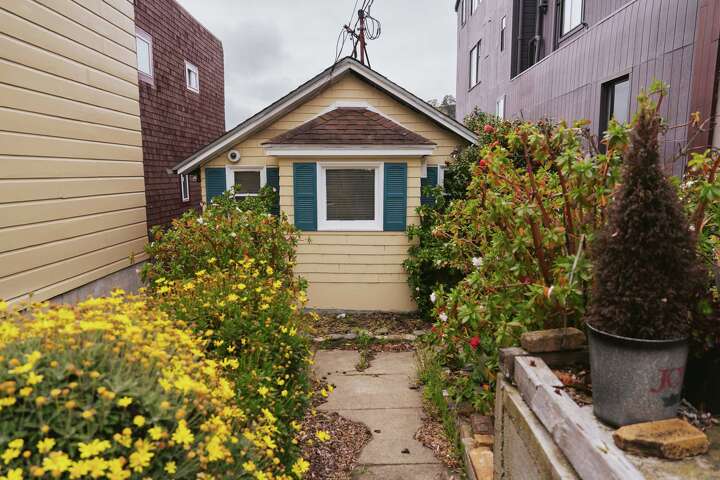
A 1906 earthquake shack in San Francisco’s Noe Valley, shown in 2023, was reduced to a roof and frame last week.
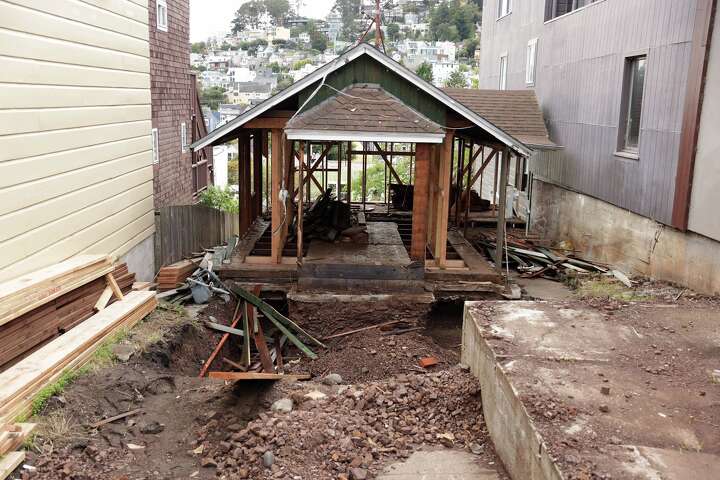
The roofs and frames are all that remain of a pair of 1906 earthquake refugee shacks at 369 Valley St. in Noe Valley after the rest of the structures was demolished last week. The shacks were joined to form one cottage.
The two shacks in question have been empty since the property sold in 2014. They are set back to the rear of the lot and pinned between taller residential buildings on both sides. The building at the back of the lot was unpermitted construction and was already demolished by the developer, Benjamin Steiner. From Norton’s property, he can see the weather vane of a rooster, though that is about all that is still standing.
Article continues below this ad
But the rubble from demolition is just as important.
“The debris is essential to any reassembly of the cottages,” Norton said. “We are demanding that the planning staff order the developer to leave everything as is, until a plan can be made to reassemble the cottages, under the supervision of a qualified preservation architect.”
On Friday, a next door neighbor sent photos to planning staff, complaining that the shacks were being destroyed. Agents from the Department of Building Inspection were sent out to stop work.
The developer, Benjamin Steiner, did not respond to requests for comment Sunday. San Francisco Supervisor Rafael Mandelman, who represents the district, also did not respond to a request for comment.
Jane Cryan, a preservationist known as the Cottage Lady, estimates there are now fewer than 20 earthquake cottages left in the city out of 5,610 built in the aftermath of the 1906 earthquake and fire. She took a census in 1983 and has been fighting for the dwindling supply, even after she was priced out of the city and living in Oshkosh, Wis.
Article continues below this ad
Cryan said the cottage at 369 Valley was made up of two shacks, one 10 by 14 feet and the other 14 by 18, and they were attached, as was the norm. Cryan, who has written two books on the shacks, said they were most likely hauled out of their original quake refugee camps in Precita Park and dragged up onto the 369 Valley by their owner, as was allowed once the camps closed in 1908. The third structure in the compound was built to mimic an earthquake shack but was not historic, and that’s why it was allowed to be demolished previously, she said.
“A whole lot of people became homeowners because of these shacks being built with the idea that people who paid $2 installments on them could take them to a lot and join two or three of them together and make a cottage out of them,” said Cryan, who lived in a cluster of three shacks in the Sunset District and was able to get them declared a city landmark. Cryan said a survey mounted in 2015 identified only 43 quake cottages in the city, with two sets in Noe Valley.
“Earhquake shacks were the greatest act of charity the world has ever known, and they’ve been mowed down by developers,” she said. “They are very endangered, and it is a terrible thing the city allowed to happen in Noe Valley.”



San Francisco, CA
Retired San Francisco firefighter dies from lung cancer after Blue Shield denies treatment claims

SAN FRANCISCO (KGO) — The retired San Francisco firefighter at the center of a bitter insurance fight has lost his battle against cancer.
Ken Jones passed away Saturday, 14 months after being diagnosed with stage four lung cancer.
PREVIOUS REPORT: City asked to intervene after SF firefighter’s stage 4 lung cancer treatment denied by Blue Shield
We first told you about Jones in January — when the 17-year veteran and supporters asked the City Commission for help.
The Fire Department’s insurance carrier, Blue Shield, denied coverage for some of his recommended treatments.
Ken Jones was 70 years old.
SF firefighters rally for retiree denied cancer treatment by Blue Shield as more come forward
“After we got some publicity, thank you, a Blue Shield physician reached out to Ken’s physician, and they worked out a different plan that Blue Shield would cover. It’s still an incomplete plan,” said Helen Horvath, Jones’ wife when ABC7 Eyewitness News spoke to her in January, 2026.
Since then, Jones’ story has led to an investigation into other cases, with the city’s mayor vowing to support firefighters.
According to San Francisco’s Health Service Board, about 5,000 city employees and retirees are insured by Blue Shield. Now, city leaders are asking anyone who has been denied cancer treatment to speak up.
Tony Stefani with the Cancer Prevention Foundation said firefighters with a cancer diagnosis have a 14% higher chance of dying than other cancer patients in the general population.
“Current statistics tell us that 65% of the men and women in our profession are going to contract some form of cancer in their lifetime. Some of them will be fatal,” Stefani said.
In a Statement Blue Shield said, in part: “For Medicare members, health plans must follow medical policy established by the Centers for Medicare and Medicaid Services (CMS).”
Copyright © 2026 KGO-TV. All Rights Reserved.

Few things are more valuable in the Bay Area than real estate. In San Francisco, the median house price is now over $2 million. Last month, at least seven houses in the city sold for $1 million over the asking price, and buyers regularly offer to pay in cash or waive contingencies to stay competitive. Yet there is one thing that remains even more valuable than a house, and possibly more valuable than money itself: stock in Anthropic or OpenAI.
Last week, 160 Noe Street, an Edwardian home in San Francisco’s desirable Duboce Triangle neighborhood, was listed for sale at $2.9 million—or the equivalent amount in Anthropic or OpenAI shares, as based on those companies’ current valuations. Rachel Swann, the listing agent, says she was inspired to set these unusual terms after meeting several Anthropic employees at an open house for a different property. “These people have a lot of paper wealth, but they don’t always have the liquidity to do things they want,” Swann says. Some of these employees were expecting to come into as much as $50 million from their Anthropic shares, and wondered if they could use that as leverage to buy a house, according to Swann. “This kept coming up over and over again.”
Swann’s listing is unconventional, but not singular. In April, an investment banker named Storm Duncan offered to exchange his Mill Valley home and an adjacent parcel of land for Anthropic shares. And in May, Vijay Chattha, who owns an agency that does PR for tech companies, listed his Healdsburg home for $2.5 million, or $2 million in Anthropic stock. “I want to sell my house, and I want to invest in Anthropic,” Chattha says. “Why not combine the two?
Chattha’s house—a three bed, three bath with a pool and a bocce court in a part of Sonoma County that abuts some of the region’s most famous wineries—also comes with coveted short-term rental status, allowing the owner to list it on platforms like Airbnb. Only a handful of properties in Healdsburg come with that status, and only about a dozen come up for sale in a given year.
Chattha is offering a $500,000 discount to Anthropic employees because he believes the value of Anthropic shares will grow faster than any other investment, and his vacation home in wine country is the best bargaining chip he has to try to access them. “If you look at Anthropic’s growth last year, it’s insane,” he says, noting the $380 billion valuation the company claimed in February. “Now they’re raising at $965 billion. That’s three X in like three months.” He added that he was open to exchanging the house for shares in Anthropic, but not OpenAI, because he prefers using Anthropic’s products.
The real estate listings come at a time when investors are salivating at the record-high valuations of Anthropic and OpenAI, and even those considered wealthy by Bay Area standards are feeling FOMO about the affluence that could come from these companies’ debuts on the stock market. (On Monday, Anthropic submitted paperwork for its initial public offering; OpenAI is also reportedly preparing to file in the coming months.) Despite the unprecedented valuations of these companies, many people believe their stock prices will only go up, and that anyone who gets a piece now could win the jackpot.
People are clamoring to buy equity in OpenAI and Anthropic on the secondary market, leading to a frenzy of transactions that may or may not be legitimate. As a result, Anthropic updated its policy around “unauthorized Anthropic stock sales” this spring, which notes that “if someone purports to sell Anthropic shares without proper board approval, that transaction is invalid.” A spokesperson for Anthropic pointed back to this policy when asked about the possibility of exchanging company shares for real estate.

Welcome to our running tally of Election Night results. Or, as this is California, well beyond tonight, as results continue to trickle in.
The first batch of results should arrive at 8:45 p.m., with three more to follow tonight. The Department of Elections has the breakdown.
San Francisco is voting in three special elections, for District 2 and District 4 supervisors and for a Board of Education member. Both supervisor races are referendums on housing, especially District 2, while the main backdrop of the D4 race is all the hot feelings around the fate of the Sunset Dunes Park (nee Great Highway).
The winners of all three special races will have to compete again in November for their seats.
Keeping it local, SF is also voting on four ballot measures. Prop A is for a bond to pay for an emergency water-system. B is for term limits. C and D are dueling measures related to the “overpaid CEO” tax. (Links go to our reporting on each race or issue; or click here for our Election 2026 page.)
Vote local, think national: Which two candidates will advance to the November election to replace Nancy Pelosi?
Statewide races include the primaries for governor, education superintendent, lieutenant governor, and much more.
Polls close soon. If you haven’t voted yet, find your polling station here.
Tuesday, June 2, 5:40 p.m.
Two and a half hours until our polls close. Before we go down the local rabbit hole, a reminder that other states have primary action today: New Jersey, Iowa, New Mexico, South Dakota, and Montana.
Why does it take so long to get results in California? CalMatters has you covered on that story. We shouldn’t expect a call tonight on the governor’s race.
The last big election was November 5, 2024. (Remember?) Ten days later, there were still races to call in San Francisco.
So if you’re waiting for the pundits (and maybe even us) to tell you What It All Means, you might have to wait a while.
More from The Frisc…
-

 Los Angeles, Ca5 minutes ago
Police investigate deadly stabbing in Tarzana; suspect in custody
-

 Detroit, MI25 minutes ago
Detroit Tigers sweep Tampa Bay Rays in win as Dillon Dingler stays hot
-

 San Francisco, CA35 minutes ago
Retired San Francisco firefighter dies from lung cancer after Blue Shield denies treatment claims
-

 Dallas, TX40 minutes ago
Trackdown: Dallas 7-Eleven robbery suspect wanted
-

 Miami, FL47 minutes ago
This new Italian restaurant in Brickell only has 10 items on the menu
-

 Boston, MA50 minutes ago
Visiting Boston this summer? Here are 8 navigation tips you need to know.
-

 Denver, CO55 minutes ago
Denver-ish Central Market? RiNo food hall vendors claim they’ve been pushed out
-

 Seattle, WA1 hour ago
New Ben & Jerry’s location opening at Seattle waterfront’s Pier 54

