Northeast
Migrant influx pushing Mass. shelter costs past $1B in FY25: report

NEWYou can now listen to Fox News articles!
Massachusetts taxpayers are on course to spend $1 billion on the state’s emergency shelter program for FY25 with migrant families making up a significant share of those receiving assistance, according to a new report.
Gov. Maura Healey’s administration has already spent $830 million so far in FY25 – which started on July 1 – accommodating more than 4,000 families who have been receiving taxpayer-funded shelter, food, education, legal aid and case management.
The costs work out at about $3,496 per week per family, or around $1,000 per person per week for the program, known as the Emergency Assistance (EA) system.
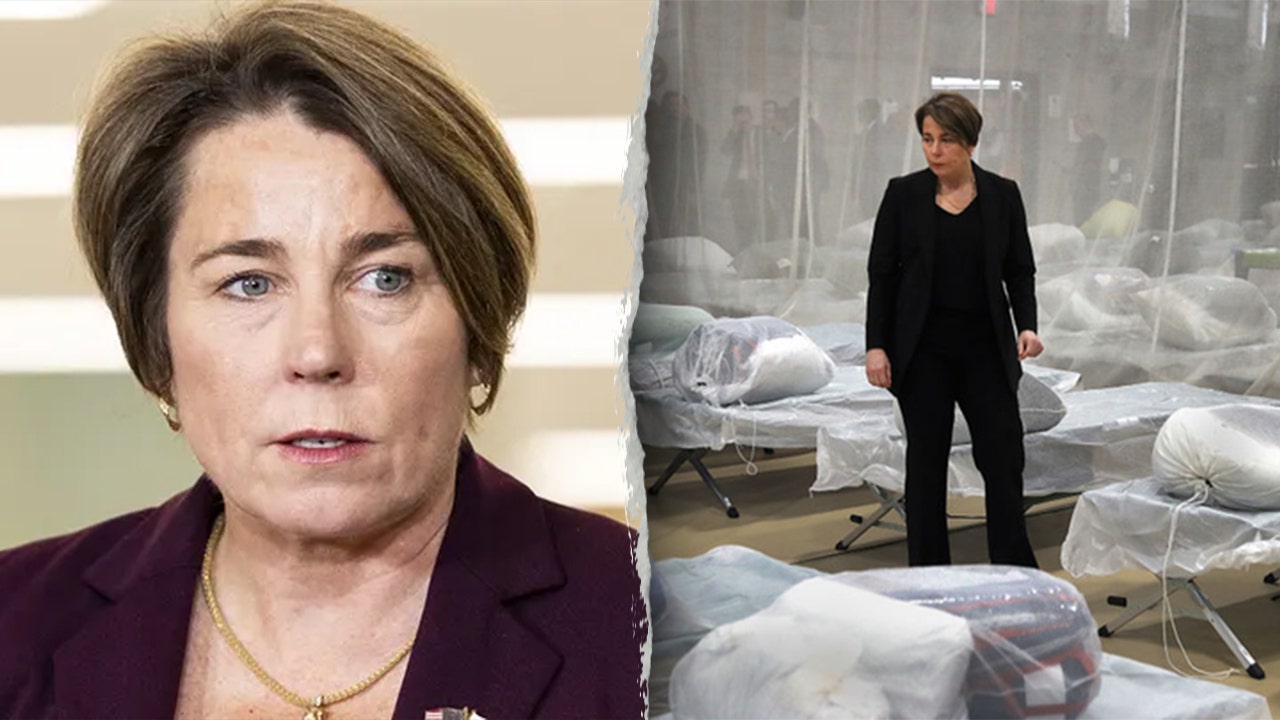
Gov. Maura Healey’s administration has already spent $830 million so far in FY25 – which started on July 1 – accommodating more than 4,000 families who have been receiving taxpayer-funded shelter, food, education, legal aid and case management. (Adam Glanzman/Bloomberg via Getty Images; Getty Images)
ILLINOIS PROJECTED TO SPEND $2.5B ON MIGRANTS BY END OF 2025, REPORT CLAIMS
The report, a June 16 biweekly update from the Massachusetts Executive Office for Housing and Livable Communities, notes that $679.6 million was spent on direct shelter costs and another $149.7 million on wraparound services, including education aid, work programs, National Guard payroll for security and rental assistance to help individuals exit the system.
Around 1,600 of the total 4,088 families currently in the system are migrants, per the report, although that figure is likely much higher as many migrant families are counted as “Massachusetts residents” for the purpose of eligibility.
The state was overwhelmed by an influx of migrants under the Biden administration and struggled to accommodate them. Many migrants ended up sleeping at Logan Airport as the Healey administration worked to set up temporary shelters, many of which are at hotels.
There are currently 599 hotel rooms being used under the program and the report states that all hotels being used under the program will be shuttered this year.
Already, the number of hotels being used as shelters has dropped to 28, down from a peak of more than 100, according to the report.
“The administration is on track to reduce [the] caseload to 4,000 families and close all hotel shelters by the end of the calendar year,” the report states. It follows Healey, a Democrat, saying last month too that all hotel shelters would be shuttered by the end of the year. She said the number of people in the EA system had dipped below 5,000 last month, as well.
Boston Mayor Michelle Wu and Massachusetts Governor Maura Healey paused to look at the Army cots set up on the gym floor as State and local officials toured the Melnea A. Cass Recreational Complex. (John Tlumacki/The Boston Globe via Getty Images)
BLUE STATE GOVERNOR SOUNDS OFF ABOUT ‘DISTURBING’ ICE OPERATIONS ON AFFLUENT LIBERAL ISLANDS
“Closing hotel shelters is essential to making sure that families are set up for success and to save our state hundreds of millions of dollars a year,” said Lt. Gov. Kim Driscoll said last month.
The report comes as the influx of new migrants has all but ended given border crossings are at historic lows.
On Tuesday, Trump administration border czar Tom Homan said Border Patrol encountered just 95 illegal immigrants in a single day and that zero migrants were released into the U.S. last month.
Mike Kennealy, a Republican running for governor who previously served as housing and economic development secretary, blasted the report.
He said that taxpayers are “being forced to bankroll billions to an unaccountable, broken system that perpetuates the migrant crisis—and we’re fed up,” per the Boston Herald. “While families are struggling to afford everyday necessities, the state is shelling out $15,166 per family per month. It’s not just insane — it’s offensive.”
Brian Shortsleeve, who is also running for governor as a Republican, criticized the governor’s leadership and said her policies were unfair to taxpayers.
“Maura Healey has made Massachusetts a migrant magnet with the value of their taxpayer-funded state benefits, nearly doubling the household income of the typical Massachusetts family,” Shortsleeve said. “At a time when our people are struggling just to get by under Healey’s smothering cost of living, her warped sense of justice adds insult to injury.” “While families are struggling to afford everyday necessities, the state is shelling out $15,166 per family per month. It’s not just insane — it’s offensive.”
Fox News reached out to Healey’s office for comment but did not immediately receive a response.
Migrants at Logan Airport last year. (Erin Clark/The Boston Globe, left, Joseph Prezioso, top right, David L. Ryan/The Boston Globe , bottom right.)
The report also notes that 1,599 individuals in the EA system are currently employed, and 2,270 migrants have received work authorizations.
With the fiscal year ending June 30, Massachusetts is likely to exceed $1.06 billion, the report forecasts.
Read the full article from Here



Multiple people were taken to the hospital following a crash on Interstate 91 in Hartford, officials said.
The Hartford Fire Department was called to the crash just before 6 p.m. The crash involved six to eight vehicles, according to officials, and happened on the southbound side near exit 33.
Multiple ambulances were also called to the scene, including one advanced life support unit.
Fire officials said all patients were helped at the scene before being taken to the hospital. It’s unknown at this time how many were injured and the severity of their injuries.
The Connecticut State Police assisted with traffic control and will investigate the crash.

A Massachusetts photographer was seriously injured when he was stabbed during a wedding reception last month in Raymond, Maine.
Donald Halsing, 26, was hospitalized for five days after the stabbing on May 23. NBC affiliate News Center Maine reported that 26-year-old Andrew Manderson was arrested and charged with elevated aggravated assault.
Still recovering, Halsing told NBC10 Boston the attack came out of nowhere — one moment, he was snapping photos on the dance floor, while the next, he was searching for help as blood spilled onto his camera.
“I was sitting there in that chair thinking, ‘There’s a real possibility I could die here,’” Halsing said. “Immediately, I put my hand on my chest here to try and stop the bleeding, get some pressure on it, and started yelling for help.”
Halsing was working at the reception at the Kingsley Pine Campgrounds. He took his last photo at 9:01 p.m., minutes before the stabbing.
“One of the wedding guests came up to me and started asking questions about our business,” he said.
Halsing said it was nothing out of the ordinary, and he tried to explain his photography business to the inquiring guest through the pulse of the DJ booth and celebrating guests.
“I thought he was going to reach in his back pocket for his phone, and instead, he didn’t pull out his phone — he pulled out a pocket knife and stabbed me,” he said.
Manderson, who faced a judge days later, is a cousin of the bride.
“There was this look in his eyes that he wasn’t quite all there,” Halsing said.
Halsing’s fiancée, Ashley Wall, was feet away as he struggled to stay awake. She has been his photography partner for eight years since they met at Framingham State University, and she was helping him work the wedding.
“People who were around me, they asked, ‘What can we do to help you? What do you need?’ And I said, ‘Please go check on Ashley. Please go check on my fiancée,’” he recalled.
Halsing spent five days in the hospital suffering from two lacerations to his liver, ultimately developing a blood clot in his left leg. But the road to recovery exceeds his physical wounds as he contemplates his mental state when he resumes photography next year.
“I’m also worried about what lingering effects there might be,” he said. “If we get out on the dance floor and I start remembering what happened, I don’t know how I’m going to react.”
Halsing still doesn’t know why he was attacked.
Manderson was released on $50,000 bail and is due back in court in October.

Twenty-eight lawmakers dissented Wednesday as the Massachusetts House voted to set new terms around what state Auditor Diana DiZoglio would be able to review in the legislative audit voters authorized her to carry out in 2024.
Almost all House Democrats voted for the measure, which also proposes to make more state government records accessible to the public. Three Democrats — Cambridge Rep. Mike Connolly, Attleboro Rep. Jim Hawkins and Fall River Rep. Alan Silvia — joined the body’s 25 Republicans in voting no.
Speaker Ron Mariano said the bill responds to an ongoing call from voters for more transparency out of Beacon Hill and provides a path forward in lieu of a what he called “politically motivated audit conducted in violation of the Constitution.”
Leaders of the House and Senate have resisted DiZoglio’s audit push, arguing that a probe by the auditor’s office would run afoul of the separation of powers laid out in the state Constitution, bringing the legislative branch under the review of a piece of the executive branch.
“We are not accountable to any constitutional officer,” said Rep. Mindy Domb, an Amherst Democrat. “We are only accountable to our constituents.”
Taunton Rep. Lisa Field, a Democrat in her first term, said she was among the 72% of Massachusetts voters who backed the audit ballot question in 2024.
“Due to legitimate concerns and questions about constitutional privileges and separation of powers, we have been stuck on this audit issue for more than a year,” Field said. “Let’s not be like Washington, D.C. and accept such gridlock — not about the audit and not about public records. Let’s not let perfect be the enemy of good progress.”
The House’s bill would authorize DiZoglio to review what it defines as the “administrative functions” of the Legislature, going back to the 2021 fiscal year. Those areas include the adoption of annual budgets, official audits of the House and Senate by independent firms, spending by both chambers, and the execution of any financial settlements with lawmakers and employees.
It would also newly apply the state’s public records law to the governor’s office, and create a process by which people could request and receive certain legislative files.
Massachusetts is currently the only state where the Legislature, governor and judiciary all claim to be exempt from the public records law.
Warren Republican Rep. Todd Smola described the process that led up to Wednesday’s vote as opaque in and of itself. Mariano last week said the House would take up what he called comprehensive transparency legislation, but did not say when or what, specifically, the bill would do.
The bill was circulated to members of the House Ways and Means Committee around 10:30 a.m. Tuesday, and committee members had a little over a half hour to vote on whether to advance it. Smola, the ranking Republican on the committee, said during that 34-minute window, “we had members on both sides of the political aisle that were calling each other back and forth to say, ‘Can you explain this portion to me?’”
“We are so much better than the process that has unfolded,” he said. “And for the sake of people that are asking us for transparency, that is not transparency. That’s the opposite of transparency.”
Rep. Michael Soter, a Bellingham Republican, said he was particularly concerned with a part of the bill that removes the courts from settling disputes between the auditor and the Legislature.
He said that by setting its own rules around an audit, the House would be “ensuring the auditor can only see exactly what we allow her to see and nothing more.”
It’s not clear yet if the Senate will pass the bill. Last week, state senators voted to turn over a limited set of documents to DiZoglio. The documents the Senate plans to provide mirror the records she would be allowed to review under the House bill.
Asked if he expected the Senate to agree to the legislation, Mariano on Tuesday said only, “I talked to the Senate.”
-

 Arizona2 minutes ago
Arizona’s dry heat may be deadlier than we thought
-

 Arkansas9 minutes ago
Texas bee swarm hospitalizes 3; Arkansas doctors explain warning signs of severe reactions
-

 California12 minutes ago
California man charged with bringing explosives to Sacramento airport after repeatedly calling FBI tip line | CNN
-

 Colorado17 minutes ago
Farming in Colorado’s vast Uncompahgre Valley
-

 Connecticut24 minutes ago
Several injured in I-91 crash involving multiple vehicles in Hartford: Officials
-

 Delaware27 minutes ago
Delaware Lottery Powerball, Play 3 Day winning numbers for June 3, 2026
-

 Florida32 minutes ago
Now hitting deadline, Florida flunks Everglades pollution cleanup
-

 Georgia39 minutes ago
Lambert rising freshman is second-youngest winner of Georgia Women’s Amateur

