Newly appointed University of Hawaii athletic director Matt Elliott speaks to the Star-Advertiser’s Stephen Tsai and Dave Reardon after the Board of Regents meeting today.
2/2
Advertisement
Swipe or click to see more
COURTESY UNIVERSITY OF HAWAII
Matt Elliott was confirmed today as the new University of Hawaii athletic director.
Advertisement
Advertisement
Matt Elliott, a key administrator at UCLA for 13 years and with the Hawaii Community Foundation for the past 18 months, today was named as the University of Hawaii’s athletic director.
Advertisement
Two weeks ago, UH president Wendy Hensel recommended Elliott from an initial field of more than 110 applicants. Hensel’s recommendation was confirmed during today’s special Board of Regents meeting on the UH Manoa campus.
Hensel made an official recommendation during the meeting. Ten regents then met in a 30-minute executive session. The regents unanimously approve Elliott.
Gabe Lee, BOR chair and co-chair of the search committee, described Elliott as the “best overall candidate.”
Regent Neil Abercrombie said Elliott will need more community support. Abercrombie also said Elliott faces the challenge of replacing Aloha Stadium, which was shuttered for spectator-attended events in December 2020.
Regent Lauren Akitake said Elliott’s law background will be useful in leading UH’s 21-sports program. Elliott has a law degree from Northwestern University.
Advertisement
Don’t miss out on what’s happening!
Stay in touch with breaking news, as it happens, conveniently in your email inbox. It’s FREE!
At UCLA, Elliott was instrumental in the Bruins’ move from the Pac-12 to the Big Ten.
Most Americans grow up learning about European royal families, from the British monarchy to the kings and queens who shaped the history of countries like France and Spain. But what many don’t realize is that Hawaii was once its own sovereign kingdom before it become a U.S. state, and there’s still a royal palace right in O‘ahu.
During a recent visit to Honolulu’s ʻIolani Palace, I found myself standing in rooms that challenge the assumptions travelers make about Hawaii. Beyond the beaches, luaus and pineapple drinks lies the story of a nation that once had its own monarchs, government and global relationships. Walking through the palace’s grand halls—and later, the room where Queen Liliʻuokalani was imprisoned—gave me a powerful reminder that Hawaii’s royal history is far more recent and more complex than many Americans realize.
ʻIolani Palace historian Zita Cup Choy tells Marie Claire that understanding Hawaii was once an independent nation fundamentally changes the visitor experience. That being said, Iolani Palace, built in 1882, serves as “both a royal residence and a place where a nation’s history, dignity and loss are held,” Cup Choy says.
Latest Videos From
The palace is located in the heart of Honolulu.
Advertisement
(Image credit: Getty Images)
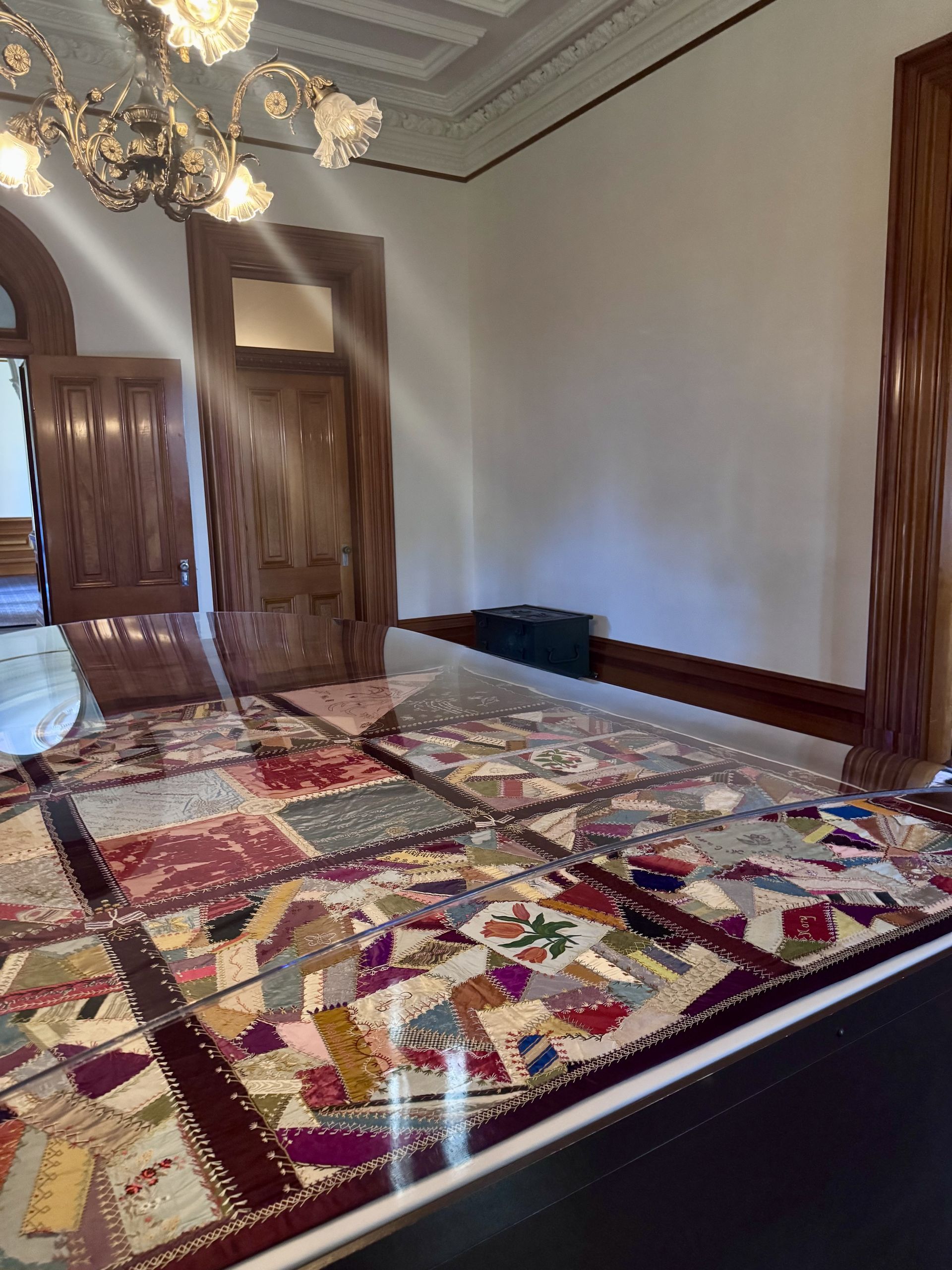
The room where Queen Liliʻuokalani was imprisoned showcases a quilt she made while being held in the room, with the center reading, “Imprisoned at Iolani Palace, Honolulu, Oʻahu, we began this quilt there.”
(Image credit: Kristin Contino)
Queen Liliʻuokalani was the Hawaiian kingdom’s last monarch, and she was imprisoned for nearly eight months in the palace after being illegally overthrown by a coup of American businessmen in 1893. “The overthrow was carried out by a small group with significant economic and political power, despite broad opposition among Hawaiian Kingdom subjects,” says Cup Choy.
The queen was forced to abdicate and lived the rest of her life as a private citizen until she died in 1917, dedicating her time to preserving Hawaiian culture and causes related to women and children such as the Lili‘uokalani Trust.
Advertisement
For many guests, myself included, the most emotional stop on the tour is the room where the queen was held. In the center of the Imprisonment Room sits a glass case displaying the quilt that Queen Liliʻuokalani worked on with her companions during her house arrest, and it reads more like a diary, with the piece stitched with significant dates and names of her supporters.
Queen Liliʻuokalani was the last reigning monarch of the Hawaiian kingdom.
(Image credit: Getty Images)
Portraits of Hawaii’s royal family line the rooms in the palace.
Advertisement
(Image credit: Kristin Contino)
As a royal editor, one of the things that struck me the most was the similarity of ʻIolani Palace’s throne room to what you’d see at Buckingham Palace. The elaborate gowns on display reflect a Victorian style, and photos on display show the Hawaiian royals visiting the British royals.
Get exclusive access to fashion and beauty trends, hot-off-the-press celebrity news, and more.
Cup Choy says that “visitors are often surprised to learn that, despite Hawaii’s geographic isolation, the kingdom was modern, globally aware and intentional in how it presented itself to the world.” This includes innovations like electric lighting and telephones, showing how Hawaii was “an educated, literate and technologically advanced kingdom.”
Queen Liliʻuokalani remains one of the most revered figures in Hawaiian history, and Cup Choy says visitors are particularly moved by the monarch’s response to adversity.
Advertisement
Instead of encouraging violence, the queen “believed the wrong done to Hawaii should be addressed through diplomacy, international law, constitutional law, the courts and the Hawaiian Kingdom’s own governing institutions,” Cup Choy says. “She sought restoration without further bloodshed.”
The Friends of ʻIolani Palace commissioned historic dress designer Iris Viacrusis to recreate four of the gowns worn by Her Majesties Kapiʻolani and Liliʻuokalani, like this peacock-themed design on display in the palace.
(Image credit: Kristin Contino)
Marie Claire’s senior royal and celebrity editor, Kristin Contino, visits ʻIolani Palace in April 2026. Protective shoe coverings help preserve the building’s floors and carpets.
(Image credit: Kristin Contino)
Advertisement
With its rich red decor, the palace’s throne room feels similar to Buckingham Palace.
(Image credit: Kristin Contino)
Walking through the palace, it’s hard not to feel moved by the story of Hawaii’s royal family, and Cup Choy says there’s a careful balance between being a tourist attraction and “a sacred place in Hawaii’s history.”
As I learned during my recent trip, O‘ahu is full of rich cultural offerings, and Cup Choy says ʻIolani Palace works with travel partners to encourage visitors to the island to explore outside its beaches. Select properties like the Halekulani Hotel, one of the Leading Hotels of the World properties where I stayed on the island, offer free admission to the palace as part of a broader mission to introduce travelers to Hawaii’s story.
“Hawaii is often seen first for its natural beauty,” Cup Choy says. “The palace invites visitors to see the depth of its history and the responsibility to care for its people, culture and environment.”
Logan Kalawaia. PC: Lahaina Restoration Foundation
Maui musician Logan Kalawaia will headline the next installment of the Hawaiian Music Series from 6 to 7:30 p.m. Thursday on the lawn of Waiola Church in Lahaina, according to concert series organizer Lahaina Restoration Foundation.
Advertisement
Parking is available onsite for the free concert, with additional spaces provided by the Lahaina Hongwanji Mission next to the Waiola Church lot. Attendees are encouraged to bring blankets, mats or low-back beach chairs for seating on the lawn.
Kalawaia was born and raised on Maui and comes from a family with deep roots in Hawaiian music, drawing inspiration from his father and uncles. He has performed professionally since a young age and is known in Maui’s music community for a contemporary sound grounded in the traditions and storytelling of Hawaiian mele.
Music has long played a role in bringing the Lahaina community together, and the organization, in partnership with Waiola Church, is continuing that tradition by providing a gathering space for residents to reconnect and celebrate Hawaiian music.
Now in its 18th year, the Hawaiian Music Series is supported by the Maui County Office of Economic Development and parking fee revenues. Waiola Church is hosting the series for 2026.
More information is available at lahainarestoration.org.
HONOLULU (HawaiiNewsNow) – One of Hawaii’s sweetest partnerships is returning with a larger footprint this year.
In celebration of National Pineapple Day and Dole’s 125th anniversary, residents who donate blood on Friday, June 26, will receive a free fresh Dole pineapple while supplies last.
The effort is a collaboration between Dole Food Company and Blood Bank of Hawaii aimed at boosting donations during a time of year when blood supplies traditionally decline.
According to Blood Bank of Hawaii, donations typically drop by about 15% during the summer months, even as hospitals continue to rely on a steady stream of lifesaving blood products every day. Organizers say all blood types are needed, with a particularly urgent demand for O-type blood, platelet donations, and AB plasma.
Advertisement
The campaign also comes during a milestone year for Dole.
The company is celebrating 125 years of pineapple history, commemorating the fruit that helped shape Hawaiʻi’s agricultural identity and introduced generations around the world to the islands’ pineapple legacy.
This year, blood donors will receive not only a pineapple, but commemorative Dole-branded anniversary gifts while supplies last.
National Pineapple Day recognizes a fruit often called the “fruit of kings.” Though pineapples originated in South and Central America, they became deeply intertwined with Hawaiʻi’s history after James Dole established commercial pineapple operations in the islands in the early 1900s. Today, Dole continues operating facilities in Wahiawā while promoting initiatives centered around nutrition and community wellness.
Unlike previous years, organizers are expanding the giveaway to every Blood Bank of Hawaii donor center and mobile drive location participating on Friday.
Advertisement
Donation sites include:
Young Street Donor Center
1907 Young Street, Honolulu
6:30 a.m. to 4:30 p.m.
Waikele Center
94-849 Lumiaina Street, Waipahu
7 a.m. to 3 p.m.
Advertisement
Windward Mall
46-056 Kamehameha Highway, Kāneʻohe
9 a.m. to 3 p.m.
Hyatt Regency Waikiki
2424 Kalākaua Avenue, Honolulu
9 a.m. to 3 p.m.
Pearlridge Center
98-1005 Moanalua Road, ʻAiea
Advertisement
Noon to 6 p.m.
Appointments are strongly encouraged and can be made through Blood Bank of Hawaii’s website or by calling (808) 848-4770.
Copyright 2026 Hawaii News Now. All rights reserved.