Northeast
Video captures New York grandmother, children narrowly avoiding manhole explosion

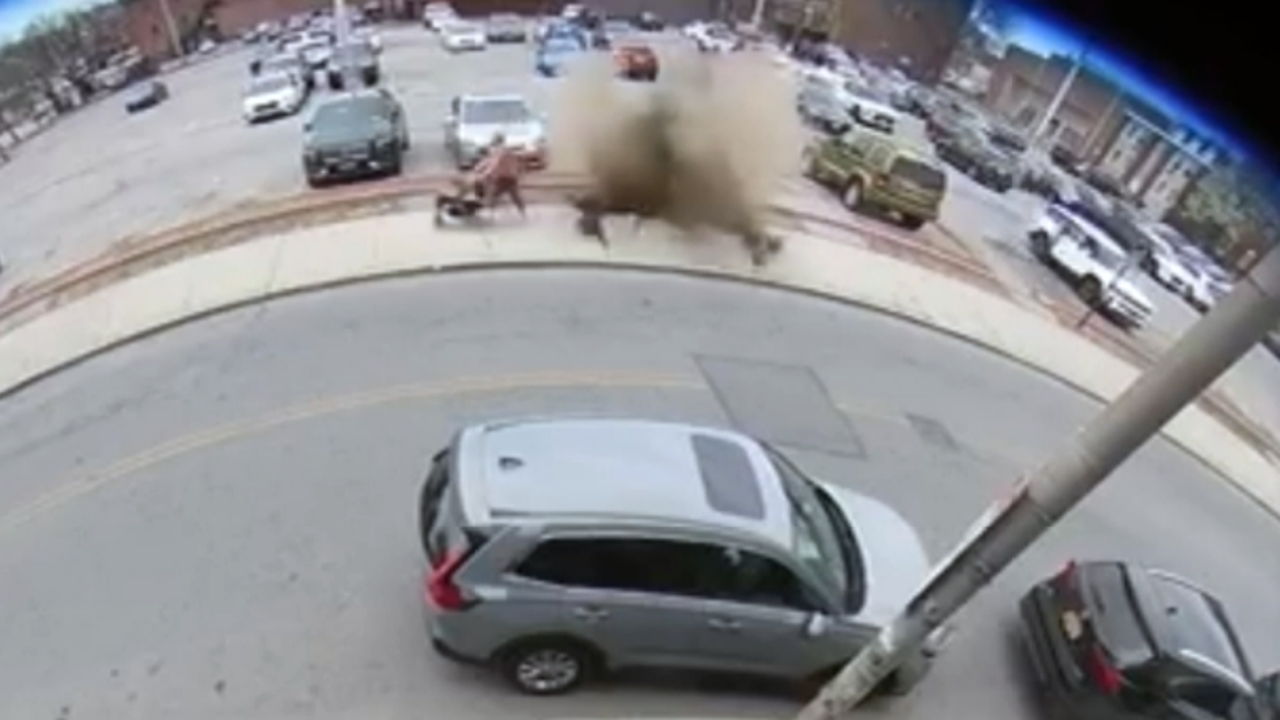
A New York woman and two young children were seen narrowly avoiding a manhole explosion in a dramatic incident captured on video.
Lisa Davis just missed the blast on Saturday in Poughkeepsie as she and her two grandchildren were walking on a sidewalk after an Easter egg hunt, according to ABC News.
“I was like, ‘Oh my God, I don’t know.’ I didn’t know where to go,” she told the station. “I didn’t know what to do except grab my grandson and run.”
Footage shows a woman walking over the manhole cover while pushing a stroller alongside a young child. Seconds later, the cover explodes, sending concrete into the air.
VIDEO: DRAMATIC BODYCAM FOOTAGE CAPTURES MOMENT FIREFIGHTER IS RESCUED AFTER HOME EXPLOSION
A manhole is seen exploding in Poughkeepsie, N.Y., on April 19. (Poughkeepsie Fire Department)
The Poughkeepsie Fire Department said, “A manhole halfway down the block as well as another on the corner of Academy and Church Streets had also exploded very narrowly missing three pedestrians.”
“Companies found high levels of carbon monoxide in multiple buildings and the occupants of all the buildings on that block were evacuated until the gas levels could be mitigated,” it also said.
‘JESUS’ BUS BURSTS INTO FLAMES FOLLOWING MASSIVE EXPLOSION
The grandmother and her two grandchildren are seen fleeing the area of the explosion. (Poughkeepsie Fire Department)
A spokesperson for Central Hudson Gas & Electric Corp. later told Mid Hudson News that the explosion “was the result of an electrical fault on an underground cable and is not related to our natural gas distribution system.”
The woman and two children are seen walking over the manhole in the moments leading up to the explosion. (Poughkeepsie Fire Department)
“While manhole events stemming from electrical faults are not uncommon, they can still pose risks of damage or injury. Fortunately, we’ve been informed that no one was hurt in this instance,” the spokesperson also said.
Read the full article from Here


More than six dozen Connecticut laws addressing the state’s housing growth, absentee ballot rules, availability of AI resources and more will wholly or partially take effect on July 1.
Connecticut laws are passed by the General Assembly during the legislative session each year — this year’s ran from Feb. 4 to May 6. They typically take effect on Jan. 1, July 1 or Oct. 1.
Here’s a look at some of the dozens of laws that will be implemented in July.
Zoning reform
Portions of a wide-ranging housing bill that Gov. Ned Lamont signed into law last year will go into effect on July 1.
Starting that day, towns must allow the development of mixed-use or “transit community middle housing” — a residential building containing anywhere from 2-9 units — on land zoned for mixed-use or commercial use.
Additionally, towns can no longer reject a proposed housing development with up to 16 units due to a lack of off-street parking unless there is a documented adverse impact on public health.
Gov. Ned Lamont signed the omnibus housing bill following last year’s special session, replacing a similar bill that he vetoed during the regular session. Its goal was to address the state’s dire lack of affordable housing. Other measures in it that have already taken effect include a requirement that towns create housing growth plans, an expansion of fair rent commissions and incentives for towns to take steps to allow more housing.
Connecticut AI Academy
The Board of Regents for Higher Education must establish a “Connecticut AI Academy” through Charter Oak State College by Dec. 31. The academy will offer online AI courses, promote digital literacy, prepare students for AI-related careers, offer community resources and help develop workforce training programs.
Senate Bill 5 also requires the establishment of a formal working group to study AI and make recommendations to the legislature. And it requires the state to consider planning around emerging technologies — like AI, quantum computing, or robotics — when creating an economic development strategic plan.
Absentee ballots
No-excuse absentee ballots are now available for all elections starting July 1.
Any voter, including those who are not yet 18 but will be by the day of an election, can request an automatic application for an absentee ballot. Voters will remain on a registry to receive them for all elections unless they are removed from the official registry list.
Connecticut is joining 28 other states that already have no-excuse absentee voting.
House Bill 5001 also says a person can only wear a mask or other covering within 250 feet of a polling place if doing so is “reasonable given the weather conditions” and the person is willing to remove it at request, or if it is for medical or religious purposes.
Psychedelic-assisted therapy
Beginning July 1, any individual who is 18 years or older and meets the clinical criteria is eligible to participate in a psychedelic-assisted therapy pilot program administered by a medical school in the state, currently Yale University.
According to Senate Bill 191, this program will provide qualified patients with MDMA-assisted or psilocybin-assisted therapy as a part of a federal Food and Drug Administration research program.
MDMA, also known as Ecstasy or Molly, is a stimulant with psychedelic properties. Psilocybin is a hallucinogen that is found in some species of mushrooms. These substances are used to treat patients with PTSD, depression and substance abuse disorders.
Bus passes for residents
Public school students in grades 9-12 are eligible for free bus passes through their local and regional boards of education starting July 1.
Senate Bill 9 will provide education boards with grant funding for this program. However, they have to provide financial statements proving that the money was used for transit funding.
The Department of Veterans Affairs is launching a similar program for all veterans in the state also starting July 1.
Breast cancer screening
Starting July 1, the Commissioner of Correction can arrange breast cancer screening, diagnosis and treatment services for incarcerated women at any licensed health care institution that is closer to the correctional facility, rather than being limited to the UConn Health Center.
Senate Bill 391 also says if the commissioner can not provide a required diagnostic and screening mammogram, they can arrange for its provision at a health care institution closer than UConn Health Center.
Connecticut’s only correctional facility for women is York Correctional Institution in Niantic, which is more than 50 miles away from UConn Health Center. There are fewer than 900 women at York.
This story was originally published by the Connecticut Mirror.

FRIENDSHIP, Maine — A federal judge has ordered U.S. Immigration and Customs Enforcement not to relocate a Friendship man who ICE agents arrested Saturday.
Dhavalkumar Kalidas Patel was seized by four ICE agents at Wallace’s Market, which Patel and his wife operate on Harbor Road in Friendship.
His wife said the agents did not say why he was being taken away in handcuffs.
Attorney Audrey Richardson of Greater Boston Legal Services filed a motion for habeas corpus, meaning he is to be brought to a court in person.
U.S. District Court Judge Indira Talwani of Massachusetts issued an emergency order hours after Patel was seized that prohibits him from being moved elsewhere.
“To provide a fair opportunity for the judge who will be randomly assigned to this case to review the merits of the petition and to rule on any contested issues of jurisdiction, unless otherwise ordered by the assigned judge, respondents will not remove the petitioner from the jurisdiction of the United States or transfer petitioner to a judicial district outside that of Massachusetts for a period of at least 72 hours from the time this Order is docketed,” Talwani wrote.
Patel is being held at the Plymouth County Correctional Facility in Plymouth, Massachusetts.
The petition filed by the attorney representing Patel argues that he is being held unlawfully.
No further hearing dates have been scheduled, but the federal government has until July 6 to file a response.
Richardson issued a statement on the arrest.
“This is another example of ICE illegally and illegitimately taking someone who is working hard to support their family,” she said, including a child born in the United States. “The family is a critical part of the fabric of a small community.”
The Patels have operated the store since 2024. The attorney said ICE agents initially did not even identify themselves. They did not say where he was being taken but he was allowed to make a call when they stopped in Scarborough.
Rob Sample, a customer of the store, said he could not understand why such an action was taken.
“We appreciate them,” he said of the Patel family, adding that they work hard to provide a community service by operating the store.
Knox County Sheriff Patrick Polky said ICE notified his department after its action. He noted the agency is not required to notify the department.
Patel is a native of India.
This story appears through a media partnership with Midcoast Villager.

BROCKTON, Mass. (WJAR) — Four people were shot on Friday night after hundreds had gathered to watch a World Cup match in Massachusetts.
Police said the shooting happened just before midnight on Main Street in Brockton.
Officers said the victims were taken to the hospital.
BE THE FIRST TO COMMENT
Police have not said if there were any arrests.
-

 Alabama4 minutes ago
Are fireworks legal in Alabama? 7 explosives that might be allowed
-
 Alaska7 minutes ago
Jesuits say goodbye to Alaska at Bethel ceremony
-

 Arizona12 minutes ago
Series Preview #28: Giants @ Diamondbacks
-

 Arkansas19 minutes ago
Harrell Wilson enters Arkansas Senate District 1 race as Gilmore seat opens
-

 California22 minutes ago
Suspected Northern California library shooter charged with murder, faces life in prison
-
Connecticut37 minutes ago
New CT laws taking effect July 1: Absentee ballots, zoning, AI
-

 Delaware42 minutes ago
State Police Investigating Shooting in Newark – Delaware State Police – State of Delaware
-

 Florida49 minutes ago
10 places to watch the fireworks in South Florida for 4th of July 2026

