Politics
More immigrants opt to self-deport rather than risk being marched out like criminals


Celeste traveled from Peru to the U.S. two decades ago, then a young woman of 19, and overstayed her tourist visa. She had studied graphic design back home but, unable to work in her field without papers, instead found arduous work cleaning hotel rooms and offices in Los Angeles. She built a life here, making friends and taking courses at a local community college. She paid her taxes annually, hoping she could one day gain legal status.
But years passed without the dramatic reforms needed to reshape and unclog the legal pathways to U.S. citizenship. And in the months since President Trump started his second term, her American dream has imploded. She’s unnerved by the news images of undocumented immigrants being loaded onto planes, shackled like violent criminals, and returned to their native countries. The thought of being ripped from her home, without time to pack up her belongings or say goodbye to friends, shakes her to the core.
So, Celeste has made a tough decision: She will continue cleaning offices and saving money for just a few more months, and return to Peru by year’s end.
Even with a plan to leave, she feels vulnerable and exposed. She now avoids restaurants, her favorite dance spots, even trail hikes. She’s stopped enrolling in online classes, she said, because she’s apprehensive about registering her name or address.
“The fear that they could grab you is always there,” said Celeste, who asked that The Times not use her full name for fear of making her a target for immigration authorities.
Trump came into his second term promising the largest deportation effort in U.S. history. During the campaign, he focused his rhetoric on undocumented immigrants who had committed violent crimes. But shortly after he took office, his administration made clear that they considered anyone in the country without authorization to be a criminal.
In the months since, the new administration has used a variety of tactics — explicit and subtle — to urge immigrants to depart the country of their own accord.
The day he was inaugurated, Trump disabled the CBP One mobile app that the Biden administration had utilized since 2023 to create a more orderly process of applying for asylum from the U.S.-Mexico border. Thousands of migrants camped at the border had their asylum appointments abruptly canceled.
Instead, the Trump administration launched a replacement app, CBP Home, that allows immigrants to notify the government of their intent to leave the country. The Department of Homeland Security did not respond to The Times’ request for data regarding the number of people who have used the app.
Last month, the agency launched an ad campaign urging people in the country without authorization to leave immediately. “If you don’t, we will find you and we will deport you,” agency Secretary Kristi Noem says in the ad. This week, Trump told Fox Noticias he’s formulating a plan to give a stipend and an airplane ticket to immigrants in the country illegally who opt to “self-deport.”
The administration isn’t just targeting undocumented immigrants. In recent weeks, Homeland Security has messaged migrants who entered the country using the Biden-era CBP One app, telling them their temporary legal status has been terminated and they should leave “immediately.”
And then there are the images of the migrants deported to a notorious El Salvador prison, shackled one behind the other in prison garb, their heads bowed and shaven. The administration invoked the Alien Enemies Act of 1798 to remove the Venezuelan nationals without due process, alleging they were all gang members.
“One of the impacts of the various Trump policy measures is to strike terror and fear in immigrant communities,” said Kevin Johnson, a professor of public interest law at UC Davis School of Law. “It’s designed to show immigrants, ‘We’re out to get you.’”
Three months in, it’s difficult to estimate how many people are making the grueling decision to leave the lives and families built here under more lenient enforcement policies to return to home countries that many have not seen for decades.
But even in liberal-leaning California, where undocumented immigrants enjoy greater access to social services than in many regions of the U.S., advocates say they are fielding more questions from people who fear being plucked up and deported and are considering leaving on their own terms.
Luz Gallegos, executive director of TODEC Legal Center in the Inland Empire, said her staff members talk “daily” with folks who are considering leaving. Pummeled by the “constant attacks” on immigrants, she said, people are posing logistical questions: Can they take their cars? What happens to their kids’ education?
“What comes up a lot in the sessions is, ‘Prefiero irme con algo, que irme sin nada,’” Gallegos said. “I’d rather leave with something than leave with nothing.”
To significantly reduce the country’s unauthorized immigrant population, currently estimated at about 11 million, the administration and Congress would need to make dramatic changes, experts say. Rounding up and packing off millions of people across the country would require a massive deployment of resources and far more detention capacity. The extensive backlog of immigration court cases — there were more than 3.6 million cases pending at the end of March, according to TRAC Reports — also stymies such efforts.
“Given the current level of resources and the current strategies, you can’t remove 11 million people from the country,” said Johnson. “They need some people to just leave.”
That’s where the notion of encouraging self-deportation comes in. Mitt Romney proposed the idea during the 2012 Republican primary, suggesting his administration would make it so hard for undocumented people to get jobs that they’d leave for a country where they could legally work.
At the time, his embrace of the concept was widely viewed as a reason he lost among Latino voters in the general election. But more than a decade later, the strategy has gained traction.
NumbersUSA, a grassroots organization focused on immigration reform, says on its website that encouraging people to return to their home countries is “key” to reducing the number of unauthorized immigrants in the U.S. Requiring employers to use E-Verify to prove their employees can legally work is the “number one” way to give people an incentive to leave, said NumbersUSA director of research Eric Ruark.
Elena, an unauthorized Mexican immigrant who has lived in the Inland Empire for nearly two decades, said she and her husband are among those who have decided to self-deport. They will move back to their homeland in the southern state of Chiapas by Christmas.
She was out shopping recently when a store employee told her she had seen an immigration agent nosing around the neighborhood. Don’t go out if you don’t have papers, the employee warned. A few months before, she was traveling along Interstate 8 near the southern border and passed an immigration checkpoint where she saw people detained and handcuffed.
“My heart hurt so badly,” said Elena, who also asked to be identified only by her first name because she fears coming to the attention of immigration authorities. “I saw workers and people traveling with their families, people who had made their lives here, and suddenly this happens and their dreams are destroyed.”
In recent years, the couple’s ability to work has been limited by age and illness. Elena, 54, has fibromyalgia and arthritis, and her husband, 62, has had a heart attack. Still, he has found work fixing cars and trucks; together they cater birthday parties and baby showers, providing large buffets of meat, rice, beans and salsas. In Chiapas, they have nearly five acres of land, where they hope to build a ranch, raise animals and grow crops.
“Many people have said that maybe I will feel more free there,” she said from the kitchen of her tidy home, “because here you feel chained up. You want to do many things, but you can’t.”
She has three adult children — two born in the U.S. — and two grandchildren in California. She chokes at the thought of being thousands of miles away.
“I think about my grandchildren, and I cry, I suffer,” she said. “I love them so much. Who is going to care for them like their grandmother?”
About 100 miles southeast, Maria, also an undocumented immigrant from Mexico, said that after 30 years in the Coachella Valley, she, too, plans to return to her home country and try to forge a new life in the western state of Michoacán. Like the other women interviewed for this article, she asked to be identified only by a first name.
She lives with a paralyzing fear of being hunted down and deported without a chance to ensure her affairs are in order. She is hesitant to go to church, hasn’t visited a doctor in months, and can’t run errands with any peace of mind. The anxiety has, quite literally, sent her packing. Over the years, she has supported herself by selling enchiladas and tacos from a small food stand. She plans to bring her cooking equipment back with her to Mexico in hopes of making a living there.
She will be leaving behind three daughters and six grandchildren, but reuniting with two sons in Mexico.
“It’s as if I’m being divided into two parts,” she said. “I haven’t been happy here, and I won’t be happy there.”
This article is part of The Times’ equity reporting initiative, funded by the James Irvine Foundation, exploring the challenges facing low-income workers and the efforts being made to address California’s economic divide.

President Trump has promoted a chain of newly rebranded gas stations across the Philadelphia area with lower gas prices. The New York Times has not been able to get detailed information about who is behind the stations. The Trump administration says it did not fund or subsidize the company.

NEWYou can now listen to Fox News articles!
Kelley Paul is no stranger to the American political scene. As the wife of Senator Rand Paul (R-Ky.), and the daughter-in-law of longtime former Congressman Ron Paul (R-Texas), she has seen her fair share of the campaign trail, emerging as a powerful surrogate during her husband’s 2016 presidential run.
She is also an accomplished writer, speaker, and public relations professional. As America ushers in its 250th anniversary, Paul saw the perfect opportunity to branch out into the world of children’s literature. Recently she sat down with Fox News Digital in Las Vegas at Freedom Fest to discuss her new book, “Good Night, Young American.”
Kelley Paul is the wife of Sen. Rand Paul and author of two books. (Courtesy Kelley Paul)
Paul credits her family for giving her the inspiration for the new project:
“I have to give a lot of credit to my daughter-in-law, Kate. She and our son were over for dinner last summer with our grandson, who was only six months old at the time. And Kate was like, you know, we need more patriotic books for babies. She wasn’t really happy with a lot of the book options she was seeing. And that night at dinner, we kind of played around with some ideas. And I came up with ‘Good Night Young American.’ And a year later, here it is.”
EXCLUSIVE: RAND AND KELLEY PAUL OPEN UP ABOUT 2016 RACE
“Good Night, Young American,” recommended for children ages 4–8, takes kids on a visually and thematically engaging journey through early and colonial history.
“Well, our revolutionary history is such a great adventure, right? So when I came up with the concept that my little boy would start out on the 4th of July with his parents, asking, what is it all about? I knew we’d be celebrating the 250th. Kids ask, what are we really celebrating?
And his dad describes the Declaration of Independence to him in the signing. So I tried to think what is going to appeal to children in this great adventure of our revolution. So when he falls asleep that night, he’s in the crow’s nest of the Mayflower. He is a pilgrim, he’s a colonist, and then he makes friends with all the great revolutionary heroes that we know. So he makes friends with Sam Adams, he joins the Sons of Liberty, he meets at the Green Dragon. This is so exciting for children, right?
It’s visual stuff. He makes friends with Ben Franklin, and he’s flying the kite. Dramatically rides on the midnight ride with Paul Revere. He and his dog, his little dog, are with him for all the adventures. And of course, he crosses the Delaware with George Washington. And I wanted to make the signing of the Declaration of Independence and the writing of it something that was dynamic and exciting visually. So I have him swinging on the Liberty Bell when the declaration is signed.”
Paul worked closely with the illustrator, Marika Monesi, to bring the events of America’s founding to life in an engaging and visually appealing way for children.
The Liberty Bell, originally saved from the British by Lynnport farmer Frederick Leaser, sits in its Philadelphia shrine. (iStock)
“She really captured the excitement on the little boy’s face, his personality, but I worked very close with her,” Paul said. “I wanted there to be a lot of movement, a lot of dynamic images. So, for example, with the Liberty Bell, for kids, a bunch of men standing around writing a document…I wanted to bring it to life. So I said, let’s have him running up to the top of the bell tower in Philadelphia at Freedom Hall and swinging on the Liberty Bell. And she was just such a great artist. With the George Washington scenes, he’s crossing the Delaware because that, again, is so visual. I wanted drive home to children the incredible bravery and courage of our founders, how cold and miserable and hard that war was.
“Also, I love the illustration that she did of the King of England reading the Declaration of Independence. I have to give my husband Rand a little credit there. On the first couple of drafts that she did, Rand was like, ‘He needs to be fatter. King George was famously fat!’ So it was a lot of fun. It was very collaborative.”
KELLEY PAUL ‘EXHAUSTED AND ANGRY’ THAT THOSE WHO HARASSED HER AND HER HUSBAND FACE NO CHARGES
Part of Paul’s motivation for the book was related to the teaching of American history today, and the controversies therein:
“I do think that we’ve gotten away from really celebrating our founders and our heroes. What they were doing in 1776 was incredibly radical, if you think about it. At that time, everyone accepted the divine right of kings. Everyone accepted hereditary rule. And our founders took Enlightenment ideas from John Locke and philosophers, and they turned it into the framework for a government. The idea of self-government and that our rights come from our Creator, that we have inalienable rights that are given to us by God and not from a king. Those were radical ideas of the time.
Historians say an early draft of the Declaration of Independence offered new insight into how Thomas Jefferson refined the nation’s founding document. (Stock Montage/Stock Montage/Getty Images)
I like to say our founders were the first civil rights heroes, the first civil libertarians. And I think our education system has gotten away from that. They don’t view them in the time that they existed, and suddenly now everything is oppressor versus oppressed narrative. And they are labeled more like colonizers or enslavers, and that’s the only view that they’re looked at, and not as human beings who sacrificed their very lives to write the Declaration of Independence, to form this country…it was an incredible, bold, and courageous act, but it was also an act of moral courage and philosophical courage.”
Ultimately, Paul hopes that her books will stimulate the natural curiosity of America’s youth to learn more about their rich history:
Participants carry the City of Cumberland’s “America 250” parade banner down Baltimore Street during the America 250 parade in downtown Cumberland, Maryland, on June 27, 2026. Spectators line both sides of the street as American and Maryland flags lead the procession. (Fox News Digital/ David Marcus)
“Well, I hope that my books, especially with America’s 250, will spark a lot of questions and that they will give a framework for parents to talk to their kids about the founding of this country. And I hope children from a very, very young age will come away with this idea that they are a part of America’s story, that they as Americans can take pride in the heroism of our revolutionary founders. That as Americans, this is all of our story. So that’s really my goal with the books.”
One of the biggest challenges Paul faced was taking big ideas that may be hard for a four or five-year-old to grasp, like the Declaration of Independence or the Constitution, and distilling them down into an accessible format for kids:
“Well, I try to use language that kids could understand, and very much use simple terms. But if you think about it, it is simple. Our rights come from God. And when he makes friends with Thomas Jefferson, he says, Thomas Jefferson has written this amazing document that says that we can all be free to live our lives the way we choose, and no government can take our rights to, you know, to life, liberty, and the pursuit of happiness away from us.
He also talks about James Madison and the Bill of Rights and the most important right is freedom of speech. That is that no government can tell you what to say or what not to say.”
Rand Paul, who famously puts Constitutional principles front and center in the public square, also played a key role in the book’s thematic development.
Kelley Paul and her husband Kentucky Republican Sen. Rand Paul. (Courtesy Kelley Paul)
“Rand has been incredibly supportive. I’m just so grateful and blessed to have had an amazing, now 36-year marriage to Rand Paul. And he was very involved. He would read over the drafts and gave me a lot of, like I said, good advice about things in history that he thought I should include.
CLICK HERE TO DOWNLOAD THE FOX NEWS APP
And I’m also just very grateful to be the daughter-in-law of Ron Paul. And so, I wanted these books to be there for our little grandson who I call ‘my favorite little American’ and help him from an early age be educated in the legacy that, the Paul family has in this country.”
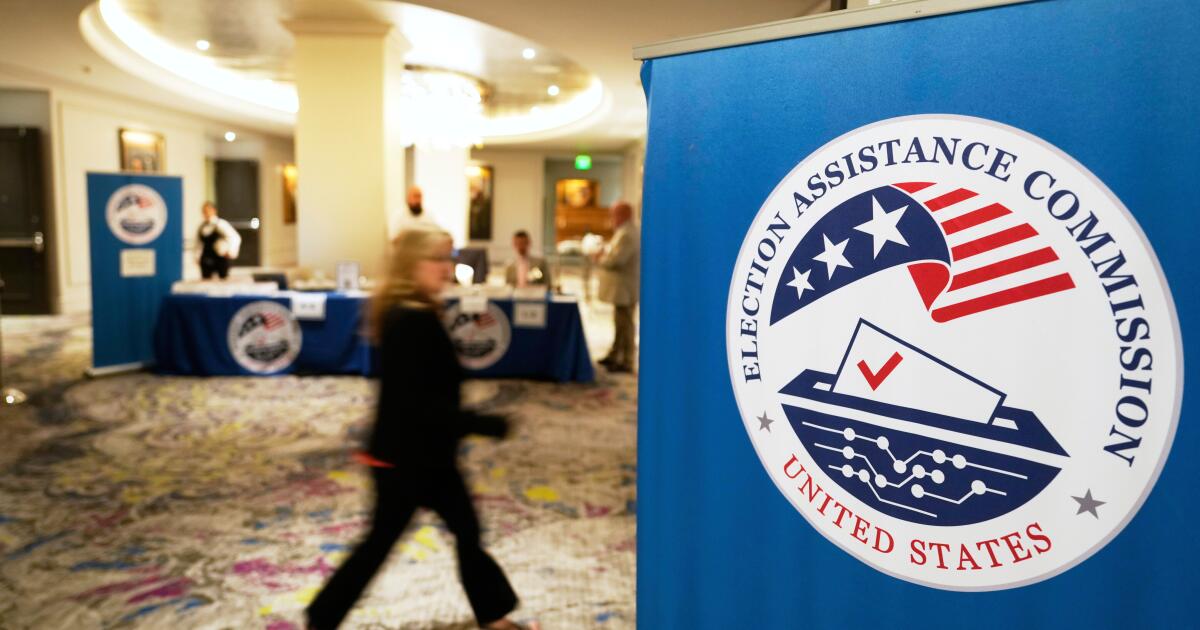
WASHINGTON — President Trump dismissed all remaining members of the bipartisan U.S. Elections Assistance Commission this week, his latest move to assert control over national elections in the final months before midterm voting.
The White House defended the move as justified by a recent U.S. Supreme Court decision handing the president greater authority to reshape independent government agencies, including by replacing appointed leaders.
Democrats and some independent elections experts blasted it as politically motivated, counter to the interests of voters and foolhardy with the November election so close.
“Purging commissioners just months before the midterm elections and further gutting support for our state and local elections officials is a blatant part of his plan to politicize our elections and enable more unlawful and dangerous election interference,” said Sen. Alex Padilla (D-Calif.), the top Democrat on the Senate Rules Committee, which oversees federal elections.
Padilla alleged the dismissals are an attempt by Trump “to dismantle yet another independent guardrail of our democracy designed to keep elections fair and secure.”
A White House official framed the dismissals in starkly different terms, saying the departing commissioners were “not totally aligned with the important task of securing America’s elections and ensuring every legal vote is counted.” It did not say when the president planned to appoint new commissioners.
The four-member commission was created by Congress in 2002 as part of the Help America Vote Act to help states improve their voting systems and voter access. By law, no more than two commissioners may belong to the same political party.
Historically, it has provided voluntary guidance and best practices for voting systems, and served as a sort of clearinghouse for election performance around the country — so that states and localities can learn from one another.
Since 2018, the panel has also disbursed more than $1 billion in election security grants, according to a report by the Bipartisan Policy Center. Those grants are then used to protect IT systems from foreign and domestic cyberattacks, update voting systems, ensure the accuracy of voter rolls and protect the integrity of ballots after they are cast.
Without leadership, the panel cannot take any official action until new members are nominated and confirmed by the Senate.
Benjamin W. Hovland, one of the Democratic commissioners removed by Trump, told NBC News that taking away a key federal agency designed to help state and local election administrators will have a negative effect on already strained elections officials.
“When you’re asking more and more of people without giving them the necessary resources, you know, mistakes happen,” he said.
California Secretary of State Shirley Weber, in a statement to The Times, said Trump was “injecting unnecessary chaos, confusion and instability into the very systems that Americans rely on to make their voices heard,” but that California “will not be intimidated or deterred” from maintaining elections “in which everyone can fairly and securely participate.”
California Atty. Gen Rob Bonta — whose office has already blocked federal agencies from implementing most of Trump’s election orders in court — called Trump’s firings “deeply troubling,” and said his office “will continue to closely monitor any efforts to weaken our democracy and fight back with every tool at our disposal.”
Gov. Gavin Newsom’s office said on X that “Newsom’s election protection efforts become more important by the day” — a reference to his recent push for state legislation that would make it a felony in California for anyone to seize ballots before a vote has been certified.
Newsom had said Thursday that Trump’s efforts to seize control over elections represented a “five-alarm fire” that must be confronted.
Trump’s dismantling of the commission comes as he wages a much broader campaign to rewrite voting rules. He has sought to place new restrictions on mail ballots, to tighten voter ID and proof of citizenship requirements for voters, to subject state voter rolls to federal oversight and purges, and to assert federal control over how and whether the U.S. Postal Service delivers mail ballots.
Much of that agenda, pushed through executive orders and other administrative actions, has been stymied by the courts, while stalling out in Congress, where it lacks support.
Whether Trump’s move to dismantle and reconstitute the commission will prove an effective path to instituting his election agenda remains unclear, experts said.
David Becker, the executive director of the nonpartisan Center for Election Innovation & Research, said the election commission has always had a “very limited mandate,” can’t dictate policy to the states and has no law enforcement powers — meaning Trump’s dismissals will have little real effect on elections.
Rick Hasen, an election law expert and director of the Safeguarding Democracy Project at UCLA Law, wrote that Trump could try to illegally direct the commission to “do his bidding” by amending the federal voter registration form to require proof of citizenship — though that would also have limited effect and would be challenged in court.
Sen. Adam Schiff (D-Calif.) said Trump’s firing of the commissioners was part of a broader effort by the president to “sow distrust in our voting system so he can contest the results if they are not to his liking.”
Kim Alexander, president of the California Voter Foundation, said California has “the most robust standards” for elections in the country, which won’t change with the removal of the commissioners.
Still, she said word of the firings rocketed around a conference of county elections officials in San Diego on Thursday — with some wondering whether the dismissals would threaten federal election funding, and others lamenting the loss of the ousted commissioners’ deep experience.
Dean Logan, head of the L.A. County Registrar-Recorder/County Clerk’s office, said in a statement to The Times that “any sudden change to the support structure for elections in the middle of an election cycle is concerning,” but that California “has a strong local and state foundation for election administration and voting systems support, and that will minimize any potential disruption caused by this action.”
In recent months, Trump has leveraged federal agencies to overhaul the nation’s voting rules in ways no previous president has attempted.
He has repeatedly pressured Republican lawmakers to pass a federal law that would require voters to provide proof of citizenship when they register, show identification when casting a ballot and force states to send voter data to the Department of Homeland Security.
Republican leaders have said the proposed SAVE America Act does not have enough votes to pass in the Senate. The GOP resistance has angered Trump, who on Friday said he was refusing to sign a bipartisan housing bill in protest.
The housing bill, which Trump called a “big yawn” last month, was to become law at midnight Friday without Trump’s signature.
-

 Virginia7 minutes ago
Vance leasing part of multimillion-dollar Virginia farm as an additional residence | CNN Politics
-

 Washington10 minutes ago
Washington State Democratic Party draws criticism over reparations, antisemitism language
-

 Wisconsin15 minutes ago
What’s new to eat and drink at the 2026 Wisconsin State Fair?
-

 West Virginia22 minutes ago
West Virginia to launch school clothing allowance program
-

 Wyoming25 minutes ago
Election Q&A: Laurie Longtine for Wyoming House District 59
-

 Crypto30 minutes ago
Morgan Stanley Targets Ethereum and Solana ETF Market Share Amid Intensifying Fee Competition
-

 Finance37 minutes ago
This new bill hopes to ‘put the brakes’ on financial fraud targeting older Americans
-

 Fitness38 minutes ago
A Strength Coach Says These Two Exercises Are All You Need to Build Stronger Shoulders

