Politics
L.A. was forged by global commerce. Can the metropolis we know survive the Trump trade wars?


When Fang Chen was growing up in the wealthy city of San Marino in the 1980s, it was still a majority white community, one where locals occasionally exploded into ugly moments of racism at the arrival of new Asian residents.
Today, the community is nearly 70% Asian, with nearly half of all residents born outside the country, according to the U.S. census. And Chen, a stay-at-home mom who travels frequently to China to visit relatives, said that for years she has urged friends and family there (assuming they have the means) to consider purchasing a stately mansion on one of San Marino’s graceful tree-lined streets.
But President Trump’s sweeping on-again, off-again tariffs have caused her to reconsider.
“I’m not sure I can make that case anymore,” she said last week, relaxing under a tree in the manicured green expanse of Lacey Park, where she had retreated, she said, to try to decompress from all the unsettling economic news. “There’s a lot of anxiety among my neighbors, because so many of us have friends and relatives in the countries affected by the tariffs.”
Like few other places in the U.S., the economy and culture of Los Angeles and its sprawling suburbs have been forged by globalization. The L.A. metro area has more foreign-born residents than any city but New York, many of whom go back and forth to their ancestral countries with some regularity. Its massive port complex, sprawling across San Pedro and Long Beach, is the largest in the Western Hemisphere. There are more languages spoken here —185, according to the census — than in any city but New York. Local businesses, from toy sellers to restaurants to small family day-care operations, rely on goods imported from elsewhere. It is a place whose distinctive culture arises from its sense of being connected to communities across the globe.
“A place you can travel around the world by going from neighborhood to neighborhood,” said former Los Angeles Mayor Antonio Villaraigosa, now a candidate for governor. “A global city.”
1
2

1. Fasika Abraham arrived in L.A. in the mid-1990s after fleeing political violence in Ethiopia. “If you’re unhappy in this country,” he says of the U.S., “you’ll be unhappy in heaven.” (Jason Armond / Los Angeles Times) 2. Merkato Ethiopian Restaurant and Market is a draw in L.A.’s Little Ethiopia. (Jason Armond / Los Angeles Times)
A global metropolis that, last week, was left shaken and on edge by Trump’s threats to upend and rework global trade. From the multinational residents of million-dollar homes in the suburbs to cramped apartments in the dense urban core, to the tens of thousands of warehouse owners, retailers and food merchants who rely on imports, people across the region expressed profound uncertainty over what a looming trade war — even the threat of one — could do to Los Angeles’ economy.
At the start of the month, Trump announced that the U.S. would begin applying a baseline tariff of 10% on imported goods from all foreign countries. Several dozen nations were to face additional tariffs based on what his administration described as an unfair trade imbalance, with Vietnam facing a 46% tax on its goods, Thailand a 36% tariff, India 26%, South Korea 25%, Japan 24% — and on it went.
But midweek, with U.S. stock markets in turmoil as the tariffs took effect, Trump abruptly changed course. He said the universal 10% tariff on most nations would be paused for 90 days, and the higher rates targeting countries with a trade imbalance lowered to 10%. At the same time, he escalated his standoff with China, raising duties on imports to 145%. Trump’s tariff on foreign automobiles, set at 25%, remains in place.
On Friday, China retaliated by raising its tariffs on American goods to 125%, even as the European Union suspended its plans for a 25% tariff on American goods while waiting out Trump’s next moves.
Taken together, it’s a trade war roller coaster that has business owners around the region scrambling to comprehend the effects on their profit margins and plot a viable path forward.
In the San Fernando Valley, Justin Pichetrungsi is the chef at Anajak Thai, the restaurant that his immigrant parents started and that he took over in 2019 and turned into a food-world darling, written up in the Michelin Guide and celebrated as the Los Angeles Times’ top restaurant in 2022. Part of what helped propel Anajak’s glittering star was its Thai Taco Tuesday, which started as a staff meal for his Mexican-born cooks and turned into a fusion phenom.
“We use so much fish sauce it’s crazy,” said Pichetrungsi, noting that “really good high-quality fish sauce, it’s gonna come from Thailand or Vietnam.” Already he said last week, it is becoming more scarce and prices are rising. And what would tariffs do to his Michelin-lauded wine list, which leans heavily on imported natural wines?

-
Share via
Listen as residents share the positive and negative effects of globalization in their lives.
Fifty miles south, in Fountain Valley, Danny Tran, who with his wife, Albee, runs Son Fish Sauce, sat down to write a message to his employees and customers. “One thing is for sure,” he wrote, “the road ahead is going to be bumpy as hell.”
Albee Tran, who was born and raised in Vietnam, is the fourth generation in her family to produce fish sauce. She met Danny, who is Vietnamese American, when he decamped to Saigon during the Great Recession for a three-week vacation that turned into a three-year stay. Together they created a company, moved back to California, and started selling high-end fish sauce to U.S. outlets including Whole Foods and Bristol Farms.
On L.A.’s Westside, Ivan Vasquez, 43, emigrated from Oaxaca, Mexico, when he was 16. He learned English at University High School in Westwood and began working in restaurants, rising from a dishwasher at Carl’s Jr. to a district operator overseeing 15 outposts for Baja Fresh.
Still, he dreamed of opening his own restaurant. He wanted to serve Oaxacan food, incorporating his mother’s recipes and the region’s distinctive drink, mezcal.

“The salesperson for this mezcal is not from Mexico,” Ivan Vasquez says of the product he sells at his Madre restaurants. “He lives here. He’s American.”
(Genaro Molina / Los Angeles Times)
His first restaurant, Madre, debuted in Palms in 2013, and he since has opened locations in Torrance, Fairfax and Santa Clarita.
The pandemic hit his restaurants hard, but he survived. But now, he said, the tariffs, if enacted, would hit just about everything that passes through his business. There is the mezcal itself, all 55 brands he sells, many of which are imported from Mexico by American companies. And there are the napkins, straws, produce, kitchenware, even the light fixtures, many of which are imported from China.
Vasquez grabbed a bottle of mezcal and raised it up dramatically: “The salesperson for this mezcal is not from Mexico,” Vasquez said. “He lives here. He’s American. He’s got a job to do here. He has a family to support.”
Though it may be tough to imagine for people who know the region only as it is today, Los Angeles was not always a global center — or even a particularly cosmopolitan one.
The city was founded in 1781 and grew up on railroads and oil, at one time accounting for as much as 25% of the world’s oil output. In the early 20th century, the twin engines of its growth were Hollywood movies, which made the city famous, and manufacturing, which actually drove the economy.
Bolstered by the nation’s huge defense buildup during World War II, the region emerged as a manufacturing center in the 1950s and ‘60s. While movie stars lived in the Hollywood Hills and coastal bluffs, neighborhood after neighborhood of modest ranch homes began to rise across the flatlands, housing for the tens of thousands of workers who kept the factories rolling, taking home decent wages that raised the standard of living across the region.
“It felt like a new factory opened up every few years, and there were jobs for everyone,” recalled Mack Johnson, 70, who grew up in South Los Angeles.
That began to shift in the 1970s, as the first great wave of globalization hit the city. Companies started opening factories overseas in search of cheaper materials and labor, a trend that accelerated in the 1980s and 1990s. The plant closures tore up communities, vaporizing what had been stable union jobs. The shuttered factories hulked over degrading neighborhoods like cavernous empty shells.
Former state Sen. Martha Escutia, 68, recalled that her grandfather worked at the Bethlehem Steel plant in Bell but lost his job in the first wave of plant closures. He eventually got another job, in Pacoima, with a lower wage and a much longer commute.
But globalization was coming for Pacoima, too. Former Democratic state Sen. Richard Alarcon was a member of the L.A. City Council in the 1990s, when the Price Pfister factory in Pacoima moved operations to Mexicali.
The era brought the rise of maquiladoras, factories operated by U.S. companies just over the Mexican border, where they could produce goods at far cheaper costs and export them back to U.S. consumers at lower prices. The trend was a natural outgrowth of the North American Free Trade Agreement, signed in 1994, which lowered tariffs between the U.S., Mexico and Canada and prioritized economic cooperation among the nations.
Maquiladoras brought jobs to Mexico and thriftier price points for cost-conscious consumers. But in Pacoima, Alarcon said, workers lost their jobs, and the jobs that replaced them often offered far lower wages.
Globalization was buffeting the region with other big changes.
Successive waves of immigration redefined Los Angeles. Between 1980 and 2010, millions of people found their way here, some fleeing persecution, others drawn by opportunity.
South Los Angeles, which once had a largely Black population, is now more than 60% Latino. The southeast cities, including South Gate, Bell and Bell Gardens, once mostly white, are now about 90% Latino. Huge numbers of Asian immigrants have settled throughout the San Gabriel Valley.
1

2

3

1. An undated historic photo of a Los Angeles tortilla factory. (John Malmin / Los Angeles Times) 2. A 1930 photo of assembly line workers at a Ford plant in Long Beach. (Los Angeles Times) 3. An undated photo of workers packing noodles at a Nissin Food Products plant in Gardena. (Bruce H. Cox / Los Angeles Times)
And even as factories closed, L.A. was able to take advantage of another offshoot of globalization. International trade spawned the use of giant cargo ships ferrying goods across the oceans in massive containers. The city’s harbor boasted deep channels that could accommodate bigger ships, as well as acres of vacant land near the docks where containers could be offloaded. The adjacent ports of Los Angeles and Long Beach were booming.
“By luck and good work, we were perfectly situated,” said City Councilman Tim McOsker, whose family has deep roots in San Pedro. “We could adjust to the new world of bigger ships and big containers. We became the shipping capital.”
These days, about 40% of all goods entering the U.S. come in through the combined ports of Los Angeles and Long Beach. “One in 9 jobs in L.A. County are directly related to the port,” McOsker said. “Think about that. That’s amazing.”
And, he added, in a time of trade wars: ”It’s terrifying.”
These colliding forces recast the region into what it is today: dizzyingly diverse and deeply intertwined — economically and culturally — with places around the globe.
Take Koreatown, one of L.A’s most densely populated neighborhoods. It is home to longtime Korean immigrants and their offspring, but also more recently acclimated Bangladeshis, Central Americans and Oaxacans. Hipsters, drawn to newly rehabbed condos, have moved in. The sidewalks are packed with vendors, and merchants advertise in a host of languages, including Spanish, English and Korean.
On Vermont Avenue, shoppers can pick up a box of doughnuts, consult with a Salvadoran attorney, seek respite at a Korean day spa, pick up meat at a carniceria, or dine out at a Korean barbecue.
Jackson Yang, now 80, was 39 when he came to L.A. County from Taiwan. He and his wife were seeking a better education for their children, and he hoped to build a successful trading business.
He started out selling toys, mugs and ceramics at a swap meet in Cerritos.
“From there I learned about what people are looking to buy,” he said last week. “I started from zero, and now we have revenue of almost $400 million a year between our two companies.”
Yang has a home on the Palos Verdes Peninsula and 11 grandchildren to visit him. He has stepped back from leading Seville Classics, the Torrance-based company that he built into an international force, with offices on multiple continents. In 2000, his son, Frank, founded the successful Torrance-based housewares company simplehuman.
Yang said across-the-board tariffs would stifle his business, but even tariffs limited to China will hurt.
“We’ve been thinking about Mr. Trump wanting to bring manufacturing into the U.S., but some items we bring in today cannot be built in the U.S.,” Yang explained. “We’ve been encouraging some of the factories to maybe move to the U.S., but it’s too expensive when you’re talking about a $10 item with a lot of labor involved. It’s not really possible for the U.S. to manufacture that.”
Smadar Gubani, 60, who emigrated from Israel in 1987, is not directly involved in international trade — but her day-care business exists as a result of it. She launched it in 1997, after struggling to find affordable day care for her daughter Hannah, who is named after Gubani’s Moroccan grandmother and her husband’s missing older sister, one of thousands of Yemenite children who disappeared after their families were evacuated to Israel between 1949 and 1950.

“No one can predict what Trump’s gonna do, what China’s gonna say,” Asher Gamzo of Gamzo & Co., a luxury jeweler in downtown L.A., says of the looming trade wars.
(Myung J. Chun / Los Angeles Times)

The trade wars set off by President Trump’s tariff threats have upended sales in the globalized jewelry market.
(Myung J. Chun / Los Angeles Times)
Gubani is Orthodox, as are most of the toddlers who cavort through her wonderland of sun-bleached playhouses. But they represent the global diversity of L.A.’s half-million Jews, melding the Hebrew and English spoken at day care with the Persian or Yiddish learned at home.
Her day care provides kosher food, serving recipes learned from her mother and collected in a 2013 cookbook. She buys whatever produce is on sale, but most kosher meat is now imported from Mexico and South America. Her youngest students snack on Bamba, the Israeli peanut butter puffs given to teething babies. Tariffs could hit her in lots of ways.
“What can I do?” Gubani asked, rocking the son of a former student in her lap. “Sometimes I just block my eyes and I put the stuff that I need [in my cart]. If I look at the prices, I will not buy nothing.”
Rising food prices — both the recent surges tied to inflation and the prospect of what tariffs would mean for imported goods — are a serious concern in communities across the region.
Every night, Maria Allana, 52, and other Central American immigrants set up food stands at South Bonnie Brae and 6th streets in Westlake for what is known as the Guatemalan Night Market.
Here, immigrants yell out their menus and sweet-talk potential customers as they stroll by. They sell grilled meats, aguas frescas and dishes from their native lands in Guatemala, El Salvador and Honduras. On a typical night, crowds huddle around the vendors, and even homeless people drop by to get discounted meals.
But the crowds have thinned out since the Trump administration’s crackdown on immigration. And inflation has cut into profits, making it harder to send money to their families back home.
“Everything is getting expensive,” Allana said.
The 50 pounds of dough she buys to make her tortillas jumped from $17 to $35. Refilling the gas tank also went up.
“With all this happening here, I’m sometimes considering whether it’s best to just head back home,” she said.
Back in San Marino, real estate agent Brent Chang, 54, who has been selling houses in the area since 2008, has a clear understanding of how much his business is tied to the global economy. For decades now, the city’s housing market has been lifted by whichever Asian economy was thriving at the time.
Japanese people in the 1980s, then Taiwanese in the ‘90s, and Chinese in the 2000s — so much so that when the rest of the housing market crashed in 2008, San Marino was untouched.
The influx has sent home prices soaring; the median home value in the city is $2.7 million, placing it in the realm of ultraluxe Westside enclaves such as Beverly Hills and Bel-Air. Chang said deep-pocketed Asian buyers have helped grow the city’s school district into one of the best in the state, and newcomers are often quick to invest in the city, including a Taiwanese homebuyer who’s planning to fund a new data software service for the San Marino Police Department.
“In the 1970s, I was the only Asian kid around. Look at it now,” Chang said. “You can’t go backwards and try to make the world small again.”
Times staff writer Anthony Solarzano contributed to this report.



President Trump has promoted a chain of newly rebranded gas stations across the Philadelphia area with lower gas prices. The New York Times has not been able to get detailed information about who is behind the stations. The Trump administration says it did not fund or subsidize the company.

NEWYou can now listen to Fox News articles!
Kelley Paul is no stranger to the American political scene. As the wife of Senator Rand Paul (R-Ky.), and the daughter-in-law of longtime former Congressman Ron Paul (R-Texas), she has seen her fair share of the campaign trail, emerging as a powerful surrogate during her husband’s 2016 presidential run.
She is also an accomplished writer, speaker, and public relations professional. As America ushers in its 250th anniversary, Paul saw the perfect opportunity to branch out into the world of children’s literature. Recently she sat down with Fox News Digital in Las Vegas at Freedom Fest to discuss her new book, “Good Night, Young American.”
Kelley Paul is the wife of Sen. Rand Paul and author of two books. (Courtesy Kelley Paul)
Paul credits her family for giving her the inspiration for the new project:
“I have to give a lot of credit to my daughter-in-law, Kate. She and our son were over for dinner last summer with our grandson, who was only six months old at the time. And Kate was like, you know, we need more patriotic books for babies. She wasn’t really happy with a lot of the book options she was seeing. And that night at dinner, we kind of played around with some ideas. And I came up with ‘Good Night Young American.’ And a year later, here it is.”
EXCLUSIVE: RAND AND KELLEY PAUL OPEN UP ABOUT 2016 RACE
“Good Night, Young American,” recommended for children ages 4–8, takes kids on a visually and thematically engaging journey through early and colonial history.
“Well, our revolutionary history is such a great adventure, right? So when I came up with the concept that my little boy would start out on the 4th of July with his parents, asking, what is it all about? I knew we’d be celebrating the 250th. Kids ask, what are we really celebrating?
And his dad describes the Declaration of Independence to him in the signing. So I tried to think what is going to appeal to children in this great adventure of our revolution. So when he falls asleep that night, he’s in the crow’s nest of the Mayflower. He is a pilgrim, he’s a colonist, and then he makes friends with all the great revolutionary heroes that we know. So he makes friends with Sam Adams, he joins the Sons of Liberty, he meets at the Green Dragon. This is so exciting for children, right?
It’s visual stuff. He makes friends with Ben Franklin, and he’s flying the kite. Dramatically rides on the midnight ride with Paul Revere. He and his dog, his little dog, are with him for all the adventures. And of course, he crosses the Delaware with George Washington. And I wanted to make the signing of the Declaration of Independence and the writing of it something that was dynamic and exciting visually. So I have him swinging on the Liberty Bell when the declaration is signed.”
Paul worked closely with the illustrator, Marika Monesi, to bring the events of America’s founding to life in an engaging and visually appealing way for children.
The Liberty Bell, originally saved from the British by Lynnport farmer Frederick Leaser, sits in its Philadelphia shrine. (iStock)
“She really captured the excitement on the little boy’s face, his personality, but I worked very close with her,” Paul said. “I wanted there to be a lot of movement, a lot of dynamic images. So, for example, with the Liberty Bell, for kids, a bunch of men standing around writing a document…I wanted to bring it to life. So I said, let’s have him running up to the top of the bell tower in Philadelphia at Freedom Hall and swinging on the Liberty Bell. And she was just such a great artist. With the George Washington scenes, he’s crossing the Delaware because that, again, is so visual. I wanted drive home to children the incredible bravery and courage of our founders, how cold and miserable and hard that war was.
“Also, I love the illustration that she did of the King of England reading the Declaration of Independence. I have to give my husband Rand a little credit there. On the first couple of drafts that she did, Rand was like, ‘He needs to be fatter. King George was famously fat!’ So it was a lot of fun. It was very collaborative.”
KELLEY PAUL ‘EXHAUSTED AND ANGRY’ THAT THOSE WHO HARASSED HER AND HER HUSBAND FACE NO CHARGES
Part of Paul’s motivation for the book was related to the teaching of American history today, and the controversies therein:
“I do think that we’ve gotten away from really celebrating our founders and our heroes. What they were doing in 1776 was incredibly radical, if you think about it. At that time, everyone accepted the divine right of kings. Everyone accepted hereditary rule. And our founders took Enlightenment ideas from John Locke and philosophers, and they turned it into the framework for a government. The idea of self-government and that our rights come from our Creator, that we have inalienable rights that are given to us by God and not from a king. Those were radical ideas of the time.
Historians say an early draft of the Declaration of Independence offered new insight into how Thomas Jefferson refined the nation’s founding document. (Stock Montage/Stock Montage/Getty Images)
I like to say our founders were the first civil rights heroes, the first civil libertarians. And I think our education system has gotten away from that. They don’t view them in the time that they existed, and suddenly now everything is oppressor versus oppressed narrative. And they are labeled more like colonizers or enslavers, and that’s the only view that they’re looked at, and not as human beings who sacrificed their very lives to write the Declaration of Independence, to form this country…it was an incredible, bold, and courageous act, but it was also an act of moral courage and philosophical courage.”
Ultimately, Paul hopes that her books will stimulate the natural curiosity of America’s youth to learn more about their rich history:
Participants carry the City of Cumberland’s “America 250” parade banner down Baltimore Street during the America 250 parade in downtown Cumberland, Maryland, on June 27, 2026. Spectators line both sides of the street as American and Maryland flags lead the procession. (Fox News Digital/ David Marcus)
“Well, I hope that my books, especially with America’s 250, will spark a lot of questions and that they will give a framework for parents to talk to their kids about the founding of this country. And I hope children from a very, very young age will come away with this idea that they are a part of America’s story, that they as Americans can take pride in the heroism of our revolutionary founders. That as Americans, this is all of our story. So that’s really my goal with the books.”
One of the biggest challenges Paul faced was taking big ideas that may be hard for a four or five-year-old to grasp, like the Declaration of Independence or the Constitution, and distilling them down into an accessible format for kids:
“Well, I try to use language that kids could understand, and very much use simple terms. But if you think about it, it is simple. Our rights come from God. And when he makes friends with Thomas Jefferson, he says, Thomas Jefferson has written this amazing document that says that we can all be free to live our lives the way we choose, and no government can take our rights to, you know, to life, liberty, and the pursuit of happiness away from us.
He also talks about James Madison and the Bill of Rights and the most important right is freedom of speech. That is that no government can tell you what to say or what not to say.”
Rand Paul, who famously puts Constitutional principles front and center in the public square, also played a key role in the book’s thematic development.
Kelley Paul and her husband Kentucky Republican Sen. Rand Paul. (Courtesy Kelley Paul)
“Rand has been incredibly supportive. I’m just so grateful and blessed to have had an amazing, now 36-year marriage to Rand Paul. And he was very involved. He would read over the drafts and gave me a lot of, like I said, good advice about things in history that he thought I should include.
CLICK HERE TO DOWNLOAD THE FOX NEWS APP
And I’m also just very grateful to be the daughter-in-law of Ron Paul. And so, I wanted these books to be there for our little grandson who I call ‘my favorite little American’ and help him from an early age be educated in the legacy that, the Paul family has in this country.”
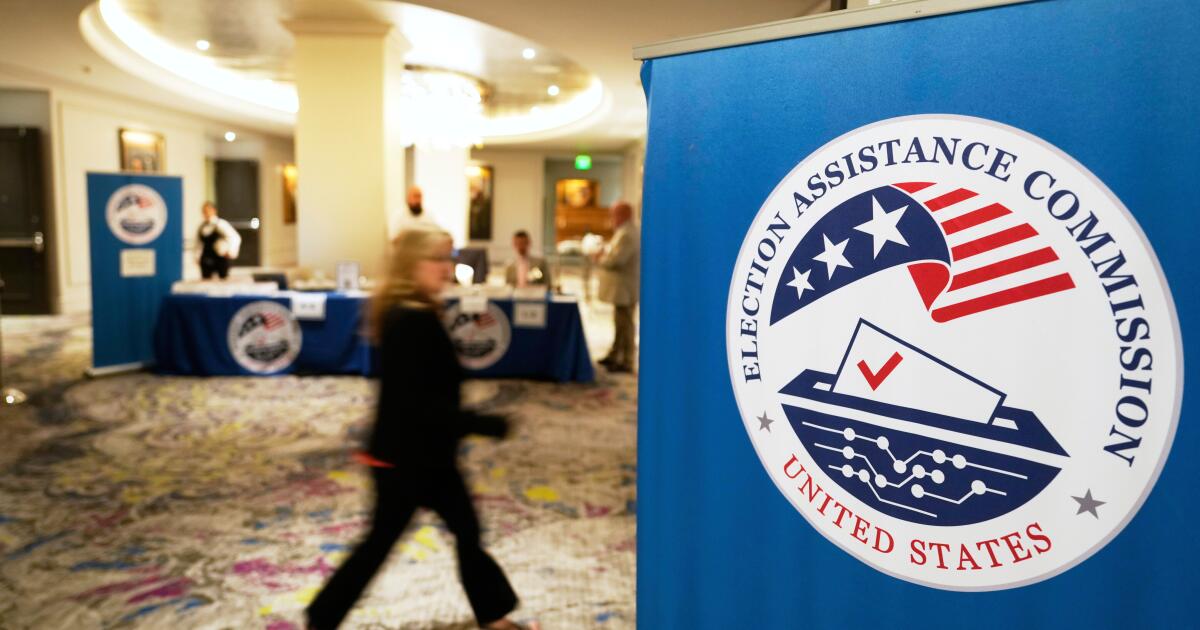
WASHINGTON — President Trump dismissed all remaining members of the bipartisan U.S. Elections Assistance Commission this week, his latest move to assert control over national elections in the final months before midterm voting.
The White House defended the move as justified by a recent U.S. Supreme Court decision handing the president greater authority to reshape independent government agencies, including by replacing appointed leaders.
Democrats and some independent elections experts blasted it as politically motivated, counter to the interests of voters and foolhardy with the November election so close.
“Purging commissioners just months before the midterm elections and further gutting support for our state and local elections officials is a blatant part of his plan to politicize our elections and enable more unlawful and dangerous election interference,” said Sen. Alex Padilla (D-Calif.), the top Democrat on the Senate Rules Committee, which oversees federal elections.
Padilla alleged the dismissals are an attempt by Trump “to dismantle yet another independent guardrail of our democracy designed to keep elections fair and secure.”
A White House official framed the dismissals in starkly different terms, saying the departing commissioners were “not totally aligned with the important task of securing America’s elections and ensuring every legal vote is counted.” It did not say when the president planned to appoint new commissioners.
The four-member commission was created by Congress in 2002 as part of the Help America Vote Act to help states improve their voting systems and voter access. By law, no more than two commissioners may belong to the same political party.
Historically, it has provided voluntary guidance and best practices for voting systems, and served as a sort of clearinghouse for election performance around the country — so that states and localities can learn from one another.
Since 2018, the panel has also disbursed more than $1 billion in election security grants, according to a report by the Bipartisan Policy Center. Those grants are then used to protect IT systems from foreign and domestic cyberattacks, update voting systems, ensure the accuracy of voter rolls and protect the integrity of ballots after they are cast.
Without leadership, the panel cannot take any official action until new members are nominated and confirmed by the Senate.
Benjamin W. Hovland, one of the Democratic commissioners removed by Trump, told NBC News that taking away a key federal agency designed to help state and local election administrators will have a negative effect on already strained elections officials.
“When you’re asking more and more of people without giving them the necessary resources, you know, mistakes happen,” he said.
California Secretary of State Shirley Weber, in a statement to The Times, said Trump was “injecting unnecessary chaos, confusion and instability into the very systems that Americans rely on to make their voices heard,” but that California “will not be intimidated or deterred” from maintaining elections “in which everyone can fairly and securely participate.”
California Atty. Gen Rob Bonta — whose office has already blocked federal agencies from implementing most of Trump’s election orders in court — called Trump’s firings “deeply troubling,” and said his office “will continue to closely monitor any efforts to weaken our democracy and fight back with every tool at our disposal.”
Gov. Gavin Newsom’s office said on X that “Newsom’s election protection efforts become more important by the day” — a reference to his recent push for state legislation that would make it a felony in California for anyone to seize ballots before a vote has been certified.
Newsom had said Thursday that Trump’s efforts to seize control over elections represented a “five-alarm fire” that must be confronted.
Trump’s dismantling of the commission comes as he wages a much broader campaign to rewrite voting rules. He has sought to place new restrictions on mail ballots, to tighten voter ID and proof of citizenship requirements for voters, to subject state voter rolls to federal oversight and purges, and to assert federal control over how and whether the U.S. Postal Service delivers mail ballots.
Much of that agenda, pushed through executive orders and other administrative actions, has been stymied by the courts, while stalling out in Congress, where it lacks support.
Whether Trump’s move to dismantle and reconstitute the commission will prove an effective path to instituting his election agenda remains unclear, experts said.
David Becker, the executive director of the nonpartisan Center for Election Innovation & Research, said the election commission has always had a “very limited mandate,” can’t dictate policy to the states and has no law enforcement powers — meaning Trump’s dismissals will have little real effect on elections.
Rick Hasen, an election law expert and director of the Safeguarding Democracy Project at UCLA Law, wrote that Trump could try to illegally direct the commission to “do his bidding” by amending the federal voter registration form to require proof of citizenship — though that would also have limited effect and would be challenged in court.
Sen. Adam Schiff (D-Calif.) said Trump’s firing of the commissioners was part of a broader effort by the president to “sow distrust in our voting system so he can contest the results if they are not to his liking.”
Kim Alexander, president of the California Voter Foundation, said California has “the most robust standards” for elections in the country, which won’t change with the removal of the commissioners.
Still, she said word of the firings rocketed around a conference of county elections officials in San Diego on Thursday — with some wondering whether the dismissals would threaten federal election funding, and others lamenting the loss of the ousted commissioners’ deep experience.
Dean Logan, head of the L.A. County Registrar-Recorder/County Clerk’s office, said in a statement to The Times that “any sudden change to the support structure for elections in the middle of an election cycle is concerning,” but that California “has a strong local and state foundation for election administration and voting systems support, and that will minimize any potential disruption caused by this action.”
In recent months, Trump has leveraged federal agencies to overhaul the nation’s voting rules in ways no previous president has attempted.
He has repeatedly pressured Republican lawmakers to pass a federal law that would require voters to provide proof of citizenship when they register, show identification when casting a ballot and force states to send voter data to the Department of Homeland Security.
Republican leaders have said the proposed SAVE America Act does not have enough votes to pass in the Senate. The GOP resistance has angered Trump, who on Friday said he was refusing to sign a bipartisan housing bill in protest.
The housing bill, which Trump called a “big yawn” last month, was to become law at midnight Friday without Trump’s signature.
-

 Cleveland, OH3 seconds ago
Cleveland’s First Round woes must end with the 2026 class
-

 Austin, TX3 minutes ago
Texas reports dozens of cyclosporiasis cases tied to contaminated fresh produce
-

 Alabama15 minutes ago
Small Plane Makes Emergency Landing In Peanut Field Near Florida-Alabama Line : NorthEscambia.com
-
Alaska18 minutes ago
An Alaska vacation can remind Israelis the world doesn’t revolve around them | The Jerusalem Post
-
 Arizona23 minutes ago
Arizona AG continues to investigate Glendale apartment complex after Friday deadline to fix A/C
-

 Arkansas30 minutes ago
Office of Keep Arkansas Beautiful Now Part of the ARDOT
-

 California33 minutes ago
Amber Alert issued for 3-year-old out of California City in Kern County
-

 Colorado38 minutes ago
Colorado Highway getting bicycle bypass bridge

