Science
This bill aims to help firefighters with cancer. Getting it passed is just the beginning

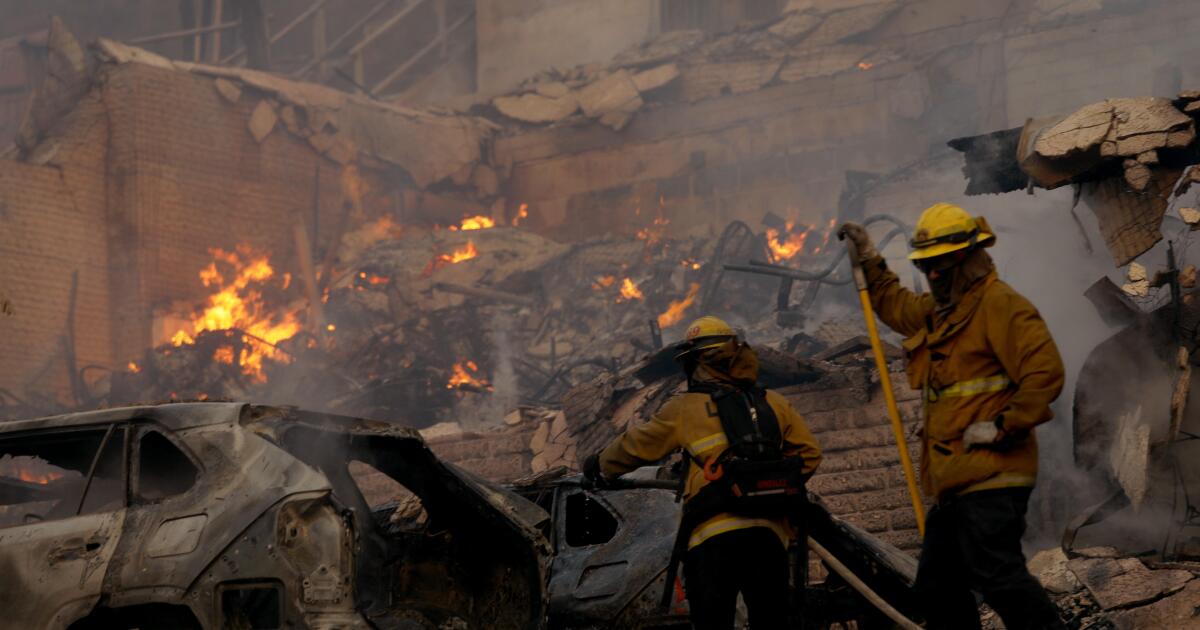
As firefighters battled the catastrophic blazes in Los Angeles County in January, California’s U.S. senators, Adam Schiff and Alex Padilla, both Democrats, signed on to legislation with a simple aim: provide federal assistance to first responders diagnosed with service-related cancer.
The Honoring Our Fallen Heroes Act is considered crucial by its supporters, with climate change fueling an increase in wildfire frequency and firefighting deemed carcinogenic by the World Health Organization. Firefighters have a 14% higher chance of dying from cancer than the general population, according to a 2024 study, and the disease was responsible for 66% of career firefighter line-of-duty deaths from 2002 to 2019.
The Los Angeles wildfires brought the fear generated by these statistics into bold relief. As homes, businesses and cars — and the products within them — were incinerated, gases, chemicals, asbestos and other toxic pollutants were released into the air, often settling into soil and dust. First responders working at close range, often without adequate respiratory protection, were at higher risk of developing adverse health conditions.
Just days after the fires were contained, researchers tested a group of 20 firefighters who had come from Northern California to help battle the flames, and found dangerously elevated levels of lead and mercury in their blood. The results are part of a longer-term study tracking the health impacts of the January fires on people exposed to the toxic emissions. The team includes researchers from Harvard, UCLA, UC Davis, the University of Texas at Austin and the USC Keck School of Medicine.
“Firefighters and first responders put their lives on the line without a second thought to protect California communities from the devastating Southern California fires,” Padilla said in a statement. “When they sacrifice their lives or face severe disabilities due to service-related cancers, we have a shared duty to help get their families back on their feet.”
But although the Honoring Our Fallen Heroes Act has bipartisan support, it still faces a rough road politically, and those who have spent years dealing with similar government-run programs warn of major implementation issues should the measure become law.
The Senate Judiciary Committee passed a similar bill in 2024, but the measure didn’t advance to a vote on the floor. And with legislators pondering potentially massive federal budget cuts, its fate in Congress this year is far from clear. What is clear is that, for legislation tying benefits to service-related health conditions, the devil is in the details.
“Getting the piece of legislation passed is not as hard as guarding it,” said John Feal, who was injured at the 9/11 ground zero site while working as a demolition supervisor. He has since become a fierce advocate for first responders and military veterans.
“You will watch the legislation mature, as more and more people who need the assistance come forward,” Feal said. At that point, he added, the program’s capacity to grow — and to successfully process the applications of those who have come forward for help — may become a challenge.
That, Feal said, is what happened with the various government programs created after the 9/11 attacks to provide monetary compensation and healthcare to injured first responders, including some later diagnosed with cancer. Both the September 11th Victim Compensation Fund and the World Trade Center Health Program encountered substantial funding issues and were beset by logistical failures.
The structure of the Honoring Our Fallen Heroes Act, sponsored by Sen. Amy Klobuchar (D-Minn.), might allow it to sidestep some funding pitfalls. Rather than create a new benefit program, the bill would grant firefighters who have non-9/11 cancer-related conditions access to the long-standing Public Safety Officers’ Benefits Program, which provides monetary death, disability and education benefits to line-of-duty responders and surviving family members.
Death benefits in such programs are considered mandatory spending and are funded regardless of congressional budget decisions. Funding for disability and education benefits, however, depends on annual appropriations.
Even with full funding, the legislation could face implementation problems similar to those plaguing the 9/11 programs, including complex eligibility criteria, difficulty documenting that illnesses are service-related, and — more recently — long waits to enroll amid seesawing federal attempts at cutbacks.
Attorney Michael Barasch represented the late New York police detective James Zadroga, who developed pulmonary fibrosis from toxic exposure at the World Trade Center site and for whom the 9/11 Health and Compensation Act is named. Barasch, who still represents 9/11 victims and lobbies Congress for program improvements and funding, said the Honoring Our Fallen Heroes Act should streamline the process for first responders to document that their cancers are related to fighting wildfires.
“In my experience representing more than 40,000 members of the 9/11 community, any similar program should have a clear set of standards to determine eligibility,” Barasch told KFF Health News. “Needless complexity creates a serious risk that responders who should have been eligible might not have access to benefits.”
Feal added that lawmakers should be ready to bolster funding to adequately staff the Public Safety Officers’ Benefits Program if it adds to the conditions currently covered, noting that the 9/11 programs have swelled as more first responders have presented service-related conditions.
“There were 75,000 people in the program in 2015. There’s now close to 140,000,” Feal said. “There’s a backlog on enrollment into the WTC program because they’re understaffed, and there’s also a backlog on getting your illnesses certified so you can get compensated.”
As the Public Safety Officers’ Benefits Program is currently implemented, firefighters and other first responders are eligible for support for physical injuries they incur in the line of duty or for deaths from duty-related heart attacks, strokes, mental health conditions and 9/11-related illnesses. The bill would add provisions for those who die or become permanently disabled from other service-related cancers.
The Honoring Our Fallen Heroes Act was introduced in 2023 and reintroduced on Jan. 23 of this year, with Klobuchar referencing the California wildfires in her news release. The Congressional Budget Office estimated last year that the bill would cost about $250 million annually from 2024 to 2034; it has not weighed in since the measure was reintroduced.
“Cancer’s grip on the fire service is undeniable,” said Edward Kelly, president of the International Assn. of Fire Fighters. “When a firefighter dies from occupational cancer, we owe it to them to ensure their families get the line-of-duty death benefits they are owed.”
This article was produced by KFF Health News, a national newsroom that produces in-depth journalism about health issues.


Three months after his son was born, Kevin Maguire felt alone.
It was 2019. He had recently moved to Barcelona with his wife and daughter and was working on marketing projects for Fortune 500 companies. The birth of his son, Bodhi, should have been a joyous event. But Maguire, now 43, became sad and irritable, and didn’t want to be around his newborn. He withdrew from family and friends, often playing video games late into the night or finding excuses to get out of the house.
“I would take the dog out for a walk,” Maguire said. “I wanted to get far away enough that I wouldn’t bump into anyone I knew and I would just sit and cry.”
Desperate for answers, he entered his symptoms online. Maguire, author of the recently published book “The New Fatherhood: Why Everything They Told You About Being a Dad Is Wrong, and How Embracing It Will Transform Your Life,” knew to look for signs of the “baby blues” in his wife. But he was surprised by articles that said men could experience postpartum depression too. The diagnosis resonated and he began writing about his condition and the trials of fatherhood on Substack.
New dads face psychological pressures, from sleepless nights to sky-high bills, which can contribute to postpartum depression. So can shifting hormone levels.
“One thing I found in my lab’s research is that when new dads have really low levels of testosterone, they might report more symptoms of postpartum depression,” said Darby Saxbe, a professor of psychology at USC and author of the recently published “Dad Brain: The New Science of Fatherhood and How It Shapes Men’s Lives.”
While hormonal shifts can create challenges, they also help men adapt to fatherhood, Saxbe explained. Several hormones can spike in men when they become dads, including oxytocin, linked to better relationship quality; vasopressin, associated with emotional bonding; and prolactin, which promotes lactation in women and caregiving behavior in guys.
New dads can also experience a decline in testosterone. According to a 2011 paper from University of Notre Dame professor Lee Gettler, part of the largest study on fatherhood and testosterone ever conducted, men averaged around a 25% drop in testosterone after becoming fathers.
While dads have reasons to be concerned by plummeting levels of testosterone, a modest dip isn’t necessarily a disaster — in fact, it can make men better parents and partners.
“We often get invested in the idea that men should always have the highest possible levels of testosterone,” Saxbe said. “What the research tells us is a little more nuanced. You really want flexibility. You want a hormonal system that can adapt to the different demands of your life.”
The prospect of a decline might scare soon-to-be fathers, especially those on TikTok and Instagram, where accounts push the idea that having “high T” is the key to being a “real man,” according to a recent study in the journal Social Science & Medicine.
Influencers stand to profit persuading men there’s a widespread “masculinity crisis,” the researchers found, noting that 72% of the accounts they analyzed had a stake in testosterone supplements and treatments.
But studies show more testosterone isn’t always better. “We found that when dads have higher testosterone, even before birth, they’re less invested [than men with lower testosterone] in co-parenting a few months after birth,” Saxbe said. High T fathers were more stressed from parenting than their lower T counterparts, and had partners who were less satisfied in their romantic relationships.
This jibes with the challenge hypothesis, which says, in multiple species, testosterone levels rise when males battle for attention from potential mates and go down when it’s time to take care of the young.
While a small decline can be adaptive, dads face mental health risks when their testosterone drops too low.
There is no “normal” level of testosterone, said Dr. Jesse Mills, director of the Men’s Clinic at UCLA Health. Experts recommend that men should consider treatment if their levels dip below 300 nanograms per deciliter (ng/dL). But men metabolize testosterone in different ways, meaning a healthy level for one might be low for another.
“If a new dad comes to me and his testosterone is 298 [ng/dL], he’s below the threshold,” Mills said. “But if he has zero symptoms and everything else is going great — he’s over the moon with his new child, he’s so happy — that’s not somebody I’m going to treat with testosterone.”
He notes that the drop in testosterone fathers experience can partly be attributed to the stresses that come with a new kid: less sleep, a poor diet and fewer trips to the gym. That means there are precautions that expectant fathers can take that don’t involve testosterone replacement therapy (TRT).
Still, while some guys with low testosterone levels might not need TRT, others in the “normal” range could benefit from treatment. (Dads who want another kid soon, beware. Mills notes that testosterone replacement therapy can take a man’s sperm count to zero.)
Both Mills and Saxbe stress that men should be paying attention to symptoms of low testosterone — such as depression and low libido — rather than trying to reach or maintain an ideal number. They also agree that tending to mental health concerns is hugely important for new fathers.
Eventually, after Maguire researched his condition, he recovered after time spent meditating, exercising and bonding with his son.
“A lot of new dads don’t realize how much they’re struggling because they feel ashamed or because they don’t realize it’s common shortly after the birth of a baby,” Saxbe said.
When they struggle, fathers can fixate on testosterone because that’s what modern culture tells them will make them feel better. And sometimes testosterone replacement therapy works. But Saxbe stresses a lot of men could use psychotherapy or support groups that bring dads together, as well as more time bonding with loved ones in general.
“The thing that predicts a man’s well-being and longevity is the quality of his relationships with other people,” said Saxbe. “You can be the world’s best weightlifter. You can have a low body-fat percentage. You can be killing it at work. Those things don’t predict how happy you’re going to be at 80.”

new video loaded: NASA Announces Artemis III Crew
transcript
transcript
NASA Announces Artemis III Crew
NASA announced the crew of Artemis III mission, which will fly to low-Earth orbit to test rendezvous and docking maneuvers with one or two lunar landers.
-
“I am excited to welcome you as the next crew in the Artemis journey to successfully return to the moon — this time to stay.” “I’m honored by the role that I’ve been given. I’m also very humbled by the task in front of us. But first and foremost, I’m grateful.” “So with that, the Artemis II crew, comrade, hands you the baton. You got the controls.” “As you know, we had a significant anomaly at our Launch Complex 36A on May 28. We’ve redoubled our efforts and are moving forward.”
By Alisa Shodiyev Kaff
June 9, 2026
Science
Santa Monica Mountains’ last steelhead trout survived the Palisades fire — and even had babies

Scientists feared the Santa Monica Mountains’ last remaining steelhead trout were dead, smothered by debris flows unleashed by the Palisades fire.
But the endangered fish surprised them: A team of biologists recently spotted 30 of the rare trout — and 21 babies — in Topanga Creek.
“There was a lot of happy dancing in the creek,” said Rosi Dagit, principal conservation biologist for the Resource Conservation District of the Santa Monica Mountains, which works with public and private landowners to conserve natural resources.
That’s because the steelhead here are endangered, at both the state and federal levels. Once, they swam in most streams of the Santa Monicas, but their numbers plummeted amid overfishing and coastal development. Increasingly frequent wildfire has further stressed their habitat. Topanga Creek, a biodiversity hot spot, is home to their last known population in the mountains that stretch from the Hollywood Hills to Point Mugu in Ventura County.
The trout that were spotted, including this one, are part of a distinct Southern California population that’s listed as endangered at the state and federal levels.
(RCDSMM Stream Team)
The California Department of Fish and Wildlife spearheaded a complex mission to rescue trout threatened by the Palisades fire that sparked in January 2025.
Time was of the essence. The fire hadn’t yet been fully contained. But rain was on the way, which would sweep massive amounts of sediment from the denuded hillsides into the water. Fish are often killed this way.
Crews stunned the fish with electricity, scooped them up in buckets, trucked them to a hatchery and ultimately moved them to Arroyo Hondo Creek in Santa Barbara County.
Within days, Topanga Creek was choked with mud. Some assumed the fish left behind were goners.
But in March, the conservation district’s team found four. The following month, when water conditions were clearer, they saw more.
“These fish continue to amaze me,” said Kyle Evans, environmental program manager for the state Department of Fish and Wildlife, who had seen the damage to the creek. “I had seen populations get wiped out in similar situations. So when I heard, I was thrilled.”
Evans surmises the fish that survived were in an area of the creek where less charred material and sediment were swept in.
“These fish likely hunkered down, were hiding under some rocks or places to try to get away from the main concentration of flow,” he said. “And luckily they weren’t buried.”
The ones that were spotted were fairly small, around 6 to 14 inches. Rainbow trout and steelhead trout are the same species, but with different lifestyles. If the fish remain in freshwater, they’ll be considered rainbows. However, they can migrate to the ocean and become steelhead, where they typically grow larger before returning to their natal waters to spawn.
Topanga Creek hasn’t fully recovered from the damage it sustained, but scientists say it’s looking better. Surveys last year were “so depressing,” Dagit said, with very few animals, and stretches that were essentially transformed into flat roads from all the sediment buildup. Some of the riparian canopy burned right down to the creek.
Then came 32 inches of rain over the last nine months, scouring out and moving sediment, creating deeper pools. Dagit said they recently found newt egg masses for the first time in years, as well as a few adult newts and many frogs. Plants that provide cover are starting to recover.
She provided photos comparing certain pools last year and this year, some dramatically transformed. In September 2025, the Shrine Pool could have been an overgrown hiking trail. This April, it was filled with shallow water.

The Shrine Pool in September 2025, left, and the same location in April 2026, right, with RCDSMM’s Isaac Yelchin donning a wetsuit.
(RCDSMM Stream Team)
Topanga Creek is home to another endangered fish, the small but hardy northern tidewater goby, often described as cute. Not long before the trout operation, Dagit led a rescue of hundreds of these fish too. Many were repatriated to the lagoon at the mouth of the creek in a moving ceremony last June.
There’s still the matter of what to do with the trout that were moved to Santa Barbara County last year. Evans would like to bring them home to the Santa Monicas at some point, but isn’t sure if it will happen. On one hand, they could bolster the small, genetically isolated surviving population. On the other, they might inadvertently bring in a disease or bacteria. There is some time to decide. Evans estimates the creek still needs to recover for two to three more years.
For now, the fish are functioning fine in their adopted creek. Experts worried the trauma wrought by the move would disrupt their spawning process, but they had babies that spring. This year, they spawned again.
-
 Lifestyle27 minutes ago
‘Disclosure Day’ star Josh O’Connor received a ‘genius’ late-night text from Spielberg
-

 Technology37 minutes ago
Claude Fable is too scared to teach you about the powerhouse of the cell
-

 World42 minutes ago
World court prosecutor who went after Netanyahu for war crimes suspended over sexual misconduct
-

 Politics49 minutes ago
Republicans fear of ‘fatal mistake’ in must-win Platner race
-

 Health52 minutes ago
Americans born after 1970 face higher death rates from several major causes in middle age
-

 Sports57 minutes ago
Tracking America’s World Cup journey: How and when to watch the US Men’s National Team
-

 Technology1 hour ago
Texas mom jailed over dirty water Facebook post
-
 Business1 hour ago
Rivian begins deliveries of cheaper electric vehicles

