Northeast
True crime reporters blocked outside courthouse where Karen Read is on trial file First Amendment lawsuit

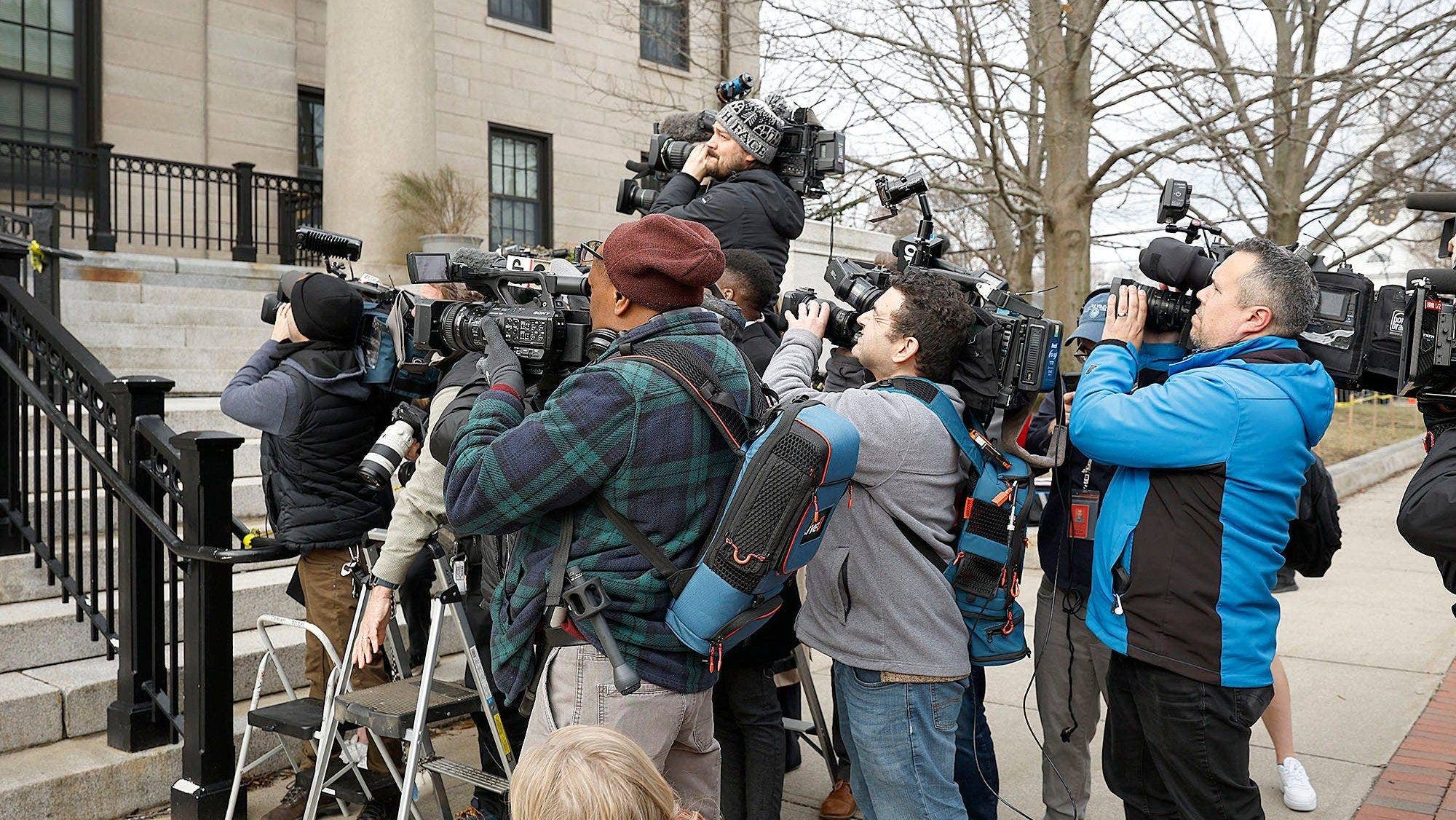
Two New England true crime reporters have filed a lawsuit against Massachusetts State Police for allegedly blocking them from covering the news outside the courthouse where Karen Read’s second murder trial in the death of John O’Keefe kicked off this week.
The lawsuit stems from a court-ordered “buffer zone” to keep protesters at a distance, but the journalists allege police hassled them inside the zone even though it is not supposed to apply to those not protesting.
The lawsuit names Massachusetts State Police Superintendent Geoffrey Noble and MSP Sgt. Michael Hardman and includes two additional unnamed state troopers.
KAREN READ APPEALS DOUBLE JEOPARDY RULING TO US SUPREME COURT
Karen Read exits Norfolk Superior Court in Dedham, Mass., Wednesday, April 2, 2025. (Dario Alequin for Fox News Digital)
“The Buffer Zone in Karen Read’s trial has now morphed into a ‘no journalism zone,’” the plaintiffs’ attorney, Marc Randazza, wrote on X in a post about the lawsuit. He is also representing four protesters who sued Judge Beverly Cannone earlier this week over the size of the no-protest area.
State police declined to comment, citing their policy on discussing pending litigation.
Media attention focuses on the courthouse for the arrival of Karen Read for her murder retrial at Norfolk Superior Court in Dedham, Mass., Tuesday, April 1, 2025. (Greg Derr/The Patriot Ledger/USA Today Network via Imagn Images)
One of the plaintiffs is Michel Bryant, a true crime producer from Connecticut whose work has appeared on A&E, Hulu and Netflix. His lawyers say he was interviewing a man named John Delgado inside the buffer zone Tuesday.
PROBE OF TOWN POLICE IN KAREN READ CASE FINDS NO SIGN OF ‘CONSPIRACY TO FRAME’ SLAIN OFFICER’S GIRLFRIEND
Karen Read kissing John O’Keefe in an undated photograph. (Courtesy of Karen Read)
“The First Amendment is obviously sacrosanct, and the ability to report on a crime or a trial is crucial for reporters.”
KAREN READ AND JOHN O’KEEFE: INSIDE EVOLUTION OF BOSTON MURDER MYSTERY SINCE JULY MISTRIAL
While Bryant’s lawyers say Delgado was not actively protesting, he was wearing a sticker that said, “Real Justice for John O’Keefe FKR.”
Read the lawsuit:
FKR is an acronym for “Free Karen Read,” a slogan some of her supporters have used in protests outside the courthouse at past hearings.
GO HERE FOR FULL COVERAGE OF THE 2ND KAREN READ TRIAL
Critics of Karen Read gather outside the courthouse in Dedham, Mass., June 28, 2024. (Patriot Pics/Backgrid for Fox News Digital)
Two unidentified state police officers allegedly told Bryant he had to get outside the buffer zone and told Delgado his sticker has “gotta go” before taking it off his jacket.
“I don’t want to see you walking by here again,” the officer, identified only as John Doe 1, allegedly told Delgado.
An unnamed officer takes a sticker off John Delgado’s jacket in this still image from a livestream recorded by journalist Michel Bryant. (Courtesy of Michel Bryant)
Bryant, who is also an Emmy winner and a lawyer, posted a clip of the encounter to his YouTube channel, where the “Justice Served” podcast is co-hosted by Linda Kenney Baden, a high-profile criminal defense attorney and legal analyst.
Bryant told Fox News Digital he is not a “Free Karen Read person” and was covering the case like he has covered many trials over the years when the interaction took place.
Matthew Pervier of Worcester holds a sign he made in support of Karen Read outside of Norfolk Superior Court in Dedham, Mass., April 16, 2024. (Greg Derr/The Patriot Ledger)
“Were we arrested? No. Were we shot at, put in a headlock? No,” Bryant said. “But why can’t you walk down the public sidewalk, especially when the court order doesn’t address that issue?”
FOLLOW THE FOX TRUE CRIME TEAM ON X
Also on Monday, podcaster Tom Derosier of “Seeking Justice with Tom and Mike,” alleged Sgt. Hardman “verbally assaulted him.”
SIGN UP TO GET TRUE CRIME NEWSLETTER
“You don’t have media credentials. You’ve got to go behind the buffer zone, OK, or you’re going to be subject to arrest,” Hardman allegedly told him. “Go follow them. You’re being told right now.”
Karen Read supporters rally on the front steps of the Registry of Deeds building. (John Tlumacki/The Boston Globe via Getty Images)
“I’m not media?” Derosier, a Massachusetts resident, asked, according to the lawsuit.
“No, you’re not,” Hardman allegedly replied.
Both men recorded the interactions and included them in court filings with the lawsuit.
“I think the reporters are probably on solid legal ground,” said Andrew Stoltmann, a Chicago-based attorney who has handled First Amendment cases in the past and teaches at Northwestern University’s School of Law.
“The judge has absolute powers in his courtroom to prevent parties or witnesses from talking about the case, but trying to gag a reporter that’s not in the courtroom is constitutionally very, very suspect for both the judge and the police officers who are trying to enforce it.”
Jury selection is underway for Read’s second trial. The first ended in a mistrial July 1 after jurors could not agree on a verdict.
She faces charges of murder, manslaughter and leaving the scene of a deadly hit-and-run for allegedly backing her Lexus SUV into O’Keefe in January 2022 and leaving him on the ground to die during a blizzard.
She has pleaded not guilty and denied the allegations, and her defense is arguing she was framed.
Read the full article from Here


Welcome to Day 2 of the Metropolitan Diary challenge, part of our celebration of the column’s 50th anniversary. On Day 1, we gave you tips for identifying your New York City story. Today, we’ll help you write it. (Missed Day 1? It’s not too late to start.)
What makes for a good Diary? It’s simply a good story that happens to be set in, and capture, the essential New York-ness of the city. While this isn’t a full writing course, we do have guidance on the kinds of elements that the submissions we publish include. They typically have: a beginning, middle and end; sharp details; catchy dialogue; a bit of surprise; some humor, warmth or emotion. But there is no formula, so flouting these loose rules can be worthwhile.
Don’t worry if you don’t think of yourself as a “writer.” Focus on being a “storyteller.” Pretend you are telling your story to the person who’d most appreciate it, using whatever conversational language or pacing that would hold their attention. Do it out loud if you want, maybe give that person a call and tell them your story (or tell it to them again). Then write it down.
That’s the big picture. For more tips, read on.
Here is an example of a published Diary that we (and readers) really liked, and a few thoughts on why that may help crystallize yours.
Unacceptable
Dear Diary:
I went to a new bagel store in Brooklyn Heights1 with my son.
When it was my turn to order, I asked for a cinnamon raisin bagel with whitefish salad and a slice of red onion.2
The man behind the counter looked up at me.
“I’m sorry,” he said. “I can’t do that.”3
— Richie Powers
One of this item’s best qualities is that it is short and snappy. Only 53 words! Although we will use stories of up to 300 words, many don’t need to be that long and the column doesn’t work if we don’t have a mix of long, medium and short, so we are always looking for stuff like this. Here’s another one!

At Attention
Dear Diary:
It was December 1967. I had just finished basic training at Fort Dix in New Jersey and was traveling to Boston in uniform. For reasons I no longer recall, I stopped in New York City on the way.1
Walking on the Upper East Side2 in a snowstorm, I spied another man in a uniform. He was older, and his cap bore the familiar gold band that identified him as an officer.
I rendered a snappy salute. It was not returned. 3The uniform was unfamiliar, so I guessed he was a foreign officer. Military courtesy still required me to salute.
A little farther down the street, I encountered another officer and offered another salute that went unacknowledged.4 His uniform was strange to me as well.
The third time it happened, the man I saluted ignored me while holding the door for a couple 5on their way into a large apartment building.
I realized I had been saluting doormen.6
— Stephen Salisbury
To get your storytelling muscles going, think through or jot down the answers to some of these questions.
Let’s start with setting the scene.
- When and where in the city did this happen? Is this place well-known?
- Was there anything particular about that point in your life that’s relevant?
- What did you see, hear, smell? Was there something notable about the weather?
Now, let’s move to the middle, the meat of the story.
- Did you have an exchange with someone?
- What details are important to how events unfolded, especially in setting up the ending?
And now, the end.
- What’s the resolution? Is there a punchline?
- Does the story end with a sense of shared humanity or some other warm feeling that lingers? You don’t need to name it. A good description will often allow readers to feel it too.
- Why has this experience stayed with you?
- Lines like “and that’s why I love New York” are almost always unnecessary.
That’s it. Keep your story simple and use the kind of plain language you use in conversation. You are sketching a moment in time. The details are important. Let them move the story along. Have fun and good luck.
Once you’re done, read through what you’ve got. What details are less important and can be left out? (Remember, there is a strict 300-word limit.)
Write your Metropolitan Diary however you like, on paper, on your phone or wherever! When you’re happy with what you’ve written, put your diary entry into the box below, fill out your information and submit it. You might just hear from me about including it in a future column.
This is the official submission form, so make sure to double-check your work before hitting submit.
That’s it! Submit your Metropolitan Diary.
By transmitting your submission, you grant The New York Times Company a perpetual, royalty-free license to use the submission in any medium. They may be edited, and may be republished and adapted in all media. You may reprint your story elsewhere after it appears in The Times.

Watch CBS News
Pittsburg, PA
Trash pickup schedules adjusted in Pittsburgh-area communities due to impending heat wave

Several communities in the Pittsburgh area have adjusted their trash pickup times as the region is bracing for a heat wave with temperatures and heat indexes expected to be near 100 degrees this week.
The hottest temperatures of 2026 are expected this week and by Tuesday afternoon, temperatures are anticipated to reach into the 90s. This, coupled with extremely high humidity levels, means the heat index — also known as the “feels like” temperature — will flirt with triple digits.
In Mt. Lebanon, trash and recycling pickup routes will begin earlier than normal to help keep workers safe amid the extreme heat.
“All trash and recycling should be placed at the curb the night before your scheduled collection day, as collection times may occur earlier than usual,” a notice posted on municipality’s Facebook page said.
Shaler Township said that it received an update from County Hauling that collection crews will begin their routes earlier than normal this week as well.
“Please place all trash and recycling at the curb the night before your scheduled collection day,” the township said.
In Robinson Township, trash collection will begin at 5 a.m. on Tuesday, one hour earlier than normal.
People are being asked to have their trash and recycling at the curb at least one hour prior to their normal pickup time.
Pleasant Hills Borough said it had adjusted its trash pickup schedule for earlier in the day on Friday to “help reduce employee exposure to hazardous temperatures.”
“This temporary adjustment is being made in the interest of employee health and safety,” the borough said. “We kindly ask that you help notify your residents that all trash and/or recycling should be placed at the curb the night before their scheduled collection day, as collection times may occur earlier than usual.”
In Brentwood Borough, Noble Environmental will begin earlier collection on pickup routes as well.
People are being asked to place their trash and recycling at the curb the night before their scheduled collection day.
The borough added that collection days are not changing, only the start time of the pickup routes.
“Thank you for your cooperation as crews work safely during this week’s heat wave,” the borough said.
The Library Volunteer Fire Company said that trash pickup in South Park Township is being moved earlier on Thursday.
“We kindly ask Township residents to place trash and recycling at the curb the night before Thursday, July 2nd pickup, as collection times may occur earlier than usual,” the notice said.
-

 Politics2 minutes ago
Fetterman unleashes on ‘dirtbag’ wing of Dems after far-left victories: ‘Orgy of socialism’
-

 Health5 minutes ago
Doctors thought man had brain cancer — they found live tapeworms instead
-

 Sports10 minutes ago
Paraguay stuns four-time World Cup champions Germany in penalty shootout after controversial call
-
 Business20 minutes ago
Comcast is spinning off NBCUniversal media and entertainment assets
-
 Entertainment25 minutes ago
Alannah Keyser is latest fired ‘Love Island USA’ contestant to apologize for using a racist slur
-

 Lifestyle32 minutes ago
Chanel’s Bruno Pavlovsky on Reengineering an Iconic Brand
-
 Politics35 minutes ago
Supreme Court limits police use of cellphone data to find crime suspects
-
 Sports47 minutes ago
Teoscar Hernández returns, and Dodgers unleash 17-hit barrage in win over Athletics

