Lifestyle
T.J. Byrnes, a No-Frills Irish Pub, Draws a Martini Crowd


Misty Gonzales has been tending bar at T.J. Byrnes, an Irish pub in the Financial District of Manhattan, for 13 years. For most of that time, she has served office workers, college students and city employees.
Two years ago, she noticed some unfamiliar faces. This new crowd was younger and usually stopped in for poetry readings, book-club gatherings and parties. Aside from their age, their drink orders set them apart.
“Martinis are the biggest thing — I couldn’t even get over how many people are drinking martinis,” Ms. Gonzales said. “Lots of Negronis, too.”
In the past year, the pub has hosted talks led by the art critic Dean Kissick, a holiday party for the leftist publication Dissent, a monthly reading series called Patio, a performance-art karaoke competition and a pre-Valentine’s Day party for single readers of Emily Sundberg’s Substack newsletter Feed Me.
Some of Ms. Sundberg’s 180 guests were initially confused by the choice of location.
“This was the first time people have texted me before being like, ‘What is this place?’” said Ms. Sundberg, 30, who first went to the bar for a friend’s birthday a couple years ago.
“I wouldn’t go as far as to call it the new Clandestino,” she added, referring to the downtown bar that is often bursting at the seams along Canal Street. “But if you have brand events — magazine parties, readings — it’s become a venue.”
At first glance, T.J. Byrnes might seem like an unlikely draw for writers, artists and fashion types. The bar is nestled in an austere plaza behind a Key Foods grocery store, at the base of a 27-story residential building. The facade looks onto a courtyard it shares with a preschool and a diner. The interior is unassuming, with a dark wooden bar in the front and white tablecloths and red leather booths in the back.
The bar’s eponymous owner, Thomas Byrne, 70, can be found most evenings at a cluttered desk just inside the dining room or perched at a hightop near the entrance, keeping an eye on the scene. In a pinch, he pulls pints behind the bar.
“I am very hands-on,” said Mr. Byrne, who has a neat mustache and typically wears a button-down shirt tucked into black trousers. He commutes into the city daily from Yonkers, where he has lived for the last 32 years. “I’m not saying I never take a day off, but I’m here a lot of the time, and I like that.”
The youngest of three, Mr. Byrne immigrated from County Wicklow, Ireland, in 1972 to join his brothers in New York, where they made their livings working in bars. With his brother Seamus, he ran a pub on Fordham Road in the Bronx from 1975 to 1991.
After they closed that spot, his brother Denis came across a vacant Chinese restaurant on Fulton Street. It needed some serious remodeling, but its sheer size and proximity to some of Manhattan’s busiest office buildings made it too good to pass up. After months of construction, T.J. Byrnes opened its doors in October 1995.
With the exception of a brief window during the city’s Covid lockdowns, the pub has been open nearly every day for the last 30 years.
“People say, ‘Oh, you’re still here,’” Mr. Byrne said. “We went through Sept. 11, we went through Sandy, the big storm and all that, and tough times. But you just hang in there, and it works out.”
Mr. Byrne recalled finally getting through police barricades the day after the attacks on the twin towers to find the bar, helmed by his brother, teeming with people from the neighborhood.
“So many people came in here just to be together,” he said. “People were in distress, and this was a meeting place to sit down and talk.”
T.J. Byrnes has always had an eclectic clientele, he said. City workers from 100 Gold St. mingled with musical theater students from Pace University. Office employees, retirees from St. Margaret’s House apartment community and residents of Southbridge Towers sat shoulder to shoulder at the bar. But it seemed to take a specific confluence of events to get a more artsy crowd in the door.
It might have started in 2022, when the writer Ezra Marcus sang the bar’s praises in the Perfectly Imperfect recommendation newsletter. “Byrnes is a holdout against the mass extinction of normal places for normal people to get a drink in the city,” Mr. Marcus, an occasional contributor to The New York Times, wrote.
A couple months later, Joshua Citarella, an artist in New York who researches online subcultures, called T.J. Byrnes the “new Forlini’s” in an article for Artnet, likening it to the red-sauce restaurant that had unexpectedly become a downtown cool-kid haunt in the years before it shuttered.
At the same time, the micro-neighborhood a few blocks from Forlini’s known as Dimes Square was becoming overexposed and — with the arrival of an opulent boutique hotel and fine dining establishments — a bit too upscale for some.
“It just has a better vibe,” Mr. Citarella said on a recent evening at T.J. Byrnes, where he was hosting a reading group with the author Mike Pepi. “With the transformation of downtown New York, everything has turned into condos; it doesn’t feel like anything is authentic or is here to stay.”
The South Street Seaport area that surrounds T.J. Byrnes has undergone its own changes. Once a gritty neighborhood celebrated by the writer Joseph Mitchell for its fish markets, the district has been transformed over the decades, most recently by large real estate investments, new shopping destinations and independent art galleries like Dunkunsthalle, located in an old Dunkin’ Donuts on Fulton Street.
When McNally Jackson Books opened its Seaport location in 2019, making it a hub for literary events, T.J. Byrnes became a favorite post-reading spot.
Jeremy Gordon, a senior editor at The Atlantic, was introduced to the bar after one of those McNally Jackson events. He took to it right away. Although T.J. Byrnes is unusually spacious for the city — another point in its favor — he described it as “beautifully cozy.”
When his debut novel, “See Friendship,” was published this month, he decided to throw a book party there.
With a lineup of readers and an open bar, Mr. Gordon invited around 60 of his friends to fete his book. The crowd sipped vodka sodas and hung out in the “many little pockets” of the space, which includes a large dining room and a side area that’s more tucked away.
“It is the type of place that I hope continues to exist for as long as I live in the city,” he said.
For some, it is a necessary counterbalance to fussy bars and restaurants that cater to the TikTok crowd or to those seeking experiences behind red ropes.
“I don’t want a concept,” said Alex Hartman, who runs the satirical meme account “Nolita Dirtbag,” railing against what he sees as a trend of bars spending exorbitantly on interior design that panders to the downtown creative class. People are “protesting this sort of aesthetic lifestyle,” he added.
With reasonably priced bars in short supply and a surge of private clubs taking over nightlife, T.J. Byrnes, with its lack of pretense, is an antidote.
“It’s the anti-members club,” Ms. Sundberg said. “There’s this huge cohort of New York City who wants to get into this locked, password protected, paywall door — and then T.J. Byrnes is right there.”
Mr. Byrne keeps track of his bar’s events and parties by hand, in a hardcover planner. Many people looking to entertain there simply text him to reserve the space — no fee or bar minimum required.
“I like the people that come here for the artist group,” Mr. Byrne said. “They’re really nice to deal with and enjoy the place, and we enjoy having them here.” During readings, he often listens from a spot toward the back.
On a recent Friday night, the furniture designer Mike Ruiz Serra celebrated his 28th birthday at T.J. Byrnes with about 100 friends. His guests downed pints of Guinness, sipped martinis and Negronis, and ordered classic bar fare like mozzarella sticks.
Away from the party, Andy Velez was closing his tab. Mr. Velez, who works for the City of New York in data communications, has been coming to T.J. Byrnes after work for 17 years, usually a few times a week.
“This is my ‘Cheers,’” he said.
Even when the crowd started to swell, as it was then, Mr. Velez said that the bar was almost never too loud to have a conversation.
“This is a very special place, a staple of the community,” he said. “Only people in the neighborhood really know about this.”



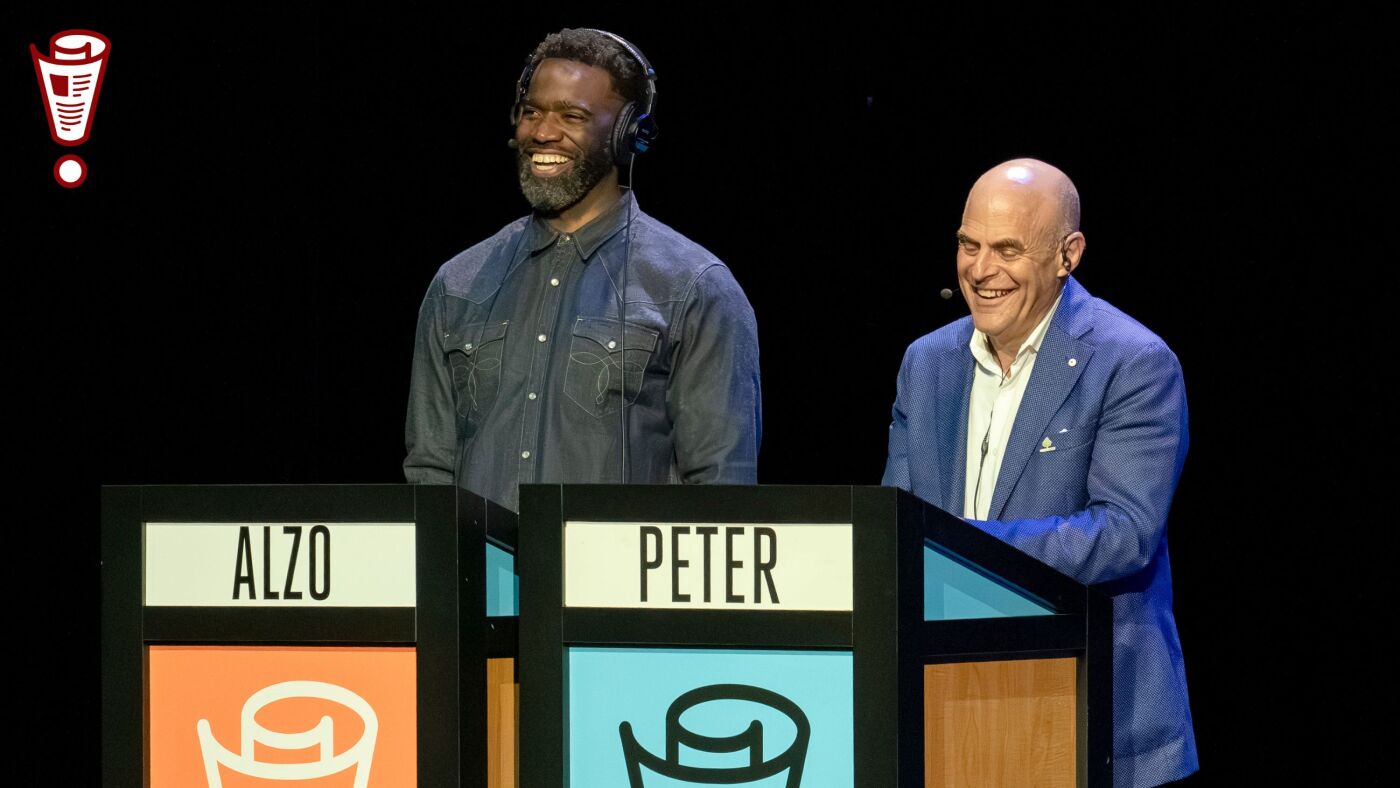
Alzo Slade and Peter Sagal on stage at the Studebaker Theater in Chicago
Jenn Udoni/NPR
hide caption
toggle caption
Jenn Udoni/NPR
This week’s show was recorded in Chicago with host Peter Sagal, judge and scorekeeper Alzo Slade, Not My Job guest Caro Claire Burke and panelists Karen Chee, Peter Grosz, and Shane O’Neill. Click the audio link above to hear the whole show.
Who’s Alzo This Time
Tourists Embrace The USA; The Wedding of the Century; Advances in Parenting
Panel Questions
Stolen Flavor
Bluff The Listener
Our panelists tell three stories about 80’s band A-ha making the news this week, only one of which is true
Not My Job: Caro Claire Burke, the author of Yesteryear, joins us to answer questions about yearbooks
This week, Caro Claire Burke, author of the book of the summer, Yesteryear, joins us to play a game called, “Yesteryear, meet Yearbook.” Three questions about yearbooks.
Panel Questions
Bookmarks and Beaches; One Man’s Trash
Limericks
Alzo Slade reads three news-related limericks: Jurassic Purse; Viper Visions; Humanity’s Tilt
Lightning Fill In The Blank
All the news we couldn’t fit anywhere else
Predictions
Our panelists predict, what would be the big surprise at Taylor Swift’s wedding
Lifestyle
Day 1,578 of WW3: The UN Security Council will meet on Monday to address Russia's latest strikes on cultural and religious sites, including the attack on Kyiv-Pechersk Lavra. ANGH, of course. This is your Saturday Ukraine discussion
Day 1,578 of WW3: The UN Security Council will meet on Monday to address Russia's latest strikes on cultural and religious sites, including the attack on Kyiv-Pechersk Lavra. ANGH, of course. This is your Saturday Ukraine discussion

NEW YORK, NEW YORK – APRIL 21: Laverne Cox attends the “Animal Farm” New York Premiere at Regal Theater on April 21, 2026 in New York City.
Jamie McCarthy/Getty Images
hide caption
toggle caption
Jamie McCarthy/Getty Images
In 2013, when the Netflix series Orange Is the New Black came out, the world met the character Sophia Burset — a Black trans woman serving as the resident hairstylist in prison.
For much of the audience, it was also the first time they met actress Laverne Cox — who landed the role of Sophia at the age 40, just when she was thinking of quitting acting altogether.
In her new memoir Transcendent, Cox talks about the challenges she faced long before Netflix came knocking: a mother who withheld love, a father who was never around and the brutal denigration she encountered growing up Black and trans in the deep South.
To unlock this and other bonus content — and listen to every episode sponsor-free — sign up for NPR+ at plus.npr.org. Regular episodes haven’t changed and remain available every weekday.
Email us at considerthis@npr.org.
-

 Mississippi13 seconds ago
Iconic Mississippi foods and top US foodie states
-

 Missouri5 minutes ago
Man shot, killed after argument spills out of south Kansas City home
-

 Montana12 minutes ago
Photos: Montana East-West Shrine Game
-

 Nebraska15 minutes ago
Deadline looms for filing Nebraska Homestead Exemption applications
-

 Nevada20 minutes ago
The nation’s data center debate has reached Southern Nevada
-

 New Hampshire27 minutes ago
'New Hampshire Outright' creates open, safe spaces for LGBTQ+ families
-

 New Jersey30 minutes ago
Gun shots fired in Greenwich Township NJ, police investigating
-

 New Mexico35 minutes ago
Fiesta Subaru helps hundreds of New Mexico dogs find homes with big donation

