Politics
Trump Says He Will Call Putin to Discuss Ending Ukraine War


President Trump said he would speak with President Vladimir V. Putin of Russia on Tuesday, as he continued to express optimism that Russia would agree to a proposal to halt fighting in Ukraine for 30 days.
“We want to see if we can bring that war to an end,” Mr. Trump told reporters aboard Air Force One on Sunday evening. “Maybe we can. Maybe we can’t, but I think we have a very good chance.”
Mr. Trump said that progress on negotiations had been made over the weekend, and there have been ongoing discussions about “dividing up certain assets,” specifically mentioning concessions over land and power plants.
“I think we’ll be talking about land, it’s a lot of land. It’s a lot different than it was before the war, as you know,” Mr. Trump said.
He added: “We’ll be talking about power plants. That’s a big question. But I think we have a lot of it already discussed very much by both sides — Ukraine and Russia.”
Steve Witkoff, the U.S. special envoy to the Middle East who has been involved in the peace talks, said Sunday on CNN that he had a positive meeting with Mr. Putin last week that lasted three to four hours. He declined to share the specifics of their conversation, but he said the two sides had “narrowed the differences between them.”
Ukraine has already agreed to support the U.S.-backed cease-fire, and President Volodymyr Zelensky of Ukraine has accused Mr. Putin of purposely delaying negotiations while trying to trap Ukrainian forces to improve his position in the cease-fire talks.
Mr. Putin had demanded on Friday that Ukraine’s troops in the Kursk region of Russia surrender. But by the weekend, after fierce fighting, the Ukrainians had withdrawn from most of the region, leaving them controlling a sliver of land in Russia.



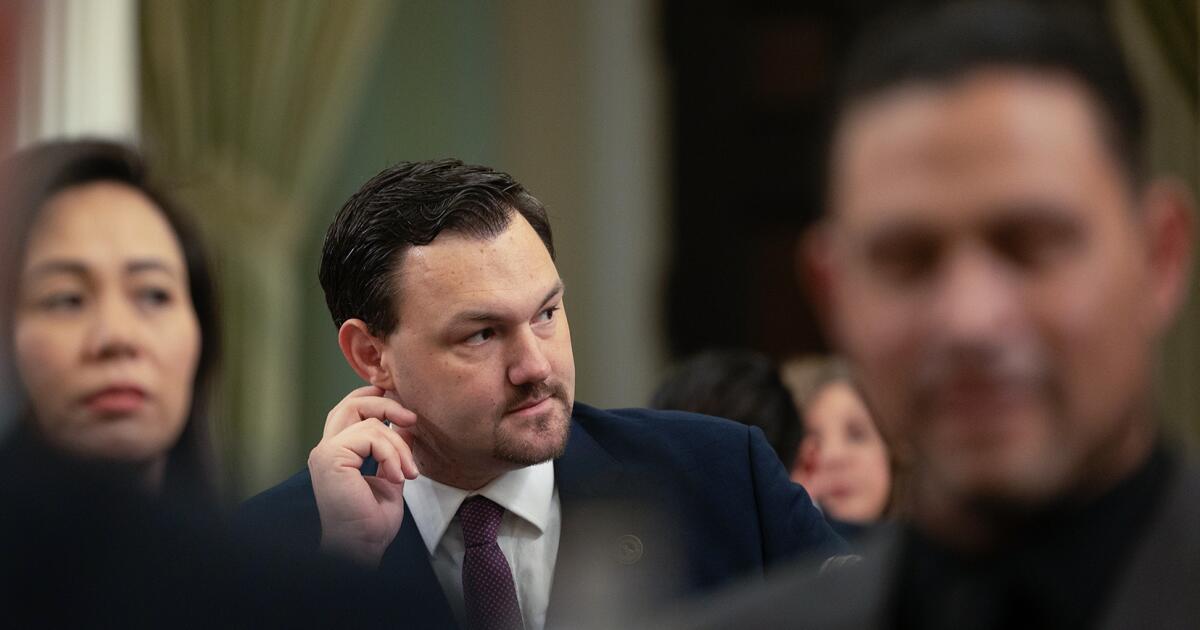
A new commission made up of legislators, public defenders, academics and advocates seeks to push California — one of just two states that don’t pay for basic public defense — to begin providing resources and enforcing minimum standards for county public defender systems.
The California Independent Commission on Public Defense includes three assemblymembers and two senators — among them Jesse Arreguín and Nick Schultz, chairs of the Senate and Assembly Public Safety Committees — as well as chief public defenders from several counties, retired judges, the directors of criminal justice nonprofits, and the heads of organizations representing thousands of defense attorneys in the state.
“We have discussed the problem of our public defense system for years,” said Schultz, a Democrat from Burbank and former prosecutor who has sponsored legislation to improve public defense.
The goal is to “move past discussion and study, and come up with an actionable road map of what we need to do to really build out the robust public defense infrastructure that Californians are rightfully entitled to,” he said.
The commissioners plan to develop a five-year plan to phase in state funding, along with enforceable standards like caseload limits and access to defense investigators.
A CalMatters investigation last year found that criminal defendants across the state are routinely convicted without anyone investigating the charges against them, significantly increasing the likelihood of wrongful convictions. Many California counties do not employ a single defense investigator who can interview witnesses, review police reports, visit crime scenes and retrieve video surveillance footage. CalMatters also found that lawyers in some rural counties are handling caseloads that far exceed even the most permissive standards, making them less likely than other defense attorneys to challenge the prosecution’s evidence in legal motions and take their cases to trial.
But the state has resisted stepping in. After a proposed bill that would have created an official state commission to address the issue was abandoned, two advocacy groups, the Wren Collective and UC Berkeley’s Criminal Law and Justice Center, decided to form an independent commission and began assembling participants who could develop and act on reforms. These types of commissions, which have facilitated significant improvements in other states’ public defender systems, are usually established by the governor.
“It became clear that this was an issue that was not a high priority for Sacramento, especially during a budget crisis,” said Chesa Boudin, the Berkeley center’s founding director and a former San Francisco district attorney. It also became clear, Boudin said, that “there was a tremendous gap between what experts understood to be the crisis and the public perception of California government as a kind of progressive leader in the country.”
In the decades since the U.S. Supreme Court established the right to an attorney in state court criminal proceedings, California has saddled its counties with the responsibility of providing lawyers to poor people accused of crimes. Many of those counties have opted for the cheapest path: paying private lawyers and firms a flat fee to represent indigent defendants, regardless of how many cases they handle or how much time they spend on each case.
“You’ve got some offices that have an incredibly high caliber of representation that they can provide, and you have other offices that are doing these flat-fee contracts where the quality has been documented to be pretty bad,” said Eve Brensike Primus, a law professor at the University of Michigan.
Primus is the only member of the new commission from outside of California. She was asked to join because of her extensive research and writing about the structure of indigent defense.
An indigent defense commission in Michigan, which was formed by the legislature in 2013, has led to significant reforms and a substantial influx in state funding.
The California commission’s work, Primus said, can serve “as a catalyst for political actors to do the right thing and start to fund and improve indigent defense delivery, or as fodder for lawsuits that then can try to get the judiciary to push the political actors to do what is necessary to provide for effective representation.”
The commission is scheduled to hold its first in-person meeting, which will be open to the public, in Berkeley in October, with additional meetings planned for Los Angeles, the Central Valley and Northern California over the next 12 months. Commissioners say they will work in subcommittees in between these quarterly sessions to develop a concrete fiscal plan for the state, draft legislative language, and establish minimum standards for how counties should structure their public defender offices, compensate their attorneys, provide access to experts, and report on their work.
Anat Rubin writes for CalMatters.
Politics
Pope Leo sends unmistakable message on immigrants during visit honoring America’s first saint

NEWYou can now listen to Fox News articles!
Pope Leo XIV used a visit Saturday honoring St. Frances Xavier Cabrini, the first American saint and patron saint of immigrants, to deliver his latest appeal on behalf of them, asking Catholics to look to her example at a time when migration remains one of the defining issues of his emerging papacy.
The remarks came as Leo continues to make migration a central focus of his public ministry, a position that has sparked months of public friction with President Donald Trump over immigration and foreign policy.
“What could be more relevant today than a missionary charism dedicated to serving migrants?” Leo said during an evening prayer service in Sant’Angelo Lodigiano, the northern Italian town where Cabrini was born.
The American-born pope prayed at Cabrini’s tomb and urged young Catholics to learn from the saint’s life of serving immigrants, many of whom had left their homelands in search of better opportunities.
POPE LEO XIV STRONGLY SUPPORTS US BISHOPS’ CONDEMNATION OF TRUMP IMMIGRATION RAIDS: ‘EXTREMELY DISRESPECTFUL’
Pope Leo XIV presides over a celebration at the parish of Santi Antonio Abate e Francesca Cabrini in Sant’Angelo Lodigiano, Italy, Saturday. The visit was part of his pastoral journey to nearby Pavia and marked the birthplace of Francesca Cabrini, the first U.S. saint and Patroness of Migrants. (Mario Tomassetti/Vatican Media)
But Leo also invoked his predecessor, Pope Francis, whose own papacy was defined in part by calls to welcome migrants.
“Let us ask ourselves: if Mother Francesca were alive today, what would her missionary spirit tell her?” Leo said. “And what would a pope like Francis — who, as the son of Italian immigrants, made service to migrants one of the key priorities of his pontificate — ask of her?”
The comments are the latest in a series of migration-focused appearances that have helped define Leo’s first year as pope.
POPE LEO APPOINTS PRO-IMMIGRATION BISHOP TO DIOCESE HOME TO TRUMP’S MAR-A-LAGO
Pope Leo XIV greets faithful as he leaves the parish of Santi Antonio Abate e Francesca Cabrini in Sant’Angelo Lodigiano, Italy, Saturday. (Mario Tomassetti/Vatican Media)
Last week, Leo traveled to Spain’s Canary Islands, a major destination for migrants departing West Africa, where he met migrants and called for greater efforts to welcome and integrate people fleeing hardship and conflict.
During that trip, Leo urged world leaders to create “legal and safe pathways” for migration and warned against reducing migrants to statistics.
Leo’s migration advocacy has frequently drawn criticism from Trump, who has accused the pontiff of venturing into politics and sharply disagreed with some of his comments on immigration and foreign affairs.
The public disagreements have become one of the most closely watched relationships between the Vatican and Washington during Leo’s papacy.
INCLUSIVE TONE OF NEW POPE ISN’T SITTING WELL WITH SOME IN THE ‘AMERICA FIRST’ MOVEMENT
Pope Leo XIV presides over a celebration at the parish of Santi Antonio Abate e Francesca Cabrini in Sant’Angelo Lodigiano, Italy, Saturday, during his pastoral journey to nearby Pavia. (Mario Tomassetti/Vatican Media)
Earlier this year, Reuters reported that Secretary of State Marco Rubio was expected to meet with Vatican officials and Italian leaders during a period of heightened tensions between the Holy See and the Trump administration.
Leo has rejected suggestions that his remarks are political attacks, arguing instead that his appeals stem from Catholic teaching on human dignity, peace and care for vulnerable people.
Saturday’s visit centered on Cabrini, who became a naturalized U.S. citizen and spent decades serving Italian immigrants through schools, hospitals and orphanages before her death in Chicago in 1917.
US CATHOLIC BISHOPS PRESIDENT SAYS DEPORTATIONS INSTILLING ‘FEAR’ IN ‘WIDESPREAD MANNER’: ‘CONCERNS US ALL’
Pope Leo XIV holds a private audience with Vice President J.D. Vance at the Apostolic Palace in Vatican City, May 19, 2025. (Simone Risoluti/Vatican Media)
The Vatican has also announced that Leo will travel to the Italian island of Lampedusa on July 4, a date likely to draw attention in the United States given the pope’s American roots.
CLICK HERE TO DOWNLOAD THE FOX NEWS APP
Lampedusa has become one of Europe’s most recognizable migration flashpoints because of the thousands of migrants who attempt dangerous crossings from North Africa each year. The island also carries symbolic importance within the Catholic Church because it was the destination of Pope Francis’ first trip outside Rome after becoming pope in 2013.
Fox News Digital’s Eric Mack and Robert McGreevy, and The Associated Press contributed to this report.

For UFC boss Dana White, heavyweight Josh Hokit’s post-fight behavior at UFC Freedom 250 on Sunday crossed a line.
On Monday, the mixed martial arts promotion’s president and chief executive told Time reporter Sean Gregory via text he is “completely against saying nasty and false things about people’s families” in reference to Hokit’s tasteless comment about Michelle Obama. During the White House spectacle in front of President Trump and others, Hokit was interviewed after his technical-knockout victory over Derrick Lewis and propped up a false conspiracy about the former first lady, declaring “Michelle Obama is a man.”
Hokit, who has a history of making tasteless comments after his fights, including the same Obama jab, drew mixed reaction from the UFC Freedom 250 crowd — and also from social media users, with some repeating the false claim in the comments on Hokit’s Instagram page and others chiding it. White, who has panned Hokit’s remarks in the past, did so again.
“Everyone knows my position on free speech but I hate that kind of nonsense,” White’s text added.
Hokit insulted Obama months after Trump faced backlash in February for a racist social media video that depicted President Obama and the former first lady as apes. Amid mounting public criticism, the White House took down the video and blamed an unnamed aide.
Michelle Obama, clearly on Hokit’s mind on Sunday, was busy with other matters over the weekend: preparing with her husband to open their Obama Presidential Center in Chicago. The museum and library hosts its grand opening Thursday and will be open to the public Friday.
Times staff writer Ana Ceballos contributed to this report.
-
 Entertainment3 minutes ago
A fake mountain and real magic transform Paris’ oldest bridge
-
Lifestyle5 minutes ago
Day 1,578 of WW3: The UN Security Council will meet on Monday to address Russia's latest strikes on cultural and religious sites, including the attack on Kyiv-Pechersk Lavra. ANGH, of course. This is your Saturday Ukraine discussion
-
Politics11 minutes ago
Can a new commission remedy California’s public defender crisis?
-
Sports21 minutes ago
2026 World Cup guide: Full TV schedule, game previews, results and standings
-

 World33 minutes ago
Poland and Ukraine’s ‘honours war’ intensifies
-

 News56 minutes ago
Newsom declares State of Emergency for Boyle Heights warehouse fire
-

 Los Angeles, Ca2 hours ago
Kids, teens can enjoy free lunch at over 90 parks across Los Angeles
-

 Detroit, MI3 hours ago
Metro Detroit church hosts community event to support youth: “We’re here for you”


