Politics
Some European Allies Fear Trump Is Out to Destroy Them


During his first term in office, President Trump described the European Union “as a foe,” established “to hurt the United States on trade.”
He repeated the charge at a cabinet meeting on Wednesday, but in more vulgar terms: “The European Union was formed in order to screw the United States. That’s the purpose of it, and they’ve done a good job of it.”
Then he said he was preparing to hit Europe with 25 percent tariffs on cars and other goods.
After Mr. Trump’s embrace of Russia and his warnings that Europe had better fend for itself, the president’s latest attack added to the increasing view of European leaders and analysts that he and his team of loyalists consider America’s traditional allies in Europe as adversaries not just on trade, but on nearly everything.
Some officials and analysts see the Trump administration as merely indifferent to Europe; others see open hostility. But there is a common view that the fundamental relationship has changed and that America is a less reliable and predictable ally.
Mr. Trump has rebuffed NATO and aligned himself with the longstanding, principal threat to the alliance: Russia. Vice President JD Vance has attacked European democracy while calling for the door to be opened to far-right parties. Elon Musk, the billionaire Trump aide, has heaped contempt on European leaders and openly endorsed an extremist party in Germany.
Equally shocking to European leaders, the United States this week refused to condemn Russia’s invasion of Ukraine at the United Nations. It instead broke from its allies and voted with Russia, Belarus and North Korea, all authoritarian governments.
European leaders are scrambling to assess and mitigate the damage. The prime minister of Britain, Keir Starmer, arrives at the White House on Thursday — the second such visit this week, after President Emmanuel Macron of France — still hoping to persuade Mr. Trump not to abandon Ukraine and to remain engaged in Europe. But Mr. Trump describes himself as a disrupter, and Mr. Macron got little for his attempt at seduction.
Friedrich Merz, 69, the conservative politician likely to be Germany’s next chancellor, has expressed strong doubts about the trans-Atlantic relationship he and his country have been committed to for decades.
On Sunday evening, after his party won the most votes in the German election, Mr. Merz said that after listening to Mr. Trump, “it is clear that the Americans, at least this part of the Americans, this administration, are largely indifferent to the fate of Europe.”
He wondered whether the American nuclear umbrella over NATO would remain — and even whether the alliance itself would continue to exist.
“My absolute priority will be to strengthen Europe as quickly as possible so that, step by step, we can really achieve independence from the USA,” he said.
His comments were a remarkable measure of the dismay felt by European leaders over the American reversal of policy on Ukraine and, perhaps more so, for its outright backing of far-right parties that despise European governments and support Russia.
Mr. Merz’s remarks were reminiscent of a 2017 statement by Angela Merkel, then the German chancellor, after contentious alliance meetings with Mr. Trump. “The times in which we could rely fully on others — they are somewhat over,” she said. She encouraged Europeans to “take our fate into our own hands.”
Her comments were considered a potentially seismic shift, but a real reorientation of European security policy never materialized. Matters are more serious now, said Claudia Major, who directs security policy at the German Institute for International and Security Affairs.
“In Munich, Vance declared a culture war and said: ‘Join us or not. We have the right values and you have it wrong,’” she said. His speech, she added, made it clear that “the country that brought us back our freedom and our democracy is turning against us.”
She is not alone in the assessment. Several analysts said the Trump administration’s actions showed that it was not merely indifferent to Europe, but was out to undo it. The distinction holds real consequences for how Europe can respond.
“There is no question the intention is there to destroy Europe, starting with Ukraine,” said Nathalie Tocci, director of Italy’s Institute of International Affairs. “The empowering of the far right is instrumental to the goal of destroying the European Union.”
The reason, she said, is that the Trump administration sees Europe not merely as a competitor, but also as an economic and even ideological threat. It wants to undermine the power of the European Union to regulate trade, competition and hate speech. The latter is a major topic for Mr. Vance, as he criticized what he called news media censorship and political correctness.
The European Union is the largest trading bloc in the world, capable of striking back against Washington economically and in tariff terms, representing the “economic foe” Mr. Trump railed against in his first term.
That power is being used against high-tech and social media companies whose leaders surround and subsidize Mr. Trump, like Mr. Musk, who owns the social media platform X. They, too, have an interest in weakening “the Brussels Effect,” as Anu Bradford of Columbia University Law School called it.
The Brussels Effect is the power of the European Union to establish global rules and norms, and it is particularly important in the realms of climate regulations, digital competition, platform accountability and artificial intelligence.
But if the Trump administration feels it necessary to destroy that threat, then there is little European nations can do to appease the White House, some warned.
If Mr. Trump and his team “are out to push the far right and destroy European democracy, then no amount of European purchasing of American LNG or weapons will matter,” said Ms. Tocci, of Italy’s Institute of International Affairs. By increasing dependency, she added, “it could be a kind of double suicide.”
U.S.-European relations tend to go in cycles, with important strategic debates in the past over Iraq or Afghanistan or even Vietnam. But now the clashes are simultaneously ideological, strategic and economic, said Camille Grand, a former NATO and French official with the European Council on Foreign Relations.
“Facing hostility on all three fronts at once is quite a shock to Europeans,” said Mr. Grand. “Adding all three together you can wonder whether you are no longer a partner but a rival and, perhaps, even an adversary.”
Every country in Europe is doing a reassessment of where it is vis-à-vis Washington, he said. What isn’t clear is whether, as in Mr. Trump’s first term, “you have an unpleasant roller-coaster ride that leaves you sick but you end up where you started, or whether the whole relationship now derails.”
Linas Kojala, director of the Geopolitics and Security Studies Center in Vilnius, Lithuania, urges calm, because “there is no real alternative to the U.S. security guarantee” for a long time to come. “Declaring the trans-Atlantic relationship has collapsed would be like stepping off a ship in the middle of the ocean with no other vessel in sight.”
So for now, he said, “Europe must swallow” the Trump criticism and “do everything possible to keep the relationship intact.”
But it is unlikely to return to where it was, Alex Younger, a former chief of Britain’s foreign intelligence service, MI6, told the BBC last week. “We are in a new era where, by and large, international relations aren’t going to be determined by rules and multilateral institutions,” he said, but “by strongmen and deals.”
Matthew Kroenig, a former defense department official who is now at the Atlantic Council in Washington, calls himself a “normal Republican” and says that “there has been a bit too much hysteria over the past couple of weeks.”
After all, Mr. Kroenig said, the first Trump term was also marked by “a lot of tough rhetoric against allies and a lot of deferential language toward Putin, but in the end, NATO was strengthened.”
Others are less sure.
Mr. Trump has been engaged in “a policy of rapid, unilateral concession of long-held positions on fundamental interests to persuade the aggressor to stop fighting,” said Nigel Gould-Davies of the International Institute for Strategic Studies, speaking of Russia in Ukraine.
“The established name for such a policy,” he said, “is ‘strategic surrender.’”
Whether it will produce the outcome Mr. Trump desires is not clear, he said. What is clear is that it is undermining allied trust in the credibility and common sense of the United States.
It is imperiling old allies in Europe.
And it is “making Russia a more powerful, assertive and attractive ally to America’s adversaries around the world,” he said.



new video loaded: Erika Kirk’s Message for Women at Turning Point USA

By Vivian Yee, Christina Shaman, Lauren Pruitt, James Surdam and Melanie Bencosme
June 18, 2026

NEWYou can now listen to Fox News articles!
FIRST ON FOX: Americans are nearly evenly split between favoring Iranian regime change and a negotiated U.S. settlement with Iran, according to a new survey.
Some 39% of respondents favor a negotiated settlement where Iran’s current government remains in place, with verifiable limits on its nuclear and missile programs, according to the findings of the Reagan Institute Summer Survey, while 36% favor replacing Iran’s current government with one more favorable to the U.S.
Another 16% favor a weakened regime where the current government stays in place but is significantly diminished militarily and economically, and 8% responded that they don’t know.
The findings underscore the political challenge facing President Donald Trump as his administration pursues a newly signed memorandum of understanding with Iran. While the agreement seeks to curb Iran’s nuclear ambitions through negotiations, Americans remain divided over the ultimate objective of U.S. policy toward the Islamic Republic.
Americans are nearly evenly split between favoring Iranian regime change and a negotiated U.S. settlement with Iran, according to a new survey. (Mandel NGAN / AFP via Getty Images)
AMERICANS AGREE WITH TRUMP THAT IRAN POSES THREAT TO UNITED STATES: POLL
Republicans who responded to the survey favored replacing Iran’s government by a 2-to-1 margin over a diplomatic deal.
Republicans were far more likely than Democrats to favor a more aggressive outcome in Iran. Half of Republican respondents said they would prefer to see Iran’s current government replaced with one more favorable to the United States, compared to 25% who said they would favor a negotiated settlement that leaves the regime in place in exchange for verifiable limits on its nuclear and missile programs.
The findings were nearly identical among self-identified MAGA Republicans, 51% of whom favored regime change while 25% backed a negotiated settlement.
SHARP PARTISAN DIVIDE EMERGES OVER IRAN STRIKE, TRUMP’S STRATEGY: POLLS
Democrats, meanwhile, largely favored diplomacy. A majority, 52%, said they would prefer a negotiated settlement with Iran’s current government, while 25% favored regime change. Another 14% favored leaving the regime in place but significantly weakened militarily and economically.
The Reagan Institute Summer Survey was conducted May 26 through June 3 among 1,555 respondents nationwide and carries a margin of error of plus or minus 2.5 percentage points. The survey used a mixed-mode methodology that included live telephone interviews, an online panel and text-to-web responses.
Smoke rises over Tehran following an explosion amid ongoing U.S. and Israeli military strikes on Iranian targets on March 2, 2026. (Majid Saeedi/Getty Images)
The findings underscore the political challenge facing President Donald Trump as his administration pursues a newly signed memorandum of understanding with Iran. (Hamid FOROUTAN / ISNA / AFP via Getty Images)
Republicans were far more likely than Democrats to favor a more aggressive outcome in Iran. (Pool via WANA/Reuters)
To better reflect the U.S. population, the results were weighted using demographic benchmarks from the U.S. Census Bureau’s 2023 American Community Survey, including age, gender, race, region and education levels. The poll also included an oversample of 331 MAGA Republicans under age 30, a group with a margin of error of plus or minus 5 percentage points.
The Reagan Institute is a Washington-based policy organization that advocates the Reagan foreign-policy tradition of “peace through strength” and sustained American leadership abroad.
The findings come as Trump has defended a newly signed memorandum of understanding with Iran as a way to reduce tensions and create a pathway toward a broader agreement addressing Tehran’s nuclear program.
The memorandum establishes a 60-day negotiating period during which the United States and Iran will attempt to reach a more comprehensive deal. The agreement also includes provisions aimed at restoring commercial shipping through the Strait of Hormuz and provides limited sanctions waivers tied to continued negotiations. Several of the most contentious issues, including the long-term future of Iran’s nuclear program, are expected to be addressed in subsequent talks.
Trump has described the arrangement as a means of avoiding a wider conflict while pursuing what he called a “great settlement” with Tehran. He has also argued that the agreement could help stabilize energy markets by reopening the Strait of Hormuz, a critical global shipping route, while creating an opportunity to negotiate additional restrictions on Iran’s nuclear activities.
CLICK HERE TO DOWNLOAD THE FOX NEWS APP
The president added that he agreed to a settlement to avoid “economic catastrophe.”
“I didn’t want to see economic catastrophe. If you kept this going, that could have happened,” he told reporters at the G7 Summit in France.
WASHINGTON — The White House pushed back Thursday against growing bipartisan criticism of a negotiated settlement to the war with Iran, arguing its concessions to the Islamic Republic were contingent on its conduct and essential to securing peace.
The administration’s defensive posture came as details of the framework agreement, known as a memorandum of understanding, were finally shared with the public, revealing a raft of compromises with Tehran long opposed by Republicans.
Vice President JD Vance, who helped negotiate the deal, told reporters Thursday that the deal was structured to reward Iran for good behavior. But the text of the agreement suggests otherwise.
The Trump administration agreed to release billions of dollars in Iranian assets that were frozen and restricted by the United States “upon the implementation” of the memorandum — before any further actions are taken or additional negotiations begin. The president will issue sanctions waivers on Iranian oil, allowing Tehran to resume trading its most valuable export and breaking with decades of policy. And to facilitate that trade, boosting Tehran’s revenues, Trump agreed to immediately end a U.S. naval blockade of Iranian ports.
Still more concessions were offered to the Iranians, including a commitment by the U.S. administration to establish a fund of “at least $300 billion for the reconstruction and economic development of the Islamic Republic” — in effect providing reparations for the war Trump started.
“All required licenses, waivers and permissions needed for the relevant financial transactions will be granted by the United States of America,” the memorandum reads.
Taken together, the document reads as a stunning reversal of U.S. policy toward Iran after decades of concern across administrations in Washington — including throughout Trump’s two terms — that the Islamic Republic represents the nation’s greatest security threats as the world’s largest state sponsor of terrorism.
Criticism from Republican senators, in particular, has been sharp and swift.
Sen. Roger Wicker (R-Miss.), chairman of the Senate Armed Services Committee, said the $300-billion fund “would make Iran’s payoff under President Obama’s 2015 deal look like a pittance by comparison.” And Sen. Ted Cruz (R-Texas) accused the Trump administration of giving Iran money it would use to kill Americans.
“History demonstrates that giving billions of dollars to theocratic lunatics who want to murder us is an exceptionally bad idea, and I think, unfortunately, the president is receiving some really bad advice on this deal,” Cruz said. “I don’t want to see us send a penny to the ayatollah. And I hope that we don’t.”
The Obama-era deal, known as the Joint Comprehensive Plan of Action, included structured sanctions relief for Iran in exchange for concrete and verifiable steps by Tehran to dismantle much of its nuclear program — a framework that Republicans broadly criticized at the time.
By contrast, Trump’s agreement commits the United States to pursuing economic relief for Iran while providing no clarity about the future of Iran’s nuclear program — the very issue Trump cited as the rationale for launching the war.
The memorandum includes a pledge by Iran to never purchase or construct nuclear weapons — a vow the Islamic Republic has made multiple times before, including by signing the Nuclear Non-Proliferation Treaty, in a religious edict issued by the late supreme leader and in the Obama-era nuclear accord.
Vice President JD Vance speaks to reporters at the White House on June 18, 2026.
(Manuel Balce Ceneta / Associated Press)
Detailed negotiations over Iran’s nuclear program — including whether Tehran could continue domestic uranium enrichment, at what level, and under what monitoring regime — were left for another day.
For more than a decade, the U.S. intelligence community has assessed that Iran sought a threshold nuclear capability, securing the strategic advantages of a nuclear power without incurring the costs of openly pursuing a bomb.
The agreement does include a commitment by Iran to do its “best” to bring commercial shipping traffic through the Strait of Hormuz, a vital international waterway, back to prewar levels. But critics of the president said he had to make deep, historic concessions just to secure a status quo ante upended by the war he started. And in the document, Tehran agreed to refrain from imposing a toll on ships transiting the strait for only a 60-day period.
“Unless you were homeschooled by a day drinker, no one’s confident that Iran is going to do anything,” Sen. John Kennedy, a Republican from Louisiana, told reporters this week.
Sen. Bill Cassidy, Kennedy’s Republican counterpart from Louisiana, called the deal “the worst foreign policy blunder in decades” that would have President Reagan “rolling over in his grave.”
“Iran’s nuclear ambitions were not curbed, and they have learned that threatening the Strait of Hormuz works and will undoubtedly leverage it in the future. Now, Iran gets to build brand-new infrastructure under this deal,” Cassidy said.
“Before the war, the strait was open, Iran was being crushed by sanctions, and 13 service members were still alive,” he added. “Now, 13 Americans are dead, families have paid billions at the pump, sanctions will be lifted, and the bombing has stopped.”
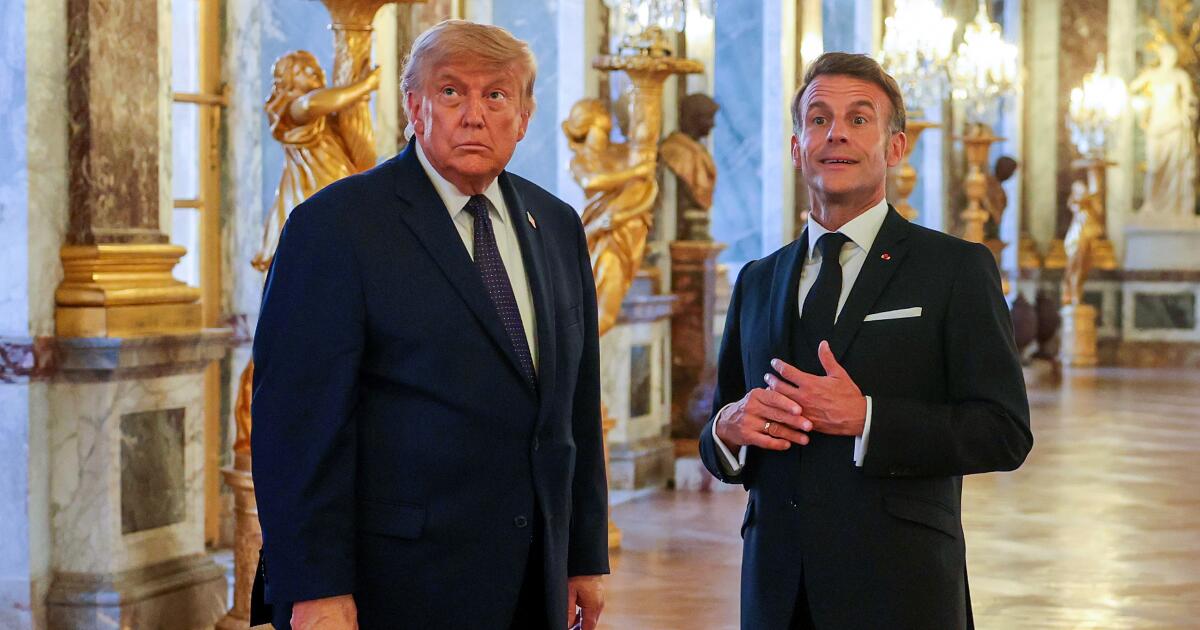
Despite mounting criticism, Trump put his signature to the memorandum on Wednesday night while attending a dinner with the French president in Versailles, a palace infamous for hosting a treaty signing that disgraced Germany at the end of the First World War.
He defended the agreement while in Europe and suggested further concessions might be forthcoming, including recognition of Iran’s claimed right to enrich uranium and a new willingness to tolerate its continued ballistic missile development — another program that Trump had vowed to eliminate as a central war aim.
“He took America to war — killing 13 soldiers, thousands of Iranian civilians and costing taxpayers $60 billion — to get rid of Iran’s missile program. And now that he’s lost the war, he pretends like it’s no big deal,” said Sen. Chris Murphy, a Democrat from Connecticut.
“Just unforgivable,” he added. “What a charlatan.”
-

 New York1 hour ago
Video: Knicks Fans Celebrate With Ticker-Tape Parade
-

 Los Angeles, Ca1 hour ago
Armed, dangerous CHP pursuit suspect tied to double homicide in Pomona
-

 Detroit, MI1 hour ago
First responders honored after rescuing 12 people from capsized sailboats near Belle Isle
-

 San Francisco, CA2 hours ago
Oakland man faces hate crime charges for Castro District attack
-

 Dallas, TX2 hours ago
At least 4 injured after vehicle drives into Dallas crowd, driver arrested
-

 Miami, FL2 hours ago
Miami Central students prepare for life changing trip to Zimbabwe amid funding challenges
-

 Boston, MA2 hours ago
Giannis to Boston is a possibility. Should the Knicks be worried?
-

 Denver, CO2 hours ago
Denver Public Schools’ decline in enrollment continues to reshape district

