Colorado
Trump funding freeze includes payments to keep the Colorado River flowing


An aerial view shows the long-depleted Colorado River (L) as it flows between California (R) and Arizona, and an irrigation ditch (R) carrying river water toward Quechan tribal land on May 26, 2023 near Winterhaven, Calif.
Mario Tama/Getty Images/Getty Images North America
hide caption
toggle caption
Mario Tama/Getty Images/Getty Images North America
The first executive order President Trump signed in his second term, “Unleashing American Energy,” wouldn’t seem to have a direct impact on how much water is in the Colorado River, at least in the short term.
The order, signed the first day Trump took office, aims to “unleash America’s affordable and reliable energy and natural resources,” by ending “burdensome and ideologically motivated regulations.”
But the order also says, “All agencies shall immediately pause the disbursement of funds appropriated through the Inflation Reduction Act of 2022.”
While some of those funds were earmarked to prop up renewable energy, at least $4 billion was set aside to protect the flow of the Colorado River, which supplies about 40 million people with drinking water, is the foundation for a massive agricultural economy across the Southwest, and generates significant hydroelectric power.
The Colorado River is shrinking
The river is shrinking due to climate change, which means the nation’s two largest reservoirs, Lake Mead and Lake Powell, created by dams on the Colorado River, have reached record low levels in recent years amid a megadrought spanning more than two decades. If water levels fall much lower, they could lose the ability to generate hydropower within the massive dams that hold them back, or even lose the ability to pass water downstream.
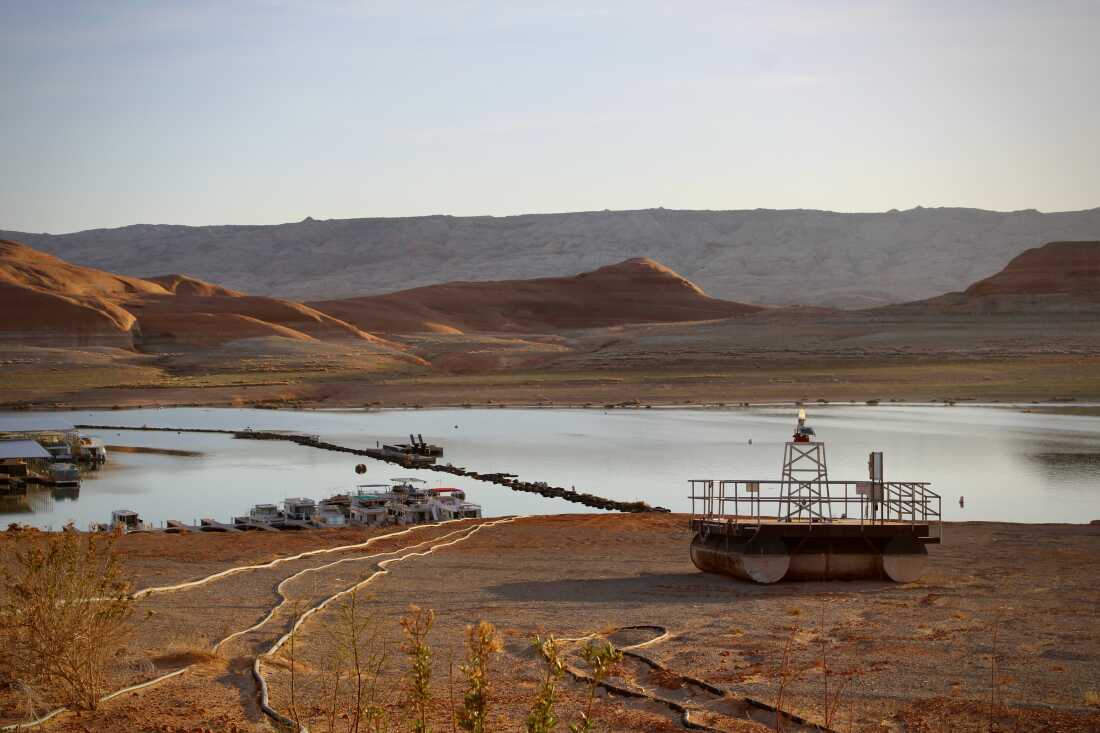
Docks and buoys, once floating atop dozens of feet of water, sit stranded on the shores of Lake Powell on April 9, 2023. President Trump paused funding that was designed to help conserve water and boost the nation’s largest reservoirs.
Alex Hager/KUNC
hide caption
toggle caption
Alex Hager/KUNC
The 2022 Inflation Reduction Act allowed President Biden to designate $4 billion for Colorado River programs, including big sums for programs that pay farmers, cities and Native American tribes to conserve Colorado River water and, instead, leave it in those reservoirs. The payments are compensation for money they can’t make by using their water to grow crops or for other uses.
A lot of the IRA money has already been delivered, but Bart Fisher, who sits on the board of the Palo Verde Irrigation District in California, is worried about what will happen if it goes away.
“If there’s no funding,” he said, “there will be no conservation.”
Farmers in Palo Verde use Colorado River water to grow cattle feed and vegetables in the desert along the Arizona border. Fisher said they want to be active participants in protecting the river, but they stand to lose money if they use less water and grow fewer crops.
“You won’t see any ag producer in any district willing to sacrifice revenue from their normal ag production for nothing,” he said.
The river’s uncertain future
In the current funding cycle, landowners in Fisher’s irrigation district alone are getting about $40 million in exchange for cutting back on their water use. No one knows how much funding, if any, will be delivered in the next cycle, which starts in August. Fisher said farmers are already thinking about their budgets for the next growing season.
“At the moment, it’s unnerving to think that maybe come August the first, all of our plans will need to suddenly change,” he said.
Some water experts say they are surprised to see these water conservation programs frozen by Trump’s executive order, since they do not appear to be in line with the president’s stated priorities of eliminating diversity programs and boosting domestic energy production.
“These are not woke environmental programs,” said Anne Castle, who held federal water policy roles during the Biden and Obama administrations. “These are essential to continued ability to divert water.”
Water users whose grants have been paused said they are asking the federal government for more information and getting little in the way of answers. The federal agencies in charge of Western water did not respond to NPR’s requests for comment.
Conservation programs like the one sending money to California farmers have been key in boosting water supplies in major reservoirs. That is no small feat, as leaders of the states that use Colorado River water are caught in a legal standoff about how to share it going forward. They appear to be making little progress as they meet behind closed doors ahead of a 2026 deadline.

A farm worker adjusts sprinkler heads spraying water that comes from the Colorado River Oct. 18, 2002 near El Centro, Calif.
David McNew/Getty Images/Getty Images North America
hide caption
toggle caption
David McNew/Getty Images/Getty Images North America
“Having this appropriated funding suddenly taken away undoes years and years of very careful collaboration among the states in the Colorado River Basin,” Castle said, “and threatens the sustainability of the entire system.”
In addition to those water conservation programs, the Inflation Reduction Act set aside hundreds of millions of dollars for projects aimed at keeping Colorado River tributaries clean and healthy. Conservation groups, small nonprofits, Native American tribes, and local governments were assigned federal money for a bevy of projects that included wildfire prevention and habitat restoration.
Sonja Chavez, general manager of the Upper Gunnison River Water Conservancy District, was expecting that money to make its way to her group for river improvement projects in Western Colorado.
“If there isn’t some resolution to the freeze or some additional guidance on what’s going to happen for folks,” she said, “we may have to put our entire programs on pause.”
Smaller watershed groups and their projects to restore and improve small sections of rivers are uniquely dependent on money from the federal government.
“Federal funding is critical because that’s the big money,” said Holly Loff, a grant writer in Western Colorado and the former director of the Eagle River Watershed Council. “No one can really compete with those big dollars, or very few other entities besides the federal government can fund at those levels.”
Small groups dependent on that federal funding have been scrambling to come up with contingency plans since it has been paused, and some of their leaders say the gap would be difficult to fill with money from donors or local governments.
Loff said a continued pause on funding would cause a lot of financial pain for communities near the Colorado River, such as those with economies dependent on water-based recreation, and people far away, like those who buy produce that is grown with Colorado River water.
“Our economy is going to be impacted,” she said. “It’s just far reaching. And I really can’t think of how anyone can avoid being impacted.”



Colorado
Southern Colorado remains in drought despite recent storms; NWS urges caution ahead of Fourth of July

COLORADO SPRINGS, Colo. (KKTV) – Recent rounds of heavy rain, hail and thunderstorms have brought much-needed moisture to southern Colorado, but experts say the storms have done little to ease the region’s ongoing drought.
Much of southern Colorado remains in moderate to exceptional drought, according to the latest U.S. Drought Monitor, with long-term moisture deficits continuing to impact soils and vegetation.
“A couple thunderstorms, a few days of off-and-on scattered rain, really isn’t going to do anything to fix that,” said Michael Garberoglio, a meteorologist with the National Weather Service in Pueblo.
Garberoglio said it will take widespread, sustained precipitation over weeks or months to significantly improve drought conditions.
“We need much more moisture over a much larger area for a much longer period of time to really start negating these exceptionally dry conditions we’ve been under,” he said.
The persistent drought is raising concerns ahead of the Fourth of July holiday, when many Coloradans are expected to celebrate with fireworks and outdoor gatherings.
“I really can’t understate the danger,” Garberoglio said. “It’s a very volatile situation. We just have not gotten enough water and it’s become frankly unsafe.”
He said fire danger can vary significantly from one location to another, even within the same county, meaning some areas remain dry enough for a single spark to ignite a wildfire.
“These fires can spread over multiple acres in just a couple of short minutes and can impact much more than anyone would initially expect,” Garberoglio said. “These little things can have months of impacts if people aren’t cautious.”
Garberoglio urged residents to follow local fire restrictions and guidance from emergency officials before using fireworks or participating in activities that could spark a fire.
“When you’re keeping things in mind and listening to the professionals, it’s not just for you, but you’re helping out your family, your neighbor,” he said.
Copyright 2026 KKTV. All rights reserved.

DENVER (KDVR) — Fast-moving fires in western Colorado, including on the Colorado-Utah border, continue to burn Sunday afternoon.
On the Colorado-Utah border, the Snyder Mesa Fire has burned over 28,000 acres as of Sunday morning, prompting evacuations in Mesa County, officials reported. At that time, the fire was 0% contained.
The Snyder Mesa Fire broke out sometime Friday evening or Saturday morning, according to the Upper Colorado River Interagency Fire Management Unit. Several fires, including the Knowles and Gore fires, combined on Saturday to form the Snyder Mesa Fire.
Three federal firefighters died and two were injured while responding to the Knowles and Gore fires on Saturday.
⬇️ Jump to: Live blog with updates below.
Ouray County has declared a state of emergency due to the Gold Mountain Fire. The fire sparked on Saturday on U.S. Forest Service land, according to the Ouray County Sheriff’s Office. The fire has triggered mandatory evacuation orders and roadway closures.
Ouray County officials reported the Gold Mountain Fire burned 560 acres as of 1:08 p.m.
Live Updates

Three firefighters died and two were injured while tackling fires on the Colorado-Utah border, the U.S. Wildland Fire Service reported Sunday.
The agency — created earlier this year to streamline firefighting and fire reduction across public lands — said the firefighters had been part of an interagency response to the Knowles and Gore fires on Saturday.
“The U.S. Wildland Fire Service stands united with the USDA Forest Service in grief and in our unwavering support for the loved ones left behind. Their bravery, dedication, and sacrifice will never be forgotten,” it said in a statement on Facebook.
The agency said it would share more information when it is available to be released.
Wildfire activity has intensified across the western United States, as consecutive days of hot, dry and windy weather have fueled flames in Utah, Arizona and elsewhere as new fires popped up across the region.
The largest blaze, the Cottonwood Fire, was burning in rugged terrain in southwest Utah. It ballooned Saturday to more than 144 square miles (373 square kilometers) after marching through canyons and mountainsides, destroying part of a ski resort and other summer cabins along the way.
Authorities in Beaver County began working with fire teams on Saturday to assess the extent of the damage, but no estimates were immediately available. Gov. Spencer Cox in a post on social media called it bleak, but he thanked crews for what he called “several miraculous stops and saves.”
The cliffs and steep slopes have made the job even harder, said Alyssa Mason, a spokesperson assigned to the fire.
“It’s hard to get dozers and other heavy equipment into that. It’s hard to get engines into that,” she said. “It doesn’t make it impossible to firefight, but it does just kind of slow things down.”
Hundreds of firefighters have been arriving in the arid state to battle new starts as well as those that have been growing because of what forecasters called critical fire weather — dangerously low humidity levels, warm temperatures and gusty winds.
The danger is even higher this year because of Utah’s record-low snowpack and its warmest winter on record. Much of the West is grappling with similar conditions, according to the National Interagency Fire Center.
From Alaska to Florida, crews worked Saturday to corral dozens of fires, including three dozen that were classified as large and uncontained.
Nationally, nearly 3 million acres (1.2 million hectares) have burned since the start of the year. That is more than the 10-year average.
The conditions in Utah were critical enough for Gov. Spencer Cox to declare an emergency earlier this week and clear the way for the state to ban fireworks ahead of the July Fourth holiday. The order comes as Utah is experiencing one of the most severe wildfire seasons in recent history, fueled by historic drought conditions.
State officials said that over the past week, Utah has seen an increase in wildfire starts, with each fire showing unprecedented behavior. These starts have stretched the state’s wildland firefighting capabilities, State Forester Jamie Barnes said.
Colorado Gov. Jared Polis also declared an emergency on Saturday, and authorized the use of the National Guard to tackle the fires.
Forecasters with the National Weather Service over recent days have been issuing red flag warnings for a wide swath of the West, from California to Arizona and New Mexico.
South of Grand Canyon National Park, authorities said the flames of a new wildfire were moving away from Grand Canyon Village and the nearby community of Tusayan on Saturday. But about 50 miles (80 kilometers) away, another fire prompted Coconino County officials to issue evacuation orders for those near Kendrick Mountain.
Parts of northern Arizona were without power Saturday as the utility serving the area initiated a safety shut-off in hopes of lessening the wildfire risk.
Power shutoffs have become more common in the West as wildfire risk has expanded. It is usually a last resort after utility forecasters weigh factors like sustained wind and gust speeds, available fuels and topography.
With extreme fire conditions persisting in Utah, Rocky Mountain Power also shut off power lines serving Beaver County and other areas.
-
 News9 minutes ago
Native Americans celebrate victory at the Battle of Little Bighorn, 150 years later
-

 New York1 hour ago
How a Global Researcher Lives on $110,000 in Long Island City
-

 Los Angeles, Ca1 hour ago
Mass shooting at L.A. street takeover leaves 1 dead, 6 injured
-

 Detroit, MI2 hours ago
On the front lines of chronic absenteeism: What Detroit’s Health Hubs do to get kids to school
-

 San Francisco, CA2 hours ago
S.F. police arrest 20 at 300-person SoMa block party during Pride
-
Dallas, TX2 hours ago
CJ Goodwin announces retirement after 8 seasons with Cowboys
-

 Miami, FL2 hours ago
Several people reportedly hurt in ‘mass casualty’ crash near Miami Gardens – WSVN 7News | Miami News, Weather, Sports | Fort Lauderdale
-

 Boston, MA2 hours ago
Inside Britten’s Record-Breaking Boston Waterfront Activation

