Sports
Inside California horse racing's complex problems that could hurt the sport nationwide


As the wildfires devastated parts of the San Gabriel Valley, Santa Anita Park did what locals always have counted on the 80-year-old track to do. It stepped up and fulfilled its role as a community citizen.
It canceled racing the first week after the fires so that the track’s expansive space could be used as a center for donation collection and distribution, staging utility vehicles that were helping fight the fires and housing large animals that could not be accommodated at animal shelters. The track was unaffected by the fires and the air quality was well within the range for safe racing.
Santa Anita did what was best for Arcadia, Altadena, Pasadena and other areas that were affected by the worst fire disaster in L.A. history.
It’s not the first time Santa Anita has stepped up. It donated the land at the corner of Huntington and Baldwin for a fire station. It also gave away the land near the track that houses the Arcadia City Hall and police department.
But these charitable gestures are getting harder to pull off. The sport is decades past the days when cars would back up onto Baldwin Avenue after leaving the 210 freeway, spectators just trying to get into the Santa Anita parking lot. The Santa Anita Handicap is no longer a must-attend event for horsemen nationally. Gone are competitive purses because of the lack of a secondary source of income such as casino gambling. Field sizes are so small that it cripples wagering. And attendance is a fraction of what it was years ago.
The unfathomable idea that the track may soon close or be sold is closer to reality than ever.
The Stronach Group, owner of Santa Anita and Gulfstream Park in Florida, has hired Keith Brackpool, a former TSG executive and chairman of the California Horse Racing Board, to kick the tires on a possible sale of the company’s 1/ST Racing division and the tracks, according to two people with knowledge of the situation not authorized to speak publicly.
While they publicly are saying Santa Anita is not for sale, Brackpool met with at least one investor about the sale, according to the two people with knowledge of the situation not authorized to discuss it publicly. The understanding is if the track were sold, whoever buys it would continue racing at least in the short term.
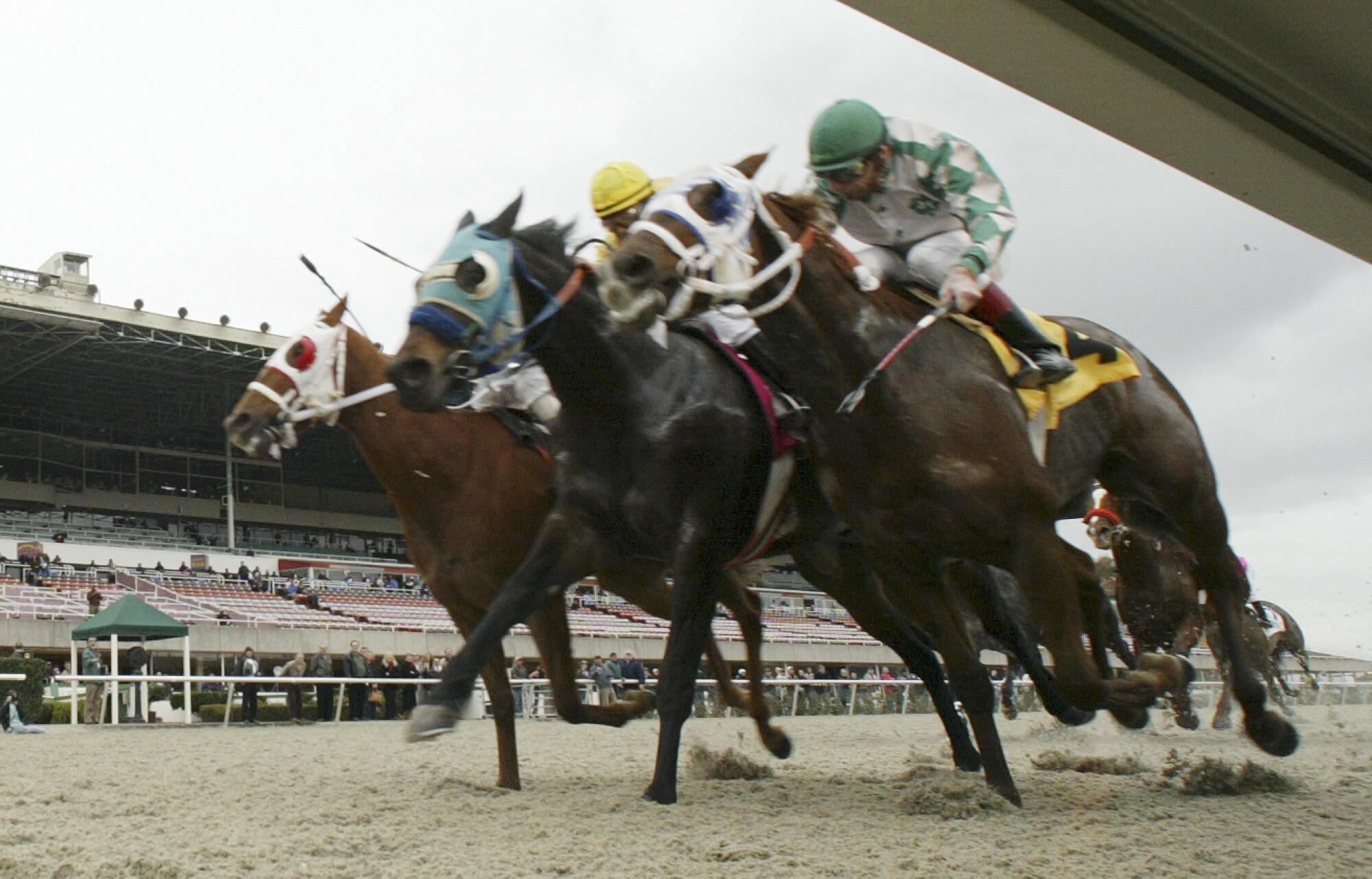
Jockey Tiago Pereira guides Katonah to a win in the Grade II $200,000 San Pasqual Stakes horse race on Jan. 25 at Santa Anita Park in Arcadia.
(AP)
The price tag of $2 billion was thought to be too high for at least one prospective buyer who was more in the look-and-see mode, the people said. The land the two properties sit on is easily worth more than $2 billion, but as race tracks, not so much.
TSG denied a Times request for an interview with Brackpool and he did not return a phone message.
While neither confirming nor denying the details, TSG issued a statement that read: “Racing in California is facing challenging economic circumstances. This is not an easy problem to solve. We are continuously thinking about solutions and in discussions with various stakeholders about the best way forward. Those discussions remain ongoing.”
The threat to racing in California is existential. And if racing in the state were to go away, it isn’t just a California problem. The branches of the sport are intertwined nationally despite the territoriality that exists between racing organizations. Racing is a four-legged stool, with one of the legs being Kentucky; another New York; tracks that hold boutique meets such as Keeneland in Kentucky, Oaklawn in Arkansas and the winter meets at Gulfstream and Tampa Bay in Florida; and finally there is California.
If racing becomes a three-legged stool, the chances of collapse are major.
Santa Anita has been there when the community needed help. But now, it’s the track that needs help. And by extension, so does horse racing in the United States.
The bigger question: Is anybody willing to help them?
In order to find out what racing executives think about the future of racing in California and the U.S., The Times spent several days at the 50th Global Symposium on Racing in Tucson in December.
About two dozen industry people painted a picture laced with shreds of optimism, but only if California can get Historical Horse Racing (HHR), an electronic gaming product, to supplement purses. Without it, few see hope of survival. The tracks say they are working toward a solution but offer little public evidence of success as it likely would take an agreement with Native American tribes, which control non-pari-mutuel gambling in California.

Jockey Hector I. Berrios steers El Potente to a win in the Grade III $100,000 Thunder Road Stakes horse race on Feb. 1 at Santa Anita Park in Arcadia.
(Uncredited / Associated Press)
The problems with racing did not just crop up. The decline has been going on for quite some time.
Sal Sinatra, 60, has been around horses since he was 12 years old. He grew up in the business and was the vice president of racing at Parx Racing in Pennsylvania, president and general manager of the Maryland Jockey Club and chief executive of Equibase, a company that supplies racing statistics.
He’s currently a consultant for the Horseracing Integrity and Safety Authority.
“I play fantasy sports,” Sinatra said, speaking as a horse owner, not as a HISA consultant. “Last night I was up all night because I played in a lousy $10 tournament and I won $10,000. I have more enjoyment doing that. I live in Lexington [Ky.] and every bar has [FanDuel] on, I have a [betting] account. I don’t even look up at the track or bet anything.”
Now, don’t mistake Sinatra as someone who has abandoned the sport. He had just finished a workshop with many of the country’s racing secretaries, offering ideas on how to make the sport more attractive to customers. He really wants horse racing to thrive, he’s just not sure how.
“I have two mares at home, and I’m not sure what I’m doing because I don’t know what it’s going to be like in three or four years,” Sinatra said. “We move like snails in this industry. If we do not protect the small outfits [trainers and owners], whether it’s by ratings classifications rather than claiming [races], the sport is limited.
“It’s the people who used to breed and race for joy, the people who protected horse racing now see it as time to retire, they’re out of the game. I think it’s very important to look at that sector. I really believe there’s a lot of purse money out there that is not being paid properly to keep the economic engine flowing.”
Sinatra was quick to recall tales of his time on the front line of racing, especially running the Maryland Jockey Club, whose marquee race is the Preakness Stakes.
He painted a picture of dysfunction that included exaggerated attendance numbers, a former boss’ obsession with mutuel handle (going so far as to give Sinatra wads of money to bet to give the mutuel pool a good head start), and deficits in his racing budget because of having to move money from racing to support big-name musical talent at the Preakness.
He suggested the roots of the problems extend beyond Maryland and have been around racing for decades.
“Simulcasting has destroyed us,” he said, referring to the practice of broadcasting races on TV or at other tracks where betting can take place. “We all thought we had found money and then the simulcasters were in our own state and our own backyard. We just poached our own bettors away. That’s all we did, for less money. It’s just insane.”
Sinatra also believes the influx of money through casino gambling has been a problem for the industry.
“The casinos do better when we race as if we’re a sideshow for them,” Sinatra said. “So, they want us to run and don’t care if you run five-horse fields and make no handle. When my budget comes out, I’ve lost $3 million and I want to cut days but I can’t.
“When the subsidies came in, we did the wrong thing. We just said, ‘OK, here’s your millions of dollars, horsemen, increase purses.’ And a lot of things were wrong.”
Sinatra thinks there should be coordination between track organizations, which historically has been as achievable as detente between the Hatfields and McCoys. A very old analogy for entrenched rivalries in a sport that is aging not so gracefully.
“When I was first at Parx and it went from $125,000 [in purses] a day to $250,000 a day, and I had all this extra money for stakes,” Sinatra said, “I called The Jockey Club, and I said, ‘Before I do this, I should contact the graded stakes committee and suggest what races I’m going to add money to’ and the group says ‘No, there are already three in that category.’
“You have to either increase distances or put them on different surfaces. That’s what they should have to do. But they say they can’t do that. I’m like, well, otherwise, everybody’s going to have million-dollar races all over the place and there’s no planning, there’s nothing.
“This is insanity, what we do.”
So, does Sinatra have any hope for California?
“Under the current domain, I’d say no,” he said. “Horses aren’t coming to California. In my estimation as an East Coaster, they killed off the north, which is where most of your farms are. So now, what are you going to do? Supply California with horses bought from Kentucky? It doesn’t seem right.”
California did not get to this position overnight. Some of the wounds are self-inflicted. Other problems, and the most difficult to solve, deal with the changing sports landscape and the gulf between people who view horses as pets and those who view them as livestock.
TSG, driven by racing interests in Southern California, played a game of Sophie’s Choice, deciding it needed to kill racing in Northern California to save racing to the south.
Hall of Fame jockey Russell Baze crosses the finish line to win at Golden Gate Fields in Albany on Jan. 1, 2008. Golden Gate Fields closed in 2023.
(Eric Risberg / Associated Press)
TSG clumsily announced the planned closure of its Northern California mainstay, Golden Gate Fields, at the end of 2023 without consulting its stakeholders. It agreed — some might say was forced — to keep the track open another six months if there was no protest about a planned legislative amendment that the simulcast money normally targeted for the north would go to the south if there is no racing in the north.
The north capitulated and even planned its own circuit, calling it Golden State Racing. It ran for 25 days, failed to meet any of its financial goals and pulled its license application for this year.
TSG may have been the architect of the closure of Northern California racing, but the Thoroughbred Owners of California was driving the getaway car, primarily supporting racing only in Southern California. It drew up benchmarks for success in the north that even Santa Anita would have had difficulty executing. Several Northern California board members quit in protest.
At one point in dealing with the California Horse Racing Board, Craig Fravel, the former chief executive of 1/ST Racing, sent a letter threatening the board with closing Santa Anita if it didn’t get its way.
TSG recently went to the same playbook in regard to Gulfstream Park. The track’s operators are pushing for something called “decoupling,” which would mean it could operate its slot-based casino without having to run horse racing. The same decoupling happened to dog racing, harness racing, quarter-horse racing and jai alai a few years ago. Dog racing was killed by ballot initiative in Florida and the other sports are, for all intents and purposes, nonexistent.
At a recent meeting with Florida horsemen, Brackpool and TSG executive Stephen Screnci said if horsemen don’t oppose decoupling, they will promise racing for at least three more years. If they oppose it, the track could close sooner.
The horsemen took it as a threat as one might expect, leading to a fistfight after the meeting.
TSG chief executive Belinda Stronach poured gasoline on the situation in an interview on NBC during coverage of the Pegasus World Championship last week when she said: “The fact is that Gulfstream Park is now in a very dense, urban setting, and that’s not great for horses, ultimately.”
Not mentioned is that all three Triple Crown races — the Kentucky Derby (Louisville, Ky.), the Preakness (Baltimore) and the Belmont Stakes (soon to be back in Long Island after a rebuild) — are in urban areas.
Jerry Bailey, a Hall of Fame jockey and NBC commentator, stated after the segment that Gulfstream Park would be gone in 10 years.
Any way you look at it, the decoupling move makes a potential sale of the track a lot easier.
Blackpool, a controversial figure in California who has settled lawsuits he filed against Stronach, is playing a significant role leading discussions about the future of racing. Missing from the Florida meeting with horsemen was Aidan Butler, the current chief executive of 1/ST Racing. Butler, when reached by The Times, declined to discuss any aspect of company business, instead referring to the statement issued by TSG.
The one thing that most agree on is that there is too much racing. The problem is that contraction is great as long as it’s not your business that is contracting. And therein lies another problem racing hasn’t fixed.
“I guess there’s a difference between contraction and a sport dying,” said Robert Hartman, chair of the prestigious Race Track Industry Program at the University of Arizona and host of the annual global symposium.
“Let’s say that healthy contraction could be good for an industry. You see what’s going on in California. Some determined that one racing circuit could make racing healthy and bolster that circuit. The fear is two unhealthy racing circuits may lead to them both dying.
“That type of contraction could be beneficial to the industry. It’s not just racing, it happens in food products or automobile manufacturing or other industries [where contraction] makes that industry healthier.”

Martin Garcia rides Citizen Bull to victory in the Breeders’ Cup Juvenile horse race in Del Mar on Nov. 1.
(Gregory Bull / Associated Press)
Craig Dado, who was a Del Mar marketing executive for two decades and is currently the president of Sports Injury Central, draws an analogy to professional sports.
“We’ve always argued [there is too much racing] from a marketing perspective,” Dado said. “You’ve got 18 NFL games a year per team. You’ve got 162 baseball games. If you run four days a week, 52 weeks a year, my goodness, that might be too much.
“Maybe the market is telling you there is too much. Maybe we need breaks. Every idea like that comes with a whole set of negatives as to why it doesn’t work. So, there’s no easy answer in California, but I’m praying that they figure it out, because I am a horse owner and I still love going to the gate, going to the tracks, so I hope it works out.”
The racing landscape in California changed in 2013 when Hollywood Park closed and eventually became SoFi Stadium. The sport believed it needed year-round racing. Santa Anita increased its signature meet to about six months, not including its fall meeting. Del Mar added a monthlong fall meeting to its summer meet. And Los Alamitos, a quarter-horse track, was the real hero, reconfiguring its track to a mile and adding about six weeks of daytime thoroughbred racing to fill the gaps.
But was that the right move?
“There’s no question that the less you run, the more demand there is for your product,” Dado said. “It’s old-school Economics 101, supply and demand. The more you run, the less demand there’s going to be. However, when you add in all those additional dates, even though you’re not as big per day, it still may make a better business platform. Especially when your state is basically saying, ‘If you don’t do it, we’re not going to make it.’ Then they forced Del Mar’s hands.
“Did we want to add the fall dates? There was a lot of consternation over that, but one of the reasons we really agreed to do it is because we thought we’d get the Breeders’ Cup by doing it. That was the feather in the cap of that discussion.”

Flavien Prat celebrates after riding Sierra Leone to victory in the Breeders’ Cup Classic horse race in Del Mar on Nov. 2.
(Gregory Bull/AP)
This year Del Mar will host the Breeders’ Cup for the third time and second year in a row.
“Let’s say Del Mar adds three more weeks [if Santa Anita were to stop racing],” Dado said. “Would Del Mar want to do it? Probably not because it’s going to make those days that they already have less special. But if the industry is saying they need to do it, then Del Mar’s going to have to step up.”
Joe Morris, the former head of West Coast racing for TSG and currently the senior vice-president of racing for Caesars Entertainment, points to a particular problem.
“The formula to building handle and having a successful meet is you need the stock,” Morris said. “I don’t think they can fix the problem. Thirty years ago, there were 20 to 25 major farms in California. Now there are just a handful. So, where are you going to get the product? The cost of living is such that it is hard to go out there if you are a trainer and put your help up and things like that.”
When Santa Anita’s owners closed Golden Gate, one of their plans was to start rebuilding all the barns at Santa Anita. Nineteen months after the announcement, there has been no appreciable construction on the barns.
“I don’t see them ever getting the product,” Morris said. “Can Del Mar get enough to ship in? I don’t know. If you don’t have product, you don’t have racing. So now you’re racing short fields and less races and the gamblers know that’s not what they need. They want more races and full fields.”
In 1990, there were 44,143 horses foaled in North America, which includes Canada and Puerto Rico. In 2023, it was down to an estimated 18,500. The foal crop has declined the last eight years.
Marshall Gramm, 51, is a numbers guy. He’s a professor of economics at Rhodes College in Memphis who has published several papers about gambling and horse racing. He teaches a class in the economics of wagering. Gramm is a regular participant in the National Horseplayers Championship.
It’s an odd spot for someone who was not exposed to racing as a child. But Gramm, who is also a horse owner, is addicted to the data and the handicapping game.
“Kentucky and Arkansas look pretty safe, and we have this new commitment to Maryland and New York, so I think that there’s probably more optimism now about what the future could bring overall in the landscape than what it was a couple of years ago,” Gramm said.
“What happens in Florida, what happens in Texas, what happens with HISA, what happens in California, those are different questions. Everyone I’ve talked to believes that California will be gone in a couple of years. I’m not as pessimistic, but maybe it’s because I’m naive.”
Gramm ran horses at Golden Gate and acknowledges his trainer is struggling with the closure. He also believes the success of some trainers, while creating stars for the sport, also may be hurting the industry.
“The reality with closing Golden Gate is none of those horses could really race in Southern California,” Gramm said. “I don’t know what they can do to attract horses. They have some trainers and owners who are really committed to racing there, and I think that’s good. But the downside is the product isn’t as strong because as we have consolidation, you get races being dominated by two or three trainers.
“Every turf race is dominated by [Phil] D’Amato and every dirt race is [Bob] Baffert. If you have a baby there and they’re all running against three Bafferts, that’s not a good consumer product, right? That’s the problem everywhere.”
Gramm fears the solution to racing’s problems also may be its eventual downfall.
“I’m not in love with alternative gaming supporting our industry,” Gramm said. “I’m not in love with the fact that to make our industry go, we have to have some sort of manufactured monopoly and other gambling.
“It turns the racetrack and racetrack operators into people who end up seeking government aid. They care less about their customers in building a good product than they do about the government. And ultimately the tail wags the dog, the casino matters more and then they don’t even care about racing.”
Gramm also notes subsidies only help trainers and owners and not the average horse player.
“The slots players are Band-Aids because they’re not going to be horse players,” Gramm said. “And the days of the numbers players coming and playing the horses or dogs doesn’t exist anymore. Maybe if it can tip the scales in the right direction and help turn those subsidies into helping horse players and making a better product, then I still think it’s a tough long-run proposition unless you get people playing the product.”
Gramm understands predicting the future is a fool’s game.
“Five years is short, but what will the sport look like in 20 years, 25 years?” he said. “Are we just racing in Kentucky and Arkansas? Are we just racing in red states? I don’t know, and that’s what worries me with everything that we want to try to do. I don’t know if minds can be changed with the prevailing direction that we’re going. So much about everything can change, I mean, are people going to be eating meat in 30 years?”
It’s difficult to find someone honestly bullish about the sport. Even those most positive about the future have some trepidation.
“I can’t imagine a racing world without California,” said Lisa Lazarus, chief executive of HISA, an organization that is facing legal challenges to its constitutionality that also could put it out of business in five years or less. Two U.S. appeals courts ruled differently on the constitutionality of HISA, leaving its future in a state of flux. The U.S. Supreme Court did not include the issue on its docket for the current session.
“Everybody believes California is critical to the ecosystem,” Lazarus said. “There are some very smart people out there, so I have full confidence that they’re going to find a way to bring in supplemental income.”
Lazarus is not the first to offer a suggestion based on cooperation among the tracks and states, who typically are interested only in benefiting their own interests. Occasionally they get together, such as recently when the New York Racing Assn. and Churchill Downs Inc. combined to sue HISA over the costs it charges states. NYRA recently settled; CDI did not.

Jockey Brian Hernandez Jr. celebrates in the winner’s circle after riding Mystik Dan to win the 150th running of the Kentucky Derby horse race at Churchill Downs on May 4 in Louisville, Ky.
(Jeff Roberson/AP)
“Everyone knows that things can’t stay the way they are, just fighting for survival,” Lazarus said. “I don’t think it’s currently possible under Kentucky law now, but I think it’s so important to the ecosystem that you could potentially see some other jurisdictions sort of stepping in to supplement California.
“This is all theoretical because right now the KTDF [Kentucky Thoroughbred Development Fund] is restricted to Kentucky. But if there was flexibility to send purse money elsewhere, then they could consider it because they have so much purse money in there.”
Donna Barton Brothers, a former jockey and currently an NBC analyst who is always the first person to interview the winning jockey of the Kentucky Derby from her horse, sees both sides to the argument for Kentucky bailing out California purses.
“You’ve got legislators in Kentucky, like state Sen. Damon Thayer and House Speaker David Osborne, who have fought really hard for where Kentucky is right now,” Brothers said. “And then they look at California and go, ‘What are the legislators doing there? What are the lobbyists doing there? What are the racetracks doing to work with the lobbyists to work with the legislators to make that happen in California?’ So why does all the stuff that we’ve worked for now have to be used to subsidize California racing?’
“On the flip side, is Keeneland going to be able to have a $1.46-billion economic impact if you don’t have people in California interested in buying horses from the Keeneland sales?”
Brothers’ hypothetical about the California legislature does bear a second look. For the most part, politicians in California have done little to support the racing industry, instead focusing more on horse safety than horse racing.
Gov. Gavin Newsom and the late Sen. Dianne Feinstein both were outspoken during the 2019 crisis of horse deaths at Santa Anita.
“How are we going to get Sacramento to like horse racing?” trainer Bob Baffert asked rhetorically while speaking on a panel in Tucson with fellow Hall of Famer Todd Pletcher.
“It’s such a big state and that question is something I wish I had the answer to. Unless we can find some other way to increase the purses, like Churchill Downs, Oaklawn, New York, [we’ve got difficulties]. What California has to offer is the weather, it’s a great place to get horses ready and it comes down to how can we get California to like horse racing?”
So, here everyone in California horse racing sits. A series of identifiable problems with some potential solutions but seemingly not enough action to solve those problems. Racing executives in the state say they are working on it but decline to speak publicly about it, leaving the horsemen shaking their heads in frustration.
“We need as an industry for California to succeed,” said Pletcher, the trainer who spoke on a panel alongside Baffert. “It’s great what’s going on in Kentucky with the purses but it’s having a negative effect on the other states because the purse structure is so high in some places yet in California they don’t have those advantages with a declining horse population.”
Louis Cella and his family are behind one of racing’s most successful stories. The owners of Arkansas’ Oaklawn Park were the first to put historical horse racing machines at their track. The facility does a great local business and holds prominent races. But even Cella sees the opportunity for success in California as limited.
“You look at California and unless they come with a solution to increase purses, I don’t think they survive in five years,” Cella said. “I don’t see how that happens or at least on the level they are currently running at. I think they have a tremendous headwind in front of them.”
Racing leaders in California, under the guise of the Horse Power Coalition, funded a survey about the impact of horses on the state economy. The survey was sent out shortly after it was announced that Golden Gate was closing.
It was timed to be a complement to the national American Horse Council Economic Impact Study. A news conference was scheduled in the paddock of Santa Anita to boast about the alleged $11.6-billion economic impact, as determined by the self-funded study.
The news conference was hastily canceled when no media showed up to cover the announcement.
Is that event emblematic of the state of and interest in horse racing in California, or just bad marketing?



NEWYou can now listen to Fox News articles!
The face of baseball will not be at Tuesday’s All-Star Game.
Shohei Ohtani was scratched from his start on Friday as the Los Angeles Dodgers said he will also miss the Midsummer Classic with what the team called left knee irritation.
Ohtani, for obvious reasons, has become an All-Star Game fixture. He has earned the honor in each of the past five seasons and made his first start in 2021.
Starting pitcher Shohei Ohtani #17 of the Los Angeles Dodgers warms up before the MLB game against the Arizona Diamondbacks at Chase Field on June 03, 2026 in Phoenix, Arizona. (Photo by Christian Petersen/Getty Images) (Christian Petersen/Getty Images)
The two-way phenom is on his way to winning his fifth MVP award in his last six seasons as he is hitting .290 with a .939 OPS and pitching to a minuscule 1.79 ERA, the second-lowest in the sport among pitchers with 80-plus innings. His OPS is also the seventh-best mark in the league.
The Dodgers said Ohtani will be the team’s designated hitter up until the break, but he will “have some interventions on his knee to put him in the best position for the second half of the season.”
Ohtani dealt with knee issues earlier in the season.
It is certainly a big hit for the game as the other face of the sport, Aaron Judge, will miss the game due to a fractured rib that has kept him out since late May.
Shohei Ohtani #17 of the Los Angeles Dodgers gets ready in the on deck circle against the Arizona Diamondbacks at Chase Field on June 01, 2026 in Phoenix, Arizona. (Photo by Norm Hall/Getty Images) (Norm Hall/Getty Images)
DODGERS WILL AGAIN VISIT WHITE HOUSE TO CELEBRATE WORLD SERIES CHAMPIONSHIP, OFFICIAL SAYS
Ohtani hit 99 home runs combined in 2024 and 2025, leading the National League with a 1.025 OPS in that span. Ohtani did not pitch in 2024 after elbow surgery but returned to the bump last year and owned a 2.87 ERA and 11.9 K/9, a figure he also put up in 2022 that led the American League.
The “Japanese Babe Ruth” is the only player in MLB history to have 300-plus plate appearances and 40-plus innings in six separate seasons (Ruth only did it twice and never stole 50 bases), and he has more than excelled at both.
Shohei Ohtani pitches for the Los Angeles Dodgers against the San Francisco Giants at Dodger Stadium in Los Angeles, California, on May 13, 2026. (Gary A. Vasquez/Imagn Images)
CLICK HERE TO DOWNLOAD THE FOX NEWS APP
Ohtani is not hitting like he has in the past, but certainly the best pitching performance of his career will make up for it. He “only” has 20 homers and 56 RBI this season.
Follow Fox News Digital’s sports coverage on X, and subscribe to the Fox News Sports Huddle newsletter.

If Mikel Merino is sleeping, please don’t wake him. If the last week has been a dream, he’d just as soon keep dreaming.
Because on Friday, for the second time in five days, Merino came off the bench for the final five minutes of a World Cup knockout game and scored the winning goal, the latest lifting Spain to a 2-1 victory over Belgium and into next week’s semifinal against France in Arlington, Texas.
“Not even in my wildest dreams could I have imagined what’s happening right now, right?” Merino said in Spanish. “Honestly, it’s crazy.”
How crazy? Merino has played less than 10 minutes in the last two games and has two goals. He’s taken four shots in the World Cup and put two of them in the back of the net, the first in stoppage time to beat Portugal in the Round of 16 and in the 88th minute Friday to beat Belgium in a quarterfinal and extend Spain’s unbeaten to streak to 36 games.
“I don’t really even know what to say. I still can’t quite believe it,” Merino said.
Yet Spain’s final substitution, which brought on Merino in the 86th minute, wasn’t the only one that figured heavily in the result. Fifteen minutes earlier Belgian coach Rudi Garcia sent backup goalkeeper Senne Lammens on for Thibaut Courtois — not by choice, by necessity.
The dropoff in talent wasn’t great — Lammens started 32 times for Manchester United this season — but the difference in experience was. Courtois was playing in his 21st World Cup game, second-most all-time, and he had been brilliant up to then.
But he tweaked a muscle making a save minutes earlier and dropped to the turf just before the second-half hydration break. After being attended to by the team’s trainers, he tried to continue but couldn’t, eventually hobbling to the sideline and collapsing on the bench in tears.
“We didn’t want his injury to get worse. That’s why I subbed him off,” Garcia said.
“It’s part and parcel of high-level sport. You need to be concentrated, 100% focused, and need to be able to perform. I did not want to put players on the pitch who were not 100%.”
The margin between Belgium and Spain, after all, is a small one, even if the teams took completely different routes to the quarterfinal.
Spain, which hadn’t gone past the Round of 16 in a World Cup since 2010 when it won its only title, had gone a record six games and 609 minutes without allowing a World Cup goal, dating to the group stage of the last tournament four years ago.
Spain midfielder Mikel Merino scores off a rebound in front of Belgium goalkeeper Senne Lammens during the second half of Spain’s 2-1 quarterfinal win in the World Cup quarterfinals Friday at SoFi Stadium.
(Robert Gauthier / Los Angeles Times)
You could binge watch two seasons of “Abbott Elementary” in that time.
But if Spain, the reigning European champion, and goalkeeper Unai Simón were the immovable objects, Belgium, playing in the quarterfinals for the third time in four World Cups, was an unstoppable force. With 12 goals in the last three games, it entered the quarterfinals with the third-most goals in the tournament. And no team had taken more shots.
Spain struck first, with Fabián Ruiz giving La Roja a 1-0 lead with his first goal of the tournament in the 30th minute. The sequence started with Pedro Porro sending a cross into the box for Dani Olmo, whose shot was parried away by Courtois. But Ruiz pounced on the rebound and deflected a shot off defender Timothy Castagne and into the back of the net.
In any other game of this tournament, that would have been enough for Simón. But not against Belgium, which ended Spain’s shutout streak in the 41st minute on a brilliant header from Charles De Keterlaere, who shielded Pau Cubarsí with his body and one-hopped a Castagne cross past a flat-footed Simón for his third goal in two games.
“The record and the milestones are there,” Spanish coach Luis de la Fuente said of his goalkeeper’s record streak. “It’s been decades since the last record was set. And perhaps somebody will break the clean-sheet record.
“But it’s going to be many, many years before that happens.”
Belgium opened the game up a bit when Garcia brought Romelu Lukaku, the country’s all-time leading scorer, on at the hour mark. But Courtois was called to make two saves in the next three minutes and came up lame after the second.
Shorty after he came off, De la Fuente summoned Merino over.
“He didn’t say much to me,” Merino said. “He told me I was coming in as the No. 10. And then, as the game was coming to an end, he told me I was incredible.
“Those are the only two things he said to me.”
The first shot Lammens faced came moments later, when Cubarsí put a one-hop shot on goal from distance. The keeper dove to his right to stop it with both hands, but the ball skipped just before it reached he and Lammens had trouble with the rebound, pushing it toward the edge of the six-yard box for Merino, who tapped it in.
“Unfortunately, to beat a team of this caliber, you need luck on your side,” Garcia, the Belgian coach, said. And the stars didn’t align for us.”

So while Belgium goes home, Spain goes to Texas for Tuesday’s semifinal with France, the only team in the world ranked ahead of it.
“Ever since the World Cup started, everyone has been waiting for this match,” Spanish wunderkind Lamine Yamal said. “I’ve been really looking forward to it. To me, they’re the two best teams in the World Cup.
“If anyone can take on France with confidence, it’s us.”
Especially if Merino keeps dreaming.
Sports editor Iliana Limón Romero contributed to this story.

NEWYou can now listen to Fox News articles!
Oba Femi and Brock Lesnar’s feud will come to a head at SummerSlam in August, and the showdown has the potential to be WWE’s match of the year.
Femi beat Lesnar at WrestleMania 42 and led to “The Beast Incarnate” deciding to retire – at least for a moment – at Allegiant Stadium in Las Vegas. Lesnar made a dramatic return a few weeks later, challenging and beating Femi at Clash in Italy.
COMPLETE PRO WRESTLING COVERAGE ON FOX NEWS DIGITAL
Oba Femi looks on during Monday Night RAW at Allstate Arena on July 6, 2026, in Chicago, Illinois. (Melina Pizano/WWE via Getty Images)
At SummerSlam, Femi and Lesnar will do battle inside a Hell in a Cell.
WWE Hall of Famer John Bradshaw Layfield called the next meeting between Femi and Lesnar a “generational matchup.”
“I’ve never seen anything like Oba – well, I have. I’ve seen Brock,” he told Fox News Digital. “It’s very much the carbon copy of Brock coming in. Brock coming in was like, oh my God, who is this guy? The guy can even talk, and he’s gonna be one of the biggest stars in wrestling. Not only could he talk, he’s a really smart guy. Brock became one of the biggest draws in professional wrestling. He came one of the biggest draws in UFC. It’s an unbelievable story, and now you got somebody who can rival that character.
Brock Lesnar in action against Oba Femi during “Monday Night Raw” at TD Garden on March 23, 2026, in Boston, Massachusetts. (Michael Owens/WWE via Getty Images)
“This Oba Femi comes out with the silly little walk he does. Everyone kinda does it, it’s like The Bushwackers. But the whole arena does it. I was in Vegas and I didn’t want to go to the matches and deal with the traffic and deal with the backstage area, and so I kinda just watched it in a sports bar. I stood in the back where nobody could recognize me, and as soon as Oba came out, the entire sports bar was sitting there doing that Oba Femi dance. The guy is just unbelievably over.
“I really think that somewhere in the NFL this year, you’re going to see an entire NFL arena doing this dance. You’re gonna have somebody like Saquon Barkley or ‘King’ (Derrick Henry) or some of these guys do this dance, and it’s infectious. Once one of them does, one of these great running backs or wide receivers, or somebody scores a touchdown, that’s when I think you’re gonna see entire arenas doing it. I just think Oba Femi is lightning in a bottle and Brock has always been that way. This is, to me, a generational matchup.”
Brock Lesnar and Oba Femi face off during WrestleMania 42: Night 2 at Allegiant Stadium on April 19, 2026, in Las Vegas, Nevada. (Georgiana Dallas/WWE via Getty Images)
CLICK HERE TO DOWNLOAD THE FOX NEWS APP
SummerSlam will take place on Aug. 1 and 2 at U.S. Bank Stadium in Minneapolis.
-

 Cleveland, OH2 seconds ago
Cleveland’s First Round woes must end with the 2026 class
-

 Austin, TX3 minutes ago
Texas reports dozens of cyclosporiasis cases tied to contaminated fresh produce
-

 Alabama15 minutes ago
Small Plane Makes Emergency Landing In Peanut Field Near Florida-Alabama Line : NorthEscambia.com
-
Alaska18 minutes ago
An Alaska vacation can remind Israelis the world doesn’t revolve around them | The Jerusalem Post
-
 Arizona23 minutes ago
Arizona AG continues to investigate Glendale apartment complex after Friday deadline to fix A/C
-

 Arkansas30 minutes ago
Office of Keep Arkansas Beautiful Now Part of the ARDOT
-

 California33 minutes ago
Amber Alert issued for 3-year-old out of California City in Kern County
-

 Colorado38 minutes ago
Colorado Highway getting bicycle bypass bridge

