Maine
No spike in immigration arrests in Maine yet, but Trump's national crackdown sparks widespread fear


President Trump’s swift and drastic immigration restrictions — including of longstanding legal pathways — are causing fear and confusion in immigrant communities across the country, and Maine is no exception. A flurry of unverified social media reports of immigration enforcement has also added to that climate of fear. Maine Public’s Nicole Ogrysko and Ari Snider broke down what immigration lawyers and local law enforcement officials are seeing on the ground in Maine.
Nicole Ogrysko: So Ari, we’ve seen a lot of news recently about immigration raids in New York, Chicago, and elsewhere. Are we seeing more immigration enforcement in Maine?
Ari Snider: In short, no. At least, that’s what I’m hearing from immigration attorneys in Maine. I spoke with Anna Welch, she’s the director of the refugee and human rights clinic at the University of Maine School of Law. Here’s what she had to say:
“We have not seen an increase in terms of large numbers of arrests,” Welch said. “I don’t even know if there’s been any substantial difference from when Biden was in office until now.”
But Welch was quick to say that just because we haven’t seen an increase in arrests yet, that doesn’t mean we won’t see an increase at some point.
Of course, the agency best positioned to answer this question would be Immigration and Customs and Enforcement, or ICE. I’ve reached out to the ICE office in Scarborough multiple times, and they have always referred me to a media email address that I have yet to hear back from.
So when it comes to people like Massachusetts teenager Zeneyda Barrera being held in ICE custody at the Cumberland County Jail, what’s going on there?
It is also not out of the ordinary to see people in federal immigration custody being held at the jail. Sheriff Kevin Joyce told me that’s been happening since the jail was built in 1992. The question is – are we seeing an increase? Sheriff Joyce said as of Thursday, the jail was holding 58 people in ICE custody, five more than they were holding the day before Trump was sworn in.
Joyce said the numbers have ticked up more noticeably since December, but of course Joe Biden was still president at that point.
Also, some of those being held at the jail for ICE were not arrested in Maine – including the teenager from Massachusetts you mentioned earlier. Joyce said that’s also not out of the ordinary. But he said he told ICE that there’s limited capacity at the jail for people in federal custody.
“You know, if you do a major roundup, you better check and see if we have beds,” Joyce said. “Because I’m not opening another pod just to, you know, take care of that, because I have to look out for my staff as well.”
So, for now, it seems we have not seen a spike in ICE arrests in Maine. But there’s still a lot of fear in immigrant communities, right?
Absolutely. Anna Welch, at Maine Law, said the Trump Administration’s “shock and awe” approach to immigration policy nationally has left many people in Maine very fearful, to the point where some are afraid to send their children to school. And she says that’s intentional.
“That’s the goal right of of this administration,” she said. “To create fear among our immigrant communities. And I think it’s understandable that folks are very fearful.”
At the same time, social media has been flooded with unverified or unconfirmed reports of ICE activity around Maine since Trump took office. I followed up on a few of these reports recently that ICE was at schools or community colleges, and, in each case, there was nothing there. Welch said those unverified reports actually add to the panic.
“And so before spreading some of those that that information, make sure that you know the source of it, and you have the accurate information, because it’s causing a lot of harm currently to our community,” Welch said.
So, to summarize, from what we’re seeing so far there has not been a noticeable increase in immigration arrests in Maine since Trump took office. But of course, immigration policy is changing really quickly, and it’s only the second week of the Trump administration. We will continue to keep a close eye on all of this.


PORTLAND (WGME) — Monday will be setting up to bring lots of sunshine with temperatures in the 70s and 80s across Maine.
Showers, thunderstorms, and rising humidity levels begin as early as Wednesday.
Planner for Monday, June 8th. (WGME)
The UV index will be very high at a 9.

Allergies continue to run moderate-to-high.
Birch, oak, and maples trees are the current allergens.
Temperature trend ahead this week. (WGME)
80s will be very common for the rest of the week, including the upcoming weekend.
Dew points ahead this week. (WGME)
Dew points will run near 60 at the coastline, indicating a sticky feel to the air.
Humidity will be on the rise, with dew points near 70 degrees by Thursday.
Rain chances ahead this week. (WGME)
Wet and stormy weather enters the forecast beginning Wednesday with afternoon and evening showers and storms.
More PM showers and storms will repeat on Thursday and Friday.
Wednesday evening. (WGME)
After bright spots in the morning on Wednesday, showers and storms will pop up by the late afternoon through the evening.
Thursday chance for showers and thunderstorms. (WGME)
A frontal passage will arrive midweek, bringing showers and storms to the area for the rest of the week. This will mostly occur in the afternoon.
Thursday and Friday will run warm, even hot, with temps in the 80s and low 90s inland.
As of Monday, there is a chance that Saturday starts with showers, but stay tuned for more updates throughout the week.
Do you have any weather questions? Email our Weather Authority team at weather@wgme.com. We’d love to hear from you!

INTERNATIONAL SPACE STATION, (WGME) — Maine native and NASA astronaut Jessica Meir is giving us a look into her view from the International Space Station.
Meir shared this breathtaking view on X Sunday. It’s a stunning aurora show.
Meir is the commander for NASA’s SpaceX Crew-12 mission.
Maine native and NASA astronaut Jessica Meir is giving us a look into her view from the International Space Station. (Courtesy of Jessica Meir)
She says there is a lot going on right now on the space station.
A few days ago, astronauts had to deal with a leak.
Meir says everyone on board is safe and happy to see the spectacular views.
The SpaceX Crew-12 has been up in the stars for 115 days.

BANGOR, Maine (WABI) – Good morning, and Happy Sunday everyone. Skies are on the cloudier side across Maine this morning with scattered showers for much of the state. A couple of breaks in clouds can be found here or there. Temperatures vary throughout the 50s for most, while reaching the 60s and low 70s in Southern Maine as more consistent sunshine is allowing for plenty of heating. Patchy fog remains across a good chunk of the state with some towns under one mile. Winds are on the calmer side this morning.
The morning hours will remain cloudier with showers and patchy fog for many. By the afternoon, showers will continue for most of the state, but will taper off from the NW to SE. This means conditions will dry out with sunshine developing across Northern Maine by the midafternoon. Showers will continue along the interstate until 3-4pm, with sunshine then filtering in by the later evening hours. Coastal locations will experience showers until the later evening hours, with clouds breaking by sunset, allowing for some sun to end the day. High temps today will vary from the upper 50s to low 70s. Dewpoints will become sticky in spots. Winds will be on the lighter side in the morning, before becoming breezy in the afternoon with WSW to NNW gusts reaching 25-35 mph.
Rainfall totals today will vary between a quarter to a half of an inch for most. Some pockets to the northwest, however, will only reach a tenth of an inch to a quarter inch.
Conditions will be quiet tonight. Besides a few clouds and light showers Downeast shortly before sunset, skies will clear with mostly to completely clear conditions and some patchy morning fog. Low temps will reach the low 40s to low 50s with North to NNW gusts remaining a bit breezy, reaching 20-30 mph.
Monday will be a dry day, and in my opinion, the pick of the week. Skies will be sunny with just a few clouds developing later in the evening. High temps will warm up, from the low 70s to low 80s. NNW/SW gusts will remain just a little breezy, reaching 20-25 mph.
Another beautiful day with mostly sunny skies is expected on Tuesday. However, temperatures will really start to warm. Highs will vary from the mid 70s to upper 80s. WNW/SW gusts will only reach 20 mph.
Above average temperatures will carry on Wednesday through Friday with highs throughout the 70s and 80s for most. However, this stretch of days is becoming increasingly unsettled. Showers and thunderstorms look increasingly more likely to develop during the afternoons as some frontal systems pass through. The greatest chance of showers and storms will be Wednesday night through Thursday. More cloud cover is thus expected, so temperatures aren’t looking to peak as high as they were originally expected to reach. Dewpoints will also become sticky towards the end of the work week, reaching into the 60s on Thursday and Friday.
SUNDAY: Highs from upper 50s to low 70s. Cloudier AM with showers. PM showers tapering off from NW to SE. Evening sunshine developing. Slightly sticky dewpoints. WSW to NNW gusts reach 25-35 mph during PM.
MONDAY: Highs from low 70s to low 80s. Sunny skies. A few evening clouds. NNW/SW gusts reach 20-25 mph.
TUESDAY: Highs from mid 70s to upper 80s. Mostly sunny skies. WNW/SW gusts reach 20 mph.
WEDNESDAY: Highs from low 70s to upper 80s. Partly to mostly cloudy AM. Cloudy PM with showers & storms possible. Slightly sticky dewpoints. SW gusts reach 15-20 mph.
THURSDAY: Highs from upper 60s to mid 80s. Partly to mostly cloudy. Showers & storms possible. Sticky dewpoints. South/SW gusts reach 15-20 mph.
FRIDAY: Highs from mid 60s to low 80s. Partly cloudy, few mostly cloudy spots. PM showers/storms possible. Sticky dewpoints. South gusts reach 15-20 mph.
Copyright 2026 WABI. All rights reserved.
-
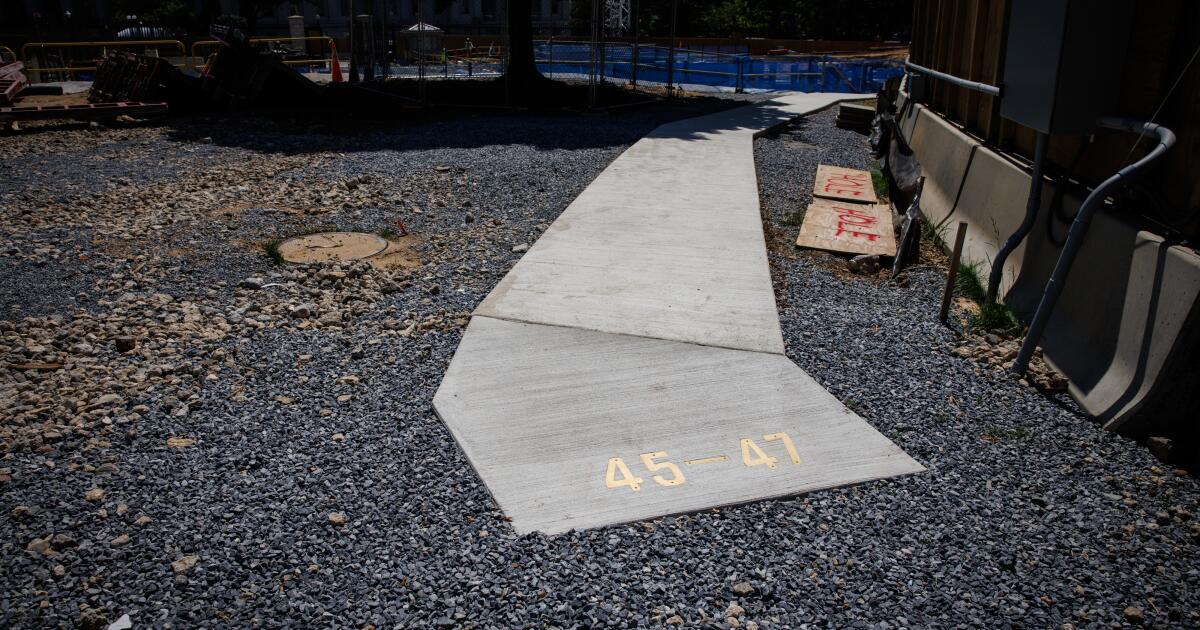 Washington, D.C3 minutes ago
Trump forges ahead with D.C. cityscape transformation against growing resistance
-

 Cleveland, OH6 minutes ago
Union Pacific Big Boy locomotive No. 4014 to stop in Northeast Ohio apart of cross-country tour
-

 Austin, TX11 minutes ago
Texas sweeps Oregon, advances to Men’s College World Series for record 39th time
-

 Alabama18 minutes ago
Flooding Concerns Continue Across North Alabama as More Rain Moves In
-

 Alaska21 minutes ago
Interior raises $3.7M in Arctic National Wildlife Refuge lease sale
-

 Arizona26 minutes ago
Arizona lake closes indefinitely to visitors after all of its fish die
-

 Arkansas33 minutes ago
Arkansas Storm Team Forecast: A few more storms today
-

 California36 minutes ago
Live updates: Trump talks ‘anti-weaponization’ fund, California elections

