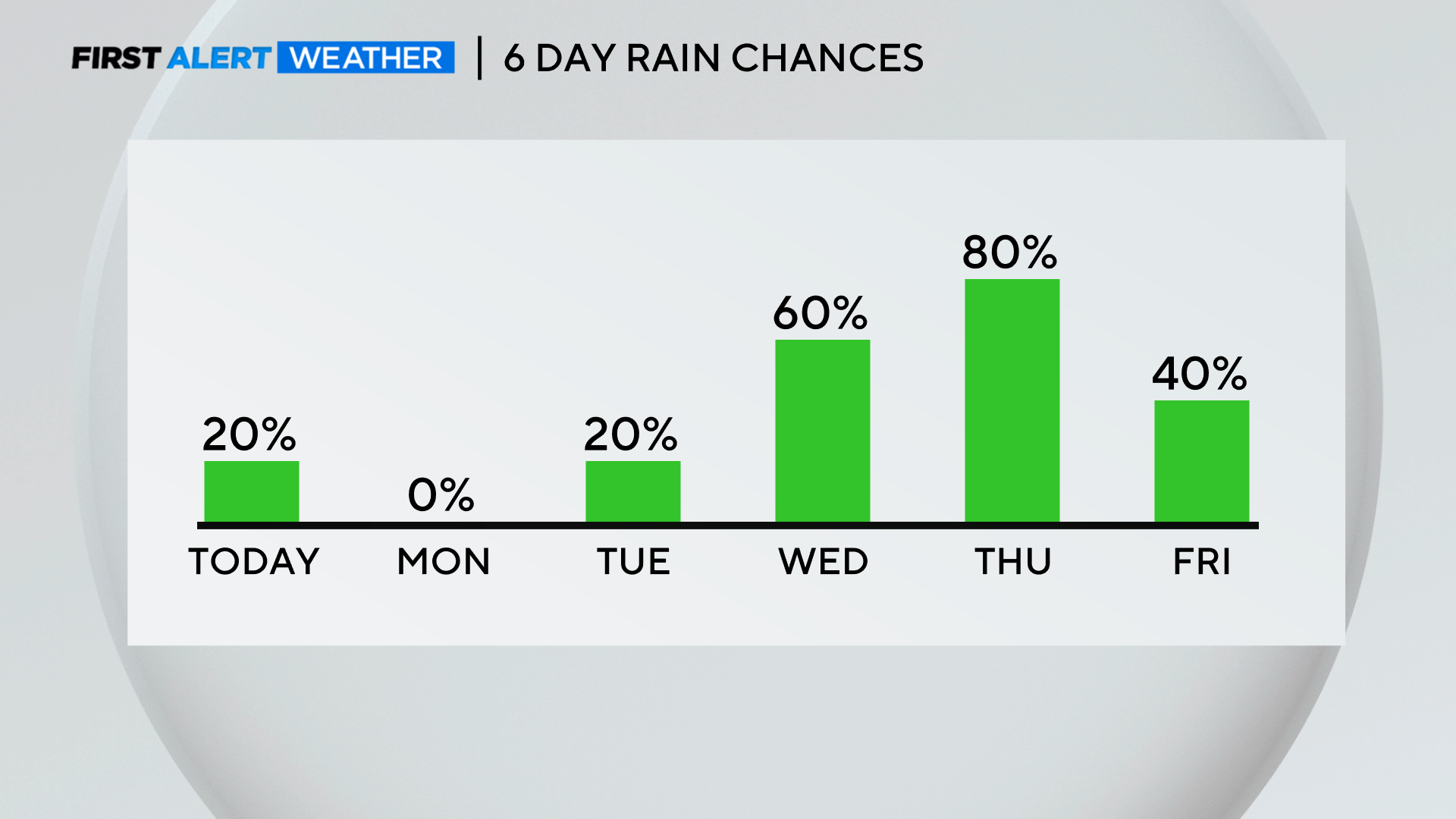
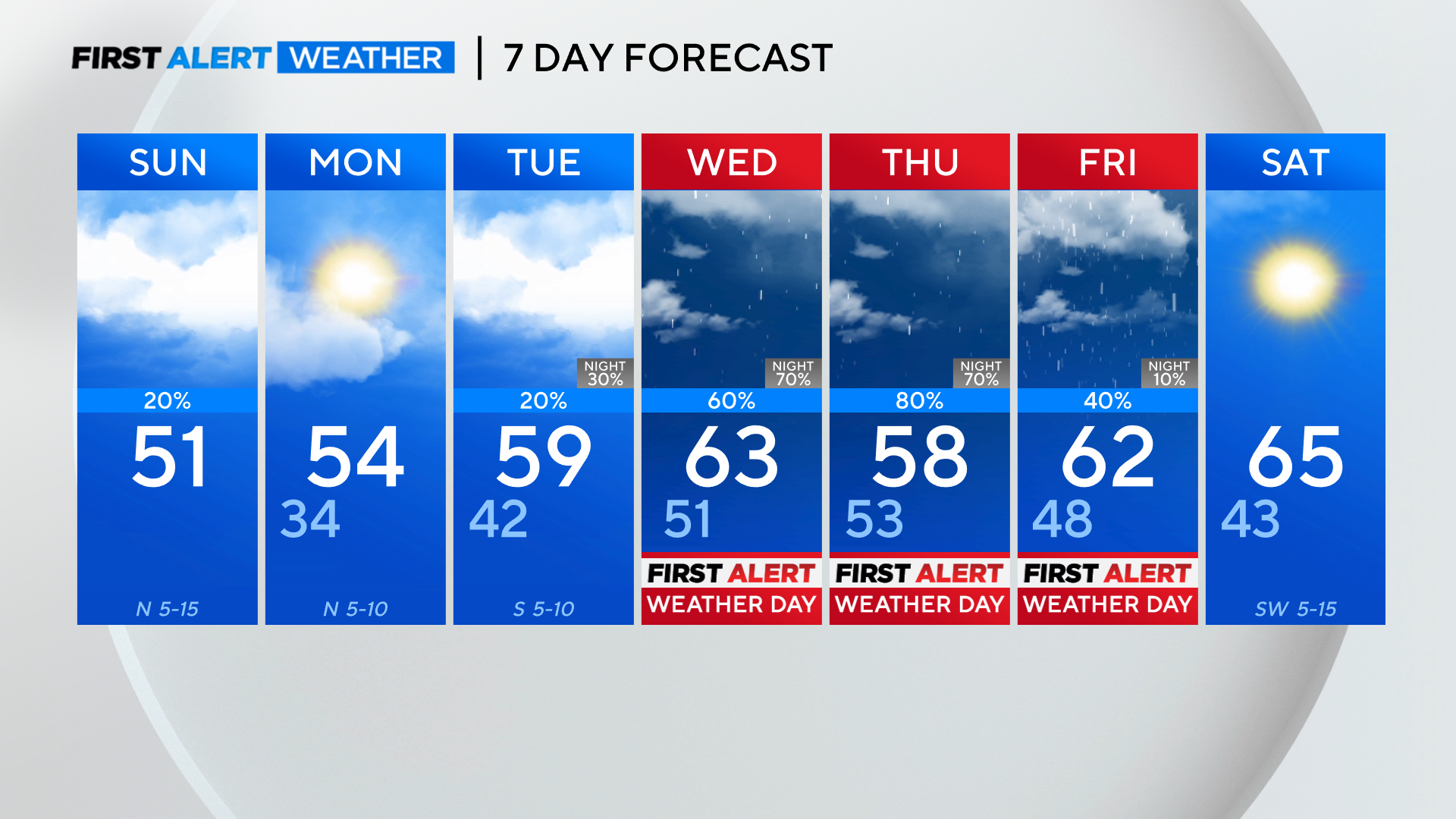
Following a nice and above-average start to the weekend, a cold front swept through North Texas overnight, bringing light rain to kick off Sunday.
Shower coverage will be fairly isolated in the Dallas Fort-Worth area and will only stick around for about the first half of the day. However, scattered showers may persist in eastern and southeastern counties.
As far as temperatures go, North Texas will feel about a 10-degree drop from Saturday, with highs falling back below average to the lower 50s this afternoon.
Advertisement
CBS News Texas
Looking ahead to the start of the new workweek, expect partly cloudy skies on Monday, with highs in the mid-50s.
By Tuesday, clouds build back in, but a southerly flow sends temperatures back to the upper 50s, approaching 60 degrees.
Tuesday afternoon and evening will mark the beginning of a significant weather shift.
Advertisement
Scattered showers roll in Tuesday evening as an area of low-pressure heads through the southwestern U.S.
CBS News Texas
This low-pressure system will continue its eastward track, bringing heavy, soaking rains on Wednesday, Thursday, and Friday.
For this reason, CBS News Texas meteorologists have issued First Alert Weather Days for all three days, warning of soaking rains, a few thunderstorms and the potential for some flooding, especially from Thursday into Friday.
Advertisement
Temperature-wise, North Texas will remain near- and above-normal throughout the extended forecast.
Landen Williams-Callis hasn’t been discussed a ton in the last month or two. Real information as it relates to Texas’ chances has been a bit tougher to come by on the elite running back from Richmond Randle. Today, Inside Texas was able to confirm that he’ll take an official visit to Texas next weekend. We’ve long known Texas wanted LW-C, but we haven’t had a good gauge on his interest in Texas.
The New World screwworm outbreak in Texas has reached five confirmed cases, prompting state agencies to establish infested zones aimed at containing the parasite’s spread.
Federal help is now involved as officials respond to the threat posed by the parasite, whose fly larvae burrow into the living flesh of warm-blooded animals, causing severe tissue damage and potential death.
“We know this development is a serious threat,” U.S. Secretary of Agriculture Brooke Rollins said. “We’ve increased the trapping for flies along the border and ramping up surveillance.”
The Texas Animal Health Commission has established four 12.5-mile infested zones where officials believe the parasite is located and reproducing. The closest zone to Austin is Zone 3, which includes Gillespie, Kerr, and Kimble counties.
Advertisement
Zone 3 was created after New World screwworm was found in a goat in Harper, Texas, on Monday. Rollins also said, “Over the past week and a half, USDA has confirmed 6 cases of the new world screw worm within the US, all but 1 in the South, uh, South of Texas.”
ALSO| New World Screwworm case confirmed in Texas, bringing total of cases in the U.S. to six
State officials say the zones are used to prevent the spread of the parasite and restrict the movement of livestock and other warm-blooded animals through the area.
In Fredericksburg, some residents said the infested zone is a necessary step. Joan Smith, who lives in Fredericksburg, said, “It’s a good thing to protect people. It needs to be done.”
Smith said pet owners should take precautions and consult their veterinarians.
Advertisement
“Many of our neighbors, we called our local veterinarians. They told us as long as we were using certain medications, your pet is covered,” she said. “Definitely talk to your local veterinarians because they can update you.”
Some businesses in the area said the county’s infested-zone label is not expected to impact tourism this summer.
AUSTIN (KXAN) — Hundreds of Texas landowners gathered in Austin this week to challenge proposed transmission line routes tied to a major statewide power infrastructure project.
Advertisement
The Bell County East to Big Hill 765-kV transmission project, proposed by Oncor and the Lower Colorado River Authority, is designed to move power across Texas and strengthen the state grid as demand rises from population growth, data centers and industrial expansion.
Landowners, attorneys and utility representatives attend a hearing on the proposed Bell County East-to-Big Hill transmission project at the J.J. Pickle Research Campus in Austin. The hearing centers on dozens of proposed transmission line routes stretching across Central Texas. (KXAN Photo/Eric Henrikson)
In March, the utilities filed plans with the Public Utility Commission of Texas that included 122 potential route options.
This week, administrative judges are hearing testimony about those routes before eventually making recommendations to the PUC.
For Burnet County resident Jan Rose, the possibility of a transmission line crossing her property is overwhelming.
“It’s going to traverse our property, not along the property lines, but right through the middle, about 150 feet from our front door,” Rose said.
Advertisement
What is the Bell County East-to-Big Hill project?
Rose is one of hundreds of Texans participating in this week’s hearing, arguing why their land is not an appropriate location for future transmission infrastructure.
“We have 13 minutes to present this whole case (to the administrative judges),” Rose said.
The proposed project spans multiple counties across Texas and is part of a broader effort to expand the state’s electric transmission capacity.
Maps showing proposed transmission line route alternatives are displayed during a hearing on the Bell County East-to-Big Hill transmission project at the J.J. Pickle Research Campus in Austin. (KXAN Photo/Eric Henrikson)
Oncor and LCRA argue they studied dozens of route options to reduce impacts to homes, landowners and environmentally sensitive areas.
Why Texas landowners oppose the transmission routes
Still, opponents argue the process pits neighbors against one another while forcing landowners to spend significant money trying to protect their property.
“All of these groups and all of these landowners are going to spend, I mean, collectively, millions of dollars easily, over this next week in legal fees,” said Mia Sarot, founder of the Hill Country Land and Legacy Alliance, an advocacy group representing landowners across Central Texas.
Advertisement
She also argued the state’s timeline for approving transmission projects compresses the process too aggressively.
How the PUC hearing process works
Under state law, the Public Utility Commission has 180 days from the initial filing to complete the transmission line approval process.
According to Sarot, landowners have about 30 days to intervene in the case, followed by roughly 90 days of review by administrative law judges and about 30 days for PUC commissioners to make final decisions.
“The decisions are made faster than they can really meaningfully have input because you have to understand the project,” Sarot said.
When Texas regulators could make a decision
Following the hearing, administrative judges are expected to send route recommendations to the PUC.
Advertisement
“It doesn’t mean that the PUC commissioners have to agree with what they do, and they can make a completely different decision,” Sarot said.
Another hearing later this month could further complicate the process. That proceeding will focus on whether additional route alternatives should have been included in the application.
If judges determine the proposed routes were insufficient, portions of the process could be revisited.
“We might then, you know, have to do this again, spend more money. That is very frustrating,” Sarot said.
For Jan Rose and her husband, Austin Rose, the hope is simple. “Our hope is that the PUC will slow this process down,” she said.
Advertisement
As part of the hearing process, Oncor and LCRA are expected to present witnesses discussing why specific routes were selected. Participants are given 13 minutes to cross-examine utility representatives and limited time to present their arguments.
The Public Utility Commission is expected to make a final decision later this year.
Advertisement
Advertisement
Advertisement
`;
}
// –>
Trending Stories
Advertisement
View All BestReviews Picks
Don’t Miss
Advertisement
Latest weather conditions from the KXAN First Warning Weather team