Business
Wildfires Will Deepen Housing Shortage in Los Angeles


Each of the homes burned in the Los Angeles fires is its own individual calamity.
Collectively, the losses — whether in the hundreds or, as is far more likely, in the thousands — will weigh on the city’s already urgent housing shortage.
Fires are still raging, and with 180,000 people under evacuation orders as of Thursday morning, the degree of displacement in the city and its surrounding areas will take time to assess. For the time being, evacuees are holing up in public shelters in Los Angeles County, with friends or family members or in hotels.
But in the coming weeks and months, people whose homes are gone will have to find more stable accommodations while they rebuild. That will not be easy in a metro area that, as of 2022, already had a shortage of about 337,000 homes, according to data from Zillow. The number of homes on the market in Los Angeles was 26 percent below prepandemic norms as of December, according to Zillow.
“One of the biggest challenges ahead will be getting people who lost their homes into permanent, long-term housing,” Victor M. Gordo, the mayor of Pasadena, said on Wednesday. Pasadena, which is battling the Eaton fire, has already lost hundreds of homes.
The area’s tight rental market is likely to become further strained as many of the thousands of displaced residents turn to rental units, while figuring out their next move. The median rent for a one-bedroom apartment in Los Angeles, as of Jan. 7, was more than $2,000, according to Zillow.
“You’re going to have a positive shock in demand, and a negative shock in supply, so this automatically means prices go up in the rental markets,” said Carles Vergara-Alert, a professor of finance at IESE Business School in Barcelona, who has studied the effects of wildfires on housing markets.
Any uptick in rental costs would affect tenants across the region, beyond those displaced by the fires, Dr. Vergara-Alert said.
Jonathan Zasloff, who lost his home in Pacific Palisades this week, teaches land use and urban policy at the University of California, Los Angeles law school, and is acutely aware of how his search for interim housing could affect the broader market.
Dr. Zasloff is staying with his brother for the time being, while a friend is putting up his wife and daughter. They evacuated their house, which they had lived in for almost 15 years, around noon on Tuesday, before the official evacuation order was issued for the area. That evening, Dr. Zasloff realized the severity of the crisis when he was watching television and saw a reporter standing on his fire-ravaged block.
His insurance agent told him it could take two to three years to rebuild his house. His family might try to find a rental in West Los Angeles near UCLA in the meantime, he said.
There aren’t many rentals in that part of the city, Dr. Zasloff said, so students and other renters could be displaced as he, and people like him who lost their homes, move in.
“It’s very possible that this event is going to cause a big increase in homelessness, even though the people who got pushed out of their homes are people of means,” he said.
California has been in the grip of an affordable housing crisis for a decade. Both state and local lawmakers have passed a raft of new laws that aim to make housing cheaper and more plentiful by making it easier to build. In Los Angeles, for instance, Mayor Karen Bass signed an executive order that streamlines permitting for projects in which 100 percent of the units are affordable. In response to state housing reforms, there has been a boom of backyard homes — called accessory dwelling units, or A.D.U.s — that homeowners often rent out for extra income and that have added to the housing stock.
Still, both the city and state remain well behind their housing production goals, and affordability has only continued to erode. The number of apartment units approved by the city of Los Angeles, for example, dipped to a 10-year low in 2024, according to data from the Los Angeles Department of Building and Safety compiled by Crosstown LA, a news site. That downturn in building permitting has raised concern about roadblocks to new housing unit creation.
“This is a place that had massive affordability challenges last week, and after this week it’s going to be that much more challenging,” said Dave Rand, a land-use lawyer at Rand Paster & Nelson in Los Angeles, who also serves on the board of directors of a statewide affordable housing organization.
After the fires are extinguished and the recovery begins, Mr. Rand said, there is hope that the common cause of rebuilding can be a catalyst for tackling affordability challenges by continuing to make it easier to build housing, particularly affordable rental housing, at a faster pace.
“This is such a devastating event that hopefully it rocks the system to the point where we can get real reform,” he said.
The Los Angeles City Council has aimed to build nearly half a million new units by 2029. But many people trying to rebuild all at once after the fires could lead to higher costs, and slow down the overall production of housing, said Jason Ward, a co-director of the center on housing and homelessness at the RAND Corporation.
A longstanding construction labor shortage in Los Angeles does not help. Andy Howard, a general contractor who has worked across the city for three decades, including in the areas affected by the fires, said many of the subcontractors he work with in the past have left California since the pandemic. And there are not enough young people entering the industry.
The fires are “going to make it worse,” Mr. Howard said. “It’s going to drive the cost up, for sure.”




Layoffs have continued with another tech company saying it was cutting people to enable it to use more artificial intelligence.
Groupon announced in a security filing this month that it will cut up to 400 jobs, or nearly 25% of its worldwide workforce, as part of a broader restructuring plan to make the platform AI-native. The Chicago company plans to carry out the layoffs in the coming months.
Earlier the company’s Chief Executive Officer Dušan Šenkypl had said the company “fell short of our expectations” last quarter.
Since 2022, more than 800,000 tech workers have been laid off, according to Layoffs.fyi, a website that tracks job cuts.
The surge in pink slips started in 2023, when companies that had gone on hiring sprees during the COVID-19 pandemic began to cut back. From January to April this year, U.S. tech employers announced 85,411 job cuts, up 33% from the same period last year, according to global outplacement and executive coaching firm Challenger, Gray & Christmas.
Groupon said in the filing that the decision to shift toward an AI-based company is to “better deliver on our mission, serving both customers and merchants.”
The company said the layoffs will cost it as much as $13 million, but save it more than $20 million per year.
This announcement comes as many e-commerce companies are shifting their business models to AI to reduce costs by automating many roles.
Artificial intelligence has also triggered fierce competition for top talent and is also fueling tens of thousands of layoffs this year. The result is that the class divide is widening in Silicon Valley as a tiny group of employees are landing unprecedented packages for AI skills, while many others struggle to find work.
The have-nots are doing everything that used to guarantee great jobs — refreshing resumes, optimizing LinkedIn profiles and doing interviews — but companies are much more picky these days. The tech jobless are rethinking their lives. Some are taking pay cuts, while others are leaving tech. Some are going back to study or launch startups. Some have retired.
Groupon shares, which have fallen 27% over the last 12 months, slipped 1% on Thursday to $21.20.
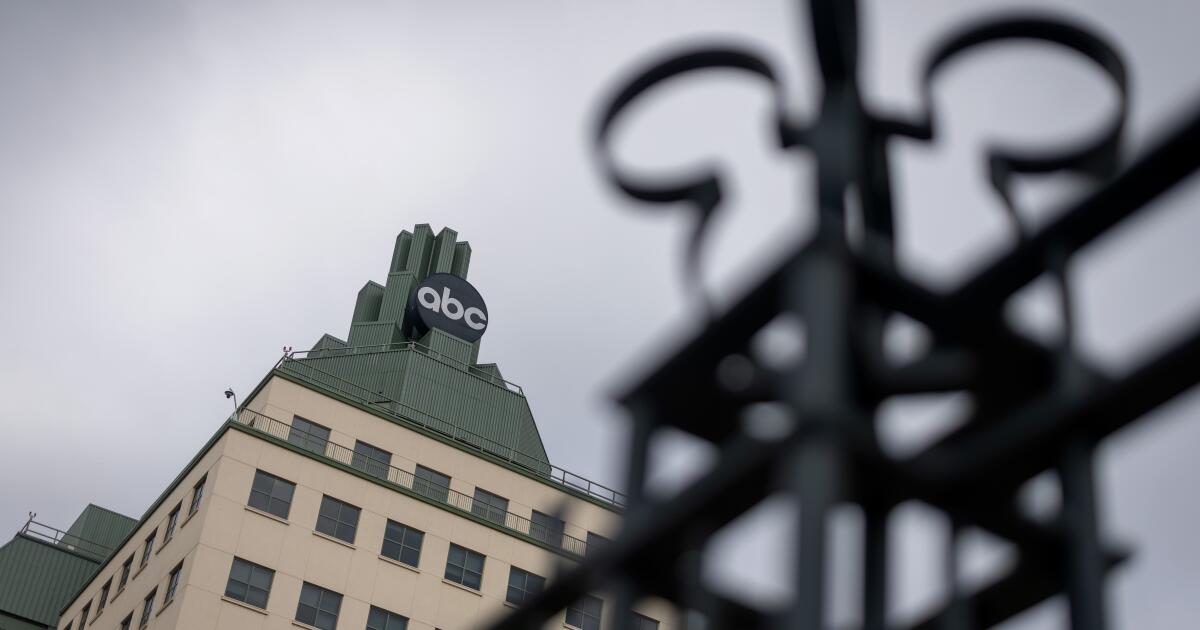
Walt Disney Co.’s ABC has filed renewal applications with the Federal Communications Commission “under protest” after an order mandating a years-early review of the network’s eight television station licenses.
The criticism was part of the network’s applications for the FCC review, which were filed ahead of a deadline Thursday. In an objection to the early renewal, Disney’s New York station WABC called the FCC order “unlawful, arbitrary and unconstitutional” and said it was “legally indefensible.”
“The Commission had not demanded early renewal in over five decades,” the station wrote in its filing. “And it has never before demanded simultaneous license renewal applications from a group of stations commonly owned with a network as it has here. The order has no legitimate purpose.”
The licenses for the eight ABC-owned TV stations, including KABC in Los Angeles, were originally scheduled for renewal between 2028 and 2031.
The FCC order came shortly after ABC late-night host Jimmy Kimmel made a joke about First Lady Melania Trump looking like an “expectant widow” days before a gunman tried to breach the White House Correspondents’ Assn. gala last month that President Trump attended.
Trump has frequently threatened to have TV station licenses pulled when he is unhappy with their coverage, but the order is the first time the government has acted on his wishes, sparking anger from free speech advocates. The FCC has said the order is part of an investigation into whether Disney’s diversity and inclusion policies violate federal law and the agency’s rules against “unlawful discrimination.”
In its response, WABC said the “only plausible reason” to issue the order was to “punish the station for speech the government does not like.”
“The ultimate injury here is not to the station or its parent company. It is to the public,” WABC wrote. “When a broadcaster must weigh regulatory retaliation before making editorial decisions, the public loses access to journalism that is free from government influence.”
FCC Chairman Brendan Carr said in a statement Thursday that Disney filed its applications to renew its broadcast licenses only after the company was told its previous answers were “disingenuous, deficient and improper.”
“Contrary to Disney’s claim that the FCC called in their broadcast licenses for early renewal for no reason, the record shows something very different,” Carr said. “Broadcast licensees have a unique obligation to operate in the public interest. The FCC will follow the facts and law wherever they may lead.”
FCC Commissioner Anna M. Gomez, the panel’s only Democrat who has backed Disney in its fight, cheered the Burbank media and entertainment company’s filing, saying in a post on X that she was “glad to see them expose the FCC’s actions as nothing more than naked political retribution and an unlawful assault on free speech and a free press.”
Times staff writer Meg James contributed to this report.

Andrew here. Warning: If you bet on prediction markets about things you could know about from your work, it may be insider trading. That’s the lesson from new charges against an employee of Google.
Also, Jamie Dimon is thinking about spending $20 billion on acquisitions; we go through some possible targets. And take our quiz about the U.F.C. fight scheduled to take place at the White House.
Gaming prediction markets
In the public’s view, prediction markets are a way to bet on the N.B.A. playoffs, the Texas Senate race or what Costco executives will say on their next earnings call.
They’re also often seen as a hive of insider trading, a view reinforced by charges filed on Wednesday against a Google employee who made more than $1 million on Polymarket. The case raises more questions about how these platforms are policed — and who should do the policing.
What happened: The Google employee, Michele Spagnuolo (who used the handle AlphaRaccoon), was accused of betting on what people were searching for on Google — wagers he was sure to win because he had access to internal search data.
“Spagnuolo correctly predicted virtually all of the outcomes on these positions,” the Commodity Futures Trading Commission wrote in its complaint.
A Google representative said in a statement that using confidential information for making these kinds of bets was “a serious breach of our policies.”
Spagnuolo isn’t the only person charged with insider trading on Polymarket. Federal prosecutors in Manhattan last month accused Master Sgt. Gannon Ken Van Dyke, a U.S. Special Forces soldier, of betting on the capture of Nicolás Maduro of Venezuela, an operation he participated in.
Insider trading is an increasing problem for prediction markets. Polymarket has faced significant scrutiny because its unregulated offshore platform has long made it easy to bet anonymously. (Kalshi, which is regulated in the U.S., has also suffered from insider trading.)
Polymarket has started clamping down on that practice, according to The Information — though some longtime users have chafed at those efforts. “Polymarket will go down the drain if they make KYC mandatory,” one user wrote on the company’s Discord discussion forum, referring to “know your customer” practices.
What are policymakers doing? Critics have accused the C.F.T.C., the primary American regulator of prediction markets, of failing to adequately police the industry. (Mike Selig, the commission’s chairman, told ABC News that his agency actively patrolled for wrongdoing.)
Some lawmakers are seeking to crack down on insider trading, including Representative James Comer, the Kentucky Republican who leads the House Oversight and Government Reform Committee, and several bipartisan groups of senators.
Why it matters: Prediction markets have become big businesses. (Kalshi was most recently valued at $22 billion.) But a growing perception that they’re rife with cheating could threaten their popularity.
HERE’S WHAT’S HAPPENING
The Trump administration is reportedly preparing to fund U.S. drone companies. Shares in Unusual Machines, a drone start-up in which Donald Trump Jr. is an investor and advisory board member, are soaring in premarket trading after The Wall Street Journal, citing unnamed sources, reported on the potential investments. (The Times hasn’t independently confirmed the report.) The deals, aimed at bolstering domestic production, are still in the negotiation stage — equity stakes are a possibility — as the Pentagon vets the companies, The Journal adds.
Investors brace for Thursday’s inflation data. The Personal Consumption Expenditures report for April, which will be closely watched by the Fed, is expected to show on Thursday that headline inflation hit a three-year high of 3.9 percent. The wartime energy spike is a big culprit, and that’s likely to tie the Fed’s hands on interest rates. Lisa Cook, a Fed governor whom President Trump has tried to fire, is the latest policymaker to say that there’s even a rate increase in the cards.
Jensen Huang reportedly agrees to join the board of a Chinese university. Huang, the Nvidia C.E.O., is expected to be the latest U.S. business leader to join the advisory board of Tsinghua University School of Economics and Management, The Financial Times reports. Tim Cook, Apple’s departing C.E.O., is the chairman, and Michael Dell and Elon Musk are members. (Nvidia is trying to jump-start business in China as the Washington-Beijing trade war continues.) Laura Loomer, a right-wing agitator, quickly seized on the Huang news, calling it “a massive scandal!!!!” on social media, and a national security risk.
What might Dimon buy?
Jamie Dimon, the C.E.O. of JPMorgan Chase, is sitting on a pile of cash and says he’s open to a deal. He even put a number on it: up to $20 billion.
While that’s not a big sum relative to the bank’s assets, it got us thinking: Where could JPMorgan, whose last major acquisition was First Republic during the 2023 regional-banking crisis, go fishing for a company to buy? Brian O’Keefe asked Mike Mayo, a banking analyst at Wells Fargo.
Here are three possibilities:
Wealth management. Driven by solid margins and lucrative high-net-worth customers, this area of finance has experienced an M.&A. boom in recent years. (The First Republic deal already bolstered JPMorgan’s wealth-advisory ranks.) Such a move would tick a lot of boxes, Mayo said, adding, “It could be a high-end private bank, it could be kind of a mass-affluent brokerage firm, it could be wealth advisory.”
-
Mary Erdoes, who runs JPMorgan’s wealth management division, told analysts in February that her unit had reviewed 25 potential deals last year and passed on all of them.
Payments. JPMorgan has invested heavily in new payment platforms, including in JPM Coin, a digital token it has tested with Coinbase and Mastercard. The bank handles between $5 trillion and $10 trillion in transactions daily, Mayo said. “There could be more opportunities to enhance the efficiency, the effectiveness, the timeliness or the geographic reach in the payments area,” he added.
Digital banking. Dimon recently singled out Revolut, the British banking app that is plotting expansion into the U.S., as an emerging competitive threat. “To the extent that an acquisition could help JPMorgan become the next Revolut outside the United States, that would seem to be attractive,” Mayo noted.
There are some big asterisks to consider. Because of its size, JPMorgan would most likely be barred from buying another U.S. lender on antitrust grounds. For that reason, Mayo thinks that a deal, if there is one, would probably happen abroad.
Dimon himself is being coy. The bank may have amassed ample capital for acquisitions, but “it’s not burning a hole in our pocket at all,” Dimon said on Wednesday at an investor conference. “If it sits there for a while, no problem,” he added.
Dimon did not suggest any potential targets on Wednesday.
Here are some guesses:
-
Aberdeen Group, Invesco or Julius Baer in wealth management?
-
Revolut is too big, but how about Wise or Toast in payments?
-
Or what about Monzo or Bunq, fintech banks that have grown rapidly in Europe?
Meta will charge for its chatbot
Meta will begin charging customers for access to its A.I.-powered chatbot, a big change for a company best known for its free products — and the latest sign that even deep-pocketed companies are wrestling with the enormous cost of artificial intelligence.
On Wednesday, we looked at how companies were reining in the costs of consuming A.I., including by switching to cheaper models. Meta’s move shows that the companies supplying A.I. models are also reckoning with ballooning costs, and seeking revenue to make up for those losses.
Meta is spending a fortune on A.I. Last month the company increased its 2026 capital expenditure forecast to as high as $145 billion, and Meta’s C.E.O., Mark Zuckerberg, said it would spend at least $600 billion on A.I. infrastructure in the next few years.
Some investors have looked skeptically on that plan. The company’s stock is down 2.3 percent this year.
Meta will use paid subscriptions to offset some of its A.I. investment. The basic tier of the chatbot, Meta One Plus, will be $7.99 per month. A premium version, Meta One Premium, will cost $19.99. From Bloomberg, which reported the subscription news earlier:
Meta has long argued that its A.I. investments are already paying off in the form of highly targeted and efficient advertising, which is improved thanks to A.I. models. But the company is also looking for other ways to recoup its A.I. spending, and consumer chatbot subscriptions have become popular with several other A.I. competitors, including Alphabet Inc.’s Google and OpenAI. Both rivals offer similarly priced subscription tiers.
The company has sought to expand its subscription business, testing plans for WhatsApp, Instagram and Facebook. It has also tried to cut costs in other corners of its business. This month, Meta laid off 10 percent of its employee base, about 8,000 workers.
Investors, eager to see revenue gains from A.I., cheered Meta’s subscription-chatbot plan. The company’s stock price was up 3.7 percent at the market close on Wednesday.
-
Elsewhere, shares in the software maker Snowflake are soaring in premarket trading on Thursday after it reported strong quarterly results that suggested that A.I. agents weren’t clobbering its core subscription business. Salesforce’s analyst call on Wednesday, however, renewed fears that this sector was still vulnerable to A.I. disruption.
Quiz: U.F.C. on the South Lawn
This question comes from a recent Times article. Click an answer to see if you’re right. (The link will be free.)
President Trump is getting ready to celebrate his 80th birthday — and America’s 250th — with an evening of mixed martial arts. Preparations are underway to host Ultimate Fighting Championship matches in an octagon on the White House’s South Lawn on June 14. Construction of the temporary arena, along with a 90-foot-tall arch known as “The Claw,” featuring LED lights and audio equipment, began this week.
U.F.C. plans to spend around $60 million on the event, said Mark Shapiro, the president and chief operating officer of TKO Group Holdings, U.F.C.’s parent company, on a recent earnings call. (He added that U.F.C. would lose about $30 million on the event but that it would be “an investment for the long term.”)
The expenses include about $700,000 to repair the lawn after the fight, Dana White, the U.F.C. president and chief executive, told Sports Business Journal.
How many people will the temporary arena hold for the U.F.C. event at the White House?
THE SPEED READ
Deals
-
“SpaceX-Tesla Merger Is ‘Only a Matter of When,’ Early Investor Says” (Bloomberg)
-
Shares in the European food-delivery company Delivery Hero are down sharply on Thursday after Uber, which is pursuing a takeover bid for the company, raised its stake to nearly 37 percent. (WSJ)
Politics, policy and regulation
-
The attorneys general of New York and New Jersey subpoenaed FIFA over soaring World Cup ticket prices. (WSJ)
-
Gov. Gavin Newsom of California said he would impose a 100 percent tax on payouts to state residents from the $1.8 billion fund tied to the Justice Department’s settlement with President Trump. (Politico)
Best of the rest
We’d like your feedback! Please email thoughts and suggestions to dealbook@nytimes.com.
-

 Finance5 minutes ago
Evoke Entertainment Closes $35 Million Production Financing Facility Backed By Major Private Credit Fund
-

 Fitness11 minutes ago
How busy women can realistically hit 10 hours of exercise a week – and unlock the biggest health benefits
-

 Movie Reviews23 minutes ago
The Breadwinner (Christian Movie Review) – The Collision
-
-U43648517271Shc-1440x752@IlSole24Ore-Web.jpg?r=1170x507&w=400&resize=400,240&ssl=1 "War breaking news. Trump postpones decision: nothing after two hours in Situation Room")
-U43648517271Shc-1440x752@IlSole24Ore-Web.jpg?r=1170x507&w=80&resize=80,80&ssl=1 "War breaking news. Trump postpones decision: nothing after two hours in Situation Room") World35 minutes ago
World35 minutes agoWar breaking news. Trump postpones decision: nothing after two hours in Situation Room
-

 News41 minutes ago
Judge Tosses Citizenship Law Aimed at New Voters in New Hampshire
-

 Politics47 minutes ago
Video: Trump’s Counterterror Strategy Focuses on the Left
-

 Science59 minutes ago
Video: Crowds Flood New York City Streets for First Day of Manhattanhenge
-
 Lifestyle1 hour ago
Trump’s name must come off of the Kennedy Center, judge rules

