Lifestyle
A look at the Aztec Rebels, a family-oriented motorcycle club based in the Bronx

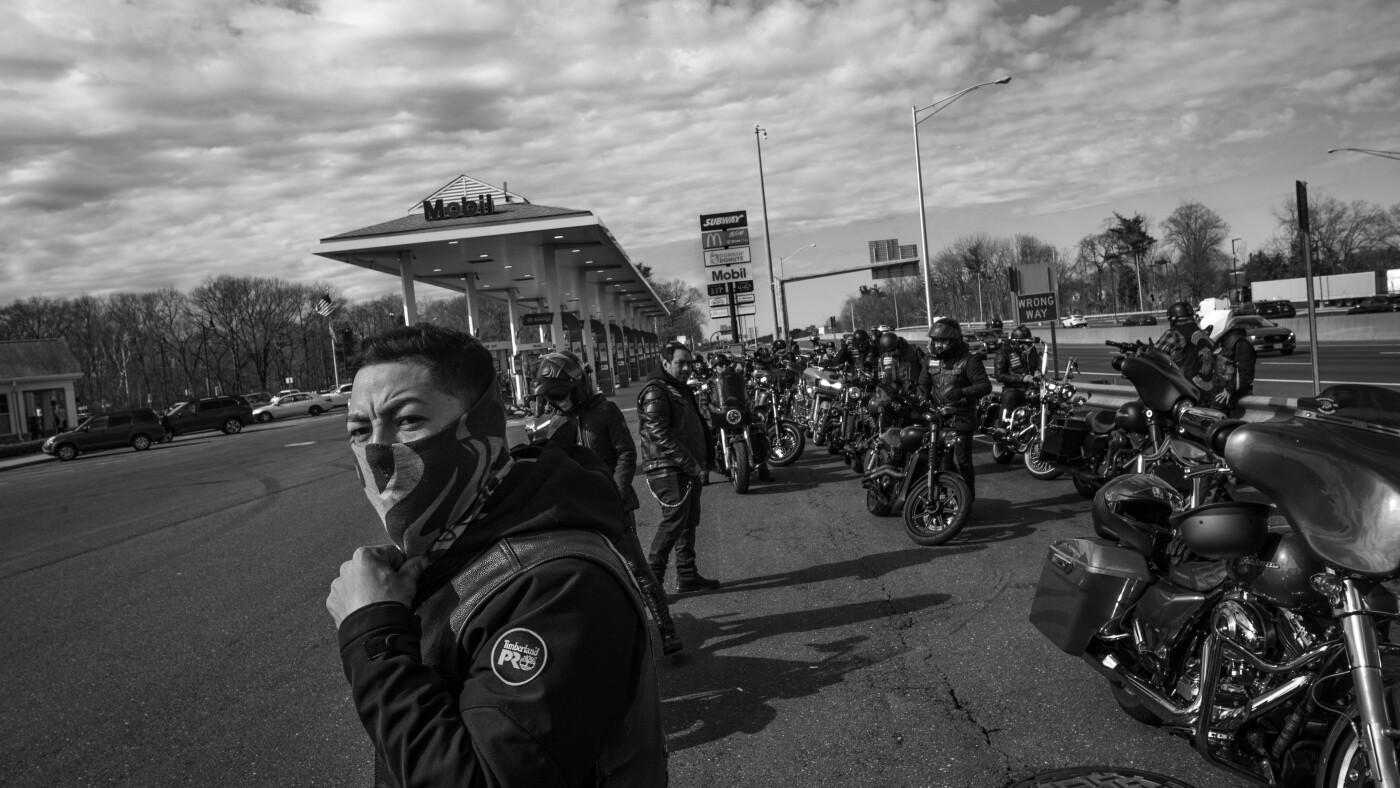
Jossiel Estefes, known as “Onex,” stands next to his bike at a gas station in Connecticut during a ride on March 17, 2024.
Mayolo López Gutiérrez
hide caption
toggle caption
Mayolo López Gutiérrez
“Look at what you built, we started with four men and now check this out,” Sergio Garcia, the sergeant at arms of the Aztec Rebels club, told Andrés Lucero as he pointed at the packed party, while their kids ran around the space and women chatted at one of the tables. Andrés didn’t say anything, but his eyes said it all — the pride of seeing his dream become a reality, surrounded by friends who had become family.
Thanksgiving night. The South Bronx.
A small opening reveals concrete stairs that go down to the basement in a quiet New York City street. But the silence doesn’t last too long. The smell of lime and oregano mixes with the faint aroma of beer as the sound of banda music fills the basement space. Tables are filled to the brim with steaming bowls of pozole, and a soft murmur of conversations weaves through the room like an invisible thread.

Andrés Morales, the club’s founder and former president, stands with club members during their Thanksgiving party in the South Bronx.
Mayolo López Gutiérrez
hide caption
toggle caption
Mayolo López Gutiérrez

The Aztec Rebels start their motors before departing on a night ride in the Bronx.
Mayolo López Gutiérrez
hide caption
toggle caption
Mayolo López Gutiérrez


Sergio Garcia, known as “Toluco,” jokes with his son outside of “Mama Puebla,” a Mexican restaurant in the Bronx owned by one of the Aztec Rebels.
Mayolo López Gutiérrez
hide caption
toggle caption
Mayolo López Gutiérrez
All the leather-vested men look to the staircase. As Andrés removed his beanie, a bald eagle tattoo was revealed, glistening under the dim lights. He walked down the steps like an old Hollywood movie star entering a bar, eyes fixed on the gathering.
The November wind blew in from the East River on to Intervale Avenue. But here, Andrés’ gaze softened as he watched his people together, sharing stories and laughter.

Jossiel Estefes and daughter pose for a portrait during a Thanksgiving party in the Bronx. He had recently became an official in the club.
Mayolo López Gutiérrez
hide caption
toggle caption
Mayolo López Gutiérrez
The festivities that night were a testament to how far the club had come, and also spoke of how Latino communities tend to integrate into American culture: While they were celebrating Thanksgiving, there was no turkey or gravy, but rather pozole, chicken and black mole, traditional of Puebla, where most of the Mexican population in New York is from. But to truly understand the Aztec Rebels, you have to look back at how Andrés and his brother, Eddie Lucero, started their journey in a very different South Bronx.

Aztec Rebels dance cumbia with their loved ones at the Thanksgiving party.
Mayolo López Gutiérrez
hide caption
toggle caption
Mayolo López Gutiérrez

Children sleep during the Aztec Rebel’s Thanksgiving dinner in the South Bronx.
Mayolo López Gutiérrez
hide caption
toggle caption
Mayolo López Gutiérrez

Andrés founded the Aztec Rebels with Eddie after learning the culture and politics in a Bronx motorcycling club called The Roadrunners. They dreamt of creating a space where they could hear their own music, speak their language, and be understood. “I started hanging out with The Roadrunners when I was 19. Eddie was 12, and he would tag along everywhere we went. My brother grew up in that club. He has always lived the life of a biker, so, in a way, we learned what a motorcycle club was. That’s why we were able to start our own club on the basis of what an actual club is.”
After deciding on brown to be the club’s color and designing the Aztec eagle insignia, the Aztec Rebels MC was officially founded in 2016 with five founding members. They’ve since expanded to over 20 full members and five prospects from every borough of NYC. Most of them live in the Bronx and Staten Island — “La Isla,” as they colloquially call it.

Sergio Garcia, known as Toluco, the Aztec Rebels’ Sergeant at Arms, smokes his cigar during a Thanksgiving party.
Mayolo López Gutiérrez
hide caption
toggle caption
Mayolo López Gutiérrez
Every full member goes through a sometimes years-long process that begins with an invite, becoming a prospect and learning the rules of the club through a current member before gaining their three distinctive vest patches. A flier for the club reads: “We accept every nationality. You don’t need a motorcycle to enter, but we do expect you to get one eventually.” The Aztecs, nonetheless, are primarily Mexican, speckled by a few Ecuadorians and a Honduran member.
Each has a different story and connection to Mexico.
“For me, the journey here was more of a game, an adventure through the desert,” Andrés says when recalling his migratory journey. “I came in ’86 and have always been looking for the opportunity to improve my situation, even when I was a kid. I was 12, and for me, it was just normal. I didn’t see the danger back then, but if I had to do it again, I would be very scared, because I’ve heard a lot of horror stories from recent migrants.”
His parents had arrived five years earlier from Piaxtla, a town of 15,000 in the mountains of Puebla. They started a fabric factory in uptown Manhattan and rented an apartment on Southern Boulevard in the Bronx. “I come from a pueblo — I was never from the city — so it was a really drastic change to arrive here and see all the people. Especially in that time — the Bronx was in the middle of the drug pandemic. Crack.”

Children crack open a piñata during a birthday party in Staten Island on May 24, 2024.
Mayolo López Gutiérrez
hide caption
toggle caption
Mayolo López Gutiérrez

The Aztec Rebels’ children jump to gather candies dropped after breaking open a piñata.
Mayolo López Gutiérrez
hide caption
toggle caption
Mayolo López Gutiérrez

Alfredo Ramirez, known as “Mad Max,” receives a birthday cake during a party in Staten Island.
Mayolo López Gutiérrez
hide caption
toggle caption
Mayolo López Gutiérrez
In the ’80s, the South Bronx still bore the scars of fires that burned entire neighborhoods to the ground the prior decade. “There were a lot of burnt buildings. It looked like a war zone. A lot of people are using drugs in the streets. I adapt quickly, nonetheless. In the end, it didn’t scare me; I just had to get used to everything. After a couple of years, it was just normal to see what was going on,” Andrés recalls from his youth.
Mexican immigration to the United States dates back to the beginning of the 20th century, with undocumented agricultural laborers traveling to work in the Californian fields. In the 1940’s, the Bracero program formalized the employment of many of these workers, who were needed to fill the gap created by the demand for men during World War II. Throughout the century, the practice of young men migrating to work in the United States grew more and more common.
In 1980, there were 39,000 people of Mexican origin in New York state, while 10 years later, the census registered an yearly increase of 8.8%. It is in this landscape that so many Mexicans have built a home in the United States, finding themselves and creating communities that make them feel safe and with a sense of identity.

Andrés Lucero poses for a portrait beside his Volkswagen Beetle on Aug. 21, 2024.
Mayolo López Gutiérrez
hide caption
toggle caption
Mayolo López Gutiérrez
In 2020, Andrés handed the president’s badge to his brother and now spends most of his time running a deli on Third Avenue. The back of the store, adorned with a Virgen de Guadalupe sprayed in gritty black graffiti, doubles as his tattoo parlor. His home is still the apartment building where his parents settled in the ’80s. One of the doors belongs to Eddie.
Stern and serious, Eddie carries an almost military posture in his shoulders — gained by private security training and a lifetime living among the club — along with five commanding officers, they keep the Aztecs riding. Eddie is not only the club president and a commanding presence amongst the Aztecs; he is also father to twin teenagers that often spend time with the club, when they are not playing soccer with the FC Harlem. Eddie, as part of a sort of training, tells his kids of the tough decisions he sometimes has to make as president, and asks them what they would do. Explaining and passing on the most important value of the club: the value of family. He is also the friendliest of the group when playing with the other members’ kids. He is loved and respected by everyone.

Christian Pérez, the club’s treasurer, is reflected in a motorcycle mirror before a ride to Long Island on Feb. 25, 2024.
Mayolo López Gutiérrez
hide caption
toggle caption
Mayolo López Gutiérrez

Some of the Aztec Rebels look out toward a lake in Long Island during a ride.
Mayolo López Gutiérrez
hide caption
toggle caption
Mayolo López Gutiérrez

Riders hold a lot of stigma and stereotypes of machismo and misogyny, sometimes supported by long-held traditions and questionable practices. To illustrate, in most motorcycle clubs, wives and girlfriends of the group wear vests that read “Property of X M.C.” As president, Eddie broke that tradition by writing “Protected by Aztec Rebels M.C.” on the women’s vests.
When looking at one of the Aztecs’ gatherings, one must see beyond the vests and the stereotypes surrounding motorcycle culture. Although they might look tough on the outside, the men that form this community are responsible family men. The club also provides a family to those who, in some cases, left their families behind and started a life completely on their own in the United States.
“People are always looking for a family, and that’s why sometimes they get into gangs. We want to be that place where Mexicans can come and be in a safe environment, without violence, but with a family,” Eddie says.

“Diablo” poses for a portrait during a ride to Long Island.
Mayolo López Gutiérrez
hide caption
toggle caption
Mayolo López Gutiérrez
At 19, ‘Diablo,’ is the youngest full member in the Aztecs. He asked us not to use his full name because of his immigration status. Most, or rather none, of the members know his actual name; they refer to him by the nickname he earned from his love of speed on his motorbike.
“I went straight into middle school and had a lot of fights. People tried to bully me because I didn’t speak English, so I just defended myself, and only then did they respect me and start hanging out with me,” Diablo recalls.
He sticks out from the other Aztecs only for his skinny build and the noticeable age difference. But he is just one of them when it comes to the brotherly rowdiness and banter.
“My mother told me that the fights in high school were not irrelevant, but they meant knives and weapons. All my friends went to the same high school, but I didn’t tell them and went to a different one. Most of them are now in gangs and some of them are no longer around,” he says, while hanging out next to a food truck selling birria and tacos on a highway in Connecticut.


Andrés Lucero, the club’s founder and former president, draws the outline of the club’s logo on the wall of their first clubhouse in Hunts Point on May 26, 2024.
Mayolo López Gutiérrez
hide caption
toggle caption
Mayolo López Gutiérrez

Members of the Aztec Rebels play pool in their newly opened clubhouse.
Mayolo López Gutiérrez
hide caption
toggle caption
Mayolo López Gutiérrez

Christian Perez holds his newborn at the Aztec Rebels recently opened clubhouse in Hunts Point, in the Bronx.
Mayolo López Gutiérrez
hide caption
toggle caption
Mayolo López Gutiérrez
Since 2016, the Rebels have been gathering in their personal apartments, garages and basements, from Yonkers to Staten Island, or “La Isla,” as they call it. But they’ve always wanted to have a permanent home.
As their numbers increased, the commanding officers started looking for potential places to rent, primarily in the South Bronx. They visited more than 20 lots that they could use, but were always turned down.

Eddie Lucero, the club’s president, poses for a portrait with his twins, Eddie and Ethan, during an Easter egg hunt on Randall’s Island for the Aztec Rebels and their families.
Mayolo López Gutiérrez
hide caption
toggle caption
Mayolo López Gutiérrez
This year, their efforts finally came to fruition. A remote street next to the Hunts Point “marketa,” as the Latino community calls it, finally accepted the Aztec Rebels as tenants. Eddie called an emergency meeting at the new location without giving away the surprise. All the men answered the call. They came thinking that their president was in danger. They climbed up the stairs without removing their helmets, ready for anything. And there stood Eddie: he said. “Welcome to your new house.”
In the next couple weeks, they remodeled the space with their bare hands. Most have worked in construction, so it wasn’t hard for them. They added a classic pool and foosball table, and a TV, where they watched the Mexican soccer league’s final between Club América and Cruz Azul.
“There’s a different way to do things. You don’t have to follow a straight path. We broke the mold by being Mexican bikers in New York. You can be wholesome and be a family man. And you can be more than just a biker. You can be a leader in your community and help everybody out by being part of something big,” Eddie concluded.

Sergio Garcia and Carlos Villatoro look at the skyline from the rooftop of the Aztec Rebels recently opened clubhouse in Hunts Point, in the Bronx.
Mayolo López Gutiérrez
hide caption
toggle caption
Mayolo López Gutiérrez

The Aztec Rebels stand outside their newly opened clubhouse in the Hunts Point neighborhood of the Bronx on May 26, 2024.
Mayolo López Gutiérrez
hide caption
toggle caption
Mayolo López Gutiérrez

Skid marks left behind in a parking lot during a ride to Long Island.
Mayolo López Gutiérrez
hide caption
toggle caption
Mayolo López Gutiérrez
Mayolo López Gutiérrez is a photojournalist based in Mexico City. You can see more of Mayolo’s work on his website, mayolopezgutierrez.com, or on Instagram at @fotomayo.
Photo edited by Virginia Lozano. Copy edited by Zach Thompson.


Lifestyle
L.A. Affairs: It’s hot when a man drives to me. But would this new guy make the trek from the Valley?

I met Dan on Hinge.
He lives in Woodland Hills, and I live in Venice. In Los Angeles, this is considered a long-distance relationship. In another city it might be nothing. Here, it’s a factor.
But I believe that with the right person, you can make anything work, so I stay open. I’m a native New Yorker, and if I were living in Brooklyn and a guy lived on the Upper West Side, that would be a 45-minute subway ride, which is truly nothing in New York. So with that same logic, I try to have flexibility with men in L.A.
When we started planning our first date, Dan suggested three options: a hike on mushrooms, a wine tasting or a walk on the beach.
A hike on mushrooms is something I’d only do with someone I already trust, not someone I just met online. I don’t do first-date hikes because I don’t like feeling trapped if the guy’s a dud. So I chose the wine tasting.
Then I learned the wine tasting was in West Hills.
On a Friday night, driving there from Venice would be insane. So I said I didn’t want to meet there because of the traffic. He suggested Malibu. That was also not ideal on a Friday.
I was getting annoyed — this was a pink flag because in my dating world, the guy is supposed to come to the woman’s neighborhood in the early days. I’ve gone out with plenty of men from the Valley who effortlessly suggested they come to me. It’s not rare or impossible.
I suggested he come to the Westside. I didn’t specifically say Venice, and in hindsight, I probably should have. He landed on Brentwood, which was manageable for both of us. On our first date, we met at an Irish pub on Wilshire Boulevard. He was cuter and more interesting than I had expected, and with the Guinness flowing, we had fun.
When I got home, he texted me: “Well, I like you 🙂 Less the tik tok and the lack of rock music in your life, but it’s not a deal breaker — there are other qualities 🙂 What are your thoughts?”
I noticed the slight negativity but was mostly dazzled that a man texted immediately after the date to say he liked me. In the modern dating economy, this felt rare.
The next day, both of our evening plans fell through, so we made a last-minute date. The wine tasting he originally suggested still sounded like fun, and although it meant me driving to the Valley, I was up for it now that we’d met.
We sipped flights at Malibu Wines & Beer Garden in its airy, romantic courtyard and played a flirty version of Truth or Dare. Halfway through, he dared me to kiss him.
We ended with sushi on Ventura Boulevard and a short make-out session in his car. He invited me to Thanksgiving at his uncle’s, which felt too soon, but also sweet.
After the second date, he texted and said he had his kids that week and was also hosting an event on Thursday, so his only day to meet was Wednesday. I said great.
On Tuesday night, he checked if we were still on, and I said yes.
Then he texted: “I’m flexible on time but not on location. I have a big event on Thursday, hopefully you can come to me again.”
My stomach tightened. This again?
So I texted back: “I drove to you last time, which was a bit of an exception for me especially in the early days, but the wine tasting location sounded special. Usually guys come to my area. How about we switch it up this time?”
He replied: “I appreciate the effort! Because of my event, I’d rather be close to a computer just if needed … Here is what i offer:
— I’ll come to your area anytime next week/end
— Lunch/dinner on me
I want to continue where we stopped last time 😉 No pressure of course, but let’s snuggle”
I responded: “Ok let’s meet next week. Snuggles sound nice … let’s see what happens …”
Then he wrote: “So I won’t see you tomorrow?”
I replied: “Unless you wanna come to me and bring your laptop along, let’s rain check until you have more flexibility.”
He said: “Dang, you are hard. I’ll let you know tomorrow around midday if it’s ok.”
And then — surprise — he decided to come.
He drove to Venice for a 5 p.m. date. He said his ETA was 5 p.m., and it ended up being 5:25 p.m., typical 405 Freeway.
When he showed up, he was in a cranky mood. On our way to KazuNori in Marina del Rey, I thanked him for picking me up and told him I think it’s hot when the guy comes to the girl.
“You’re just saying that because you want me to come to you more,” he said, not playfully, but aggressively.
That was basically the end for me. But there I was, in his car, heading to dinner. So I stayed pleasant and tried to make the best of it.
I shared that in the early stages of dating, I find it’s good etiquette for the guy to come to the woman’s neighborhood. He immediately disagreed and started ranting about how dating rules are ridiculous and how they swing in women’s favor. He resented paying for dates and declared he wasn’t looking to “sponsor a woman’s life.”
“If women want equality and equal rights,” he said, “then it should apply all across the board, including dating, and the man shouldn’t have to pay.”
I said women don’t actually have equal rights because we get paid less than men and often receive lower salaries than men in the same position.
I tried to change the subject and reset the mood, but he insisted we keep hashing it out.
I tried to explain masculine/feminine dynamics: providing and protecting, giving and receiving.
“What does the man get out of this arrangement?” he asked.
It was like watching someone’s personality warp into Mr. Hyde. Then he brought up another point: He’s a single dad of two kids, so he gets tired; and because I don’t have kids, that should factor into who drives where.
At this point, I was barely engaging and focused on eating my hand rolls, and I couldn’t wait to get home.
The check came, and I happily split it, wanting nothing further from him.
In the car back to my place, he remarked: “It’s obvious we’re never gonna see each other again.”
Obvious, but did it need to be stated?
Then he showed me a Spotify playlist he’d made for me of his favorite electronic music, because he knows I like EDM.
“Oh, that’s sweet,” I said.
“Yeah, that’s how I show interest. Through things like this, not who drives to who,” he replied.
When I got out of the car, we wished each other luck, and I headed inside and shut the door.
Two hours later, he sent me the playlist. I’ve yet to listen to it.
It wasn’t the distance that ruined it. It was the resentment. I’m not looking for a man who feels burdened by the effort. I’m looking for a man who sees the value of courting a woman in the first place.
The author is a writer, comedian and former psychologist who lives in Venice. She is the creator of the new vertical series “Manfari.” She’s on Instagram: @solange_neue and @manfari.show.
L.A. Affairs chronicles the search for romantic love in all its glorious expressions in the L.A. area, and we want to hear your true story. We pay $400 for a published essay. Email LAAffairs@latimes.com. You can find submission guidelines here. You can find past columns here.

Lonnie Bunch III is the 14th Secretary of the Smithsonian. He’s pictured above in September 2017.
J. Scott Applewhite/AP
hide caption
toggle caption
J. Scott Applewhite/AP
In a memo addressed to staffers sent Tuesday, the secretary of the Smithsonian, Lonnie G. Bunch III, defended the institution after the White House issued a 162-page report that characterizes the National Museum of American History as a place which has become “subject to institutional capture by a radical, activist ideology that is fundamentally opposed to telling the noble, honest story of the great country we know and love.”
In his email, which NPR has obtained, Bunch wrote in part: “While there will always be room for improvement, this report is not a fair characterization of the work and totality of the National Museum of American History. At the Smithsonian, our work is driven by scholarship, accuracy and an uncompromising commitment to tell the fullness of America’s story. As public servants and the keepers of this institution, we are charged with helping a nation find understanding, hope and clarity and as part of that duty, we are dedicated to excellence, reflection and growth.”

He continued: “We remain focused on what grounds us: a steadfast commitment to scholarship, nonpartisanship, independence, accuracy and integrity. For nearly 180 years, the Smithsonian has worked alongside partners across government — from the White House to Congress to our governing Board of Regents — guided by our enduring mission to increase and diffuse knowledge. That purpose remains: to pursue knowledge with rigor and to serve the American public with clarity and care.”
The White House report was issued on July 4 by the Domestic Policy Council under the title “Saving America’s Story: How Ideological Capture at the Smithsonian Institution’s National Museum of American History Erases Our Heritage.”

The council faults the National Museum of American History on a multitude of fronts, saying it underemphasized the Founding Fathers and early colonial and Revolutionary history; was not sufficiently celebratory of the country’s 250th anniversary; and that it engaged in “anti-white,” “illegal alien” and transgender activism.
It also accuses the museum of trying to “indoctrinate” teachers and students through its exhibitions, programming and teaching resources.
In the report, the council also specifically criticizes museum director Anthea Hartig, who has led the National Museum of American History since 2019 and is concurrently the president of the Organization of American Historians, calling her “an activist advancing an ideological agenda contradictory to the museum’s founding purpose of fostering patriotism.”

The Trump administration has made the Smithsonian museums one of its primary targets in its efforts to reshape cultural narratives to align with its viewpoints. In August 2025, the White House requested a “comprehensive internal review” of eight Smithsonian museums, including the National Museum of American History, following an executive order issued by President Trump in March 2025 in which he called for the removal of “improper ideology” from the Smithsonian’s offerings.
According to the Smithsonian’s charter, all of its 21 museums, 14 education and research centers, and the National Zoo are meant to be run independently of the federal government. The Smithsonian is overseen by Bunch and a board of regents, which includes Vice President Vance, Supreme Court Chief Justice John Roberts and other members appointed by Congress.
In an interview with NBC’s Meet the Press on Sunday, Bunch spoke about the Smithsonian’s 250th anniversary special exhibition at the Smithsonian Castle, which is called “American Aspirations.”
He told NBC: “It’s really important for people to understand that America is much an ideal as it is a place, that it’s a series of aspirations that have really shaped who this country is. And so for me, what is so powerful is to say, ‘Let us honor the words of Thomas Jefferson and the founders, but let us use those to challenge us to be better.’”
Jennifer Vanasco edited this story.

-

 San Francisco, CA3 minutes ago
San Francisco Mayor Daniel Lurie Blocks Vacant Grocery Store Tax Proposal | KQED
-

 Miami, FL8 minutes ago
Oregon Battling Miami, Mario Cristobal for Four-Star EDGE Recruit
-

 Dallas, TX10 minutes ago
FC Dallas Forward Logan Farrington Inks Contract Extension
-

 Boston, MA18 minutes ago
Red Sox face lengthy travel issues ahead of series vs. Mets
-

 Denver, CO25 minutes ago
What’s going on with the Nuggets? Unpacking an NBA offseason on hold
-

 Seattle, WA28 minutes ago
Seattle Kraken Sign Goaltender Victor Östman and Defenseman Ville Ottavainen to One-Year Deals | Seattle Kraken
-

 San Diego, CA33 minutes ago
An executive shuffle at San Diego’s Sempra
-
Milwaukee, WI40 minutes ago
Survey finds less than half of Jews in Milwaukee identify as Zionists | The Jerusalem Post


