Louisiana
Hoover passes for 4 TDs as TCU beats Louisiana-Lafayette in the New Mexico Bowl


Josh Hoover passed for four touchdowns to help TCU beat Louisiana-Lafayette 34-3 on Saturday in the New Mexico Bowl.
Hoover was 20 for 32 for 252 yards with an interception. Eric McAlister had eight catches for 87 yards and a TD for the Horned Frogs (9-4).
TCU’s defense also had a solid day, holding Louisiana-Lafayette (10-4) to 209 yards, including 61 on the game’s final possession.
Ben Wooldridge was 7-for-20 passing for 61 yards for the Ragin’ Cajuns. He also threw an interception.
The Horned Frogs put together a fast start. Hoover found DJ Rogers for a 3-yard TD pass, capping an 11-play, 75-yard drive on the game’s opening possession.
After Lou Groza Award winner Kenneth Almendares missed a 54-yard field goal for Louisiana-Lafayette, TCU went right back to work.
McAlister’s 1-yard touchdown reception finished a 10-play, 63-yard drive and gave the Horned Frogs a 14-0 lead in the first quarter.
Kyle Lemmermann kicked two field goals and JP Richardson added a 20-yard touchdown reception as TCU opened a 27-0 halftime lead.
Takeaways
TCU: Two years removed from an appearance in the national championship game, the Horned Frogs turned in a strong performance after going 5-7 last season. They scored on their first four possessions against the Cajuns. and held a 27-0 halftime lead.
Louisiana-Lafayette: It was a rough afternoon for the Cajuns. Almendares made a 24-yarder in the fourth quarter to account for their only points.
UP NEXT
TCU opens the 2025 season Aug. 30 at North Carolina in coach Bill Belichick’s debut with the Tar Heels.
Louisiana-Lafayette opens at home against Rice on Aug. 30.



The Fourth of July holiday usually brings to mind fireworks and hot dogs, patriotic t-shirts and hot weather.
But as American marks her 250th birthday, it can also be a time to learn something about the origins of our nation. KATC sat down with a couple of historians from South Louisiana Community College to get a history lesson: SoLAcc Humanities Chair Sarah Senette and Steven Schwamenfeld, PhD., Associate Professor of Humanities and Communication.
If you’d like to hear all their answers, scroll down; we’ve put together a video of their unedited responses to our questions.
We learned a lot. For instance – did you know that Louisiana, and in particular the Acadians, were pivotal in the course of the Revolutionary War?
“The war would not have been won without Louisiana. It’s not just the foreign aid that comes with France and Spain. That is very important. The war would not have been won without that alone, but without the participation of Louisianans specifically. I don’t think the American Revolution at least would have ended w hen it did,” says SoLAcc Humanities Chair Sarah Senette.
The French and Spanish – both of whom controlled what is now Louisiana at one time – both held bitter resentments against the British following the French and Indian War. And, the Acadians – who had just been expelled from their homes by the British in 1755 – had a personal score to settle and were ready to fight, she said.
“But you also had people like the Cajuns, I guess we to call them the Acadians then, who were exiled as a byproduct of the French and Indian War, who were living in Louisiana at that time. And they are passionate about fighting against the English. And in f act, (00;03;38;40: it’s one of the only times in Cajun history where you really see active participation from the Cajuns, in the military campaign. In fact, Galvez, the governor of Louisiana, he actually writes about them in one of his letters. And he says the Acadian men in particular, remember the past injustices of the English. So it was personal for them,” Senette says.
Another person with Louisiana ties who played a pivotal role in the war was Galvez – Bernardo de Galvez, who was colonial governor of Spanish Louisiana and Cuba, and later Viceroy of New Spain. He led the Gulf Campaign of the war – which many people have never heard of.
“This is a very heroic campaign. So they have all the Spanish ships that are out in the Gulf, and they want to do a siege against Pensacola. But it’s a little bit problematic because there’s another fort that’s more of a supply for the smaller fort , Fort George, and a little bit inland and so they can’t siege against Pensacola because it will just go on indefinitely. But they have to take Pensacola because it’s going to cut off the back entrance to, for supplies that keep the British from coming around to the western side of the American Revolution. So they must take Pensacola,” Senette says.
“Famously, Galvez says, who’s with me? And everyone’s like, nobody. No, we’re not doing it. And it’s because it’s dangerous. The British are smart. They know that this is really the only way to effectively win. So they have cannons on either side. It’s going to be very treacherous. And so famously, Galvez says, fine, I’ll do it myself. “ Yo solo ” I alone am going to, you know, lead this campaign. And actually it goes on his coat of arms later when he becomes, I think, the viceroy for all of Latin America, he is elevated into the upper aristocracy for this. But, so he takes it and he does lead the campaign i n this, you know, long, drawn out battle which ultimately determines the course of the American Revolution. So he is someone that is almost never talked about as a great military commander. But he was, and he’s quite heroic, even by his own account. So I feel like we should be very proud of. Yes, we should be very proud of his contributions. He was only about mid 30s, I think he was about 37 maybe by the time that happens. But so he was a young man doing all this,” she continues.
In recent years, more historians have begun studying this aspect of the war, she added.
“When you talk about the American Revolution, you hear about the northern front, you hear about the southern front, maybe you know the Navy, but you you don’t hear about the Gulf front. What is that? Right: Louisiana? I thought they were Spanish, but no, actually, Louisiana is deeply involved in this war,” she says.
Many Louisiana folks are familiar with Joseph Broussard dit Beausoleil, the guerrilla fighter who teamed up with indigenous people to resist the British up in Acadie. His son was a hero of the Revolutionary War; he fought under Galvez.
“It ’ s just a little slice of their of Cajun history. By the time you’re talking about the American Revolution, you have approximately 2,000, Acadians in Louisiana, and that’s men, women and children. And that would be the larger end of that number. So perhaps just a few hundred [Cajuns] are actually actively fighting in the American Revolution. So the Acadians are completely disinterested in fighting in the Civil War, right? They don’t get truly passionate about another war until World War Two. So this is a very odd moment in Cajun history, but one that when you know what the British did to the Acadians makes perfect sense,” she adds.
But it wasn’t just the Acadians who fought in the War on the side of the colonies, she adds.
“So you have Choctaw who were, you know, strong French allies, the Native Americans, you know, the French, you have the Spanish, you have the African militia, which was, which was an all African American, troop that gained its freedom under the French during something called the Natchez Revolt. They fight in the American Revolution on behalf of America, as part of the Spanish campaign. I mean, le gens de couleur libres, free men of color.
“So it it’s funny because when people think about ‘what did an American soldier look like,’ right? I mean, I’m, I’m guilty of this. I think, like, oh, it’s John Adams and he’s got a big mug of cider and you’re just ready for that. But really, you think about a lot of the important points in the Revolutionary War. They might have been speaking Spanish. They might have been speaking French. These are every different kind of phenotype. People looking completely not at all like I think what most Americans would think of when they think of the important American soldier. And there were women, by the way, that we can’t know those numbers because they’re women, obviously had to go in disguise. But there were women who were wounded in the American Revolution. And when they were defrocked, it became known that they were in fact not young boys. And there have been some estimates that it could be, you know, maybe as much as a couple hundred women possibly, that secretly fought in the American Revolution.”
We learned a lot about the political landscape and military details from Schwamenfeld. John Adams argued that there were three political factions in the colonies leading up to the war.
“America was evenly divided, between patriots, loyal active loyalists and the indifferent. In practice, probably the percentage of loyalists was somewhat lower than that. Probably not a full third of the population. Probably something more like 20% or less. The problem that the British had was that they’re not the majority anywhere. Loyalists do not form a majority of the population anywhere. So they became, in a sense, a source of weakness for the British. The British hoped that loyalists would come flocking to the colors. That the revolution was led by a sort of cabal, conspiracy of extremists. And as soon as soldiers showed up, people would come out of the woodwork, to declare their loyalty to the king and ask for the army’s protection. That really didn’t happen. Instead, the loyalist minority had to be protected. The British had to divide their own forces, to protect loyalists from the larger number of colonists who were actively engaged in revolutionary activities and support for the revolution,” Shwamenfeld said.
“Now, usually the numbers are 40%, in favor of the revolution. Actively. 40%. More or less on the fence and 20%, actively loyal. Initially, the British actually did not want to recru it loyalist soldiers because they wanted to prevent civil war. They just wanted to kind of, reestablish order, come in and do a police action. Didn’t didn’t work out that way,” he says. “They found organized patriot resistance and the Patriots in the majority. Later in the war, after France and Spain, entered an alliance, with the French entering a formal alliance with the Americans. British became desperate for manpower. They had to commit more of their troops to the defense of the home islands. And then they activel y recruited loyalists and perhaps as many as 20,000, Americans did serve in British forces. In in loyalist regiments, during the war. But again, that’s much smaller number than served in Patriot militias and in the Continental Army.”
The French and the Spanish were pivotal, he says – with the French looking for an opportunity for pay-back.
“It’s hard to overstate the significance of the French and Spanish contributions. Even before the French formally recognized the United States as independent and basically entered into alliance, the French were secretly providing the Americans with muskets, with ammunition, and even with cannon, which had the emblem of the French monarchy scratched off,” Shwamenfeld says. “A very high proportion of American colonies did own firearms, probably a higher proportion among the population than anywhere else on Earth. But those were all manufactured in England, and in Europe. So the Americans were very short of weapons. And they began to come from both France and Spain, before any official recognition. Of course, the American uprising was a great opportunity for France and Spain, especially France, to get just plain old revenge on Great Britain. For the events of the previous war, Seven Years War with the Americans called the French and Indian War, in which the French were essentially driven from the North American continent. Now they had an opportunity to stir up some serious trouble, within Britain’s own empire.”
The French and the Spanish got their revenge, eventually.
“The American Revolution would have gone on much longer. Much, much longer if France and Spain had not actively supplied the rebels. The 13 colonies were very large. British Navy was the largest in the world, so they could always blockade successfully the American coastline. But the British Army was by no means the largest in the world, which is why they ultimately had to recruit loyalists and more.
The war’s hero, George Washington, had a strategy most don’t realize.
“Despite multiple defeats, Washington preserved his army in most general engagements. He certainly never wanted a decisive victory until the very end. It’s only the final campaign of the war that Washington actually chooses full strategic goal, destroys a British army in the field, causes its surrender. Until that point, he basically just kept the army going,” Schwamenfeld said.
In addition to being a military commander, he had to be capable of political maneuvers as well.
“He fully understood the precariousness, of his position. That there were officers in his army who were actually plotting against him to take control, to actually take control of the Army, to convince Congress to remove him from command. This did not spur him to take unnecessary risks, to try to gain spectacular victories in the field that might actually end up with the army being exposed. So he showed tremendous self – control. It was, in many ways, his greatest characteristic. He was able to curb his own desire t o try to gain, glory in a single tactical engagement, and instead pursue this consistent strategy of of caution and maintaining the army, intact,” Schwamenfeld says.
Some facts about Washington’s army probably aren’t palpable to some. He wanted a long-term, professional, trained militia.
“It should be said that Washington kept corporal punishment in the Continental Army, to help maintain those European standards. He did. It’s not something that we necessarily want to talk about, but it was. The American soldiers were flogged during the Revolutionary War. In the regular army. It should also be said that the Continental Army was the only American army to be integrated. And this was true of the regular regiments rather than the militia regiments. Washington was looking for soldiers to fill up his army and maintain and stick with it, for months and years at a time. And so African Americans served side by side with white soldiers in the Continental Army. Something that would end pretty much with the Revolutionary War and would not be seen again until the Korean War,” Schwamenfeld says.
Here’s the video:
Full Responses

BATON ROUGE, La. (KNOE) – Louisiana State Police introduced two new k-9 officers Wednesday.
K-9 Billy and K-9 Rossy, German shorthair pointers specially trained in explosives detection, will serve LSP in the Capitol detail, LSP said in a Facebook post.
DPS Corporal Harold Conner and DPS Senior Officer Adrienne Colson will be their handlers. Both recently earned their national police K-9 certifications after completing weeks of intensive training, LSP said.
The teams will support security operations during special events, dignitary visits, sporting events and other high-profile events across the Capitol Complex, LSP said.
Copyright 2026 KNOE. All rights reserved.

More than half of Louisiana’s WIC clinics failed to meet required outreach standards, most operated only during traditional business hours, and the state ranked last in the nation for participation in the federal nutrition program, according to a performance audit by the Louisiana Legislative Auditor.
The analysis found the Louisiana Department of Health did not adequately oversee outreach efforts intended to connect eligible women, infants and children with the Special Supplemental Nutrition Program for Women, Infants and Children, commonly known as WIC.
Auditors concluded stronger oversight, expanded clinic access and improved community outreach could increase participation among families eligible for the federally funded program.
The audit also found Louisiana returned approximately $111.6 million in unused federal WIC food benefits to the U.S. Department of Agriculture between federal fiscal years 2021 and 2024 because eligible participants did not redeem them. The benefits were federal funds, not state taxpayer dollars.
During federal fiscal year 2024, about 92,000 people participated in Louisiana’s WIC program even though an estimated 196,000 residents were eligible, placing the state last nationally for participation.
State policy requires every WIC clinic to conduct at least one outreach activity each month to raise awareness of the program among eligible residents. However, auditors found 56 of Louisiana’s 100 WIC clinics failed to report meeting that requirement during federal fiscal year 2025, up from 51 clinics the previous year.
The audit also found weaknesses in the department’s oversight. Although the department said it reviews clinic outreach reports and issues findings when clinics fail to comply, auditors determined it identified only four of the 56 clinics that failed to meet the monthly outreach requirement.
According to the audit, the department generally reviews outreach activities only during comprehensive evaluations, which state policy requires for at least 20% of clinics each year, rather than reviewing reports submitted by every clinic.
Auditors also found clinics lacked clear guidance on what qualified as outreach. They reviewed 3,780 outreach activities reported during federal fiscal years 2024 and 2025 and found 328 were not consistent with the department’s outreach goals.
Examples included answering telephone calls, donating unused infant formula and processing prescription formula requests for participants already enrolled in the program rather than activities intended to reach eligible families who were not participating.
Access to services presented another challenge. Although the U.S. Department of Agriculture estimates 77% of WIC households nationally include working families, 81 of Louisiana’s 100 WIC clinics operate only between 8 a.m. and 4:30 p.m. Just 19 clinics offer appointments outside those hours, and only two provide weekend appointments. The department’s own 2024 WIC Participant Satisfaction Survey found that 275 of 518 complaints, or 53.1%, involved appointment availability.
The audit also found Louisiana has limited alternatives for residents who cannot easily travel to a clinic. While at least 11 states use mobile WIC clinics or other approaches to deliver services outside traditional offices, Louisiana operates one mobile clinic that serves Barksdale Air Force Base. Auditors identified several communities, including Vinton, Raceland, Kaplan, Jeanerette and Mandeville, where large numbers of lower-income residents live more than 10 miles from the nearest WIC clinic.
In addition to recommending expanded mobile services, auditors said the department should increase off-site appointments in the community and strengthen partnerships with home visiting programs that can help enroll eligible mothers and children. The report noted other states have used community-based appointments to increase enrollment and said Louisiana could build on its existing partnership with the Maternal, Infant, and Early Childhood Home Visiting program to help families enroll outside traditional clinic settings.
Survey results included in the audit suggest personal connections often played a larger role in enrollment than clinic outreach. Among 424 current WIC participants surveyed, 63.7% said family or friends encouraged them to enroll, while 42.7% said a medical professional encouraged them.
To improve participation, auditors recommended the department review outreach reports from every clinic each month, provide clearer guidance on acceptable outreach activities, expand appointment availability outside traditional business hours, increase mobile and off-site services, and continue developing partnerships that help enroll families in community settings.
The Louisiana Department of Health agreed with the recommendations. In its response, the department said it will begin reviewing outreach reports from every clinic each month, update outreach policies and clinic toolkits, and continue a statewide initiative launched in December 2025 aimed at increasing WIC participation by 25% by the end of 2026.
-

 Lifestyle4 minutes ago
Why Chanel Is Acquiring Charvet
-
 Politics7 minutes ago
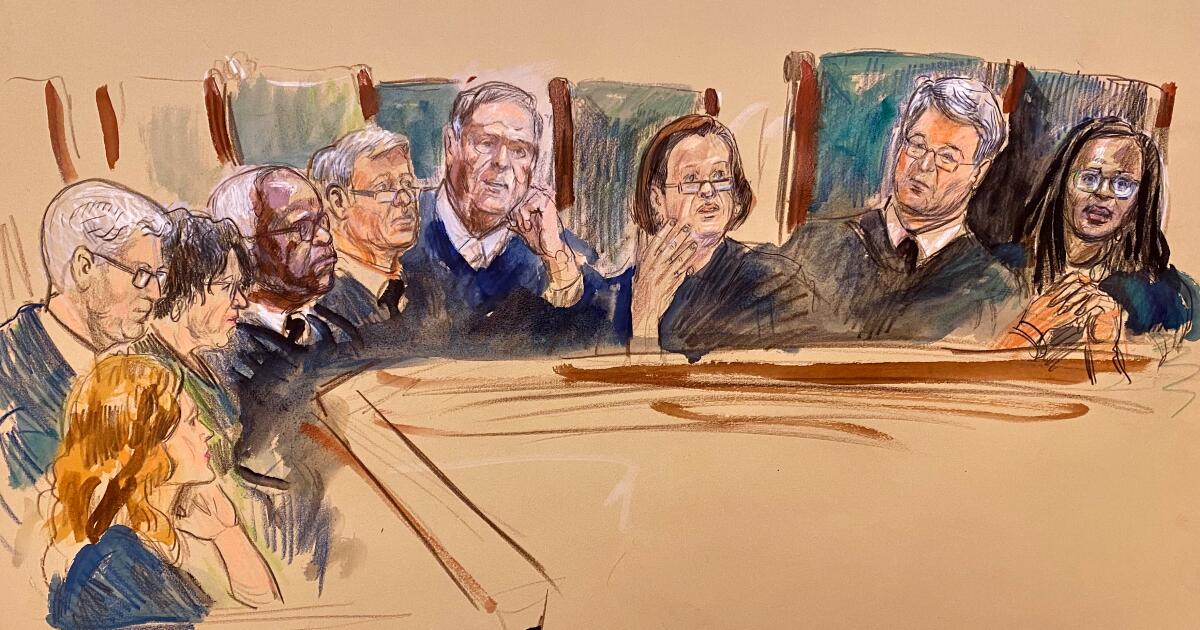
How Roberts led a fractured Supreme Court to wins for the right and defeats for Trump
-
 Science12 minutes ago
Contributor: Alcohol should be stigmatized like smoking
-
 Sports19 minutes ago
Thousand Oaks native Claire Liu finally reaches Wimbledon’s third round, will face Coco Gauff
-

 World27 minutes ago
Could water become a flashpoint between Islamabad and New Delhi?
-
 News52 minutes ago
Ukraine latest / Limits of military might / Can major powers regain dominance? : Sources & Methods
-

 Los Angeles, Ca2 hours ago
Juvenile charged with murder after 4-month-old Claremont infant thrown to her death
-

 Detroit, MI3 hours ago
Silence from Jalen Duren’s camp is what the Pistons want to hear

