West
California Democrats urge feds to approve high-speed rail funding before DOGE nixes ‘boondoggle’

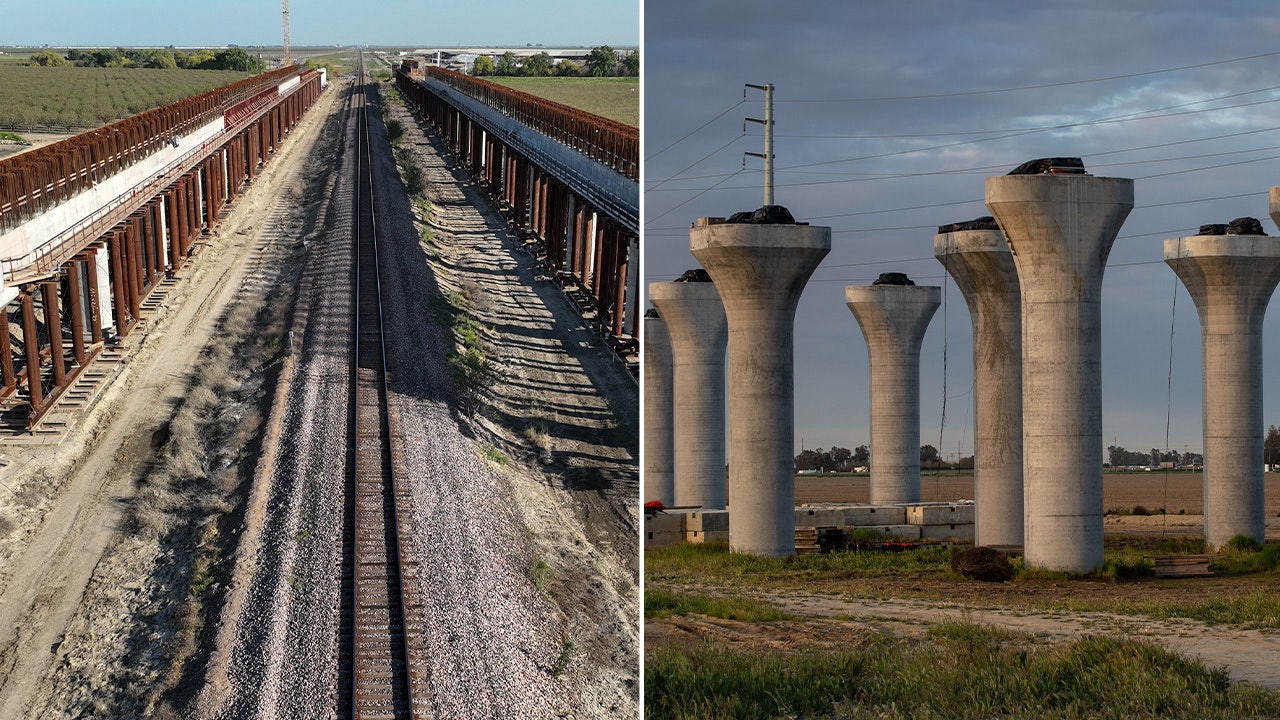
Several prominent California Democrats are calling on the U.S. Department of Transportation to approve a grant application for $536 million in federal funds to move forward with the state’s long-awaited high-speed rail network.
The monies would come from funds already allocated in general to “federal-state partnership[s] for intercity passenger rail grants” through the 2021 “Bipartisan Infrastructure Law” and made available via the Consolidated Appropriations Act of 2024.
Democrats urged Secretary Pete Buttigieg to approve the funds, saying progress on the “California Phase I Corridor” is “essential to enhancing our nation’s and California’s strategic transportation network investments.”
“The Phase 1 Corridor aims to address climate concerns, promote health, improve access and connectivity, and boost economic vitality, while addressing current highway and rail capacity constraints,” a letter to the outgoing Cabinet member read.
BUILDING STARTS ON HIGH-SPEED RAIL LINE BETWEEN LAS VEGAS AND LOS ANGELES AREA
Drafted by Sen.-elect Adam Schiff, Sen. Alex Padilla, and California Democratic Reps. Jim Costa, Zoe Lofgren and Pete Aguilar, the letter calls for the funds to go to two projects in particular: tunneling through the Tehachapi Mountains in Southern California and through the Pacheco Pass of the Diablo Mountains in Northern California.
“These investments will continue to support living wage jobs, provide small business opportunities, and equitably enhance the mobility of communities in need – including disadvantaged agricultural communities – all while reducing greenhouse gas emissions,” Schiff and the other lawmakers wrote.
“Please consider the enormous value and meaningful impact that FSP-National grant funding will provide to advancing CAHSR beyond the Central Valley,” they told Buttigieg.
The bores are needed, the lawmakers said, to connect with other intercity passenger rail systems including the Brightline West, CalTrain, Metrolink and Altamont Commuter Express.
FLASHBACK: COMER TOUTS HUNTER BIDEN HEARING: RASKIN, SCHIFF ‘PULL STUFF OUT OF THEIR REAR’
Ongoing construction of the California bullet train project is photographed in Corcoran, California, left, and Hanford, California, right. (Getty)
According to California Republicans, the overall high-speed rail project is nearly $100 billion over budget and decades behind schedule.
Trump’s DOGE duo of Elon Musk and Vivek Ramaswamy aren’t keen on the idea of continuing to fund what many Republicans consider a costly and unfruitful endeavor.
Rep. Kevin Kiley, R-Calif., said as much earlier this month in remarks on the House floor.
“I am very happy to report that the newly formed Department of Government Efficiency has honed-in on perhaps the single greatest example of government waste in United States history – and that is California’s high-speed-rail boondoggle,” Kiley said.
The official DOGE X account also described both California’s high-speed rail expenditures and requested funding in a November tweet.
Earlier this month, Ramaswamy also called the plans a “wasteful vanity project” that burned “billions in taxpayer cash with little prospect of completion in the next decade.”
He said Trump “correctly” rescinded $1 billion in federal funding for the project in 2019 and lamented President Biden’s reversal of that move.
“Time to end the waste,” Ramaswamy said.
California’s top state Senate Republican echoed the DOGE leaders’ concerns.
Sen. Alex Padilla (Getty Images)
“California’s ‘train to nowhere’ has already wasted billions of taxpayer dollars – now Biden wants all Americans to fund this boondoggle,” State Sen. Brian W. Jones of San Diego told Fox News Digital.
“When President Trump returns to office in a few weeks, he must defund the high-speed rail. This wasteful government experiment must end once and for all,” he added.
If approved, the federal funds will be bolstered by $134 million in state monies from California’s “cap & trade” program, according to the Sacramento Bee.
At a 2013 conference, Musk floated the idea of a “hyperloop” which was also presented in a white paper. Though it has not yet come to fruition, Musk said at the time he had thought whether there is a better way to get from Los Angeles to San Francisco than what California has proposed.
“The high-speed rail that’s being proposed would actually be the slowest bullet train in the world and the most expensive per-mile,” he said. “Isn’t there something better that we can come up with?”
The world’s richest man described Hyperloop at the time as a combination of a Concorde, a rail gun and an air-hockey table.
Read the full article from Here


CASPER, Wyo. — High school athletics in Wyoming could see some drastic changes in the coming years following legislative changes to the state’s education budget, the Wyoming High School Activities Association recently announced in a statement.
According to the WHSAA, Wyoming school districts are facing a projected $3.9 million shortfall in activities funding, forcing officials to consider significant cuts to high school sports and extracurricular programs.
The WHSAA shared details regarding a new “silo” funding model implemented by the Legislature, stating that the recalibrated block grant model reduced funding for student activities and extra-duty responsibilities from $46.3 million to $42.4 million, an approximately 8.4% decrease statewide.
WHSAA Commissioner Trevor Wilson said the restructuring also restricts district access to an additional $76.2 million in previously flexible funding.
“A significant portion of the [April 28 WHSAA Board of Directors] meeting was dedicated to discussing the projected funding shortfall,” Wilson wrote.
The WHSAA is weighing several strategies to address rising costs with fewer resources. Proposed changes include eliminating regional tournaments and reducing the number of teams qualifying for state events from eight to four; limiting wrestling to two classes and restricting track and field state participants to the top 16 marks; making cuts to soccer, indoor track and field, Nordic and Alpine skiing, swimming and diving, spring golf and tennis; and reducing in-person speech and debate events by half and centrally locating All-State Music events to minimize travel. The board also recommended increasing gate admission or implementing student participation fees to offset costs.
While the WHSAA release states that no plans have been finalized and the various changes are currently just possibilities, Natrona County School District 1 Board of Trustees member Mary Schmidt criticized the WHSAA’s handling of the news at Monday’s board meeting.
“I take some issues with this, [including] the sheer fact that we as Board of Trustees members have not talked about that at all,” Schmidt said. “It is not our intent and it has not been brought to us to cut our athletics or activities budget for the upcoming school year. … I take issue with them picking sports and getting the community upset and ginning them up to be upset that this is all going to be cut when that hasn’t been discussed.”
Later in the meeting, Superintendent Angela Hensley clarified that Natrona County School District 1’s athletics and activities budget saw a reduction of roughly $550,000 in the coming year’s budget, but said the local school district does not plan to cut any sports.
“Thank you, Trustee Schmidt, for saying this, because I think people are wondering — we are not planning to cut athletics and activities for next year,” Hensley said. “We do have to take a look at our entire budget as we have talked about, as we learn more about these new rules that come in.”
Related

San Francisco is having a civic nervous breakdown because the brother of President Donald Trump’s son-in-law is buying a minority stake in the Giants.
Not Donald Trump. Not Jared Kushner. Joshua Kushner. And not control of the team. A minority stake.
Apparently, that is enough to send parts of San Francisco’s activist and media culture into full panic mode.
One Giants employee posted a video from Oracle Park turning in their uniform and quitting because Kushner was buying into the team.
Social media lit up with complaints about “MAGA ownership” and Trump-world influence invading one of San Francisco’s most beloved civic institutions.
There is just one problem. Joshua Kushner is not exactly Steve Bannon in a Giants cap.
He has historically donated heavily to Democrats and has occupied a very different political lane than his brother Jared and the Trump orbit. But nuance never stood a chance here.
For some in San Francisco, the name “Kushner” was enough. That is the story.
The Giants are not some random expansion franchise nobody cares about. They are one of the oldest and most storied franchises in Major League Baseball history — with eight World Series titles and a lineage that includes Willie Mays, Barry Bonds, Buster Posey, Madison Bumgarner, and Bruce Bochy.
Oracle Park is one of the great settings in American sports. Giants-Dodgers is still one of baseball’s defining rivalries. Generations of Northern Californians are emotionally attached to this team.
Which is precisely why the reaction has been so revealing.
Nobody was arguing about payroll. Nobody was debating the farm system. Nobody was asking whether this helps the Giants close the gap with the Dodgers in the NL West.
The panic was political from the first pitch.
That tells you where we are now.
Sports ownership used to be judged mostly by whether owners were competent, stable, and willing to spend money to win. Now it is an ideological background check.
Who donated to whom? Who attended what fundraiser? Whose brother married whose daughter? Who might show up in the owner’s suite?This is what happens when politics becomes religion. Everything becomes a loyalty test. Even baseball.
The irony is almost too perfect.
San Francisco is not exactly at risk of becoming a MAGA beachhead because a Democratic donor with the wrong last name bought a small piece of the Giants. But symbolic politics runs the city now.
In Democrat circles in San Francisco, politics is not just something people believe. It is something they perform. It is identity. It is status. It is social sorting.
So even indirect association becomes contamination. Joshua Kushner does not have to be Trump. He does not even have to be conservative. He just has to be Kushner.
That is enough.
To be fair, Giants ownership was already politically sensitive. Current owner Charles Johnson has drawn years of criticism for conservative political donations.
So this latest development landed on dry grass.
Still, the reaction says more about San Francisco’s liberal elite than it does about the Giants. The city’s activist class cannot even let baseball remain baseball.
A minority owner becomes a political emergency. A family connection becomes a scandal. A business transaction becomes a moral crisis.
This is not normal.
Fans used to argue about batting orders and pitching rotations. Now they investigate ownership family trees.
And the Giants are not being bought by Donald Trump. They are not being turned into a Trump campaign surrogate. They are not replacing team mascot Lou Seal with a MAGA hat.
A minority stake is changing hands. That’s it.
Yet for the loudest voices in San Francisco, even that apparently requires public anguish.
If this is the reaction to the brother of Trump’s son-in-law buying a minority piece of the Giants, imagine what happens if Donald Trump ever throws out the first pitch at Oracle Park.
Jon Fleischman, a longtime strategist in California politics and a lifelong baseball fan, writes at SoDoesItMatter.com.
Denver, CO
‘Thursday Night Football’ vs. Seahawks, Christmas Day vs. Bills highlight Broncos’ standalone matchups in 2026

ENGLEWOOD, Colo. — The Broncos are set to take center stage five times in 2026.
Denver is scheduled to play in five standalone games during its 2026 season, three of which will be contested at Empower Field at Mile High.
The Broncos will open their season with a “Monday Night Football” showdown against the AFC West rival Kansas City Chiefs. Last season, Denver swept the Chiefs for the first time since 2014.
This year’s Week 1 matchup will mark the first time since 2022 that Denver will begin its season in prime time. During Head Coach Sean Payton’s tenure, the Broncos have posted a 3-0 record on “Monday Night Football,” including last year’s victory over the Cincinnati Bengals.
The Broncos will then host their first prime-time game of the year, a “Sunday Night Football” matchup with the Los Angeles Rams in Week 3. The Rams posted a 12-5 record in 2025, advancing to the NFC Championship Game.
The Sept. 27 game will mark the Broncos first home “Sunday Night Football” matchup since 2023. Denver is 2-0 in “Sunday Night Football” games under Payton, including a 2025 road victory over the Commanders.
Just three weeks later, Denver will host the reigning Super Bowl champion Seattle Seahawks on “Thursday Night Football.” The Seahawks will be led by quarterback Sam Darnold and the reigning Offensive Player of the Year, wide receiver Jaxon Smith-Njigba.
Denver is 1-0 on “Thursday Night Football” at home under Payton and 2-2 overall.
The Broncos will then play their second and final standalone road game, traveling to Pittsburgh for a Black Friday matchup with the Steelers. The Steelers won the AFC North in 2025 and advanced to the postseason for the third straight year. This will be Denver’s first-ever game played on Black Friday.
The Broncos’ final scheduled standalone game is set for Christmas Day. Denver will host the Buffalo Bills, setting up a rematch of last year’s Divisional Round game. The Broncos and Bills have faced each other out of the playoffs in the last two seasons, with the teams splitting the pair of games. The last time the teams faced off in the regular season was in 2023, when the Broncos earned a Monday night road victory.
This will mark the second consecutive year that Denver will play on Christmas. The Broncos are 3-2 all time on Christmas Day, including last year’s victory over the Chiefs at GEHA Field at Arrowhead Stadium.
The NFL’s flexible scheduling rules could also lead to the Broncos playing additional prime-time games in 2026. The dates of Denver’s Week 17 and 18 games are also yet to be determined.
See below for a complete list of Denver’s standalone games:
Week 1: Broncos at Chiefs, “Monday Night Football,” Sept. 14, 6:15 p.m. MT, ABC/ESPN
Week 3: Broncos vs. Rams, “Sunday Night Football,” Sept. 27, 6:20 p.m. MT, NBC
Week 6: Broncos vs. Seahawks, “Thursday Night Football,” Oct. 15, 6:15 p.m. MT, Prime Video
Week 12: Broncos at Steelers, Black Friday, Nov. 27, 1 p.m. MT, Prime Video
Week 16: Broncos vs. Bills, Christmas Day, Dec. 25, 2:30 p.m. MT, Netflix
-

 West Virginia4 minutes ago
West Virginia Yeager International Airport launches ‘Behind the Journey’ campaign
-

 Wyoming10 minutes ago
WHSAA warns of possible changes to statewide athletics and activities following budget cuts
-

 Crypto16 minutes ago
US and Bolivia Target the ‘Modern Pablo Escobar’ in Massive Crypto Laundering Probe
-

 Finance22 minutes ago
Casino Group Communication
-

 Fitness28 minutes ago
Very difficult and extremely cool: how to start doing pull-ups
-

 Movie Reviews40 minutes ago
Movie Review – In the Grey (2026)
-

 World52 minutes ago
U.S. and China Will Start Discussing A.I. Safety, Bessent Says
-

 News58 minutes ago
Man Charged With Posting Bomb Instructions Used in New Orleans Attack