Science
Why scientists say we are fighting H5N1 bird flu with one hand tied behind our backs

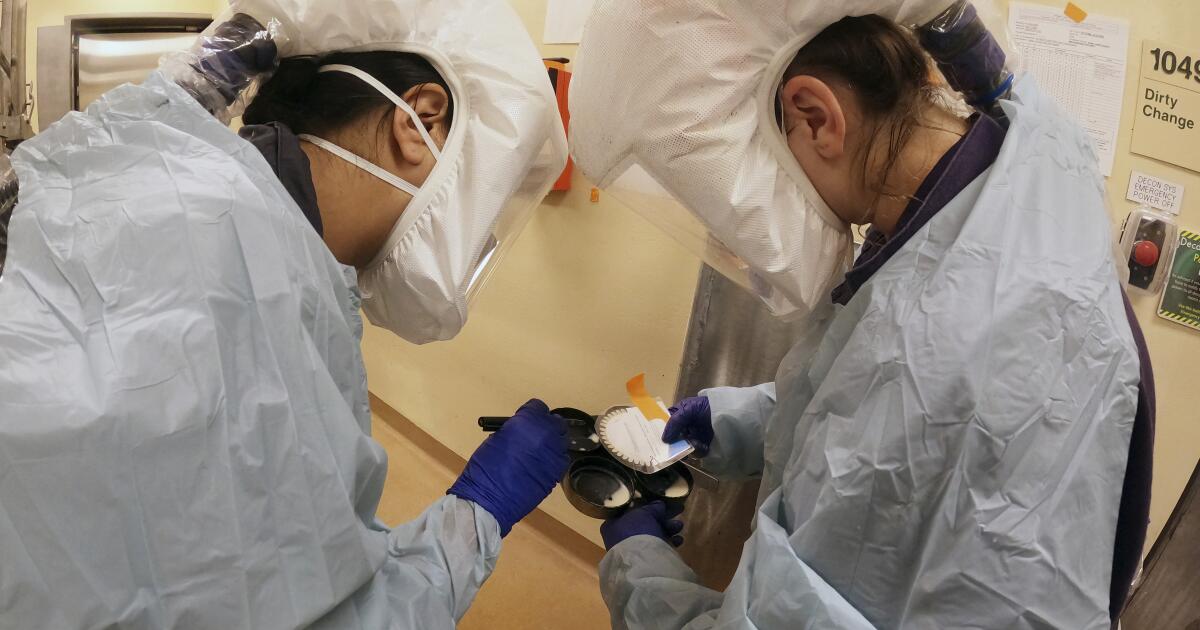
As the H5N1 bird flu virus steamrolls its way across the globe — killing wild animals, commercial livestock and even some people — scientists and health officials fear we’re on the precipice of another global pandemic.
But when, where and how that could come to pass is hard to predict — in part, some researchers say, because of guardrails the federal government has placed around gain-of-function research.
The term describes experiments that seek to understand a virus’ potential to adapt to new hosts, spread more easily, survive longer in the environment and cause those infected to become sicker. Though many scientists view the approach as a critical tool for conducting biological research, other experts have long complained that it’s unacceptably risky — a reputation exacerbated by persistent speculation that the virus responsible for the COVID-19 pandemic was created in gain-of-function experiments in a laboratory in Wuhan, China.
That led many virologists to steer clear of the work to avoid its stigma and regulatory red tape. Some in the field say that has deprived officials of valuable information that could have helped them anticipate and prepare for H5N1’s next moves.
“Do I believe if that research was more widely accepted, we’d have a better grip on this virus and what it might do next? Or how quickly it could change? Or what that would take?” asked Richard Webby, director of the World Health Organization’s Collaborating Center for Studies on the Ecology of Influenza in Animals and Birds. “YES.”
Felicia Goodrum, a molecular virologist at the University of Arizona, said gain-of-function research could enable health officials to recognize worrisome H5N1 mutations and identify targets for antivirals and vaccines.
“Without it, we’re just flying in the dark,” she said.
Critics of this line of research don’t see it that way. They say the work is too dangerous, making it possible for a souped-up pathogen to escape into the environment where people have no natural immunity. Even worse, they argue, it could wind up in the hands of nefarious actors who could use it as a bioweapon.
These risks outweigh the promise of work that may not be as helpful as its supporters suggest, said Marc Lipsitch, professor of epidemiology at the Harvard T.H. Chan School of Public Health.
What scientists and health officials need to know to contain the outbreak, Lipsitch argues, are things like which animals are infected, which people have been exposed, how many of them caught the virus and how sick they became as a result.
“Those are basic epidemiology and veterinary questions,” Lipsitch said. “I can’t think of any route by which gain-of-function studies could have informed — much less answered — those questions.”
An animal caretaker collects a blood sample from a dairy calf vaccinated against bird flu in Ames, Iowa, in July.
(USDA Agricultural Research Service via Associated Press)
The controversy dates to 2011, when two independent research groups said they had conducted gain-of-function experiments that resulted in strains of H5N1 that could be spread via air between ferrets, a species used to model influenza’s behavior in humans.
H5N1 was first identified in wild geese in China in 1996 and soon spread among birds in Asia, jumping to people on hundreds of occasions along the way. More than half of those known infections were fatal.
The high mortality rate and geographical spread of the virus prompted then-President George W. Bush to establish a $7.1-billion program to prepare for its inevitable arrival on U.S. shores. He spearheaded the establishment of a global surveillance and preparedness network via the WHO, as well as a national one. He also directed federal funds into the stockpile of vaccines and antiviral medications, as well as millions of dollars toward laboratory research.
Amid this flood of support, Yoshihiro Kawaoka‘s team at the University of Wisconsin in Madison and Ron Fouchier‘s at Erasmus University in the Netherlands simultaneously began to experiment with H5N1, introducing genetic mutations into its RNA to see what changes could transform it from a virus that passed easily between birds into one that passed efficiently between people.
Kawaoka and his colleagues combined the H5 hemagglutinin gene from the bird flu virus with genes from the 2009 H1N1 swine flu virus. Then they coaxed their hybrid to evolve in a way that allowed it to bind with mammalian cells rather than bird cells. They found that four mutations in the H5 gene were enough to create a virus capable of spreading between ferrets in neighboring cages.
Meanwhile, the researchers in Fouchier’s lab tinkered solely with H5N1. They added a handful of mutations that helped fuel previous flu pandemics, then infected their ferrets. The virus didn’t spread on its own at first, so the scientists helped it along by transferring it from the noses of infected animals to healthy ferrets. After 10 such passages, the virus had evolved to the point where it spread on its own from one ferret to another.
The studies offered valuable confirmation that the bird flu virus had the potential to spark a human pandemic, said Dr. Arturo Casadevall, an immunologist and infectious disease physician at Johns Hopkins University.
“Before those experiments were done, we did not know whether H5N1 had the biological capacity to become mammalian-transmissible,” he said.
But they also underscored the risk that scientists could accelerate the threat. “That was the original gain-of-function poster child,” Casadevall said.
Concern that information in the studies could be put to ill use prompted Kawaoka and Fouchier to voluntarily pause their work in 2012, and their papers were published only after passing a thorough safety review by the U.S. National Science Advisory Board for Biosecurity. Gain-of-function research resumed the following year.
Fears were revived in 2014 after federal labs mishandled samples of smallpox, anthrax and H5N1. Nobody was sickened, but it prompted a three-year freeze on federal funding for gain-of-function experiments involving particularly dangerous pathogens, until stricter oversight rules were put in place.
Plans for such experiments now go through several layers of review at a potential researcher’s institution. If the work is funded by the National Institutes of Health, additional reviews follow.
“There are a lot of regulatory hurdles to assure there’s appropriate risk mitigation,” said Seema Lakdawala, a virologist at Emory University who studies influenza viruses. “We’re all being extra careful because nobody wants to be accused of having done something unsafe.”

Biohazard suits hang in a Biosafety Level 4 laboratory at the U.S. Army Medical Research Institute of Infectious Diseases at Ft. Detrick, Md.
(Patrick Semansky / Associated Press)
Those hurdles can delay a research project by several months or more, if they are approved at all, she said. The uncertainties have acted as a deterrent, especially for scientists in the early stages of their careers.
“It’s definitely uncomfortable to do gain-of-function research,” Goodrum said. “We’re discouraging people from entering the field.”
To some, the timing couldn’t be worse.
At least 65 people in the U.S. have been infected with H5N1 since it arrived in North America in 2021, according to the Centers for Disease Control and Prevention Most of the cases have involved workers on dairy and poultry farms, and their symptoms — including conjunctivitis and upper respiratory irritation — have tended to be mild. But in two cases, people have become severely ill, including a person in Louisiana and a teenager in Canada.
There is no evidence that the virus can spread directly from one person to another, the CDC said. Scientists expect that will change sooner or later. With flu season picking up steam, the risk is rising.
“The thing I’m most afraid of today is a recombination event between the stuff going around in cows and the seasonal flu,” Casadevall said. If both viruses infected the same mammal at the same time, their components could mix and match in a way that creates “a strain that is able to infect humans very easily, and for which we don’t have immunity.”
“That is a gain-of-function experiment being done by nature,” he added.
It’s a point that Webby suggested as well, noting that gain-of-function experiments are a whole lot safer in a sealed-off Biosafety Level 3 laboratory equipped with special ventilation systems and other precautions “than on a farm.”
But Lipsitch and others say the fact that the virus is constantly mutating and changing calls into question the relevance of gain-of-function research. A viral strain that can be concocted in a laboratory is not necessarily going to match whatever emerges in the environment.
“There’s a big element of randomness in evolution,” Lipsitch said. “The fact that an experiment goes one way in the lab doesn’t mean it will go the same way somewhere else.”

Three rod-shaped H5N1 influenza virus particles are seen in a pair of colorized transmission electron micrographs.
(CDC and NIAID)
Even if it’s a close match, Lipsitch said, there’s “compelling evidence that what you learn in one strain can be the opposite for a very closely related strain. So the generalizability is very low.”
He cited a paper that took the mutations that made H5N1 “more mammal-friendly” in Kawaoka’s and Fouchier’s experiments and applied them to a slightly different version of the virus. In that case, the researchers found “a completely different effect.”
These shortcomings make the research risks harder to justify, said Nicholas Evans, a bioethicist at the University of Massachusetts Lowell.
“I think what the gain-of-function debate has yet to answer is, ‘What is the social value of these studies?’” he said.
To Evans, there appears to be very little, especially considering the lack of urgency in the government’s response.
“Saying that this particular piece of extremely niche biological research into H5N1 would have made a material difference in an outbreak that has largely been characterized by a lack of interest on behalf of public federal agricultural and public health regulators just is kind of nonsense to me,” he said.
Kawoaka declined to discuss his research, and Fouchier could not be reached.
Michael Imperiale, a virologist at the University of Michigan in Ann Arbor, said the experiments conducted by Kawaoka and Fouchier are extremely useful as blueprints of what to watch out for as the virus sweeps the globe. And he’s surprised more people aren’t talking about their value.
“No one seems to point out the fact that those gain-of-function experiments … gave us an important piece of information, which is that that virus can jump,” Imperiale said.
Other gain-of-function experiments conducted on H5N1 years ago have tipped off scientists about potential mutations that could help the real-world virus spread more easily through the air, get better at infecting cells in the mammalian respiratory tract, and become resistant to antiviral medications.
“Those experiments 10 years ago were so informative,” Lakdawala said. “It helped us be better prepared.”
But unless the scientific community stands up for the work and challenges its negative image, that won’t be the case in the future, Goodrum said. “It’s very likely that we will be less prepared for the next pandemic than we were for the last one.”


new video loaded: NASA Announces Artemis III Crew
transcript
transcript
NASA Announces Artemis III Crew
NASA announced the crew of Artemis III mission, which will fly to low-Earth orbit to test rendezvous and docking maneuvers with one or two lunar landers.
-
“I am excited to welcome you as the next crew in the Artemis journey to successfully return to the moon — this time to stay.” “I’m honored by the role that I’ve been given. I’m also very humbled by the task in front of us. But first and foremost, I’m grateful.” “So with that, the Artemis II crew, comrade, hands you the baton. You got the controls.” “As you know, we had a significant anomaly at our Launch Complex 36A on May 28. We’ve redoubled our efforts and are moving forward.”
By Alisa Shodiyev Kaff
June 9, 2026
Science
Santa Monica Mountains’ last steelhead trout survived the Palisades fire — and even had babies

Scientists feared the Santa Monica Mountains’ last remaining steelhead trout were dead, smothered by debris flows unleashed by the Palisades fire.
But the endangered fish surprised them: A team of biologists recently spotted 30 of the rare trout — and 21 babies — in Topanga Creek.
“There was a lot of happy dancing in the creek,” said Rosi Dagit, principal conservation biologist for the Resource Conservation District of the Santa Monica Mountains, which works with public and private landowners to conserve natural resources.
That’s because the steelhead here are endangered, at both the state and federal levels. Once, they swam in most streams of the Santa Monicas, but their numbers plummeted amid overfishing and coastal development. Increasingly frequent wildfire has further stressed their habitat. Topanga Creek, a biodiversity hot spot, is home to their last known population in the mountains that stretch from the Hollywood Hills to Point Mugu in Ventura County.
The trout that were spotted, including this one, are part of a distinct Southern California population that’s listed as endangered at the state and federal levels.
(RCDSMM Stream Team)
The California Department of Fish and Wildlife spearheaded a complex mission to rescue trout threatened by the Palisades fire that sparked in January 2025.
Time was of the essence. The fire hadn’t yet been fully contained. But rain was on the way, which would sweep massive amounts of sediment from the denuded hillsides into the water. Fish are often killed this way.
Crews stunned the fish with electricity, scooped them up in buckets, trucked them to a hatchery and ultimately moved them to Arroyo Hondo Creek in Santa Barbara County.
Within days, Topanga Creek was choked with mud. Some assumed the fish left behind were goners.
But in March, the conservation district’s team found four. The following month, when water conditions were clearer, they saw more.
“These fish continue to amaze me,” said Kyle Evans, environmental program manager for the state Department of Fish and Wildlife, who had seen the damage to the creek. “I had seen populations get wiped out in similar situations. So when I heard, I was thrilled.”
Evans surmises the fish that survived were in an area of the creek where less charred material and sediment were swept in.
“These fish likely hunkered down, were hiding under some rocks or places to try to get away from the main concentration of flow,” he said. “And luckily they weren’t buried.”
The ones that were spotted were fairly small, around 6 to 14 inches. Rainbow trout and steelhead trout are the same species, but with different lifestyles. If the fish remain in freshwater, they’ll be considered rainbows. However, they can migrate to the ocean and become steelhead, where they typically grow larger before returning to their natal waters to spawn.
Topanga Creek hasn’t fully recovered from the damage it sustained, but scientists say it’s looking better. Surveys last year were “so depressing,” Dagit said, with very few animals, and stretches that were essentially transformed into flat roads from all the sediment buildup. Some of the riparian canopy burned right down to the creek.
Then came 32 inches of rain over the last nine months, scouring out and moving sediment, creating deeper pools. Dagit said they recently found newt egg masses for the first time in years, as well as a few adult newts and many frogs. Plants that provide cover are starting to recover.
She provided photos comparing certain pools last year and this year, some dramatically transformed. In September 2025, the Shrine Pool could have been an overgrown hiking trail. This April, it was filled with shallow water.

The Shrine Pool in September 2025, left, and the same location in April 2026, right, with RCDSMM’s Isaac Yelchin donning a wetsuit.
(RCDSMM Stream Team)
Topanga Creek is home to another endangered fish, the small but hardy northern tidewater goby, often described as cute. Not long before the trout operation, Dagit led a rescue of hundreds of these fish too. Many were repatriated to the lagoon at the mouth of the creek in a moving ceremony last June.
There’s still the matter of what to do with the trout that were moved to Santa Barbara County last year. Evans would like to bring them home to the Santa Monicas at some point, but isn’t sure if it will happen. On one hand, they could bolster the small, genetically isolated surviving population. On the other, they might inadvertently bring in a disease or bacteria. There is some time to decide. Evans estimates the creek still needs to recover for two to three more years.
For now, the fish are functioning fine in their adopted creek. Experts worried the trauma wrought by the move would disrupt their spawning process, but they had babies that spring. This year, they spawned again.

The Pacifica Municipal Pier was shut down and taped off Thursday after city workers noticed cracks running through the landmark structure and concrete chunks falling into the ocean.
It’s just one of many coastal California structures that have recently crumbled under pressure from a rising and relentless ocean.
Officials from the small, beach city south of San Francisco said the pier was closed due to “cracking, separation, and displacement of the concrete walkway and structural elements.”
It will stay closed while structural engineers asses its safety.
Photos taken by city employees show a wide crack that runs from top to bottom and across the structure as well. Other photos show a large horizontal crack under the foundation of a small restaurant on the pier, the Chit Chat Cafe.
The cafe was also shut down.
This is not the first time the 53-year-old pier has shown signs of stress. In 2021, part of it was shut down after handrails along the edge collapsed. And in 2023, after a series of storms pummeled the Central California coast, damaging parts of the pier, the structure was partially closed for more than year.
Those same storms caused extensive damage in Aptos and Capitola, 70 miles south, where piers and waterfront infrastructure were swept away or damaged.
In 2024, a 150- to 180- foot section of the Santa Cruz wharf was ripped off by powerful waves.
At least 10 of the state’s dozens of coastal public piers were closed for part or all of 2024 due to structural damage sustained in winter storms since 2022. At least five others have longer-term upgrades planned to address structural issues.
“These things are costly to maintain,” said Zach Plopper, senior environmental director at Surfrider. “They are a part of our California coastal culture in many ways, but we’re going to need to reckon with, one, the state that they’re in, and two, the continuous and worsening threats they’re going to experience,”
He said most of the piers were constructed in the early 1900s, and they weren’t built to withstand decades of rough seas, storms and rising sea level.
“With this incoming El Niño, which is forecasted to be significant, and this marine heat wave we’re in the midst of, we’re kind of in uncharted waters as far as what this winter could bring in terms of storms and swells to the California coast, and we’re likely going to see a lot more damage,” he said. “Not just piers, but roads and other coastal infrastructure up and down the state.”
There was no storm in Pacifica earlier this week, so no single event could be blamed for the destruction.
However, a 2025 report from an outside engineering firm, GHD, found that several sections of the pier were in “poor” or “serious” condition, and they recommended closure before anticipated storms or events that could “subject the piles to high winds, swells and large waves.”
The firm found several areas of the pier where concrete was missing and rebar was exposed and corroding.
“The pier has continued to experience high winds and large waves in a harsh marine environment,” the engineers wrote in the report, noting that continuous exposure to seawater or marine spray was “detrimental” to the structure.
A 2023 city report estimated it would cost $19 million to repair.
That same year, a state law was enacted to require local governments along the California coast to plan for sea level rise in the coming decades.
Sea level has risen some 8 inches, on average, along the coast in the past 150 years, Plopper said, and researchers anticipate another foot in the next 25 years.
“We’re going to see profound shifts on our coastline, none that we have ever experienced before, and building static structures on the coast just doesn’t work all that well,” he said. “We’re going to have to make some really hard decisions.”
-

 Los Angeles, Ca33 minutes ago
Los Angeles High School locked down as police search for armed juvenile
-

 Detroit, MI51 minutes ago
‘Diarra From Detroit’ sets date for second season on Paramount+
-

 San Francisco, CA1 hour ago
San Francisco police release video of shootout that critically wounded officer
-

 Dallas, TX1 hour ago
3 Dallas educators among FIFA World Cup volunteers
-

 Miami, FL1 hour ago
Miami Gardens man arrested after fleeing Florida Keys deputies at 125 mph, sheriff says
-

 Boston, MA1 hour ago
Boston gives update on plans for 3 a.m. last call at bars, outdoor drinking areas during World Cup
-

 Denver, CO1 hour ago
One Invitation Can Change a Life: Called By Name Campaign Inspires Future Priests For a Second Year in Denver
-

 Seattle, WA1 hour ago
Survey: What’s the toughest game to start the Seahawks’ season?

