Business
Column: Trump's anti-science backers go after water fluoridation, a historic healthcare success


Regular visits to the dentist to fill cavities used to be a shared ordeal for millions of American children and adults. The reason that hasn’t been the case for late baby boomers and subsequent generations is that the fluoridation of drinking water became common starting in the late 1940s and continuing today.
So it’s right to question why Donald Trump’s nominee to head the Department of Health and Human Services, Robert F. Kennedy Jr., has placed the ending of fluoridation atop his list of first-day initiatives in his campaign against American public health.
“On January 20,” Kennedy tweeted a few days before the election, “the Trump White House will advise all U.S. water systems to remove fluoride from public water.”
‘Fluoridation is the most monstrously conceived and dangerous Communist plot we have ever had to face.’
— The unhinged Gen. Jack D. Ripper in the 1964 film ‘Dr. Strangelove’
The reason, he asserted, is that “fluoride is an industrial waste associated with arthritis, bone fractures, bone cancer, IQ loss, neurodevelopmental disorders, and thyroid disease.”
That’s all flatly untrue or grossly misleading. Kennedy’s screed against fluoridation is part and parcel of a policy package that has legitimate scientists warning of a public health catastrophe in the making.
Fluoridation of tap water has generated local controversies ever since it was introduced in the U.S. in 1945. But it remains fully supported by a majority of Americans and by professional organizations including the American Dental Assn. and the American Academy of Pediatrics. That suggests that the proper stance of a Health and Human Services secretary would be to voice support for the practice. Kennedy has done just the opposite.
According to the Centers for Disease Control and Prevention, fluoridation is one of the 10 great public health achievements of the 20th century, up there with vaccination, family planning and recognition of the health dangers of tobacco.
Fluoridation revolutionized dentistry, especially for children. Fluoridation of tap water was credited with reducing the incidence of tooth decay by as much as 70% when it was first introduced; by the mid-1980s, when other sources of fluoride, such as fortified toothpastes, were available, the effects of tooth decay in children were still 18% lower among those living in fluoridation communities than in those without it.
Who would benefit from the end of community fluoridation and a recrudescence of tooth decay? Dental supply companies, investors in which are rubbing their hands in glee at the prospect of more demand for their products. For example, shares of Henry Schein Inc., a distributor of specialty dental products, have risen more than 9% since RFK Jr. was named as Trump’s choice for HHS secretary.
Kennedy’s tweet about fluoridation exemplifies the anti-vaccine crowd’s method of casting doubt on established public health policies. There are two elements. One is to portray rare adverse health effects — some so rare that their very existence is questionable — as major and acute threats. The second is to downplay the beneficial effects of a policy. That leaves the public believing that the policy has only adverse effects, and that those are immediate and severe.
Tooth decay is a little-recognized public health problem, in part because fluoridation has made it rarer than it used to be. But it hasn’t disappeared. The American Academy of Pediatrics calls it “one of the most common chronic diseases in children,” and one that can have “lifelong consequences.” It disproportionately affects children who are racial minorities, come from low-income families or have special needs.
It’s not only about the occasional toothache or cavity needing filling. Tooth decay can produce “incapacitating pain,” bacterial infection that may spread throughout the body, and, of course, to the loss of a tooth. In the first part of the last century, the only remedy for decay was to pull the tooth.
As of 2012, two-thirds of Americans had access to fluoridated tap water. Thanks to fluoridation, the CDC says, “tooth loss is no longer considered inevitable, and increasingly adults in the United States are retaining most of their teeth for a lifetime.”
More baby boomers reached 60 with “a relatively intact dentition at that age than any generation in history,” the CDC says. Interestingly, that makes water fluoridation more important than ever, since it means that seniors have more teeth vulnerable to decay than before.
Communities that have ended fluoridation have seen dental illnesses soar. Since fluoride was removed from drinking water in Calgary, Alberta, Canada, in 2011, Alberta Children’s Hospital has seen dental infections requiring treatment with IV antibiotics increase by 700%, a hospital specialist told the City Council in 2019. Half of those infections were in children younger than 5.
Windsor, Ontario, Canada, voted in 2018 to resume fluoridation five years after it had ended the program, after discovering that the number of children with tooth decay or oral conditions requiring urgent care had increased by 51% in the interim.
Opponents of fluoridation have played on paranoid fears for decades, but into the 1960s, these were popularly dismissed as ravings from fringe organizations. In the 1964 film “Dr. Strangelove,” the unhinged Gen. Jack D. Ripper declares that “fluoridation is the most monstrously conceived and dangerous Communist plot we have ever had to face” — echoing the position of the John Birch Society.
The anti-fluoridation camp has long claimed that the process “increased the risk for cancer, Down syndrome, heart disease, osteoporosis and bone fracture, acquired immunodeficiency syndrome, low intelligence, Alzheimer disease, allergic reactions, and other health conditions,” the CDC noted in 1999. “No credible evidence supports an association between fluoridation and any of these conditions,” the agency stated.
More recently, critics object that fluoridation “is being imposed on them by the states and as an infringement on their freedom of choice,” the National Research Council reported in 2006 — similar to the elevation of individual “freedoms” over communal interests that animates the anti-vaccine movement.
The anti-fluoridation camp scored a legal victory in September, when federal Judge Edward M. Chen of San Francisco, an Obama appointee, ordered the Environmental Protection Agency to review its safety standard for fluoridation in tap water. Chen concluded not that “fluoridated water is injurious to public health” but that “there is unreasonable risk of such injury,” triggering a legal mandate that the EPA take a closer look.
Chen’s findings were heavily based on a government study with a checkered research history. More on that shortly. Despite the limitations of his order, it may well be taken as a validation of suspicions about fluoridation.
What of RFK Jr.’s roster of adverse health effects? Let’s take them one by one. To begin, although fluoride can be a byproduct of industrial processes, it’s also a mineral naturally present in soil, groundwater, plants and food.
Arthritis? The National Research Council’s 2006 analysis of government fluoride standards identified “no indications” in the existing scientific literature implying “that fluoride had a causal relationship with … rheumatoid arthritis.”
Bone fractures? The 2006 analysis determined that the leading evidence for fluoride’s effect on bone strength pointed to lifetime exposure to fluoride at concentrations at or exceeding 4 milligrams per liter, which is more than five times the concentration in fluoridated tap water. The effect was found chiefly in people prone to concentrating fluoride in their bones, such as those with kidney disease.
Bone cancer? The main source of this claim appears to be a 15-year study led by the Harvard School of Dental Medicine, published in 2006 in the journal Cancer Causes and Controls.
In the same issue of the journal, however, two Harvard experts cast doubt on the study, noting that the original researchers were unable to replicate their findings when they repeated their study with new subjects. The results, they said, “do not suggest an overall association between fluoride and osteosarcoma” (that is, bone cancer).
Evidence of “thyroid disease,” as Kennedy tweeted, is similarly inconclusive, especially at the approved levels of fluoride in tap water.
That brings us to Chen’s ruling in the San Francisco lawsuit. His findings relied heavily on a monograph by the National Toxicology Program first published in 2019. The paper initially concluded that “fluoride is presumed to be a cognitive neurodevelopmental hazard to humans,” based on findings that children exposed to high concentrations of fluoride showed lower IQs than others.
The survey focused on the effect of water with more than 1.5 milligrams of fluoride per liter, more than twice the approved level in the United States. It acknowledged that it had only “moderate confidence” that such concentrations could result in lower IQs, and stated that it had “insufficient data” to determine that the 0.7 mg/liter concentration in fluoridated tap water affects IQ.
There were lots of problems with the National Toxicology Program’s monograph. Two peer reviews by the National Academies of Sciences, Engineering, and Medicine essentially ripped it apart, rejecting it both times. The program “had not adequately supported its conclusions,” the peer reviewers wrote.
The monograph lacked a “rigorous statistical review.” The reviewers recommended that the program “make it clear that the monograph cannot be used to draw any conclusions regarding low fluoride exposure concentrations … typically associated with drinking-water fluoridation.” Among other changes in the final monograph published this summer, the program removed references to a “neurodevelopmental hazard to humans.”
Critics also pointed out the inherent problems with treating IQ as an all-purpose measure of intelligence, since it’s well-known that IQ can be affected by “socioeconomic, physical, familial, cultural, genetic, nutritional, and environmental factors,” the American Academy of Pediatrics observes.
Kennedy’s mindset is curious: He has promoted treatment of COVID-19 with ivermectin and hydroxychloroquine, which have been proven to be useless for the purpose, but he campaigns against fluoridation, which has demonstrated a health benefit over nearly eight decades. Is this any way to run a public health agency such as the HHS?


The luxury shopping center in Pacific Palisades will reopen next month after more than $100 million in renovations forced by the January 2025 wildfire that devastated the Los Angeles neighborhood.
Palisades Village will reopen Aug. 15, owner Rick Caruso announced Wednesday. The outdoor center survived the blaze that destroyed homes and other businesses but needed refurbishment to eliminate contaminants that the fire could have spread.
Crews are putting finishing touches on mall buildings after tearing them down to the studs, treating the wood and rebuilding the walls, Caruso said.
“Everybody’s working, and stores are moving their products in,” he said. “It’s a really cool feeling that people have really locked arms and are working together.”
An electrician installs lighting for a restaurant at Rick Caruso’s Palisades Village on Thursday. The shopping center is scheduled to reopen mid-August.
(Myung J. Chun / Los Angeles Times)
Pacific Palisades resident Allison Polhill, who is rebuilding the home of 30 years that her family lost in the blaze, said she is “thrilled” at the prospect of returning to the mall she used to frequent. Its comeback is a boost for the community, she said.
“Every single step that we make to reopen our commercial corridors is going to bring more people back into the Palisades,” said Polhill, who expects to move back into her home at the end of August.
A total of 6,822 structures were destroyed in the Palisades fire, including more than 5,500 residences and 100 commercial businesses, according to the California Department of Forestry and Fire Protection.
Caruso previously attributed the mall’s survival to the hard work of private firefighters and the fire-resistant materials used in the mall’s construction.
The $200-million shopping and dining center opened in 2018 with a movie theater and a roster of upmarket tenants, including Erewhon, which may be the only grocer in the heart of the fire-ravaged neighborhood when it opens.
Caruso’s company was able to fill the mall with tenants despite the long shutdown.
Palisades Village is 99% leased, with the majority of tenants returning, said Jackie Levy, chief financial and revenue officer. Nearly one-third of the shops and restaurants are new to the property.
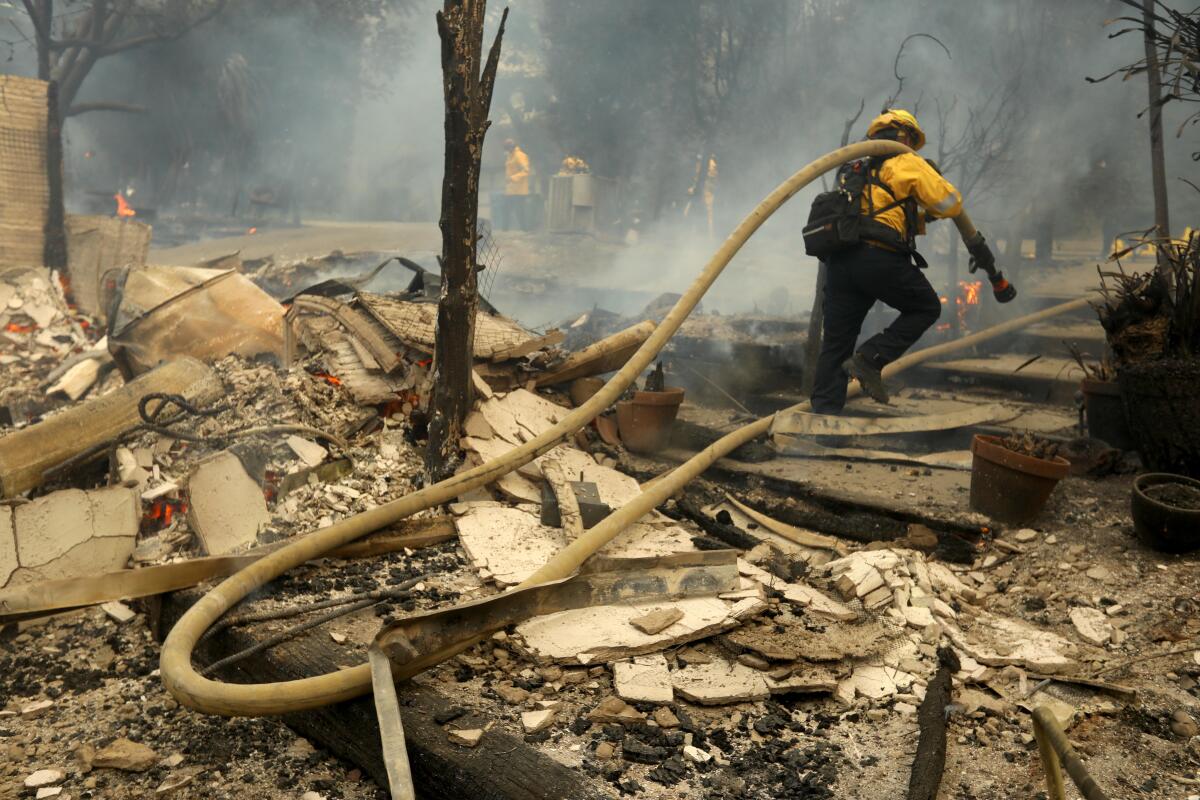
A firefighter carries a hose back to his rig while walking through a destroyed home from the Palisades fire in Pacific Palisades on Jan. 7, 2025.
(Genaro Molina / Los Angeles Times)
Last year, Pacific Palisades-based fashion designer Elyse Walker said she would reopen her eponymous store in Palisades Village after losing her 25-year flagship location on Antioch Street to the inferno.
Other neighborhood shops destroyed in the fire that are reopening at the mall include K Bakery and Loomey’s Toys, which caters to children up to age 12 and used to be across the street from Palisades Elementary Charter School.
“It’s been a journey and I’m excited because I wasn’t sure that there was going to be a place to come back to,” said toy store owner Amanda Rastegar. “Hopefully we can bring some of that magic back.”
Rastegar’s home in the Palisades survived but was damaged by the fire. The family returned about eight weeks ago. Her last memory of the fire was a burning supermarket.
“I just couldn’t wrap my brain around what was happening,” she said. “By the time I left, Gelson’s was on fire.”
Among the returning tenants is Angelini Ristorante & Bar. Well-known Los Angeles chef Gino Angelini said he will be in the kitchen next month for a return of the Italian restaurant.
“We won’t do a big celebrity open,” he said. “We want to have a very soft opening and see our customers come back.”

Construction takes place at Rick Caruso’s Palisades Village on Thursday. The shopping center is scheduled to reopen mid-August.
(Myung J. Chun / Los Angeles Times)
An elaborate celebration would not feel “correct for me,” Angelini said, because the devastation has been “very sad” for so many.
Other new tenants include local chef Nancy Silverton, who has agreed to move in with a new Italian steakhouse called Spacca Tutto. Women’s activewear retailer LESET will open its first West Coast location.
Caruso said he is optimistic that customers will return to the center, even though many Pacific Palisades residents are still dispersed. One tracking system estimated that about 30% of the Village’s customer base was impacted by the fire, he said.
“That means 70% did not get impacted, so there’s a lot of customers still left out there,” Caruso said. Historically, the center drew customers from as far away as Beverly Hills and Calabasas, as well as Malibu, Brentwood and Santa Monica.
He also hopes many will be inspired to visit the revived mall.
“I believe in the goodness of people and I believe that people are going to want to support the Palisades,” he said. “They’re going to want to be there and support the businesses that have had the courage and the heart to reopen.”

Walmart is rapidly expanding its network of electric vehicle chargers designed for customers to use while they shop.
The network could help fill gaps in EV infrastructure in states with greater need for chargers. Walmart, which has more than 5,000 locations in the U.S. and hundreds in California, says more than 90% of Americans live within 10 miles of one of its stores.
The chargers also offer an incentive for customers to choose Walmart — Walmart Plus members will receive a 10% discount off an average price of $0.46 per kilowatt-hour of energy at the company’s chargers.
Walmart chargers are already available at more than 75 locations in 17 states, with Texas boasting the most charging stations, followed by Florida and Arizona.
Matthew Nelson, Walmart’s director of energy policy, said last week on LinkedIn that the network will soon reach 29 states, including California.
“We are delivering on the promise of affordable, reliable and convenient charging,” Nelson said in his post.
According to Walmart’s website, six charging stations are coming to California soon, though the company did not offer a specific timeline.
The chargers will be installed at stores in Antelope, Brea, Fresno, Stockton, Suisun City and Vallejo.
Most charging sites in California will include eight to 16 fast-charging stalls, said Walmart spokesperson Kelsey Bohl.
The company first announced plans in April 2023 to install its own EV chargers at Walmart and Sam’s Club stores, with a goal of installing thousands of chargers by 2030. Partnering with ABB E-Mobility and Alpitronic, it added 25 new charging sites this past May and six more in June.
“Walmart is building a leading retail-integrated EV fast-charging network, focused on delivering an affordable, reliable and convenient charging experience where customers already shop,” Bohl said in an emailed statement. “Customers can charge while they shop, access stations through the Walmart app they already use, and benefit from affordable pricing.”
The charging stations already available include 612 individual charging stalls using 400-kilowatt chargers. Each stall has a dual charging cord with both Combined Charging System and North American Charging Standard connectors. The standard connectors, designed by Tesla, are smaller and lighter than the combined systems.
The primary way to pay for the chargers is through the Walmart app, but the company is also experimenting with built-in credit card readers to allow those without the app to use the stations.
Customers can check charger availability on the Walmart app. The company said the chargers will be available 24 hours a day.

Robotaxis could be turning into robocops.
A self-driving Waymo reported two teens to San Mateo, Calif., police on Monday after they were found drinking alcohol and shooting toy guns in the back of the vehicle.
According to a social media post from the San Mateo Police Department, officers detained two 15-year-olds after the Waymo they were riding in contacted the department and stopped in a parking lot until law enforcement arrived.
“Parents do you know where your teens are?” the San Mateo Police Department wrote on Facebook following the incident. “Waymo does!”
Officers removed both teens from the vehicle and determined they were using toy guns to shoot Orbeez out the windows. Orbeez are small, water-absorbing beads sold at toy stores.
“Toy guns, water guns, and BB guns all pose real dangers, especially to an untrained eye,” the Police Department said. “The simple handling of them can cause fear in [passersby].” “
A video posted on Facebook shows at least five officers and a police dog responding to the scene and approaching the Waymo with their weapons raised.
Waymo did not immediately respond to a request for comment.
Waymo vehicles have internal cameras and microphones that may be used in an emergency or to “promote safety and security,” according to Waymo’s online support page.
The cameras are also used to ensure the vehicles are clean and to help find lost items, according to the support page.
The company said it does not use facial recognition or other biometric identification technologies to identify individuals.
“In more urgent circumstances, support may access live video during a trip,” the Waymo page said.
The San Mateo Police Department’s Facebook post has garnered nearly 60 comments, with one user accusing Waymo of “snitching.”
“At least they got a designated driver?!” one user commented.
-
 Entertainment1 minute ago
Justin Baldoni and wife break silence after ‘It Ends With Us’ legal battle with Blake Lively
-
 Lifestyle4 minutes ago
A meal with an animated Mona Lisa? Immersive dining goes high tech — but will L.A. eat it up?
-
 Politics9 minutes ago
Nexstar launches its first digital subscription service with The Hill Insider, aimed at political junkies
-
 Science16 minutes ago
Not everyone is leaving California. A new commercial battery maker just landed in Sacramento
-
 Sports19 minutes ago
Mookie Betts’ eighth-inning single gives Dodgers the win over the Rockies
-
World31 minutes ago
From sewers to swimming sites: how Europe's cities reclaim their rivers
-

 News1 hour ago
Three more people charged with damaging Reflecting Pool after Trump’s multimillion-dollar restoration | CNN Politics
-

 Los Angeles, Ca2 hours ago
Loved ones search for missing 34-year-old Southern California woman

