Business
Column: Trump's appointment of anti-vaxxer RFK Jr. to his Cabinet has scientists fearing a catastrophe for public health


In a tweet he posted shortly before the election, Robert F. Kennedy Jr. took arms against the Food and Drug Administration and its scientists.
“The FDA’s war on public health is about to end,” he wrote, decrying the agency’s “aggressive suppression” of such worthless anti-COVID nostrums as ivermectin and hydroxychloroquine.
“If you work for the FDA and are part of this corrupt system, I have two messages for you,” he continued: “1. Preserve your records, and 2. Pack your bags.”
Academic scientists need to stand together, or they’ll be picked off individually and science will suffer.
— Epidemiologist Robert Morris
Donald Trump’s nomination of Robert F. Kennedy Jr., as his secretary of Health and Human Services, which oversees key public health agencies such as the Centers for Disease Control and Prevention, the Food and Drug Administration and the National Institutes of Health, would give Kennedy the power to turn his threat into reality.
That has sent a chill through the scientific community. Serious scientists are understandably dismayed about the damage that Kennedy and Trump could do to the nation’s public health infrastructure — indeed, to public health itself.
“Scientists are facing a huge threat and need to respond, if not for their own well-being, but for public health in general,” says Robert Morris, an epidemiologist and former professor of community health at Tufts medical school. “Academic scientists need to stand together, or they’ll be picked off individually and science will suffer.”
Kennedy is an overt anti-vaccination agitator, among his many other pet pseudoscientific positions. He has called the COVID vaccines, which have saved millions of lives worldwide, “the deadliest vaccine ever made.”
He has pushed the long-discredited claim that the MMR (measles/mumps/rubella) vaccine causes autism. A 2005 screed alleging the link, published jointly by Rolling Stone and Salon.com, was so stuffed with falsehoods that it was retracted by both publications.
Kennedy has voiced the unmistakably antisemitic claim that the COVID virus was “ethnically targeted” by a mysterious sinister force “to attack Caucasians and Black people,” while sparing Jews. He has asserted that chemicals in the environment are turning children gay or transgender, a position he shares with the conspiracy-monger Alex Jones.
Kennedy has elevated threats to the livelihoods of scientists who have resisted his brand of balderdash from the implicit to the explicit. He has talked about firing hundreds of government-employed researchers as a method of remaking the government’s scientific establishment.
The hostility he displays toward government scientists isn’t new.
In a 2021 book titled “The Real Anthony Fauci” — described by the veteran pseudoscience debunker David Gorski as a “conspiracy theory extravaganza,” he absurdly portrayed Fauci, one of the most respected public health officials in America, as a “powerful technocrat who helped orchestrate and execute 2020’s historic coup d’etat against Western democracy.” Fauci’s presumed crime was advocating social distancing and mask policies in the heat of the pandemic.
Never mind that the person in charge of the government’s anti-pandemic policies at that time was Kennedy’s new patron, then-President Trump. Kennedy’s attack on Fauci got taken up by House Republicans as part of their long campaign of slander against scientists involved in COVID research.
To be sure, a few nuggets of legitimate science peek out from within the depths of Kennedy’s world view, as is often the case with conspiracists. His critique of the FDA’s “war on public health” also blamed the agency for ostensibly suppressing “clean foods, sunshine, exercise … and anything else that advances human health and can’t be patented by Pharma.”
At an anti-vaccine gathering in November 2023 when he was running for president, Kennedy called on the NIH to take a “break” from studying infectious diseases such as COVID-19 and measles and to pivot to the study of such chronic conditions as diabetes and obesity.
Such a policy, however, would be based on false premises. The NIH hasn’t downplayed the importance of diabetes and obesity; one of its subsidiary institutes, the National Institute of Diabetes and Digestive and Kidney Diseases, is a key source of funding for clinical trials into diabetes treatments and for obesity research.
If Kennedy wishes to increase such funding, that’s all to the good. But to reduce or suspend funding for research into infectious diseases that can have an acute impact on public health, as though all this research is part of a zero-sum game, would be catastrophic.
Kennedy’s appointment would advance the ideology-based anti-science policies of the first Trump term, when COVID research was stymied for three years.
History provides ample evidence of the consequences of allowing ideology to govern scientific inquiry.
The best example may be the reign of Trofim Lysenko, who gained power over the entire scientific establishment of Soviet Russia beginning with Stalin’s regime and continuing under Nikita Khrushchev. Lysenko benefited from Stalin’s suspicion of and hostility toward scientific experts, whom his henchmen denigrated as “enemies of the people” for their defense of “pure science for the sake of science.”
The principle target was genetics, which the Stalinists derided as “pseudoscientific trash” and subjected to “a one-sided political battle,” as the dissident Soviet biologist Zhores Medvedev wrote in his lengthy examination of Lysenko’s career (smuggled out of the U.S.S.R. and published in the U.S. in 1969).
Lysenko’s key theories harked back to the 19th century naturalist Jean-Baptiste Lamarck, who held that environmentally acquired characteristics could be inherited by offspring — a theory that was exploded by the experiments of Gregor Mendel in the 1850s and 1860s.
Disastrously, the results of his dominance over Soviet science included repeated crop failures. The final estimated toll of famines under Stalin came to more than 7 million of his own citizens. In China, tens of millions more perished in a 1959-1961 famine caused in part by Mao Zedong’s embrace of Lysenko’s policies.
As Medvedev observed, those who wish to undermine science often begin by attacking individual scientists, While Lysenko occupied the highest echelon of Soviet scientific policymaking, “vulgarization, demogoguery, and slander against Soviet geneticists filled both the scientific and the popular press,” Medvedev observed.
These may be extreme examples, but the lesson here is that positioning science as the servant of ideology is perilous.
Childhood vaccination rates for the MMR (measles/mumps/rubella) vaccine have been declining for years, thanks in part to anti-vaccine propaganda purveyed by Kennedy and his ilk.
In 2019, according to CDC figures, 20 states had vaccination rates of 95% or above, 23 had rates of 90% to 94.9%, and only three had rates below 90%. By the 2023-2024 school year, only 11 states were at 95% or higher, 24 were in the 90%-94.5% range, and 14 states were below 90%.
The latter group included the red states Florida, Georgia, Ohio, Iowa, Idaho and Oklahoma. (In California, where state law eliminated exemptions for anything other than a documented medical condition, the rate was above 96% in both school years.)
As vaccination rates decline, outbreaks of vaccine-preventable diseases rise. The CDC counts 277 measles cases in the U.S. so far this year, up from only 13 cases in 2020. The World Health organization and CDC reported only a few days ago that measles cases rose last year to 10.3 million people worldwide, a 20% increase over 2022, largely due to shrinking vaccine coverage.
Even before Kennedy’s nomination, the future looked dire. During the campaign, Trump declared, “I will not give one penny to any school that has a vaccine mandate or a mask mandate.”
As was typically the case, Trump offered no further specifics, but all 50 states mandate not only MMR vaccinations, but shots against polio, diphtheria, whooping cough, tetanus and chicken pox for all schoolchildren. His pledge undermined what might be considered the lone anti-pandemic victory of his tenure, the development of the very COVID vaccines that he later disparaged.
Despite the mandates, many states have taken a lax approach to exemptions, with the result that the nationwide rate for all such vaccinations declined to less than 93% in 2023-2024 from 95% in 2019. That’s alarming, because 95% is generally considered the minimum to produce “herd immunity,” in which vaccination is so widespread that even the unvaccinated are protected from the spread of these diseases.
If the hostility displayed by Kennedy and Trump toward vaccination mandates becomes federal policy, we may well see more and larger outbreaks.
The outlines of a response by the scientific community — including organized opposition to Kennedy’s appointment — are only now developing. Morris has proposed the establishment of a “Science Public Information Network” as a public counterweight to scientific disinformation.
As Medvedev documented, the precondition for destroying public confidence in science is to demean and demonize scientists — as “enemies of the people,” as saboteurs and grifters. Kennedy and Trump have gone down that road.
In a town hall last year sponsored by News Nation, Kennedy complained that “experts” often end up on opposite sides of a debate, which he took as an indication that they shouldn’t be believed.
“Trusting the experts is a function of religion and totalitarianism,” he said. “It is not a function of democracy. In democracy, we question everything.”
Yet our understanding of the science of disease and vaccination isn’t a product of “experts” simply winging it; it’s the product of years of empirical data, all available publicly.
Is the scientific establishment up to the task? Morris isn’t sure. “Most of the people I know are actively deciding whether to go the ramparts or go to the bunker.”

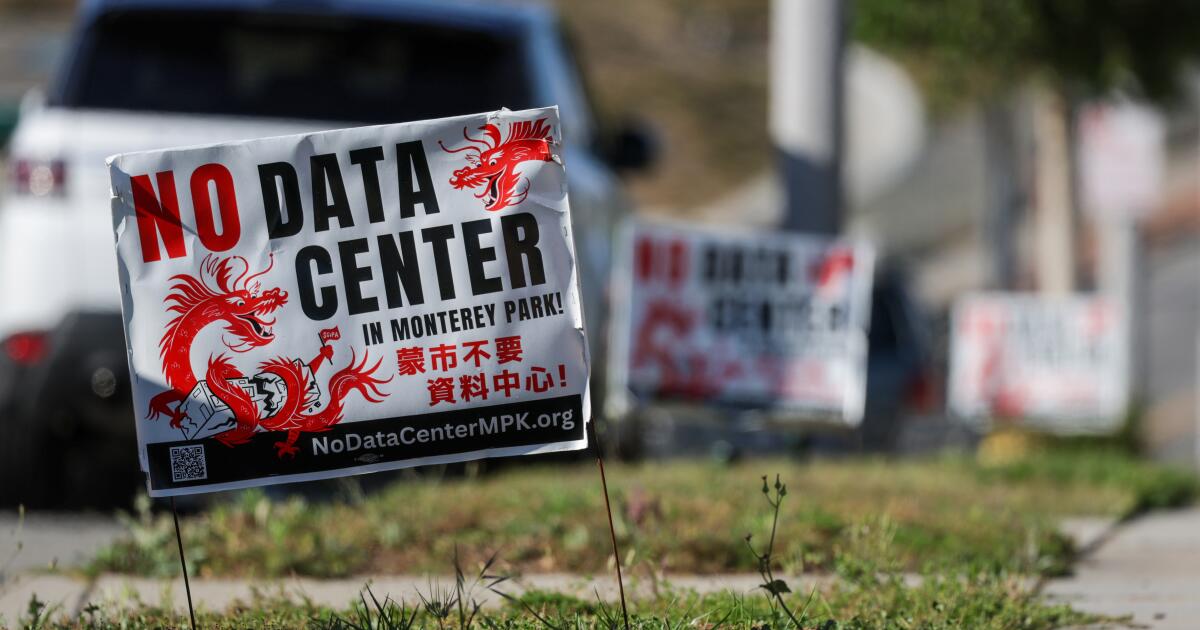
Residents of Monterey Park voted overwhelmingly to ban data centers on election day, making the San Gabriel Valley city the first in the nation to do so by public vote.
As of Wednesday, 86% of votes were in favor of Measure NDC, the city ban, according to the Los Angeles County registrar-recorder/county clerk.
Other cities and towns have passed moratoriums on data centers, as a wave of opposition sweeps the country. But the Monterey Park vote can only be overturned by another ballot measure, making it the most permanent data center ban in a jurisdiction.
Monterey Park’s City Council had already banned data centers by ordinance, after a proposed 247,000-square-foot data center met an outpouring of public anger and concern. The developer withdrew that plan.
That facility would have been less than 500 feet away from the nearest home, and would have used three times the electricity of the entire 60,000-person city. Residents said it would have caused noise and air pollution and driven up electricity rates.
“This ensures long-lasting protections for current and future generations,” Amy Wong, co-founder of the group San Gabriel Valley Progressive Action, said of the vote. “It means that future city councils cannot overturn a data center ban, even if data center developers wanted to spend money to fund pro-data center candidates.”
The measure had no formal opposition. The developer of the proposed facility, investment firm HMC StratCap, said it wouldn’t engage in the ballot fight when it withdrew in March.
The Data Center Coalition, an industry trade group, expressed disappointment in the vote.
“It sends a signal that the area is closed for business, both for data centers and for other significant economic development projects,” state policy director Khara Boender said.
“It deprives local residents of the opportunity to compete for jobs and investment, while also causing the area to relinquish substantial long-term economic investment, high-wage jobs, and critical tax revenue to neighboring areas or other states.”
SGV Progressive Action worked with hyperlocal groups including No Data Center Monterey Park to rally support for the measure.
The group is now focused on stopping data center proposals in the City of Industry and fighting a move by City of Industry, Santa Fe Springs, Vernon and City of Commerce to welcome data centers and other industry with fast-tracked permitting and tax incentives.
City of Industry, in the San Gabriel Valley, and Vernon, south of downtown L.A., are primarily industrial areas, each with around 300 permanent residents. They are employment centers, and tens of thousands of workers commute in daily.
There has been little vocal opposition to data centers among the few residents of these cities. Wong said the protest is primarily coming from the surrounding neighborhoods.
“If a data center gets built in City of Industry, residents across the region would bear the brunt of pollution and increased utility costs,” Wong said, noting that it is surrounded by 16 other cities and unincorporated communities.
Data center proposals have been limited in California compared to Virginia, Texas, Georgia, Illinois and Arizona, which sit at the center of a recent boom in hyperscaler facilities to power artificial intelligence.
California has the third-most data centers in the country, with 300, but high electricity rates, expensive land and regulatory hurdles mean that fewer, and smaller, facilities are currently planned than in other hotspots.
That doesn’t mean opposition hasn’t been fierce. In Coachella and Imperial County, residents are showing up in droves to protest local proposals.
In the San Gabriel Valley, Montebello, El Monte and Baldwin Park have all enacted temporary moratoriums, and Alhambra recently banned data centers as part of a zoning code update.
Wong said she hoped the ballot measure vote would galvanize the opposition. “The vote is a testament to the people power of our region,” she said. “Our region is worth protecting, and we won’t let data centers determine our future.”

A rule intended to prevent rent gouging in the wake of the Eaton and Palisades fires has lapsed in Los Angeles County, possibly exposing some renters to hikes.
The executive order that blocked rent increases was issued by Gov. Gavin Newsom amid the devastating wildfires last year. Under the order, landlords couldn’t increase rents by more than 10% above their prefire levels.
The rule, which was supposed to be temporary and was repeatedly extended, ended Friday after a vote to extend it again failed to garner enough votes. Supervisor Lindsey Horvath, whose district includes Pacific Palisades, sounded the alarm in a motion to extend price protections that failed to pass at the Board of Supervisors’ May 19 meeting.
“These price gouging protections continue to be necessary as construction and rebuilding continue, and as thousands of people remain displaced,” the motion said. “Families which signed short-term leases could face drastic price increases of 50% or more without further price gouging protection.”
Los Angeles County is home to more than 1 million rental properties, though not all of them needed protection from the new rule. There are already stricter rent increase caps for many residences, depending on the location, type and age of the building. Despite the rent control in the region, the people of Los Angeles pay among the highest rents in the country.
It is uncertain whether renters will face rapidly rising rents now that the protection has lapsed. But some real estate experts and policymakers said there was no need for the temporary rule that was part of the governor’s state of emergency.
Supervisors Kathryn Barger, Janice Hahn and Holly Mitchell abstained from voting on the motion to extend the protection, while Supervisors Hilda Solis and Horvath supported it.
“I abstained because I did not see sufficient evidence to justify extending this emergency ordinance, nor did I see evidence to eliminate it entirely,” Hahn said.
Barger’s office said she supported allowing the protections to sunset while waiting to see whether new information emerged.
“Market data already shows countywide rents are only about 2% above pre-emergency levels and rental inventory has grown,” Barger representative Helen E. Chavez Garcia said. “The Supervisor is also mindful of the burden these ongoing protections place on small property owners throughout the county.”
Mitchell did not immediately respond to a request for comment.
There haven’t been steep rent hikes in neighborhoods within three miles of the Palisades fire, according to a Times analysis of data from Zillow, the property listing company.
In ZIP Codes within three miles of the Palisades fire, rent increased 4.8% from December 2024 to April 2025. In areas around the Eaton fire, which destroyed swaths of Altadena, rent jumped 5.2% in the same period.
In L.A. County, ZIP Codes farther from the fires saw only about a 2% increase.
A landlords representative, Jesus Rojas of the Apartment Owners Assn. of Greater Los Angeles, told the supervisors during public comment at the meeting that the county’s rent-gouging rules have “long outlived the emergency they were intended to address” and are now being “wrongfully used to harm thousands of rental housing providers throughout the county.”
“There is no proof that multifamily rental housing providers are hugely increasing rents for impacted homeowners,” Rojas said.
Indeed, there are strong signs that the property market in the Los Angeles area has at last begun to cool.
L.A. metro-area rent prices recently fell to a four-year low, with the median rent slipping to $2,167 in December.
Meanwhile, condominium sales had their slowest start of the year in decades. Condo sales in Los Angeles have plummeted to a 20-year low, with fewer than 2,000 units sold in January and February — the worst start to the year since 2005.
Newsom defended the price-gouging protections shortly after they went into effect.
“In the days following the Los Angeles firestorms, we worked quickly to protect Los Angeles survivors from any form of exploitation,” he said in February 2025. “The state has the tools in place to not only block price gouging during this emergency, but also to prosecute bad actors.”
The Los Angeles County Department of Consumer and Business Affairs said it received more than 2,000 complaints after the fires, alleging that retailers and landlords were taking advantage of people put in hardship by their losses, and sent out more than 2,000 cease-and-desist letters to businesses and landlords for alleged price gouging, said Morine Merritt, who oversees department investigations into consumer and real estate fraud.
“Close to 90% of the complaints that we received involved allegations of rent increases,” Merritt said in an interview. Now that the fire-related protections have expired, existing laws and “regular market conditions determine price increases for goods and services, including rents,” she said.
Crackdowns on fire-related rent gouging have been rare, said Chelsea Kirk of the activist organization the Rent Brigade, which analyzed L.A. County’s rental market in the year after the fires. It reported 18,360 potential examples of price gouging in listings but said that few lawsuits had been filed by authorities so far.
Last week, Rent Brigade announced what it said was the first private civil lawsuit brought by a family that claimed to be rent-gouged in the aftermath of the wildfires. Plaintiffs Randall and Candy Renick, whose Altadena home was damaged, said they were charged nearly three times the maximum permitted rate for nearly 10 months. They seek restitution of $96,000 plus civil penalties and attorneys’ fees.
The rental market has probably stabilized since the fires, Kirk said, but other families may still be “locked into illegal rents” that they agreed to pay when they were in a rush to find housing after they were displaced.


Dear Mr. Pelley:
I meant what I said in my letter last week to the 60 Minutes team: joining 60 Minutes is the honor of my career and I am grateful to be working alongside the people who have contributed to the most important television journalism brand this country has ever produced. While I’m new to 60 Minutes, I’ve devoted my career to investigative journalism and storytelling. I started this job excited to collaborate and to benefit from the wisdom and experience of the 60 Minutes veterans, with you among them. For that reason, one of the first things I did in my new role was call you to talk and invite you to dinner. It is a profound disappointment that you rejected that overture and chose ambush instead. Yesterday, you hijacked my first meeting with staff to disparage me, my qualifications, and my intentions with remarkable incivility and contempt. I welcome a diversity of viewpoints and respectful debate among the team, but this was nothing of the sort. Yesterday’s performative display of hostility enacted in front of the staff instead of in a civil, private conversation-demonstrated that you have no interest in contributing to the future success of the show, or approaching my new tenure with a mind open to collaboration and progress. I am here to deliver first-in-class news programming, not to make headlines about newsroom drama. I am eager to work alongside those who share this goal.
Despite yesterday’s misconduct, I had hoped that in sitting down with you today we could find a path forward together. You made clear that you are not interested in such a path.
Your antipathy to the future of the show has come through loud and clear. And I have heard you. I therefore write on behalf of CBS News, Inc. (“CBS”) to inform you that your employment with CBS is terminated for cause effective immediately. Enclosed is your formal termination letter.
Sincerely,
Nick Bilton
Executive Producer, 60 Minutes
-
 News13 minutes ago
National Guard has done little to reduce violent crime in D.C., a new study finds
-

 Los Angeles, Ca2 hours ago
Man claiming to be armed robs Culver City bank, gets away with $10,000
-

 Detroit, MI2 hours ago
Fired Detroit TV anchor Taryn Asher files sex discrimination lawsuit against old station, claims new GM protected men
-

 San Francisco, CA2 hours ago
San Francisco family devastated as they face nearly 90% rent increase
-

 Dallas, TX2 hours ago
Wings’ top pick Azzi Fudd hosts clinic as Cash App donates to Dallas nonprofit
-

 Miami, FL2 hours ago
Patients left scrambling for care after Miami-Dade woman accused of operating an unlicensed surgery recovery center
-

 Boston, MA2 hours ago
Clover plans to reopen some locations after sudden closure, thanks to an anonymous investor
-
 Denver, CO2 hours ago
New report finds Denver metro home buyers and sellers experiencing ‘unattainability fatigue’

