Science
Why picking RFK Jr. to lead HHS is raising alarms among many public health specialists

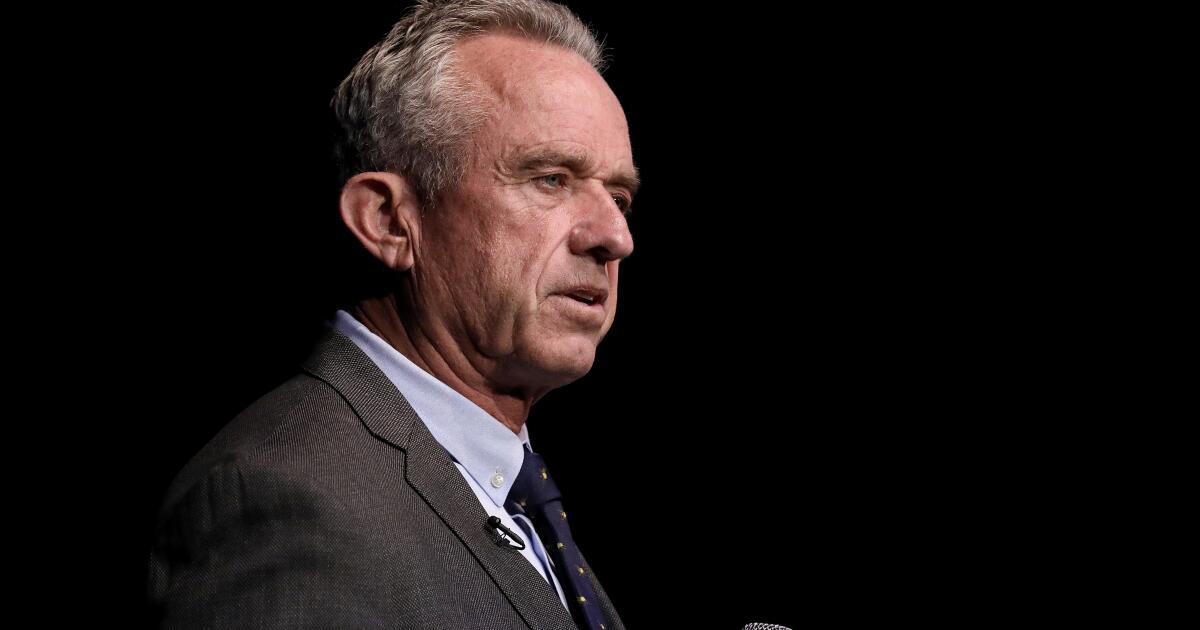
With President-elect Donald Trump’s selection of Robert F. Kennedy Jr. as his nominee to lead the Department of Health and Human Services, numerous public health leaders are voicing fears that the nation’s premier health agencies will be weakened at a time when the country faces rising threats from infectious diseases, emboldened industry lobbyists and the dangerous consequences of medical misinformation.
If confirmed as secretary of HHS, Kennedy — a proponent of fringe medical conspiracies and a self-described “poster child for the anti-vax movement” — would have oversight of institutions including the Centers for Disease Control and Prevention, the Food and Drug Administration, the Centers for Medicare & Medicaid Services and the National Institutes of Health.
Like the two most recently confirmed HHS secretaries, Xavier Becerra and Alex Azar, Kennedy is an attorney with no formal scientific or medical credentials. His purview would include programs and departments he has fiercely criticized in the past, often in ways that opponents say distort or ignore facts and misinterpret science.
Many of the problems Kennedy has publicly said he wants to tackle are concerns shared broadly by healthcare providers, public health officials and members of the public. They include pervasive chronic disease, poor nutrition and the ubiquity of processed foods containing artificial chemicals.
But his nomination has alarmed many public health and medical officials who say they are worried that the solutions Kennedy might deem appropriate could undermine Americans’ health in the long run.
“Putting somebody in charge who is unable to discern the difference between good and bad science is really dangerous for the American people,” said Dr. Peter Lurie, president and executive director of the Center for Science in the Public Interest.
“Yes, there are some things that he supports that we would agree with, but they feel more like the stopped clock that’s right twice a day,” Lurie said, citing food additives as one example. “There are opportunities for small victories. … But overall, it’s dissolved in so many bad ideas that it’s absolutely not worth it.”
Kennedy declined to discuss his plans for HHS with The Times, but he has indicated some priorities for the agency in previous public statements.
For instance, he said Trump would advise against water fluoridation on his first day in office. He told NBC News he wouldn’t “take away” vaccines, but he would “make sure scientific safety studies and efficacy are out there, and people can make individual assessments about whether that product is going to be good for them.”
More than half a dozen experts who spoke with The Times said Kennedy’s suggestions that the science around vaccines is unsound would undercut public health.
The United States has “the best vaccine safety system in the world,” said said Dr. Richard Besser, a former acting CDC director who now leads the Robert Wood Johnson Foundation. “RFK Jr. has done a lot to undermine confidence in that.”
Indeed, cases of measles have been rising in the U.S. as childhood vaccinations lag, especially since the COVID-19 pandemic. The CDC has identified 277 measles cases this year, up from 59 in 2023.
“I don’t want to have to see us go backwards in order to remind ourselves that vaccines work,” Dr. Mandy Cohen, the CDC’s director, said this week at the Milken Institute Future of Health Summit in Washington, D.C.
Kennedy’s zeal to remove fluoride from drinking water on the claim that the mineral causes neurodevelopmental disorders and other health conditions is another example of shirking the best science, said Dr. Walter Willett, a professor of epidemiology and nutrition at the Harvard T.H. Chan School of Public Health.
“That has been looked at carefully and there has not been evidence of a link,” Willett said. “On the other hand, there are serious problems with lead in water systems.”
Vaccines and fluoride are just two areas where Kennedy will have an opportunity to implement ideas that lack strong scientific support.
Last month, he decried the FDA’s “aggressive suppression” of unproven health remedies like dietary supplements and ivermectin and warned: “If you work for the FDA and are part of this corrupt system, I have two messages for you: 1. Preserve your records, and 2. Pack your bags.”
But food safety advocates who have shared many of Kennedy’s criticisms about lax regulation said gutting the agency is not the answer. Any effort to reduce or eliminate chemical additives in foods would require experienced staffers to draft new rules and shepherd them through the required regulatory process, said Ken Cook, president of the Environmental Working Group.
“If you’ve gotten rid of all the bureaucrats, who’s going to write the regulation?” Cook said.
Or consider FDA’s reliance on user fees from companies that want the agency to approve its medical products. Such fees make up nearly half of the agency’s operating budget. Kennedy and others have criticized such fees, but if those dollars went away, Congress would be unlikely to backfill them, Lurie said.
“Ending user fees is tantamount to starving the agency,” he said. “That would mean a food program that’s limited in what it can do, drugs coming to market more slowly, and vaccines that are even less well-monitored for safety.”
Lurie said he wouldn’t be surprised to see Kennedy task researchers at the National Institutes of Health with looking for damaging side effects of vaccines and elusive benefits of potential therapies that have already been shown to be ineffective, such as chelation as a treatment for autism and ivermectin and hydroxychloroquine for COVID-19.
“He seems to think these hold great promise,” Lurie said. “Most of those ideas are sinkholes for government spending, which is ironic given the Trump administration’s purported devotion to efficiency.”
Significant as the HHS role is, Kennedy would still find his powers curtailed by the limits of the agency’s reach — and potentially by the whims of his boss.
Willett said he agrees with Kennedy that the nation’s health is in decline, and that our food and healthcare systems are “in many ways dysfunctional.” He would welcome efforts to crack down on the amount of salt allowed in foods and to curtail consumption of added sugars, refined grains and sugar-sweetened beverages.
But if Kennedy takes steps like these, “we know for sure he will run into resistance from industry,” Willett said. “It would be interesting to see if he’s prepared to take on Coca-Cola.”
Although Kennedy is passionate about reducing pesticides and other chemicals in foods, it’s up to the Department of Agriculture to regulate pesticide use on crops, and it’s the job of the Environmental Protection Agency to determine what exposure levels are considered safe for people, Cook said. Nor would Kennedy have the power to reform farm subsidies to encourage organic and regenerative agriculture.
“He doesn’t have much purchase on pesticides from his perch,” Cook said. “That’s not really an HHS thing or an FDA thing.”
The FDA does have the authority to regulate the chemicals that come off of food packaging and can find their way into food, and Kennedy could prioritize that, Cook said.
It’s also possible that Kennedy could protect the budgets of the National Institute of Environmental Health Sciences and the Agency for Toxic Substances and Disease Registry, Cook said.
To help him achieve his goals, Kennedy has invited the public to weigh in on people who could fill important roles within the federal government’s health agencies.
Names that have garnered thousands of votes in the “America’s Health” category of his “Nominees for the People” website include Dr. Sherri Tenpenny, who claimed COVID-19 vaccines made people magnetic, and Dr. Simone Gold, the anti-vaccine Beverly Hills physician whose medical license was suspended after she pleaded guilty to unlawfully entering the U.S. Capitol on Jan. 6, 2021. (Her license has since been restored.)
Kennedy’s own accession to the HHS secretary post is not yet certain. Cabinet positions are supposed to be confirmed by the Senate, though Trump has suggested that he may use recess appointments to bypass the need for lawmakers’ approval.
Dr. Georges Benjamin, executive director of the American Public Health Assn., said that even if Kennedy wins confirmation, it’s uncertain how long he would remain in Trump’s good graces.
“I remind folks that his first health secretary didn’t last a year,” Benjamin said. “We’ll see what happens here.”


new video loaded: NASA Announces Artemis III Crew
transcript
transcript
NASA Announces Artemis III Crew
NASA announced the crew of Artemis III mission, which will fly to low-Earth orbit to test rendezvous and docking maneuvers with one or two lunar landers.
-
“I am excited to welcome you as the next crew in the Artemis journey to successfully return to the moon — this time to stay.” “I’m honored by the role that I’ve been given. I’m also very humbled by the task in front of us. But first and foremost, I’m grateful.” “So with that, the Artemis II crew, comrade, hands you the baton. You got the controls.” “As you know, we had a significant anomaly at our Launch Complex 36A on May 28. We’ve redoubled our efforts and are moving forward.”
By Alisa Shodiyev Kaff
June 9, 2026
Science
Santa Monica Mountains’ last steelhead trout survived the Palisades fire — and even had babies

Scientists feared the Santa Monica Mountains’ last remaining steelhead trout were dead, smothered by debris flows unleashed by the Palisades fire.
But the endangered fish surprised them: A team of biologists recently spotted 30 of the rare trout — and 21 babies — in Topanga Creek.
“There was a lot of happy dancing in the creek,” said Rosi Dagit, principal conservation biologist for the Resource Conservation District of the Santa Monica Mountains, which works with public and private landowners to conserve natural resources.
That’s because the steelhead here are endangered, at both the state and federal levels. Once, they swam in most streams of the Santa Monicas, but their numbers plummeted amid overfishing and coastal development. Increasingly frequent wildfire has further stressed their habitat. Topanga Creek, a biodiversity hot spot, is home to their last known population in the mountains that stretch from the Hollywood Hills to Point Mugu in Ventura County.
The trout that were spotted, including this one, are part of a distinct Southern California population that’s listed as endangered at the state and federal levels.
(RCDSMM Stream Team)
The California Department of Fish and Wildlife spearheaded a complex mission to rescue trout threatened by the Palisades fire that sparked in January 2025.
Time was of the essence. The fire hadn’t yet been fully contained. But rain was on the way, which would sweep massive amounts of sediment from the denuded hillsides into the water. Fish are often killed this way.
Crews stunned the fish with electricity, scooped them up in buckets, trucked them to a hatchery and ultimately moved them to Arroyo Hondo Creek in Santa Barbara County.
Within days, Topanga Creek was choked with mud. Some assumed the fish left behind were goners.
But in March, the conservation district’s team found four. The following month, when water conditions were clearer, they saw more.
“These fish continue to amaze me,” said Kyle Evans, environmental program manager for the state Department of Fish and Wildlife, who had seen the damage to the creek. “I had seen populations get wiped out in similar situations. So when I heard, I was thrilled.”
Evans surmises the fish that survived were in an area of the creek where less charred material and sediment were swept in.
“These fish likely hunkered down, were hiding under some rocks or places to try to get away from the main concentration of flow,” he said. “And luckily they weren’t buried.”
The ones that were spotted were fairly small, around 6 to 14 inches. Rainbow trout and steelhead trout are the same species, but with different lifestyles. If the fish remain in freshwater, they’ll be considered rainbows. However, they can migrate to the ocean and become steelhead, where they typically grow larger before returning to their natal waters to spawn.
Topanga Creek hasn’t fully recovered from the damage it sustained, but scientists say it’s looking better. Surveys last year were “so depressing,” Dagit said, with very few animals, and stretches that were essentially transformed into flat roads from all the sediment buildup. Some of the riparian canopy burned right down to the creek.
Then came 32 inches of rain over the last nine months, scouring out and moving sediment, creating deeper pools. Dagit said they recently found newt egg masses for the first time in years, as well as a few adult newts and many frogs. Plants that provide cover are starting to recover.
She provided photos comparing certain pools last year and this year, some dramatically transformed. In September 2025, the Shrine Pool could have been an overgrown hiking trail. This April, it was filled with shallow water.

The Shrine Pool in September 2025, left, and the same location in April 2026, right, with RCDSMM’s Isaac Yelchin donning a wetsuit.
(RCDSMM Stream Team)
Topanga Creek is home to another endangered fish, the small but hardy northern tidewater goby, often described as cute. Not long before the trout operation, Dagit led a rescue of hundreds of these fish too. Many were repatriated to the lagoon at the mouth of the creek in a moving ceremony last June.
There’s still the matter of what to do with the trout that were moved to Santa Barbara County last year. Evans would like to bring them home to the Santa Monicas at some point, but isn’t sure if it will happen. On one hand, they could bolster the small, genetically isolated surviving population. On the other, they might inadvertently bring in a disease or bacteria. There is some time to decide. Evans estimates the creek still needs to recover for two to three more years.
For now, the fish are functioning fine in their adopted creek. Experts worried the trauma wrought by the move would disrupt their spawning process, but they had babies that spring. This year, they spawned again.

The Pacifica Municipal Pier was shut down and taped off Thursday after city workers noticed cracks running through the landmark structure and concrete chunks falling into the ocean.
It’s just one of many coastal California structures that have recently crumbled under pressure from a rising and relentless ocean.
Officials from the small, beach city south of San Francisco said the pier was closed due to “cracking, separation, and displacement of the concrete walkway and structural elements.”
It will stay closed while structural engineers asses its safety.
Photos taken by city employees show a wide crack that runs from top to bottom and across the structure as well. Other photos show a large horizontal crack under the foundation of a small restaurant on the pier, the Chit Chat Cafe.
The cafe was also shut down.
This is not the first time the 53-year-old pier has shown signs of stress. In 2021, part of it was shut down after handrails along the edge collapsed. And in 2023, after a series of storms pummeled the Central California coast, damaging parts of the pier, the structure was partially closed for more than year.
Those same storms caused extensive damage in Aptos and Capitola, 70 miles south, where piers and waterfront infrastructure were swept away or damaged.
In 2024, a 150- to 180- foot section of the Santa Cruz wharf was ripped off by powerful waves.
At least 10 of the state’s dozens of coastal public piers were closed for part or all of 2024 due to structural damage sustained in winter storms since 2022. At least five others have longer-term upgrades planned to address structural issues.
“These things are costly to maintain,” said Zach Plopper, senior environmental director at Surfrider. “They are a part of our California coastal culture in many ways, but we’re going to need to reckon with, one, the state that they’re in, and two, the continuous and worsening threats they’re going to experience,”
He said most of the piers were constructed in the early 1900s, and they weren’t built to withstand decades of rough seas, storms and rising sea level.
“With this incoming El Niño, which is forecasted to be significant, and this marine heat wave we’re in the midst of, we’re kind of in uncharted waters as far as what this winter could bring in terms of storms and swells to the California coast, and we’re likely going to see a lot more damage,” he said. “Not just piers, but roads and other coastal infrastructure up and down the state.”
There was no storm in Pacifica earlier this week, so no single event could be blamed for the destruction.
However, a 2025 report from an outside engineering firm, GHD, found that several sections of the pier were in “poor” or “serious” condition, and they recommended closure before anticipated storms or events that could “subject the piles to high winds, swells and large waves.”
The firm found several areas of the pier where concrete was missing and rebar was exposed and corroding.
“The pier has continued to experience high winds and large waves in a harsh marine environment,” the engineers wrote in the report, noting that continuous exposure to seawater or marine spray was “detrimental” to the structure.
A 2023 city report estimated it would cost $19 million to repair.
That same year, a state law was enacted to require local governments along the California coast to plan for sea level rise in the coming decades.
Sea level has risen some 8 inches, on average, along the coast in the past 150 years, Plopper said, and researchers anticipate another foot in the next 25 years.
“We’re going to see profound shifts on our coastline, none that we have ever experienced before, and building static structures on the coast just doesn’t work all that well,” he said. “We’re going to have to make some really hard decisions.”
-

 Seattle, WA4 minutes ago
Survey: What’s the toughest game to start the Seahawks’ season?
-

 San Diego, CA11 minutes ago
Daily Business Report: June 10, 2026, San Diego Metro Magazine
-

 Milwaukee, WI14 minutes ago
50 electric school buses to transport MPS kids starting this fall
-

 Atlanta, GA20 minutes ago
Atlanta Dream hold off Chicago Sky 82-75, Rhyne Howard becomes youngest player to hit rare WNBA milestone
-

 Minneapolis, MN26 minutes ago
Operation Metro Surge cost Minneapolis $700 million, city leaders say
-
 Indianapolis, IN29 minutes ago
Person fatally shot on north side of Indianapolis
-

 Pittsburg, PA34 minutes ago
12+ things to do this weekend, from Pogopalooza and PizzaFest to the Beers of the Burgh Festival
-

 Augusta, GA41 minutes ago
World Cup: Where to find a crowd to catch all the action

