Sports
Dodgers to move Mookie Betts to infield in 2025, seek pitching and outfielders this offseason


The Dodgers’ other big need this offseason, Gomes confirmed Wednesday, is starting pitching.
And while the free-agent market is rich with veteran talent, the team is monitoring star Japanese pitcher Roki Sasaki, too.
A 23-year-old right-hander with a triple-digit fastball and career 2.02 ERA in his native country’s Nippon Professional Baseball league, it’s uncertain if Sasaki will be posted for MLB clubs to sign this offseason. But if he is, he will come as a bargain, since league rules for international free agents under the age of 25 would restrict him to signing only a minor league contract with a modest signing bonus (similar to when Shohei Ohtani, then also 23, signed with the Angels for $2.3 million in 2017).
Sasaki, whom Gomes declined to discuss Wednesday since he is still under club control in Japan, has been long coveted by the Dodgers and heavily scouted by their executives in recent years.
And with the Dodgers considered favorites to sign him if he does come to MLB this winter, he could represent the front office’s dream acquisition: A young, gifted, cost-controlled pitcher to bolster a starting rotation beset by injuries in recent years.
The Dodgers, of course, will have other avenues if Sasaki doesn’t become their latest Japanese acquisition.
Two-time Cy Young Award winner Blake Snell would be the most obvious name for the Dodgers to pursue. Last spring, the team made a late play for the left-hander before he signed with the San Francisco Giants. And even though the soon-to-be 32-year-old is expected to fetch the kind of nine-figure contract that eluded him last offseason, his track record of durable success (he is top 15 in the majors in both ERA and starts since 2017) should make him a priority target for the Dodgers again this winter.
If not Snell, the Dodgers could pivot to other big names.
Corbin Burnes is a former Cy Young winner whom the Dodgers had trade interest in last year, though is projected to command even more money than Snell, which might price him out of the Dodgers’ plans.
Max Fried is a Harvard-Westlake product who has a career 3.25 ERA, but also battled forearm injuries the last two seasons, something the Dodgers will have to weigh given the other health-related question marks already populating their pitching staff.
The next tier of free-agent starters includes Jack Flaherty (the Dodgers’ key trade deadline acquisition this past year), Nathan Eovaldi (a veteran the Dodgers were monitoring at the trade deadline before trading for Flaherty), Yusei Kikuchi, Sean Manaea and Luis Severino.
And then there’s Walker Buehler, whom the Dodgers remain interested in re-signing even after declining to extend him a one-year, $21-million qualifying offer this week.
The Dodgers could be open to still paying Buehler something in that ballpark, depending on how the rest of his market develops. And Gomes emphasized that Buehler’s contributions in the postseason, including closing out Game 5 of the World Series on one day of rest, “does not go lost on us.”
At the same time, however, it’s possible Buehler could fetch proposals beyond what the Dodgers are willing to match, especially since he is not encumbered by the qualifying offer (which, if he had declined, would have required other teams to forfeit draft compensation to sign him).
Like most things this time of year, the Dodgers remain in wait-and-see mode for now.

Sports
Conor McGregor’s long-awaited Octagon return cut short by apparent knee injury seconds into UFC 329

NEWYou can now listen to Fox News articles!
Nearly five years after his last walk to the Octagon, Conor McGregor made his long-awaited UFC return Saturday night against fellow MMA star Max Holloway in the main event of UFC 329 in Las Vegas.
McGregor opened aggressively, attempting a running kick before throwing a head kick moments later. He appeared to slip on both tries. Holloway quickly capitalized after the second, taking top position and landing a right hand before McGregor was able to work his way back to his feet.
Moments later, McGregor hit the canvas again after trying to throw a kick with his right leg, which appeared to buckle underneath him.
CLICK HERE FOR MORE SPORTS COVERAGE ON FOXNEWS.COM
Conor McGregor of Ireland participates in the walkout before facing Max Holloway of the United States in their welterweight bout during UFC 329 at T-Mobile Arena in Las Vegas. (Ian Maule/Getty Images)
The official inside the Octagon waved off the fight moments later, giving Holloway a TKO victory.
During the broadcast, UFC CEO Dana White pointed to a first-round replay that appeared to show the moment McGregor suffered the injury. The apparent injury was not to the same leg McGregor broke during his 2021 fight against Dustin Poirier, which led to a lengthy absence from the Octagon.
The loss extended McGregor’s long winless drought, with his last UFC victory coming by first-round TKO against Donald “Cowboy” Cerrone in January 2020.
JAKE PAUL’S BUSINESS PARTNER GIVES TIMELINE ON RETURN TO RING AFTER CAREER-THREATENING INJURY
McGregor earned a unanimous decision over Holloway in a featherweight clash in 2013, when neither was an MMA megastar. In the blink of an eye, McGregor’s star rose.
Conor McGregor and Max Holloway face off during the UFC 329 ceremonial weigh-in at T-Mobile Arena in Las Vegas, Nevada, on July 10, 2026. (Chris Unger/Zuffa LLC)
On Wednesday, he admitted he got caught up in his own stardom after winning UFC belts in two weight classes and becoming one of the biggest names in combat sports.
“I launched an Irish whiskey,” McGregor said. “I didn’t drink heavily, if at all, at that time of my life. I was an athlete at the top of my game. Next thing you know, thousands upon thousands of bottles (are) in my garage.
RONDA ROUSEY REVEALS WHAT INSPIRED HER TO END NINE-YEAR MMA HIATUS FOR ONE FINAL FIGHT
“‘Sell this, Conor.’ OK, I’d leave my property with two bottles under my arm, and that was it. I was caught. And I wasn’t used to it. And that’s it. God gave me these lessons. That’s it. I was trapped and caught, and it is what it is.”
Conor McGregor jumps into the air for a kick as he fights Max Holloway in a welterweight bout at UFC 329 in Las Vegas, Nevada. (John Locher/AP)
CLICK HERE TO DOWNLOAD THE FOX NEWS APP
Easier said than done, perhaps, as the controversial former champion has been embroiled in multiple controversies and legal issues over the past several years.
The Associated Press contributed to this report.
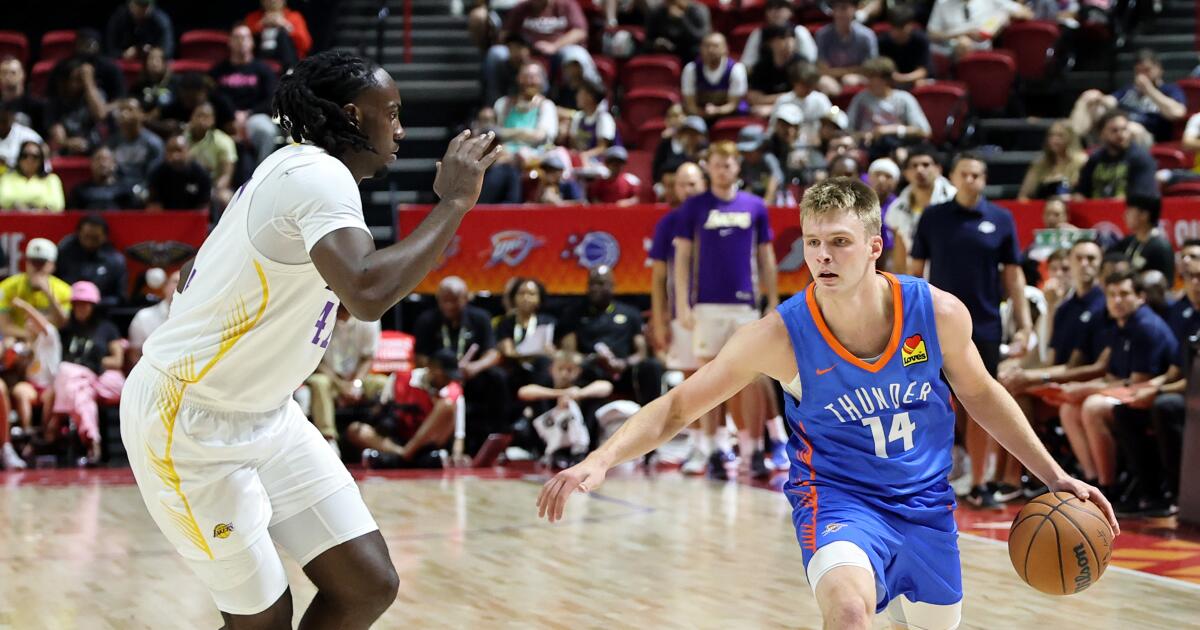
LAS VEGAS — The door opened for Arthur Kaluma to show his worth for the Lakers in the NBA Summer League on Saturday night.
He did so in a big way.
Kaluma had 34 points and five rebounds during the Lakers’ 91-70 win over the Dallas Mavericks at the Thomas & Mack Center.
He was 11 for 16 from the field and six for 10 from three-point range.
With Lakers rookie guard Cameron Carr unable to play because of a right thumb contusion, Kaluma took over the scoring role. Carr, the 24th pick in the NBA draft, is averaging 17 points per game.
“Cam doesn’t play tonight, so he gets a little bit more minutes, gets a couple more touches,” said Lakers Summer League coach Ty Abbott about Kaluma. “But he’s done a really good job of making the most of it when he doesn’t have actions run for him. So the way that he’s been able to stay ready, find windows for himself has kept him in a rhythm. So, on a night like tonight, when we can run some actions for him, he knocks them down and just plays out of his mind. It was great.”
Kaluma said he was “a little nervous” but his three-point shooting said otherwise.
“When [teammate] Jon Elmore came down and he pitched it back to me for a three … I just knew when it came off my hand it was cash,” Kaluma said. “So I said, ‘Yeah, I’m hot.’ It went on from there.”
Late in the fourth quarter, Kaluma lined up a three-pointer, setting his feet and scoring from 29 feet out. He flashed three fingers and smiled. His teammates on the bench stood and cheered, as did the fans.
“We have such a great group of guys this year at Summer League and going through this it’s hard to get that camaraderie with a group,” Kaluma said. “But I feel like everybody wants to see everybody succeed and I felt that tonight. I’m not going to lie to you. They tell me to shoot the ball. I passed up a couple of shots and they were mad at me the other day.”
Kaluma played for the South Bay Lakers in the G League last season. He averaged 14.6 points per game, 4.9 rebounds and shot 55% from the field, 37% from three-point range.
“The G can get grimey, you know what I’m saying? It’s a time where everybody is trying to fight for a position and there is a certain hunger that you have to have in order to be successful in the G,” Kaluma said. “And I feel like that drive that I had my first year in it pushed me into this summer to really get better and work on my game and come here and have the opportunity to perform.”
Kaluma wasn’t alone in helping the Lakers improve to 2-0 in Summer League play.
Adou Thiero ran the court, took a lob pass from Chris Mañon and threw down a two-handed dunk. He had another solid outing with 15 points and four rebounds. He shot just four for 12 from the field, but was a plus-15.
But the night belonged to Kaluma.
“I pride myself on the defensive end,” he said. “I know I got hot offensively, but the shot was just falling today, you know what I’m saying? My game is three-and-D. I lock-up on defense and I know I can hit open shots. I just got hot today and I’m not going to try to let it get to my head.”
Sports
Golf star records lowest round in LPGA major history with astounding performance at Evian Championship

NEWYou can now listen to Fox News articles!
There are good days on the golf course, and then there is what Haeran Ryu just did on Saturday.
Ryu, 25, recorded the lowest round in LPGA major history on Saturday with an 11-under 60 at the Evian Championship. With the South Korean golfer’s historic round, she holds a three-stroke lead.
Ryu’s round comes just two weeks after winning her first major at the Women’s PGA Championship. On the 18th hole, Ryu left a 30-foot eagle putt a few inches short, and instead settled for a birdie.
CLICK HERE FOR MORE SPORTS COVERAGE ON FOXNEWS.COM
Haeran Ryu of South Korea reacts on the 18th green after the third round of The Amundi Evian Championship at Evian Resort Golf Club in Evian-les-Bains, France, on July 11, 2026. (Stuart Franklin/Getty Images)
She said after the round that she had no idea what she had done until she counted up her scorecard.
“But after the putt and I counted my score with my caddie,” she said. “Oh my God, it’s 11-under par today. It was so amazing. My caddie says, ‘Yep.’ I’m so happy right now.”
If Ryu had made the eagle putt on the 18th hole, she would have been just the second player to shoot a 59 in LPGA history.
ZERO BS. JUST DAKICH. TAKE THE DON’T @ ME PODCAST ON THE ROAD. DOWNLOAD NOW!
Haeran Ryu of South Korea celebrates a birdie on the 15th green during the third round of The Amundi Evian Championship at Evian Resort Golf Club on July 11, 2026, in Evian-les-Bains, France. (Stuart Franklin/Getty Images)
Her 60 broke the record for the lowest round in an LPGA major by one shot. Leona Maguire and Jeungeun Lee6 in 2021, and Hyo Joo Kim in 2014, each shot 61 at the Evian Championship, which was designated as an LPGA major in 2013.
The lowest round in a men’s major is 62, which is shared by four players — Branden Grace at Royal Birkdale in the 2017 British Open, Xander Schauffele and Rickie Fowler in the 2023 U.S. Open at Los Angeles Country Club, and Schauffele and Shane Lowry in the 2024 PGA Championship at Valhalla.
CLICK HERE TO DOWNLOAD THE FOX NEWS APP
Haeran Ryu of South Korea and Lottie Woad of England interact after their round on the 18th green during the third round of the Amundi Evian Championship at Evian Resort Golf Club in Evian-les-Bains, France, on July 11, 2026. (Stuart Franklin/Getty Images)
Ryu hopes her historic third round can help propel her to a second major win in three weeks.
“That is amazing, amazing dream,” Ryu said. “So I just want that one to come true, but we have one more day.”
The Associated Press contributed to this report.
Follow Fox News Digital’s sports coverage on X, and subscribe to the Fox News Sports Huddle newsletter.
-

 Michigan2 minutes ago
Sturgis closure may be ‘first of more’ for Michigan rural hospitals
-

 Massachusetts5 minutes ago
Commentary: Massachusetts needs a journalist shield law
-

 Minnesota10 minutes ago
Minnesota was center of immigration enforcement. Here’s how its playing out legally.
-

 Mississippi17 minutes ago
Mississippi Lottery Mississippi Match 5, Cash 3 results for July 11, 2026
-

 Missouri20 minutes ago
Recovery efforts continue after deadly Missouri flash flooding | Latest Weather Clips | FOX Weather
-

 Montana25 minutes ago
Missoula and Western Montana neighbors: Obituaries for July 12
-

 Nebraska32 minutes ago
MLB Draft: Cubs select Nebraska RHP Carson Jasa in the 3rd round
-

 Nevada35 minutes ago
Nevada joins western coalition that aiming to strengthen regional power grid

