US banks have a lot riding on the outcome of Election Day even if they’re not 100% sure how either candidate might treat their industry.
The “knee-jerk reaction,” according to KBW analyst Chris McGratty, is that a Donald Trump victory will mean a return to looser regulation of banks and more leniency in approving the sort of corporate mergers that produce big profits for Wall Street giants.
A Kamala Harris win, on the other hand, may mean that a more aggressive period of overseeing the nation’s largest financial institutions under President Joe Biden will continue.
Screens show the presidential debate between former President Donald Trump and Vice President Kamala Harris on Sept. 10. REUTERS/Adam Gray ·REUTERS / Reuters
“In my investor conversations, it definitely feels like people are pricing in Trump,” McGratty told Yahoo Finance. “So initially, if the election goes to Harris I would think banks would sell off,” he added.
The country’s largest lenders have had a great year thanks to the economy’s resilience during a period of elevated interest rates and a rebound in their investment banking and trading operations. The hope is next year could also turn out well, if lending and Wall Street dealmaking churn higher while interest rates fall.
Advertisement
An index tracking 24 of the largest domestically chartered US commercial banks (^BKX) is up 27% so far this year, outperforming the broader financial sector and major stock indexes.
Those other indexes for the financial sector (XLF), Nasdaq Composite (^IXIC), S&P 500 (^GSPC) are up 24%, 21% and 20%, respectively.
The consensus among industry observers is that a Trump White House might be more favorable for a run-up in financial stocks. After all, bank stocks rose 20% following the three months after Trump was elected in 2016.
But the challenge for bank executives as they assess the impact of a new president is that neither Trump or Harris have said much about how they want Washington to oversee the biggest banks in the US.
So instead their track records have largely spoken for them.
Advertisement
The Trump administration of last decade delivered a big corporate tax cut, and it also rolled back some big bank rules that were imposed in the aftermath of the 2008 financial crisis.
Harris, on the other hand, has touted her clash with big banks when she was California’s attorney general as an example of her willingness to take on powerful interests.
One big unknown is what either administration would do with a new set of controversial capital rules proposed by top bank regulators that would require lenders to set aside greater buffers for future losses.
The requirements are based on an international set of capital requirements known as Basel III imposed in the decade following the 2008 financial crisis.
Advertisement
Banks have been fighting this US proposal for the last year in an aggressive public campaign and even dropped hints about suing regulators if they don’t get their way.
They won a big victory in September when some regulators said they would water down those requirements. But not all regulators appear to be on board with that plan, putting the final version in doubt.
Some in the industry expect regulators to scrap the proposal if Trump wins.
“If you’re looking at how Trump views the world, I think you see less cooperation with international standard setters,” Allen Puwalski, chief investment officer at Cybiont Capital, told Yahoo Finance.
“And I think you see the US back out of Basel III.”
Advertisement
And a Harris win means the proposal for bank capital increases likely won’t “change that much,” according to Ian Katz, a managing director at Capital Alpha Partners.
“If Harris wins, I expect regulators to sit down to reassess the proposal and try to move forward,” he added.
Federal Reserve vice chair for supervision Michael Barr, one of the architects of new proposed capital rules for big banks. REUTERS/Kevin Lamarque ·REUTERS / Reuters
But Katz is also quick to point out even in a Trump win, a more friendly regulatory climate for the biggest lenders can’t be assured and it certainly won’t be touted.
“You can’t assume that every Republican these days is going to do favors for the largest banks,” he added.
KBW predicts that on day one a Trump administration could make as much as eight leadership changes at federal regulatory agencies that oversee different corners of the financial services industry.
That includes the Office of the Comptroller of the Currency (OCC), the Consumer Financial Protection Bureau (CFPB), the Securities and Exchange Commission and potentially even the Federal Deposit Insurance Corporation, if Biden nominee Christy Goldsmith Romero isn’t confirmed by the end of the year.
Advertisement
New leaders would also take over the Justice Department and the Federal Trade Commission, which would likely make it easier for giant companies to merge without running afoul of antitrust concerns.
KBW expects significant change at the Federal Reserve in 2026, when the chairmanship of the Fed’s Jerome Powell ends.
What is perhaps even more relevant for the banking industry is that 2026 is also the end of a term for Michael Barr as vice chair of supervision. Barr is the architect of the new bank capital rules and one of the industry’s chief antagonists.
The Washington Post has reported that bank executives and former Fed officials expect Trump to demote Barr, who was a Joe Biden appointee and a Treasury official during the Barack Obama era.
It is not known if Trump would have the legal power to make such a move, the Post reported.
Advertisement
Some big bank executives are clearly not fans of the current Biden-era regulators.
JPMorgan Chase (JPM) CEO Jamie Dimon this past week called a raft of regulatory proposals from his overseers “an onslaught,” criticized CFPB director Rohit Chopra, and made it clear the industry is willing to push back on new rules in court.
“It’s time to fight back,” Dimon said while speaking at an American Bankers Association convention in New York City. “I’ve had it with this sh*t.”
JPMorgan Chase CEO and Chairman Jamie Dimon gestures as he speaks before a Senate committee in 2023. REUTERS/Evelyn Hockstein/File Photo ·REUTERS / Reuters
“We don’t want to get involved in litigation just to make a point,” he added, “but I think if you’re in a knife fight, you’d better damn well bring a knife.”
No matter which candidate takes the country’s top job, some bankers are convinced that the election will not define an industry full of institutions that have endured at least a century of change.
“We’ve done this through World Wars, money panics, depressions, the Texas meltdown of the 80s, great financial crisis and COVID,” Phil Green, CEO of San Antonio-based Frost Bank, told Yahoo Finance. Frost is 156 years old.
Advertisement
“We’re kind of like cockroaches in that way. We’re gonna still be here, at least that’s our plan,” he added.
David Hollerith is a senior reporter for Yahoo Finance covering banking, crypto, and other areas in finance.
Click here for in-depth analysis of the latest stock market news and events moving stock prices.
Read the latest financial and business news from Yahoo Finance
New York City, NY, July 11, 2026 (GLOBE NEWSWIRE) — Recently, the US financial market has been undergoing a new round of structural changes. With the continued surge in investment in artificial intelligence (AI), a large amount of international capital is flowing into US technology companies, while the US Treasury market faces pressure from factors such as widening fiscal deficits, increased bond supply, and persistently high long-term yields.
The market generally believes that global capital allocation patterns are changing, and the US financial market is thus entering a new stage of development. For decades, the US current account deficit has primarily relied on overseas official institutions purchasing US Treasury bonds for financing, a mechanism that has long supported the international status of the US dollar.
However, as global central banks gradually diversify their asset allocation, coupled with the continued expansion of the US fiscal deficit, some overseas investors are beginning to reduce their allocation to US Treasury bonds, preferring to invest in growth industries such as artificial intelligence and semiconductors.
AI Drives Financial Market Innovation
Driven by the wave of artificial intelligence, the US technology sector continues to attract international capital inflows. A recent study by Deutsche Bank indicates that in recent years, inflows of foreign capital into the US stock market have continued to grow, while inflows into US Treasury bonds have slowed relatively, creating a significant gap that indicates capital is gradually shifting towards technological innovation.
Advertisement
Meanwhile, US long-term Treasury yields remain high, and the market continues to focus on fiscal financing pressures, interest rate policy, and the future trajectory of the US dollar. Analysts believe that under the new capital flow pattern, the correlation between the technology industry, the stock market, and the US dollar is constantly strengthening, and artificial intelligence is becoming a key factor driving the development of the US financial market.
Against this backdrop, EX DeFi announced the launch of its AI-driven automated trading technology, combining artificial intelligence, big data analytics, and automated execution to provide users with a more intelligent and efficient trading experience.
According to EX DeFi, the system can analyze market prices, transaction data, technical indicators, and other multi-dimensional information in real time, and automatically execute trades based on user-preset strategies, improving market analysis efficiency while helping to optimize strategy execution processes.
Advertisement
EX DeFi stated that it will continue to advance its artificial intelligence technology research and development, continuously improving data analysis capabilities, automation levels, and platform performance to provide users with more intelligent and convenient trading assistance tools.
The Application of AI in Fintech Continues to Expand
In recent years, artificial intelligence (AI) has become a key development area for global financial institutions and technology companies. From massive data analysis and market trend identification to risk management and strategy optimization, AI is continuously improving the intelligence level of financial services.
Currently, EX DeFi’s technological research and development is mainly focused on the following areas:
AI Market Data Analysis
Advertisement
Automated Trading Technology
Intelligent Risk Management
System Monitoring and Performance Optimization
Platform Infrastructure Upgrades
The company stated that it will continue to invest in research and development to continuously improve its AI analysis capabilities and enhance the overall operational efficiency and technical performance of the platform.
Advertisement
Continuously Improving the Platform Security System
Regarding platform security, EX DeFi has established a multi-layered security system covering data encryption, multi-factor authentication (2FA), real-time monitoring, automatic anomaly detection, and intelligent risk control, continuously improving platform stability and user account security.
The company stated that it will continue to optimize its security architecture and technology system in the future, using AI-assisted risk monitoring to continuously improve the platform’s reliability and overall service quality.
Accessing the Platform
Users can create an account through EX DeFi’s official website to explore available AI-driven trading solutions.
Advertisement
The company stated that registered users can view different types of AI-powered trading contract services and determine whether the technology aligns with their individual profit goals and risk tolerance.
Users should carefully read all relevant information before using any AI-powered fintech service.
About EX DeFi
EX DeFi is a fintech platform focused on AI applications, automated trading technology, and market data analysis. It is committed to providing users with smarter and more efficient trading and investment solutions through AI, big data analytics, and automation technologies.
Looking ahead, as AI continues to develop in the fintech field, EX DeFi stated it will continue to increase investment in technology research and development, continuously improving its AI analysis capabilities, platform infrastructure, and automated service system to provide users with a more intelligent, secure, and efficient fintech service experience.
Advertisement
For more information on EX DeFi’s trading technology, please visit:
There are plenty of AI stocks whose valuations have surged amid the current AI boom. There are now three companies worth at least $4 trillion, six companies worth at least $2 trillion, and 15 companies worth at least $1 trillion. And of the 15 companies worth at least a trillion, 13 are tech companies.
One of the newest members of the trillion-dollar club is Micron(MU 1.05%), which had a market cap of $1.07 trillion as of the market close on July 8. The stock is up more than 660% in the past 12 months and 200% this year, making investors a lot of money along the way — including President Donald Trump.
Trump’s 2025 financial disclosure showed that he owned between $1.67 million and $6.65 million in Micron stock. Should Trump’s stake in Micron be a sign that investors should follow his lead?
Image source: The Motley Fool.
At the right place at the right time
Trump’s stake in Micron is noteworthy given the company’s $250 million commitment to the president’s “Trump Account.” But when you set that aside, the investment in Micron is a matter of striking while the iron is hot.
Advertisement
Micron is a memory chip maker and has found itself at the right place at the right time during the current AI boom. As AI hyperscalers such as Amazon, Microsoft, and Alphabet have spent billions building out data centers and other AI infrastructure, there has been a shortage of memory hardware that these data centers rely on to operate.
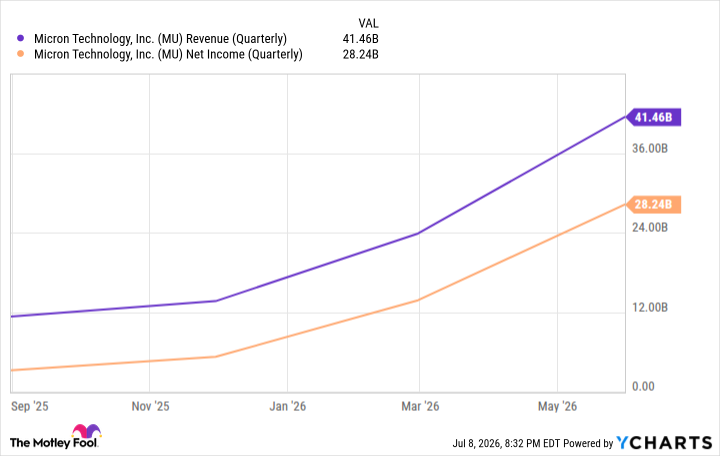
Given the high demand and short supply, Micron has been able to considerably raise prices and improve its profits and margins (though it has been accused of collusion and price-fixing). In the past year, Micron’s revenue has increased by 266%, while its net income has surged by 782%.
MU Revenue (Quarterly) data by YCharts
Unsurprisingly, the unique position Micron has found itself in — both financially and in terms of market position — has attracted many investors hoping to capitalize on it. And based on the president’s latest disclosure, he’s been one of those investors.
Today’s Change
(-1.05%) $-10.39
Advertisement
Current Price
$981.25
Key Data Points
Market Cap
$1.1TMarket cap calculated using publicly traded shares outstanding only. Does not include unlisted, private, or dual-class non-traded shares. Implied market cap may vary.Market cap calculated using publicly traded shares outstanding only. Does not include unlisted, private, or dual-class non-traded shares. Implied market cap may vary.
Day’s Range
$954.13 – $998.00
Advertisement
52wk Range
$103.38 – $1255.00
Volume
859.4K
Avg Vol
Advertisement
51.2M
Gross Margin
72.60%
Dividend Yield
0.05%
Advertisement
Should you follow Trump’s lead?
You shouldn’t invest in Micron simply because the president did. It’s true his stake in the company means he has a vested interest in making sure the stock does well, but you don’t want to blindly follow his moves simply for that reason.
You should, however, consider investing in Micron because its unique market position is bound to last for the foreseeable future. But even when supply meets demand, and Micron can’t command the premium it’s currently charging, the company will still have long-term agreements in place.
It’s operating in a cyclical industry that’s riding the high end, but it’s still a solid company with good long-term potential. It’s likely to be highly volatile along the way, but I trust its trajectory.
GRAND FORKS — Student loan repayment options and federal PLUS loans are seeing the biggest changes with the implementation of the federal One Big Beautiful Bill Act, said the director of student finance at the University of North Dakota.
Matt Lukach said students will see minor changes, but most of the work to make the alterations will fall upon UND’s system.
“It’s going to create work on our end, though, because all these changes will be manual, so we will have a lot more work on the back end. But hopefully, our students won’t see too much of a change from past years,” he said.
On Wednesday, July 1, changes to federal student aid programs from the OBBBA went into effect. Of the changes, Luckach sees the removal of the SAVE (Saving on a Valuable Education) loan repayment plan, the removal of the Graduate PLUS Loan Program and the alteration to the Parent PLUS Loan Program and scheduled reductions for federal loans at the undergraduate level as the most significant.
For undergraduate loans, students previously could get their full federal loan even if they were not a full-time student taking 12 credits. Following the changes, loans will be pro-rated down, depending on how many credits a student is taking. Most of UND’s undergraduate students are full-time students, Lukach said. For part-time students, UND will work to make adjustments to loan offers early so they won’t be as affected if they need to find alternative funding. UND already makes schedule reductions for Pell Grant funding.
Advertisement
A big change that may affect graduate students is the removal of the federal Graduate PLUS Loan Program. Some graduate students have used it to fund living expenses and pay for shortfalls while they finish their program. Graduate borrowers who have had a PLUS loan disbursed before July 1, 2026, while enrolled in a program, can continue to borrow for three academic years or the remainder of their program, whichever is less. Newer graduate students won’t be able to get the loans, and Lukach has seen movement in the private loan sector to balance this.
“We have had a lot of traffic, a lot of movement in the private loan sector in the last year to come up with options to help fill that gap of graduate PLUS loans,” he said. “The private educational loan industry is doing a pretty good job of coming up with some really comparable options to that loan.”
The Parent PLUS Loan Program won’t be going away, but it will be capped. Eligible parents can borrow a maximum of $20,000 per aid year per dependent student. In the past there was no cap, but Lukach said there wasn’t a high percentage of parents borrowing more than $20,000.
In Lukach’s opinion, the financial aid changes will be minor to current and incoming students. The bigger changes, he said, are in student loan repayment.
The SAVE plan, PAYE (Pay As You Earn) plan and the ICR (Income-Contingent Repayment) plan all are being phased out. Loan servicers are reaching out to current borrowers notifying them they have to choose different plans, though they can pay through the ICR plan until July 1, 2028. Their other options include a new tiered standard repayment plan and the new Repayment Assistance Plan.
Advertisement
RAP allows borrowers to pay monthly payments of 1-10% of the borrower’s income based on their adjusted gross income, with a minimum monthly payment of $10.
“I honestly don’t know what the effects of these new plans will be yet, because we’ve not heard from anybody, and they just went into effect,” Lukach said. “I’m sure we’ll see some chatter in the next few months on that (RAP) to see if it looks good, bad, the same. It’s hard to tell if it will be a benefit or a detriment to those people who are on the SAVE plan. We’re real early in this.”
New borrowers who borrow loans on or after July 1, 2026, have the options of the new tiered repayment plan or RAP.
Same as any other year, Lukach offers students this advice: Make a financial plan and know what is needed.
UND also has a monthly payment plan to cover gaps between a student’s charges and their financial aid, something Lukach has noticed students use more over the years. Overall, he’s seeing students be more fiscally responsible.
Advertisement
“It’s a good sign,” he said. “It means we have really high-quality students at the University of North Dakota, which I really, really love.”