Lifestyle
You can’t wear political clothing at the polls, so this woman voted in her bra


It seemed like a simple request.
Election workers asked a voter in Hamilton Township to take off her MAGA hat and cover up her shirt expressing support for former President Donald Trump.
Enraged, the woman took off her hat and shirt, spinning it like a lasso. She then proceeded to vote, wearing her bra, after hurling vulgar epithets at the workers before a crowd of as many as 100 voters, several people told NJ Advance Media.
In Gloucester Township, a voter waltzed into the polling location wearing a red cloak and white bonnet, inspired by The Handmaid’s Tale, the dystopian book and television series about a patriarchal society where women are forced into sexual slavery to bear children for their masters.
She complied with the request to remove her cloak and bonnet before voting, and then she walked out quietly while putting her outfit back on.
Early voting began in New Jersey last Saturday and turnout has been heavy so far. In addition to long lines, poll workers around the state have had to contend with, and sometimes confront, belligerent people who insist on showing their candidate preferences at the polls. Many may not realize that wearing political messaging while voting is not allowed, election officials said, but some simply don’t seem to care.
Indeed, ”electioneering” is against the law in the Garden State.
People cannot “distribute or display any circular or printed matter or offer any suggestion or solicit any support for any candidate, party or public question within the polling place or room or within a distance of 100 feet of the outside entrance to such polling place or room, or within 100 feet of a ballot drop box in use during the conduct of an election.”
That includes wearing T-shirts, hats or buttons, for example, that support a candidate or can be interpreted as trying to sway a voter’s opinion, election officials said. Bumper stickers and flags on vehicles within 100 feet of polling places are also prohibited.
When the “handmaid” voter arrived at the Gloucester Township polling location for early voting on Saturday, at first, poll workers thought she was wearing a Little Red Riding Hood costume, perhaps for a Halloween party.
She was dressed in a flowing red cloak with a white bonnet.
Then workers saw the bloody red handprints on the bonnet.
“When the board worker asked, she said it was Handmaid’s Tale,” said Sarah Napper, one of Camden County’s election administrators, who said the costume was a political statement. “We asked her to remove it. She did, but she proudly put it back on when she walked out of here.”
The woman who ultimately voted in her bra in Mercer County took offense when she was asked to remove a MAGA hat and T-shirt.
It happened at the Colonial Fire House in Hamilton Township, where voters waited on a long line for their turn to cast a ballot, said Jill Moyer, chair of the Mercer County Board of Elections.
“I asked her to remove her hat and said if you want to go get a jacket from your car, I will hold your place in line or you could go into the bathroom to turn the shirt inside out,” Moyer said of the Saturday encounter. “Before I could get it all out, she took off her shirt and flung it around.”
The woman started to curse at election workers and call them “nasty” names, Moyer said.
Moyer said she went to call the police but the woman quickly voted and left the building.
But before the voter left, one witness told NJ Advance Media, they captured a photo of the woman as she voted in her bra.
The witness said before the voter left, she put her shirt back on, inside out this time, and she also donned her hat, but not before she had another message for poll workers. “She gave the finger and said ‘Suck my ****,’” a witness said.
“I felt so bad for (the poll workers). They’re just trying to do their jobs and people are saying this god-awful stuff,” the witness said.
But it didn’t end there. The photo vent viral on social media, getting the attention of vice presidential candidate JD Vance. He retweeted the photo and called the voter a “patriot.” Vance later removed the post.
It’s not just about apparel. At the Galaxy Mall in Guttenberg in Hudson County on Saturday, Ben Applegate was standing in line with several dozen people, all waiting for their turn to vote. He said he heard someone start clapping for the crowd, as if they were happy to see so many people had come to cast their ballots. It was a man leaning over the second floor railing, he said.
“Then he yelled ‘Go Trump,’ and a man in a MAGA hat in line behind us said, ‘F*** it, I’m not afraid,’ and also started chanting ‘Trump,’” Applegate said. “I told him it was a polling place and they couldn’t do that here, and told him to shut up.”
Ben Applegate is photographed wearing his “I voted” sticker. He said someone shouted support for former president Donald Trump at a polling site.Courtesy Ben Applegate
The man who was upstairs came down and started walking through the line, shouting, “Trump! Where were you all in 2020?” Applegate said. “The poll workers were mostly older ladies, and I felt so bad for them. They were conferring with each other about what to do.”
Maryanne Kelleher, Hudson County’s Superintendent of Elections and Commissioner of Registration, said the man was “quickly shooed away by onlookers.”
“What we were advised is that Saturday’s incident was a momentary event that ended quickly, and was beyond 100 feet of the polling entrance,” she said.
Election officials across the state noted several dozen reports of electioneering, mostly people who were asked to remove hats or to cover T-shirts, and most complied without incident. But when voters don’t cooperate, poll workers call police for backup.
It happened at the Lower Township Library voting site in Villas, Cape May County, on Saturday, when a voter grew defiant.
“A gentleman had a Trump hat on. He was asked to remove it but he refused,” said Michael Kennedy, registrar and department head of the county Board of Elections. “One of the poll workers called the police. He told them he was being harassed by one of the other voters.”
The man removed the hat when police asked, Kennedy said. At least, he temporarily removed it.
“I was told right before he went in to vote that he put the hat on after the police left,” he said.
With Halloween on Thursday, some election officials said they are expecting more mischief.
“We are waiting for Halloween when someone comes dressed at a candidate,” said Beth Thompson, administrator for the Hunterdon County Board of Elections.
Back in Camden County, at the site of the Handmaid’s Tale incident, Napper, a Republican, said there are times when voters test the limits of the electioneering rules while accusing election workers of partisanship.
“When you talk to a voter and the first thing they say is, ‘Oh, you must be a certain party,’ that’s when I introduce my counterpart,” she said, giving a nod to Nellie McFadden, who serves as the county’s Democratic elections administrator.
“They are testing us,” McFadden said.
They shared the story of another voter who came to cast her ballot wearing a “Make Halloween Great Again” T-shirt. It included a picture of someone wearing a hockey mask like the one made famous by the Mike Meyers character in the Halloween movie franchise.
“It also had Trump hair, so you’re pushing it there,” Napper said.
“The voter said she was being discriminated against when she was asked to cover it up. She said it was a Halloween shirt but it’s a political statement as well,” Napper said.
“We do get pushback, but we try to explain to them we just want to run everything smoothly,” McFadden said. “We want everybody to vote and to be fair and kind to one another. We want this to be a pleasant experience for everyone.”
Please subscribe now and support the local journalism YOU rely on and trust.
Karin Price Mueller may be reached at KPriceMueller@NJAdvanceMedia.com. Follow her on X at @KPMueller.



Here’s something American concertgoers might not know: before a musician from another country can take the stage in the U.S., someone has to file paperwork with the federal government on their behalf. And not just any paperwork — a petition, hundreds of pages long, stacked with press clippings, award documentation, testimonial letters from other artists, venue contracts, a detailed tour itinerary, and evidence that the artist is legitimately accomplished at what they do.
And that’s just to start the clock in a process that may take over a year to complete.

This is the reality for international artists — from musicians to painters, dancers to comedians — who want to come to the U.S. to share their work. It’s a complicated, expensive process that arts advocates say has long made the country a difficult place for foreign artists to access. But now, they say it’s gotten much worse.
The time it takes to process a visa has dramatically increased. The number of available interview slots at U.S. embassies is backlogged. Application costs have surged. And there’s an added layer of uncertainty: paperwork can be perfect, fees can be paid, and yet artists still can be turned away at the border.
For U.S. audiences, all of this means a quiet loss of global cultural exchange.
What does the artist visa process look like?
To illustrate the nonimmigrant visa process for artists, let’s take Kongero, a small, Swedish folk a cappella group that completed its second U.S. tour last fall.
First step: File a petition.
The group’s booking agent planned the tour and gathered all the necessary documentation to file a petition with U.S. Citizenship and Immigration Services (USCIS) to demonstrate that the group qualified for a P-3 visa, the category for culturally unique artists.
Once USCIS approved the petition, each individual artist still needed to wait for a separate visa interview at a U.S. consulate in their country of residence.
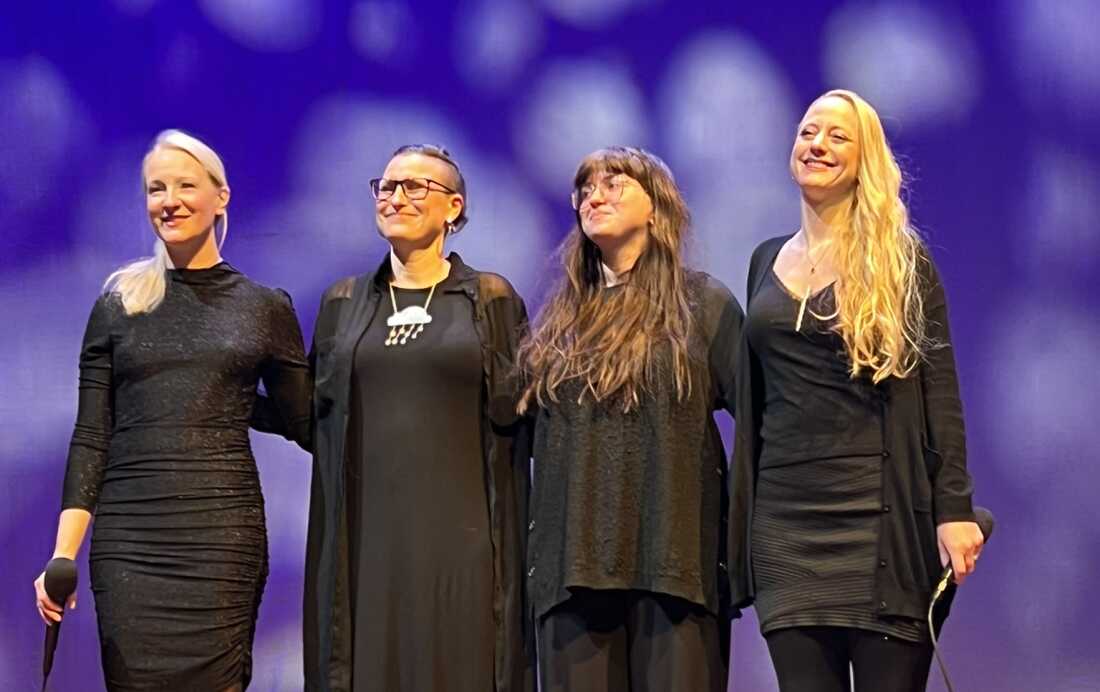
Swedish Folk’appella group Kongoro, Anna Wikenius, left, Lotta Andersson, Sophia Hultqvist Kott and Emma Björling perform in Greensboro, Vt., in December 2023.
Danielle Devlin
hide caption
toggle caption
Danielle Devlin
According to several artists and attorneys, nonimmigrant visa processing had historically taken around two to four months, though processing time started to increase after a backlog built up during the pandemic, and then increased further after the Trump Administration’s crackdown on immigration.
Visas can be withheld and reviewed again any time the federal government announces an immigration policy change, like a travel ban update, or revisions to the petition review policy, said Zelo Safi, a senior attorney with the Artistic Freedom Initiative. There have been several similar changes during the Trump Administration.
Right now, the average time to review a P visa petition like Kongero’s is 11 1/2 months. Processing for an O-1 visa petition — for individual artists of “extraordinary ability” — has grown to a little over a year. The problem is that the government won’t even accept petitions more than a year in advance for all O visas, which are temporary work visas for those with extraordinary ability or achievement.

According to one manager of a dance troupe from Spain, the process is “completely out of sync with how the arts industry works.” Like many artists and managers NPR reached out to, this dance troupe manager requested that NPR not use their name out of fear that there would be reprisals against their future visa applications. Others declined to be interviewed for the same reason.
A statement to NPR from the U.S. Citizenship and Immigration Services said that the new procedures are due to “increasing threats to public safety and national security.” It continued, “Verifying identities and personal histories from various countries requires a rigorous process — one that prioritizes the safety of the American people over everything else.”
Step two: take out your wallets
If you can’t wait a year — and most artists can’t — you pay. Specifically, you pay $2,965 per petition for premium processing, another travel fee that has increased in recent months. According to immigration attorneys, paying that fee is essentially a mandatory step for artists if they want to make their scheduled tour dates.

Kongero paid it, and they still ran into trouble. The group was granted only two months of entry instead of the year they’d applied for, forcing them to cancel their planned 2026 summer, fall and winter appearances.
Matthew Covey, executive director of Tamizdat, a legal nonprofit that helps performing artists navigate U.S. visa processing, has watched his client numbers drop since premium processing effectively became mandatory. He says that they’re choosing not to come to the U.S., because for many, the cost of total travel expenses has become too great.
“The current situation is [that] a tour that would have been marginal and maybe break-even, even five years ago, is a losing-money project now,” he said.
Step three: the interview
Once USCIS approves a petition, each individual artist still needs to wait for and complete a separate visa interview at a U.S. consulate in their country of residence. It is the Department of State that issues visas if everything checks out. With current backlogs, an interview can take months to schedule, and they cannot be missed.
Group member Emma Björling missed the first week of a two-month U.S. tour after the Trump administration instituted a new, mandatory in-person interview requirement last September.
When the new requirement was announced, she was on tour with a different musical group in Canada. Now, because of the new policy, she first needed to fly all the way back to Sweden to do the interview, before returning to North America to do the U.S. tour.
The U.S. tour ended up running $8,000 in the red. Kongero won’t return to the U.S. in 2026.
“With all the additional fees and costs and troubles and stress … it’s not worth it, not financially, and not stress-wise and workload-wise,” Björling said.
In a statement, the Department of State said, “Under President Trump, the United States is unapologetic in implementing America First visa policies. We welcome the many foreign artists who follow the required procedures and meet all of the visa requirements under U.S. law.”
But if your paperwork is approved and your interview is completed, and your fees are paid, congratulations! You have a visa!
But does that mean you get to enter the country?
Maybe not.
Step four: get past the border
Once artists have their travel arrangements set, their petition approved and their passport stamped, one final hurdle awaits once they arrive in the U.S.
U.S. Customs and Border Protection (CBP) agents have final authority at ports of entry — and arts organizations say the current climate has introduced a new level of unpredictability in how that authority gets used.
Comedian and theater-maker Alaa Shehada had come to the U.S. twice before to perform his one-man show, The Horse of Jenin, about growing up in the West Bank. He had a valid O-1B visa when he landed at John F. Kennedy Airport last November for another scheduled performance. But this time around, he says officers pulled him aside for additional questioning as soon as they saw his Palestinian Authority passport.

Alaa Shehada in The Horse of Jenin.
Dario & Misja Photography
hide caption
toggle caption
Dario & Misja Photography
After hours of questioning, Shehada said he was handcuffed and transferred to an immigration detention facility in New Jersey, where he described spending the night with other detainees in a cramped room on a concrete floor, shocked and confused.
He was placed on a return flight to his residence in Amsterdam the following morning — one day before his scheduled performance in Massachusetts. Neither he nor his producer received a clear explanation for why his visa was rejected. In a statement to NPR, CBP said Shehada was refused entry for “not being forthcoming with facts” during his interview with CBP officers.
“When an immigrant attempts to enter the U.S. without possessing an immigrant visa or is not forthcoming with facts during an interview, travelers may be subject to detention and refusal as statutes or visa terms may be violated,” the statement read. “A visa is a privilege, not a right, and only those who respect our laws and follow the proper procedures wil

l be welcomed.”
About a month later, the Trump administration issued an expansive travel ban that suspended visa issuance to individuals applying using any travel documents issued or endorsed by the Palestinian Authority.
“Of course, it is scary to sit with people with power who can just kill your dreams as simple as that,” Shehada said, who had planned to tour additional U.S. and Canadian cities. “You feel how unfair and humiliating that is.”
Covey says there’s heightened scrutiny at U.S. ports of entry, but less consistency with how that scrutiny is applied. In a statement, CBP said, “Admissibility determinations are made on a case-by-case basis using law enforcement, national security, and immigration information available at the time of inspection. CBP officers have the authority to question travelers, conduct inspections, and determine admissibility consistent with U.S. law.”
Jennifer Roe, executive director of Folk Alliance International, which connects artists with presenters globally, says that this means there’s no room for even the smallest of mistakes.
“I know a lot of artists are fearful of coming into the U.S.,” she said. “They’re hearing stories of being asked random questions at the border and being sent home because they didn’t answer something correctly.”
Ripple effects
When an international artist cancels their tour, the effects ripple outward.
The presenters who were stops on Shehada’s upcoming visit had already begun marketing the show and selling tickets. The New York Theatre Workshop had built an entire festival around the show. Boom Arts, a small presenter in Portland, had rented a theater for Shehada’s live performance. While several of the presenters were able to switch to showing a filmed version of the show, Shehada’s tour producer Jenny Tibbels said the losses totaled tens of thousands of dollars.
Shehada’s performance at the University of Massachusetts Amherst Fine Arts Center had been planned for nearly a year before it was canceled at the last minute. Executive Director Jamilla Deria said the organization had been eager to share a story from a Palestinian artist with the community.
“In Western Massachusetts, where our communities are more rural, access to storytelling and the perspective of folks who are coming from parts of the world that you don’t have direct engagement with is not only lost for that night, but maybe lost for good,” she said.
Tracy Francis, a presenter with Boom Arts, said that recent travel bans and changes in immigration policy are forcing her to make difficult decisions about which international artists she can safely invite to share their art in person. She’s already shaped her next season around which countries’ artists are realistically likely to be allowed in.
“I was bringing more European artists for the first time next season, just because their visas are more likely to get approved,” she said. “I also was more careful about making sure that artists I am bringing are on a larger tour, so there’s more shared costs.”
Shehada said his experience traumatized him.
“This experience was so hard and deeply hurtful, so the idea of coming back becomes so hard,” he said. “I would love to go and meet the international audiences, the Americans. I have lots of people and friends in the U.S,, and of course, this is my mission as an artist. This is my approach to reach audiences, but with that experience, right now, I don’t feel like going back at all.”
Jennifer Vanasco edited this story for broadcast and digital. Chloee Weiner mixed the audio. Danielle Scruggs edited the visuals.

My favorite memory of the 2026 World Cup happened last month. By the late morning of June 18 in Koreatown, hours ahead of the Mexico vs. South Korea group-stage match, it was apparent that the neighborhood would be unrecognizable by kickoff.
I had heard rumblings about the Korean Festival Foundation’s watch party, but once I found out it would take place at Seoul International Park, I was almost dissuaded entirely. Although it is the beloved destination of my dog’s morning walks, its insignificant size and awkward location just off Olympic Boulevard didn’t seem appropriate for such a coveted event. So, I went to scout it out beforehand — and I almost couldn’t believe my eyes. There were already about 100 to 200 fans in the park, about six hours before the first whistle; laughing, drinking, lending a hand to vendor setups.
My apartment is only about six-odd blocks from the park, but closer to the game, I noticed a gigantic wave of red, lavender and white jerseys already crashing toward the watch party. It took my roommates and me about 30 minutes to walk the half-mile at 4 p.m., squeezing past fervent fans to eke out a spot in front of one of the two humongous screens situated on either side of Irolo Street.
Unfortunately for us, all of the good vantage points were taken. A mass in front of both screens was impenetrable; smaller televisions hooked up to generators were already seized by 10 too many eyes; even the roofs surrounding the park were full of attendees much bolder and athletic than me. We settled on the soccer field in the park, where we could juggle a ball around a bit while watching the match on our phones (and thank you to my girlfriend’s dad for his Peacock subscription).
The first half onscreen was mostly uneventful, but off-screen, I was able to witness a sort of camaraderie seen rarely in sprawling Los Angeles. People were swarming vendors from eateries all around Koreatown, dance circles formed around speakers blasting banda music, and “oohs” and “ahhs” at every missed shot were in perfect sync. Then, it happened: a goal in the 50th minute by Luis Romo of the Mexican side. The park and its surroundings exploded into a collective cheer that tickled my rib cage and resonated deep in my ear canal to the point I had to cover my ears. I can hardly remember if I joined the chorus, or if the excitement was so heavy that I just felt like an equal part of it.
Seeing my neighborhood in this light will stick with me much longer than the 1-0 result, or the fact that neither of these teams (both of which I partially rooted for) made it far into the tournament. But these memories, I believe, are what the World Cup is really about.
So tell us about your most cherished memory of the 2026 World Cup in L.A. so far. And remember, no moment is too small. We may feature it in an upcoming story.

Sam Neill arrives at the premiere of “Apples Never Fall” on March 12, 2024, in Los Angeles.
Richard Shotwell/AP Photo/Invision
hide caption
toggle caption
Richard Shotwell/AP Photo/Invision
WELLINGTON, New Zealand — Sam Neill, a smoothly elegant and versatile actor whose career moved from art film to blockbuster as he dodged velociraptors in “Jurassic Park” to playing Holly Hunter’s husband in “The Piano,” has died. He was 78.
In 2023, Neill disclosed he had been diagnosed with angioimmunoblastic T-cell lymphoma, a rare type of non-Hodgkin lymphoma. Neill died on Monday in Sydney, according to a statement posted to the actor’s social media page.
His death was “sudden and unexpected,” the statement said, adding that he “remained cancer free” when he died. A cause of death wasn’t specified.
“Sam was surrounded by family and passed with the dignity that has characterised his whole life,” his family wrote.
Actor came to world’s notice with ‘Dead Calm’ and ‘My Brilliant Career’
Neill was one of a host of actors and directors who achieved international fame after an explosion of Australian films that began in the late 1970s, a list that includes Paul Hogan, Mel Gibson, Geoffrey Rush, Russell Crowe, Jane Campion, Peter Weir and Gillian Armstrong. His range was remarkable, playing opposite Helena Bonham Carter in the Alan Ayckbourn comedy “Sweet Revenge” to chopping off Hunter’s finger in “The Piano” to poking his own eyes out in the sci-fi horror “Event Horizon.”
In “Omen III: The Final Conflict,” he played Damien the Antichrist and he also played Cardinal Thomas Wolsey in “The Tudors.”
The actor first came to the attention of international audiences in Armstrong’s 1979 film “My Brilliant Career,” which also introduced Judy Davis. He later appeared in Phillip Noyce’s “Dead Calm,” a classy thriller set at sea and co-starring the then-relatively unknown Nicole Kidman.
Neill twice co-starred with Meryl Streep, in Australian director Fred Schepisi’s “Plenty” and — again for Schepisi — in “A Cry in the Dark,” a film about the sensationalized aftermath of a dingo killing a baby in the Australian Outback. He earned an Emmy nomination for his performance in the title role of the 1998 miniseries “Merlin” and another as narrator of 2017’s “Wild New Zealand.”
‘Jurassic Park’ was his best-known film
Perhaps Neill achieved his highest level of fame in “Jurassic Park” playing paleontologist Alan Grant, who is summoned to an island off Costa Rica where a theme park has been built to house herds of cloned dinosaurs. He co-starred alongside Laura Dern, Jeff Goldblum and Richard Attenborough.
His character was thoughtful and reasonable, a scientist who warned the mastermind of the theme park before the chaos: “Dinosaurs and man, two species separated by 65 million years of evolution have just been suddenly thrown back into the mix together. How can we possibly have the slightest idea what to expect?”
Grant survived the harrowing events when the creatures get loose, but didn’t return for “The Lost World: Jurassic Park II” in 1997. He came back for the third episode in 2001 and “Jurassic World: Dominion” in 2022.
“It’s probably a little late to learn these things,” he told the Daily New of New York in 2001, “but I finally feel I’ve worked out how to be an action hero. I’m happier with Grant this time. He’s gnarly and grizzled, but he looks like he knows what he’s doing.”
Neill grew up in Northern Ireland, then New Zealand
Born in 1947 in Northern Ireland, Neill emigrated to New Zealand at the age of 7. He was born Nigel Neill, but told interviewers he started to go by Sam because there were too many Nigels at his school.
His family settled in Dunedin on the South Island and he was sent to boarding school in Christchurch. After college, he took the lead in “Sleeping Dogs” in 1977, the first feature made in New Zealand in more than a decade.
Neill’s other film roles included playing a Soviet submarine officer who memorably dreams of a home in Montana in “The Hunt for Red October” and an investigator in director John Carpenter’s “In the Mouth of Madness.”
On the small screen, Neill played the malign Chester Campbell in TV’s “Peaky Blinders” and Thomas Jefferson in the four-hour CBS miniseries, “Sally Hemings: an American Tragedy.” On Apple TV+, he was on “Invasion,” playing Oklahoma Sheriff John Bell Tyson, a man late in his career searching for his purpose. In 2024 he starred opposite Annette Bening in the Peacock series “Apples Never Fall.”
Actor beloved in New Zealand as an unassuming celebrity
The actor became known in New Zealand as a modest and unassuming person who didn’t embrace celebrity. On social media, he often posted images of his farm animals, many of them affectionately named after celebrities and friends, like Laura Dern the chicken, Kylie Minogue the duck and Helena Bonham Carter the cow.
New Zealand Prime Minister Christopher Luxon mourned Neill as “one of the greats” in a statement posted to social media.
“He started out when there was barely a film industry to speak of,” Luxon wrote. “For more than fifty years he took New Zealand stories to the world and his talents helped make our film industry into what it is today.”
Neill was also a vintner and under his Two Paddocks brand, he produced pinot noir and riesling wines from his winery in the Central Otago region of New Zealand’s South Island.
His memoir “Did I Ever Tell You This?” came out in March 2023 and he was awarded a knighthood in recognition of his “outstanding contribution to film,” a title approved by the late Queen Elizabeth II.
“I can’t pretend that the last year hasn’t had its dark moments,” Neill told The Guardian in 2023, referring to his cancer diagnosis and treatment. “But those dark moments throw the light into sharp relief, you know, and have made me grateful for every day and immensely grateful for all my friends.”
He is survived by his four children and eight grandchildren.
-

 Augusta, GA51 seconds ago
Augusta data center rules in limbo as deadline looms
-

 Washington, D.C7 minutes ago
DC residents who’ve owned their home for 70 years now told they can’t park there
-
Cleveland, OH13 minutes ago
Ohio ties emerge in major international cybercrime takedown
-

 Austin, TX19 minutes ago
Texas launches investigates LinkedIn over claims of “ghost jobs”
-

 Alabama25 minutes ago
Tuberville residency challenge appealed to Alabama Supreme Court
-
 Alaska31 minutes ago
Winners & losers
-

 Arizona37 minutes ago
AMC Theater’s Valuation Was Excessive, Says Arizona Tax Court
-

 Arkansas43 minutes ago
Governor, AEDC award $12.5 million in grants to rural Arkansas communities – Talk Business & Politics


