Science
A wave of major listeria recalls shows food safety will 'never be perfect'


Deli meats, grab-and-go salads and frozen meals are staples of the modern American diet — convenient and inexpensive options that shoppers readily toss into their carts during grocery runs.
But after hundreds of those products were flagged in major listeria-related recalls recently, nervous consumers have been left to scour their refrigerators for potentially tainted food as government inspectors try to piece together how the problems began.
Listeria contamination at a BrucePac processing plant this month and a deadly multistate outbreak linked to Boar’s Head liverwurst over the summer led to the sweeping recalls. All told, about 20 million pounds of meat and poultry products sold nationwide at Trader Joe’s, Walmart, Target, Ralphs and other businesses were affected, highlighting the public health challenges that come with producing food for the mass market despite significant advancements in sanitizing and testing.
“The messages that go out to consumers typically are, ‘We have the safest food supply in the world,’” said Barbara Kowalcyk, director of the Institute for Food Safety and Nutrition Security at George Washington University. “What these back-to-back recalls show is we aren’t where we thought we were.”
Although listeria has been the culprit in many food scares lately — on Friday, TreeHouse Foods issued a recall for hundreds of frozen waffle and pancake products for potential contamination — food safety experts said the string of incidents is merely coincidence.
“There’s no evidence at all to suggest that our food supply is less safe than before — in fact, I would argue for the opposite,” said Martin Bucknavage, a senior food safety extension associate at Pennsylvania State University’s Department of Food Science.
The safety of mass-produced food has improved dramatically in the last three decades, experts noted, thanks to better sanitization procedures, increased regulation and the use of technologies such as whole genome sequencing to help detect pathogens quickly.
But listeria, a common and stubbornly persistent type of bacterium, presents unique hurdles.
Unlike many other foodborne pathogens, it thrives in the cool, damp conditions found in processing plants. Unsanitary facilities can cause contamination, but the bacteria can also be introduced through raw ingredients, water, soil tracked into a plant on a worker’s shoe and even incoming air, said Brian Schaneberg, executive director at the Institute for Food Safety and Health at Illinois Institute of Technology.
“It is ubiquitous in the environment,” he said.
Making things worse, listeria can spread easily if food comes into contact with contaminated surfaces and multiply rapidly despite aggressive cleaning and sanitizing, according to the USDA. Listeria has been found in products including cold cuts, hot dogs, sausages, unpasteurized milk, soft cheeses, smoked seafood and raw vegetables and fruits.
Boar’s Head Virginia Ham was one of many products recalled as part of an investigation into a deadly listeria outbreak that began in July.
(Associated Press)
The U.S. Department of Agriculture’s Food Safety and Inspection Service has jurisdiction over the safety of meat, poultry and egg products. It requires manufacturers to develop and implement systems to prevent and reduce the occurrence and numbers of pathogens on their products and to decrease the incidence of foodborne illness.
Meat and poultry processing facilities are checked by federal inspectors at least once during every shift that a plant is in operation, according to a Food Safety and Inspection Service spokesperson.
For their part, food companies take preventive measures such as requiring workers to cover their shoes or step onto sanitized mats or into disinfecting foot baths whenever they enter a facility, and change their disposable aprons and gloves when moving from one production line to another.
They also conduct their own in-house testing, which can include extensive swabbing of surfaces, raw ingredients, finished products and areas where listeria is known to thrive, such as floor drains.
“No company wants to have an issue like this,” Bucknavage said, referring to the recent spate of recalls. Listeria’s ability to adapt and proliferate under varied conditions means “it’s an ongoing battle,” especially at large food-processing establishments like BrucePac, which churns out precooked, ready-to-eat meat and poultry products in huge quantities.
“You’ve got chicken juices, you’ve got people moving around, you have a lot of different types of equipment,” he said. “All of that has to be controlled down to the microbiological level.”
BrucePac and Boar’s Head did not respond to requests seeking information on how they conducted their safety tests before the recalls.
Every year an estimated 48 million people get sick from a foodborne illness, 128,000 are hospitalized and 3,000 die, according to the Centers for Disease Control and Prevention, which typically coordinates 17 to 36 investigations in multiple states each week.
Consumption of food contaminated with listeria can lead to listeriosis, a serious infection that primarily affects adults 65 and older, people with weakened immune systems, pregnant women and newborns. Symptoms include fever, muscle aches, headache, stiff neck, confusion, loss of balance and convulsions sometimes preceded by diarrhea or other gastrointestinal issues. It is the third leading cause of death from foodborne illness in the U.S., the CDC said.
The Boar’s Head outbreak, which began in July, has been linked to 59 hospitalizations and 10 deaths across 19 states. No illnesses have yet to be reported in the BrucePac and TreeHouse recalls.

TreeHouse Foods is recalling hundreds of its frozen waffle and pancake products for potential listeria contamination. The items were sold under various labels and distributed to stores including Trader Joe’s and Target.
(TreeHouse Foods Inc. via AP)
There’s also a steep financial cost. The economic burden of foodborne illness was estimated to be as high as $90 billion annually, according to a 2020 research paper published in the Journal of Food Protection.
Listeria is unusually hard to trace after an outbreak because it has a long incubation period — the CDC says it can take up to 10 weeks for some people to develop symptoms. Many people don’t seek medical attention after they become sick, and those who do generally have trouble recalling what they ate several weeks ago.
Boar’s Head, which produces and sells deli meats, cheeses and condiments, called the outbreak a “dark moment in our company’s history” in a letter to customers in September.
“Comprehensive measures are being implemented to prevent such an incident from ever happening again,” the Sarasota, Fla., company said.
Boar’s Head has been working with the USDA, state government regulatory agencies and food safety experts to determine what went wrong. The investigation is still ongoing, and the results will include “what needs to be improved and where policy changes are needed,” the Food Safety and Inspection Service spokesperson said.
Boar’s Head shared some preliminary findings last month, saying it had identified the root cause of the contamination as “a specific production process that only existed” at its facility in Jarratt, Va., and was used only to make liverwurst. As a result, it said it was permanently discontinuing the production of liverwurst and was closing the Jarratt plant for good.

An aerial view of the Boar’s Head processing plant in Jarratt, Va., that was tied to a deadly food poisoning outbreak in July.
(Steve Helber / Associated Press)
Boar’s Head also published a notice of suspension that the USDA sent on July 31, which laid out numerous “insanitary conditions” and other problems at the plant. Among them: beaded condensation dripping over products, employees moving racks of coolers between lines without changing personal protective equipment and a sample collected from a pallet jack that tested positive for listeria.
“Clear liquid was observed falling from a square patch in the ceiling,” the notice said. “A black fan was mounted to the ceiling and was blowing the leaking clear liquid into the Blast Cell Hallway, where 9 trees of uncovered Assorted Hams were stored.”
What these back-to-back recalls show is we aren’t where we thought we were.
— Barbara Kowalcyk, director of the Institute for Food Safety and Nutrition Security at George Washington University
Besides working with government inspectors to investigate contamination, food manufacturers also have to help track down products affected by their recalls, an unwieldy task in situations where hundreds of different items with various sell-by and best-by dates were sent to businesses around the country. In the BrucePac case, items were widely distributed to supermarkets, big-box discounters, wholesale clubs, restaurants, schools and other establishments.
Retailers like to say they have close relationships with their suppliers and buy only from vendors they trust. But issues still arise, leaving companies scrambling to get the word out to customers.
Trader Joe’s, which is in the process of recalling several of its private-label salads, wraps and other items made with ready-to-eat BrucePac products, says it does “daily work to make certain our products meet our stringent food safety expectations.”
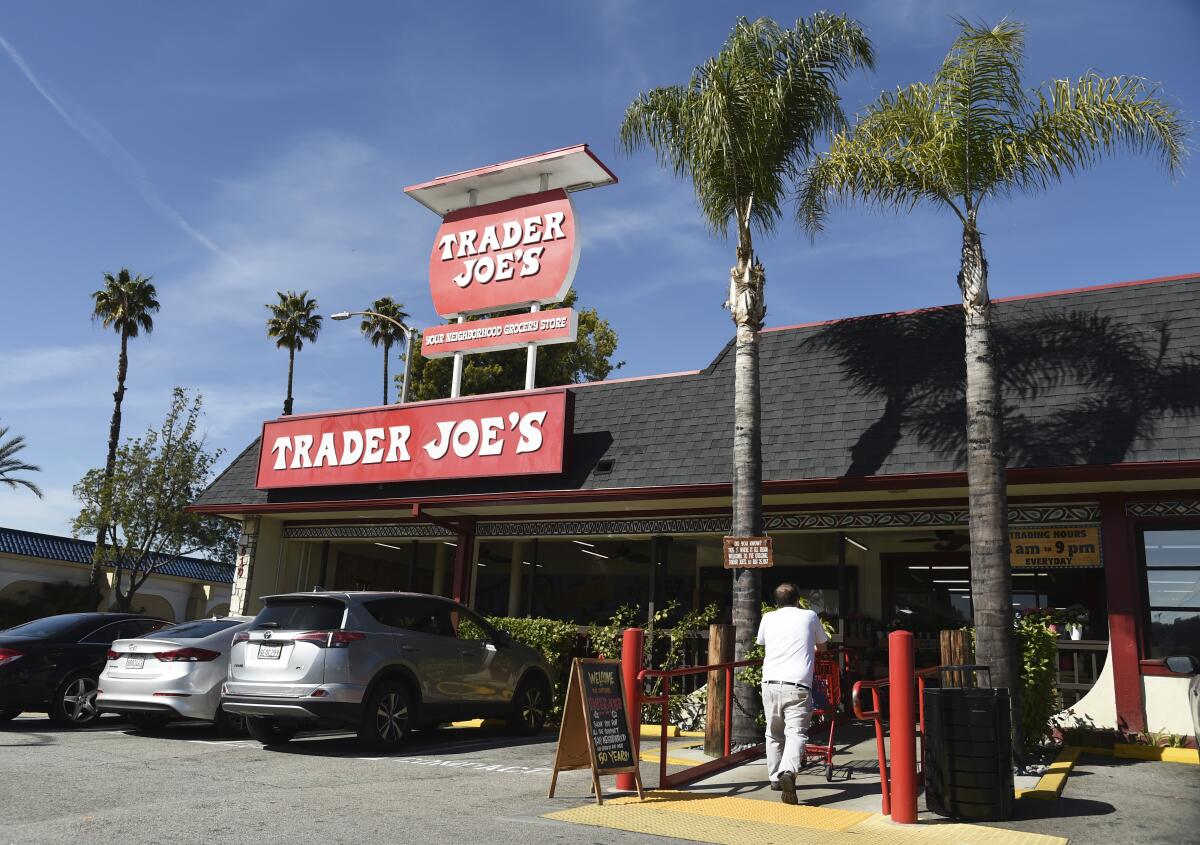
(Chris Pizzello / Associated Press)
“We voluntarily take action quickly, aggressively investigating potential problems and removing the product from sale if there is any doubt about its safety or quality,” the company says on a food safety page on its website.
Yet another high-profile deadly outbreak was announced Tuesday, when the CDC issued a food safety alert after discovering an E. coli outbreak linked to McDonald’s Quarter Pounders; there are currently 49 cases across 10 states, including 10 people who were hospitalized and one who died. The CDC, USDA, Food and Drug Administration and public health officials in multiple states are now investigating.
Although inspections and investigations are shared responsibilities between food manufacturers and government entities, “the onus is really on the company,” Kowalcyk, of the Institute for Food Safety and Nutrition Security, said.
“If you look at the complexity of our food supply and the number of producers and the number of importers, it’s growing exponentially,” she said. “Do I think the agencies can do more? Yes. Do I think they have the resources that they need to do more? No.”
Food safety will “never be perfect because pathogens are living things and all systems fail,” she continued. “We’ve got to recognize we’ll never get to zero, but we can get pretty close and that’s what we should be striving for.”


new video loaded: NASA Announces Artemis III Crew
transcript
transcript
NASA Announces Artemis III Crew
NASA announced the crew of Artemis III mission, which will fly to low-Earth orbit to test rendezvous and docking maneuvers with one or two lunar landers.
-
“I am excited to welcome you as the next crew in the Artemis journey to successfully return to the moon — this time to stay.” “I’m honored by the role that I’ve been given. I’m also very humbled by the task in front of us. But first and foremost, I’m grateful.” “So with that, the Artemis II crew, comrade, hands you the baton. You got the controls.” “As you know, we had a significant anomaly at our Launch Complex 36A on May 28. We’ve redoubled our efforts and are moving forward.”
By Alisa Shodiyev Kaff
June 9, 2026
Science
Santa Monica Mountains’ last steelhead trout survived the Palisades fire — and even had babies

Scientists feared the Santa Monica Mountains’ last remaining steelhead trout were dead, smothered by debris flows unleashed by the Palisades fire.
But the endangered fish surprised them: A team of biologists recently spotted 30 of the rare trout — and 21 babies — in Topanga Creek.
“There was a lot of happy dancing in the creek,” said Rosi Dagit, principal conservation biologist for the Resource Conservation District of the Santa Monica Mountains, which works with public and private landowners to conserve natural resources.
That’s because the steelhead here are endangered, at both the state and federal levels. Once, they swam in most streams of the Santa Monicas, but their numbers plummeted amid overfishing and coastal development. Increasingly frequent wildfire has further stressed their habitat. Topanga Creek, a biodiversity hot spot, is home to their last known population in the mountains that stretch from the Hollywood Hills to Point Mugu in Ventura County.
The trout that were spotted, including this one, are part of a distinct Southern California population that’s listed as endangered at the state and federal levels.
(RCDSMM Stream Team)
The California Department of Fish and Wildlife spearheaded a complex mission to rescue trout threatened by the Palisades fire that sparked in January 2025.
Time was of the essence. The fire hadn’t yet been fully contained. But rain was on the way, which would sweep massive amounts of sediment from the denuded hillsides into the water. Fish are often killed this way.
Crews stunned the fish with electricity, scooped them up in buckets, trucked them to a hatchery and ultimately moved them to Arroyo Hondo Creek in Santa Barbara County.
Within days, Topanga Creek was choked with mud. Some assumed the fish left behind were goners.
But in March, the conservation district’s team found four. The following month, when water conditions were clearer, they saw more.
“These fish continue to amaze me,” said Kyle Evans, environmental program manager for the state Department of Fish and Wildlife, who had seen the damage to the creek. “I had seen populations get wiped out in similar situations. So when I heard, I was thrilled.”
Evans surmises the fish that survived were in an area of the creek where less charred material and sediment were swept in.
“These fish likely hunkered down, were hiding under some rocks or places to try to get away from the main concentration of flow,” he said. “And luckily they weren’t buried.”
The ones that were spotted were fairly small, around 6 to 14 inches. Rainbow trout and steelhead trout are the same species, but with different lifestyles. If the fish remain in freshwater, they’ll be considered rainbows. However, they can migrate to the ocean and become steelhead, where they typically grow larger before returning to their natal waters to spawn.
Topanga Creek hasn’t fully recovered from the damage it sustained, but scientists say it’s looking better. Surveys last year were “so depressing,” Dagit said, with very few animals, and stretches that were essentially transformed into flat roads from all the sediment buildup. Some of the riparian canopy burned right down to the creek.
Then came 32 inches of rain over the last nine months, scouring out and moving sediment, creating deeper pools. Dagit said they recently found newt egg masses for the first time in years, as well as a few adult newts and many frogs. Plants that provide cover are starting to recover.
She provided photos comparing certain pools last year and this year, some dramatically transformed. In September 2025, the Shrine Pool could have been an overgrown hiking trail. This April, it was filled with shallow water.

The Shrine Pool in September 2025, left, and the same location in April 2026, right, with RCDSMM’s Isaac Yelchin donning a wetsuit.
(RCDSMM Stream Team)
Topanga Creek is home to another endangered fish, the small but hardy northern tidewater goby, often described as cute. Not long before the trout operation, Dagit led a rescue of hundreds of these fish too. Many were repatriated to the lagoon at the mouth of the creek in a moving ceremony last June.
There’s still the matter of what to do with the trout that were moved to Santa Barbara County last year. Evans would like to bring them home to the Santa Monicas at some point, but isn’t sure if it will happen. On one hand, they could bolster the small, genetically isolated surviving population. On the other, they might inadvertently bring in a disease or bacteria. There is some time to decide. Evans estimates the creek still needs to recover for two to three more years.
For now, the fish are functioning fine in their adopted creek. Experts worried the trauma wrought by the move would disrupt their spawning process, but they had babies that spring. This year, they spawned again.

The Pacifica Municipal Pier was shut down and taped off Thursday after city workers noticed cracks running through the landmark structure and concrete chunks falling into the ocean.
It’s just one of many coastal California structures that have recently crumbled under pressure from a rising and relentless ocean.
Officials from the small, beach city south of San Francisco said the pier was closed due to “cracking, separation, and displacement of the concrete walkway and structural elements.”
It will stay closed while structural engineers asses its safety.
Photos taken by city employees show a wide crack that runs from top to bottom and across the structure as well. Other photos show a large horizontal crack under the foundation of a small restaurant on the pier, the Chit Chat Cafe.
The cafe was also shut down.
This is not the first time the 53-year-old pier has shown signs of stress. In 2021, part of it was shut down after handrails along the edge collapsed. And in 2023, after a series of storms pummeled the Central California coast, damaging parts of the pier, the structure was partially closed for more than year.
Those same storms caused extensive damage in Aptos and Capitola, 70 miles south, where piers and waterfront infrastructure were swept away or damaged.
In 2024, a 150- to 180- foot section of the Santa Cruz wharf was ripped off by powerful waves.
At least 10 of the state’s dozens of coastal public piers were closed for part or all of 2024 due to structural damage sustained in winter storms since 2022. At least five others have longer-term upgrades planned to address structural issues.
“These things are costly to maintain,” said Zach Plopper, senior environmental director at Surfrider. “They are a part of our California coastal culture in many ways, but we’re going to need to reckon with, one, the state that they’re in, and two, the continuous and worsening threats they’re going to experience,”
He said most of the piers were constructed in the early 1900s, and they weren’t built to withstand decades of rough seas, storms and rising sea level.
“With this incoming El Niño, which is forecasted to be significant, and this marine heat wave we’re in the midst of, we’re kind of in uncharted waters as far as what this winter could bring in terms of storms and swells to the California coast, and we’re likely going to see a lot more damage,” he said. “Not just piers, but roads and other coastal infrastructure up and down the state.”
There was no storm in Pacifica earlier this week, so no single event could be blamed for the destruction.
However, a 2025 report from an outside engineering firm, GHD, found that several sections of the pier were in “poor” or “serious” condition, and they recommended closure before anticipated storms or events that could “subject the piles to high winds, swells and large waves.”
The firm found several areas of the pier where concrete was missing and rebar was exposed and corroding.
“The pier has continued to experience high winds and large waves in a harsh marine environment,” the engineers wrote in the report, noting that continuous exposure to seawater or marine spray was “detrimental” to the structure.
A 2023 city report estimated it would cost $19 million to repair.
That same year, a state law was enacted to require local governments along the California coast to plan for sea level rise in the coming decades.
Sea level has risen some 8 inches, on average, along the coast in the past 150 years, Plopper said, and researchers anticipate another foot in the next 25 years.
“We’re going to see profound shifts on our coastline, none that we have ever experienced before, and building static structures on the coast just doesn’t work all that well,” he said. “We’re going to have to make some really hard decisions.”
-

 Arkansas55 seconds ago
Arkansas lands grant to battle deadly cattle tick disease
-

 California6 minutes ago
Operation Hands Down disrupts Central California gangs – Inside CDCR
-

 Colorado13 minutes ago
$25.7M Colorado private ski mountain property heads to auction
-

 Connecticut16 minutes ago
Connecticut driver spots snake in car while driving, police say
-

 Delaware21 minutes ago
Delaware Bay’s new oil spill response boat officially christened
-

 Florida28 minutes ago
Sheriff’s Office investigating fatal shooting of child in Florida City
-

 Georgia31 minutes ago
Northwest Georgia Congressman pushes for impeachment of federal judge for misconduct
-

 Hawaii36 minutes ago
A wet start to the dry season in East Hawaii – West Hawaii Today

