Science
Kids are sucking down baby food pouches at record rates. ‘We’re going to pay for it,’ experts say


Every week, Caitlin Scuttio stops by Target and piles her cart with pureed food pouches for her 4-year-old and twin 18-month-olds sons.
In goes a 24-pack of unsweetened applesauce. Then a 24-pack of the fruit and veggie blend. And finally, the yogurt pouches for her oldest son’s breakfast. “He’d eat six apple sauce pouches a day if I let him,” Scuttio said.
Total monthly pouch budget: $200.
“They have such a choke hold on my family. I can’t imagine our grocery list without it at this point,” she said. “We are definitely a pouch family.”
Sales of baby food pouches have increased 900% over the last decade. Pouches are now the most popular baby food on the market.
And they aren’t alone. Sales of food pouches — soft bags with plastic spouts for easy consumption — have increased 900% since 2010, overtaking jarred purees as the predominant baby food on the market. Parents generally spoon-feed jars of pureed foods for a few months in the first year of life when introducing solids, but pouches marketed to parents of toddlers and older children have prolonged pureed food eating by years.
While the occasional pouch can be part of a healthy diet, doctors and nutritionists are raising concerns that an overreliance on pouches can interfere with nutrition, long-term food preferences, dental hygiene and even speech and language development. And marketing practices can leave parents confused about what’s actually inside the packages.
“Pouches are highly processed foods,” said Dr. Steven Abrams, a professor of pediatrics at the University of Texas at Austin Dell Medical School. “They certainly serve as a quick snack, but we need to make sure that pouches don’t make up too much of a toddler’s diet. We want kids to learn to chew and eat foods like meat, and fruits and vegetables that are not processed.”

Heidi Martinez gathers baby food pouches for her three kids at their home in Pittsburg, Calif. She said she always buys the pouches with at least one vegetable.
What’s inside varies greatly — some contain only fruit, while others have a mix of vegetables, grains, yogurt and even meat. Whereas many jarred foods contain a single ingredient like pureed peas or carrots, pouches are more often a blend that features a sweet fruit such as apple or pear as the primary ingredient.
A 2019 study found that infant and toddler food in pouches contained significantly more sugar per serving than foods available in other forms of packaging.
To be sure, there is not an epidemic of children who don’t know how to chew. But Dr. Mark Corkins, a pediatric gastroenterologist at the University of Tennessee Health Science Center who chairs the American Academy of Pediatrics committee on nutrition, said he sometimes sees children who are so reliant on the smooth, sweet taste of pouches that they have developed food and texture aversions and refuse to eat regular fruits or vegetables.
“In the long run we’re going to pay for it,” he said.

Engage with our community-funded journalism as we delve into child care, transitional kindergarten, health and other issues affecting children from birth through age 5.
Why are baby food pouches so popular?
Pouches are convenient: Unlike glass jars, they don’t shatter when dropped and toddlers can suck down the slurry without help from a caregiver.
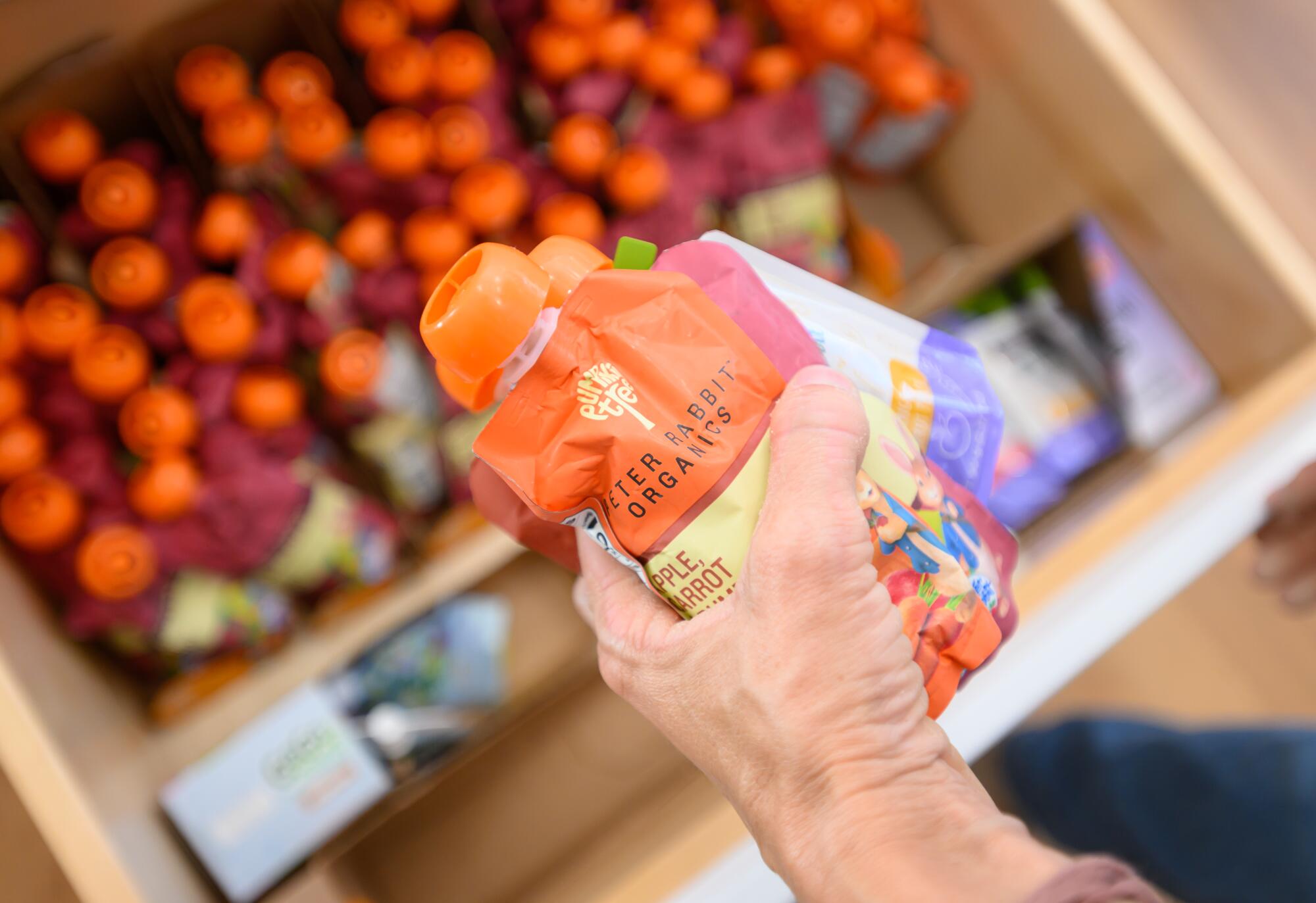
Pouches are convenient because they don’t shatter when dropped, and toddlers can suck down the slurry without help from a caregiver.
“It is so dang hard to be a parent of young children in the U.S. Having [pouches] on an airplane, having them in the car — it is so convenient that I would never take that away from parents. I used pouches with my children,” said Bridget Young, an associate professor of pediatrics at the University of Rochester School of Medicine.
“The industry has gone from jars to pouches because it’s more cost-effective and convenient,” said Dr. Tanya Altmann, a pediatrician in Calabasas and author of the book What to Feed Your Baby. But it’s what’s inside that’s important, and “not all pouches are created equal.”
As a tool, she said, pouches “can be a contributor to a family’s nutrition,” but not a prime source. Those without added sugars or salt may even have advantages over other processed snacks.
Heidi Martinez, a mother of three in Pittsburg, Calif., said she always buys the pouches with at least one vegetable. As her oldest son goes through “picky stages, I like that he is still getting some kale and beets,” she said. “I don’t know that they’re actually healthier but I feel better about it.”

Heidi Martinez plays with her sons while they eat from pouches. “I don’t know that they’re actually healthier but I feel better about it,” she said of pouches that include vegetables.
At the age of 7, he eats two to three pouches a day.
Manufacturers appeal to parents by marketing a pouch as “all natural,” “organic” or containing vegetables.
But the advertising on the front of a pouch doesn’t necessarily reflect what’s inside. A green pouch advertised as broccoli-pear might turn out to be little more than pear puree. And a pouch labeled something like turkey dinner “might be apple sauce with a whisper of turkey,” Young said. “And there’s nothing wrong with apple sauce. But there is something wrong when you think you’re feeding your child turkey.”
Parents of picky eaters may be particularly vulnerable to this kind of marketing.
“It’s kind of the perfect storm, when the child is transitioning to solids and trying new foods,” said Fran Fleming-Milici, director of marketing initiatives at the Rudd Center for Food Policy and Health at the University of Connecticut. “You’re not sure of the nutrition that the child is getting.
Martinez said the real appeal, however, is the pouch itself. She considers pouches to be in the same category as a smoothie or yogurt, but in an easy to-go form.

Ezekiel Martinez, 7, eats from a pouch while hanging upside down at a park. He eats two to three pouches a day.
The slippery slope of sweet, smooth purees
The early years of a child’s life are crucial for developing lifelong healthy eating habits. Babies are born with a preference for sweet foods, said Jill Castle, a pediatric dietitian in Massachusetts and author of the book “Kids Thrive at Every Size.” Typically, a child must be repeatedly introduced to various foods to get them used to different textures and flavors, such as the taste of vegetables.

It’s hard to beat the convenience of pouches — they’re easy to throw in a diaper bag or hand to a screaming toddler in the car. But experts warn relying on them too much could be a problem.
Fruit puree can disguise the taste of vegetables, reinforcing sweetness, Castle said.
If a child’s diet consists mostly of pouches, “when you actually give them chopped-up carrot and peas that roll around the plate, they’re not used to that at all,” and may refuse it, said Daisy Coyle, who researches pouches at the George Institute for Global Health in Sydney, Australia.
Ideally, lumpy textures should be introduced as early as possible so the child can learn to use their tongue and jaw to manipulate and swallow food, a process that requires 30 different muscles to work together, said Susan Greenberg, a speech pathologist at Children’s Hospital Los Angeles. “We think it’s a natural process, but it’s like learning to walk,” she said.
A variety of textures is also crucial to developing a child’s long-term food preferences. “If you prolong purees and don’t introduce lumpy foods by 10 months, we have evidence that by 15 months and even 7 years, it influences food acceptance,” Greenberg said.
The full sensory experience of eating food is also important, she added — getting messy, using spoons, fingers and tiny fists to squish food and smear on a highchair and face.
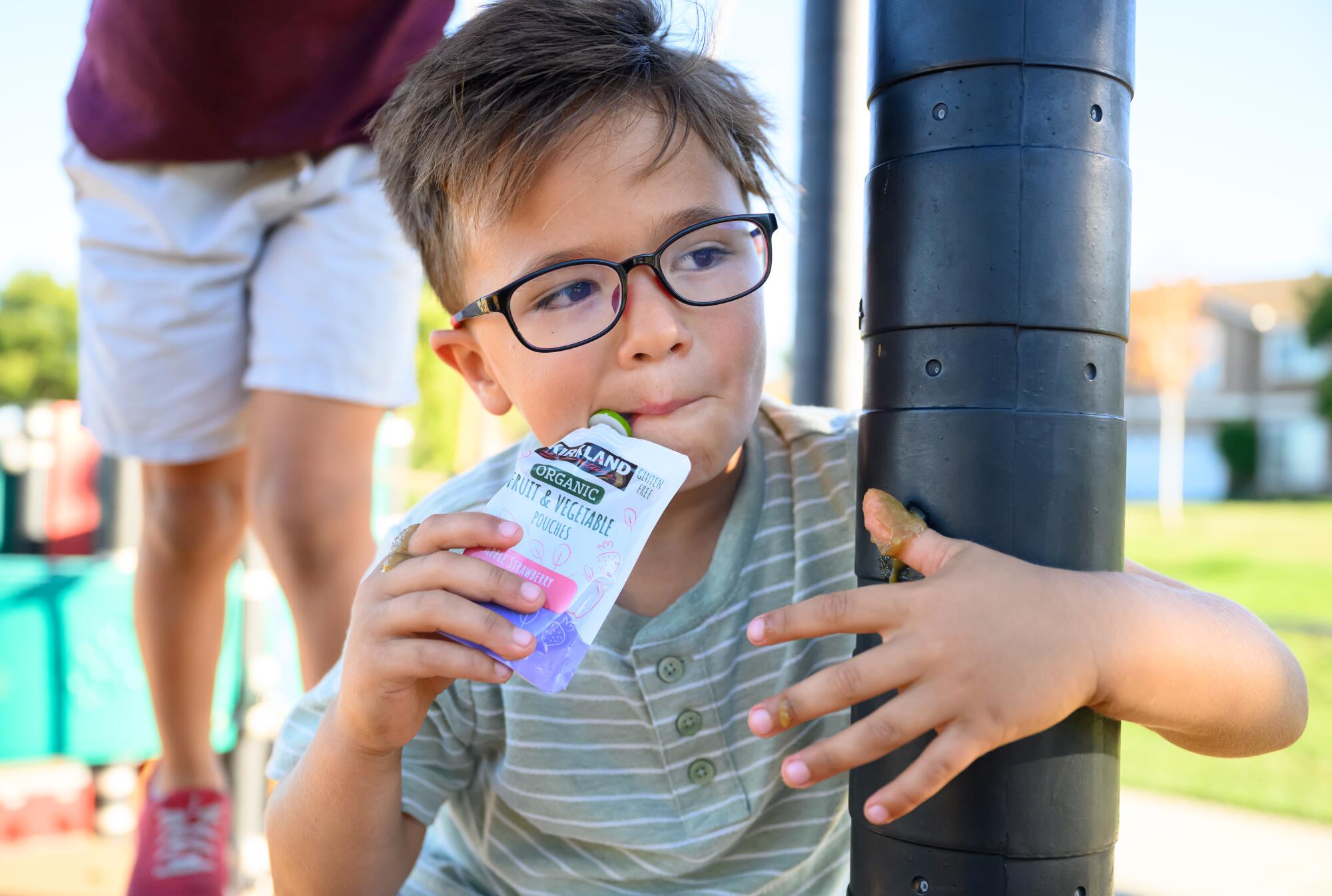
Lucas Martinez, 5, snacks while at a park.
Dentists also have concerns about what pouches mean for oral hygiene. Dr. Francisco Ramos-Gomez, director of the UCLA Center for Children’s Oral Health, said the way purees such as apple sauce stick to the teeth is different from eating an actual apple, and it sits on a child’s teeth before being washed. This prolonged exposure increases the acidity of the mouth, erodes the teeth and causes cavities.
But it’s all a matter of moderation, Greenberg said. “Pouches are easy, and we live in a world that’s really busy these days. I think we can all agree that it’s not a bad thing. It just can’t replace the other things.”
Do toddlers really need their own special food?
By about 12 months old, typically developing children do not need pureed food. “It was always a goal to get kids off of purees by 9 months and get them onto table food,” Castle said. “By 1 year, you’re sitting at the table with your family, and you’re eating what the whole family is eating.”
Toddlers and young children can eat most anything that an adult can eat, as long as it’s cut or prepared in a way that’s appropriate for their eating skills and doesn’t make it a choking hazard.
But brands have invented a whole new, lucrative category of toddler foods, from pouches and teething crackers to bars and puffs, Fleming-Milici said.
The major pouch manufacturers — including Gerber, Plum Organics and Happy Family Organics — did not respond to requests for comment from The Times.
In the last 12 months, American families have spent more than $466 million on baby food pouches, according to data from the market research firm NIQ.
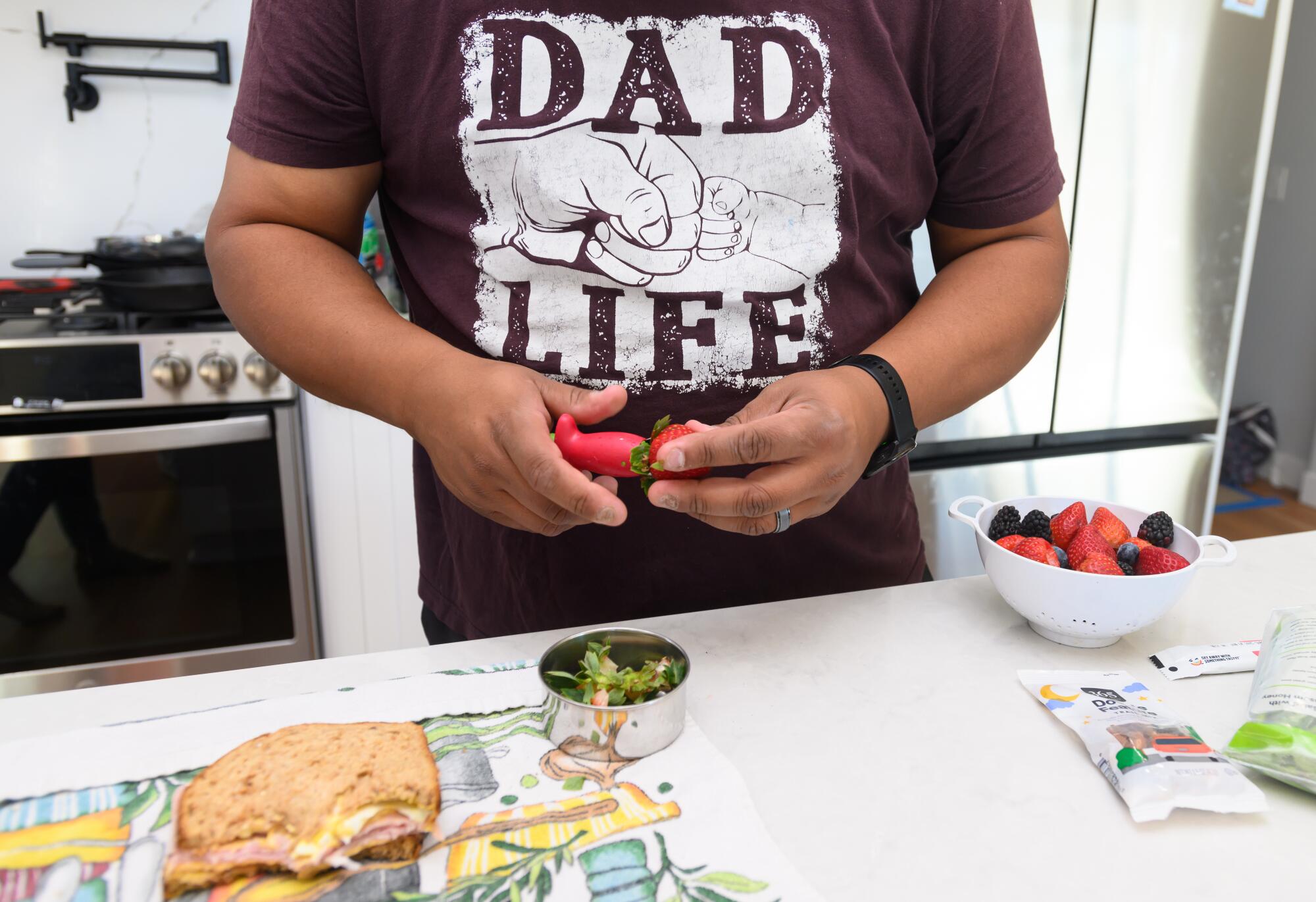
Mario Martinez prepares snacks for his three sons.
The “Wild West” of the baby food aisle
As opposed to the tightly regulated U.S. infant formula sector, baby and toddler foods do not have their own special marketing and production rules; they are subject to the same requirements as adult foods.
“The baby food market is like the Wild West,” Castle said.
The World Health Organization came up with its own nonbinding set of standards for baby food, which included limits on fat, sugar and sodium. It also requires clear labeling of ingredients and prohibits the use of health, nutrition and marketing claims on the packaging.
A study by Coyle earlier this year published in the journal Nutrients found 60% of the baby or toddler food products for sale at the top 10 grocery stores in the U.S. failed to meet the WHO nutritional recommendations. Almost all packages included at least one prohibited marketing claim, and some had as many as 11.
Earlier this year, the FDA recalled 3 million cinnamon applesauce pouches that contained extremely high levels of lead, after dozens of children across the United States were found to be suffering from lead poisoning. The FDA does not currently set heavy-metal limits or require baby food manufacturers to test for them.
“We really need to have some U.S.-based regulations, or decide we’re following the World Health Organization’s regulations. But there needs to be more tight control,” Castle said. “These are some of our youngest, most vulnerable members of our population.”
Instead of blaming families for overusing pouches, she said, new regulations, healthier ingredients that target key nutrients, and more transparent advertising are needed. “Even just having more pouches that are predominantly veggie based and less sweet would be a really positive change,” she said.

Lucas Martinez eats from a pouch. Manufacturers appeal to parents by marketing a pouch as “all natural,” “organic” or containing vegetables.
How to see through marketing pitches
To select the healthiest pouches, nutritionist Young recommends ignoring the advertising on the front of the package — including the name of the product.
Instead, flip to the back, where the ingredients are listed in order of how much is in the package, and look for pouches that list the veggies first. A pouch that lists apple first probably will be mostly applesauce.
Beth Saltz, a pediatric dietitian in Woodland Hills, said a general rule of thumb is to make sure that all of the ingredients listed could be sold in the grocery store. If the ingredients include things such as “organic tapioca starch” or “pea protein isolate,” or even natural coloring, you might reconsider.
“A little toddler does not need those,” she said.
This article is part of The Times’ early childhood education initiative, focusing on the learning and development of California children from birth to age 5. For more information about the initiative and its philanthropic funders, go to latimes.com/earlyed.


new video loaded: NASA Announces Artemis III Crew
transcript
transcript
NASA Announces Artemis III Crew
NASA announced the crew of Artemis III mission, which will fly to low-Earth orbit to test rendezvous and docking maneuvers with one or two lunar landers.
-
“I am excited to welcome you as the next crew in the Artemis journey to successfully return to the moon — this time to stay.” “I’m honored by the role that I’ve been given. I’m also very humbled by the task in front of us. But first and foremost, I’m grateful.” “So with that, the Artemis II crew, comrade, hands you the baton. You got the controls.” “As you know, we had a significant anomaly at our Launch Complex 36A on May 28. We’ve redoubled our efforts and are moving forward.”
By Alisa Shodiyev Kaff
June 9, 2026
Science
Santa Monica Mountains’ last steelhead trout survived the Palisades fire — and even had babies

Scientists feared the Santa Monica Mountains’ last remaining steelhead trout were dead, smothered by debris flows unleashed by the Palisades fire.
But the endangered fish surprised them: A team of biologists recently spotted 30 of the rare trout — and 21 babies — in Topanga Creek.
“There was a lot of happy dancing in the creek,” said Rosi Dagit, principal conservation biologist for the Resource Conservation District of the Santa Monica Mountains, which works with public and private landowners to conserve natural resources.
That’s because the steelhead here are endangered, at both the state and federal levels. Once, they swam in most streams of the Santa Monicas, but their numbers plummeted amid overfishing and coastal development. Increasingly frequent wildfire has further stressed their habitat. Topanga Creek, a biodiversity hot spot, is home to their last known population in the mountains that stretch from the Hollywood Hills to Point Mugu in Ventura County.
The trout that were spotted, including this one, are part of a distinct Southern California population that’s listed as endangered at the state and federal levels.
(RCDSMM Stream Team)
The California Department of Fish and Wildlife spearheaded a complex mission to rescue trout threatened by the Palisades fire that sparked in January 2025.
Time was of the essence. The fire hadn’t yet been fully contained. But rain was on the way, which would sweep massive amounts of sediment from the denuded hillsides into the water. Fish are often killed this way.
Crews stunned the fish with electricity, scooped them up in buckets, trucked them to a hatchery and ultimately moved them to Arroyo Hondo Creek in Santa Barbara County.
Within days, Topanga Creek was choked with mud. Some assumed the fish left behind were goners.
But in March, the conservation district’s team found four. The following month, when water conditions were clearer, they saw more.
“These fish continue to amaze me,” said Kyle Evans, environmental program manager for the state Department of Fish and Wildlife, who had seen the damage to the creek. “I had seen populations get wiped out in similar situations. So when I heard, I was thrilled.”
Evans surmises the fish that survived were in an area of the creek where less charred material and sediment were swept in.
“These fish likely hunkered down, were hiding under some rocks or places to try to get away from the main concentration of flow,” he said. “And luckily they weren’t buried.”
The ones that were spotted were fairly small, around 6 to 14 inches. Rainbow trout and steelhead trout are the same species, but with different lifestyles. If the fish remain in freshwater, they’ll be considered rainbows. However, they can migrate to the ocean and become steelhead, where they typically grow larger before returning to their natal waters to spawn.
Topanga Creek hasn’t fully recovered from the damage it sustained, but scientists say it’s looking better. Surveys last year were “so depressing,” Dagit said, with very few animals, and stretches that were essentially transformed into flat roads from all the sediment buildup. Some of the riparian canopy burned right down to the creek.
Then came 32 inches of rain over the last nine months, scouring out and moving sediment, creating deeper pools. Dagit said they recently found newt egg masses for the first time in years, as well as a few adult newts and many frogs. Plants that provide cover are starting to recover.
She provided photos comparing certain pools last year and this year, some dramatically transformed. In September 2025, the Shrine Pool could have been an overgrown hiking trail. This April, it was filled with shallow water.

The Shrine Pool in September 2025, left, and the same location in April 2026, right, with RCDSMM’s Isaac Yelchin donning a wetsuit.
(RCDSMM Stream Team)
Topanga Creek is home to another endangered fish, the small but hardy northern tidewater goby, often described as cute. Not long before the trout operation, Dagit led a rescue of hundreds of these fish too. Many were repatriated to the lagoon at the mouth of the creek in a moving ceremony last June.
There’s still the matter of what to do with the trout that were moved to Santa Barbara County last year. Evans would like to bring them home to the Santa Monicas at some point, but isn’t sure if it will happen. On one hand, they could bolster the small, genetically isolated surviving population. On the other, they might inadvertently bring in a disease or bacteria. There is some time to decide. Evans estimates the creek still needs to recover for two to three more years.
For now, the fish are functioning fine in their adopted creek. Experts worried the trauma wrought by the move would disrupt their spawning process, but they had babies that spring. This year, they spawned again.

The Pacifica Municipal Pier was shut down and taped off Thursday after city workers noticed cracks running through the landmark structure and concrete chunks falling into the ocean.
It’s just one of many coastal California structures that have recently crumbled under pressure from a rising and relentless ocean.
Officials from the small, beach city south of San Francisco said the pier was closed due to “cracking, separation, and displacement of the concrete walkway and structural elements.”
It will stay closed while structural engineers asses its safety.
Photos taken by city employees show a wide crack that runs from top to bottom and across the structure as well. Other photos show a large horizontal crack under the foundation of a small restaurant on the pier, the Chit Chat Cafe.
The cafe was also shut down.
This is not the first time the 53-year-old pier has shown signs of stress. In 2021, part of it was shut down after handrails along the edge collapsed. And in 2023, after a series of storms pummeled the Central California coast, damaging parts of the pier, the structure was partially closed for more than year.
Those same storms caused extensive damage in Aptos and Capitola, 70 miles south, where piers and waterfront infrastructure were swept away or damaged.
In 2024, a 150- to 180- foot section of the Santa Cruz wharf was ripped off by powerful waves.
At least 10 of the state’s dozens of coastal public piers were closed for part or all of 2024 due to structural damage sustained in winter storms since 2022. At least five others have longer-term upgrades planned to address structural issues.
“These things are costly to maintain,” said Zach Plopper, senior environmental director at Surfrider. “They are a part of our California coastal culture in many ways, but we’re going to need to reckon with, one, the state that they’re in, and two, the continuous and worsening threats they’re going to experience,”
He said most of the piers were constructed in the early 1900s, and they weren’t built to withstand decades of rough seas, storms and rising sea level.
“With this incoming El Niño, which is forecasted to be significant, and this marine heat wave we’re in the midst of, we’re kind of in uncharted waters as far as what this winter could bring in terms of storms and swells to the California coast, and we’re likely going to see a lot more damage,” he said. “Not just piers, but roads and other coastal infrastructure up and down the state.”
There was no storm in Pacifica earlier this week, so no single event could be blamed for the destruction.
However, a 2025 report from an outside engineering firm, GHD, found that several sections of the pier were in “poor” or “serious” condition, and they recommended closure before anticipated storms or events that could “subject the piles to high winds, swells and large waves.”
The firm found several areas of the pier where concrete was missing and rebar was exposed and corroding.
“The pier has continued to experience high winds and large waves in a harsh marine environment,” the engineers wrote in the report, noting that continuous exposure to seawater or marine spray was “detrimental” to the structure.
A 2023 city report estimated it would cost $19 million to repair.
That same year, a state law was enacted to require local governments along the California coast to plan for sea level rise in the coming decades.
Sea level has risen some 8 inches, on average, along the coast in the past 150 years, Plopper said, and researchers anticipate another foot in the next 25 years.
“We’re going to see profound shifts on our coastline, none that we have ever experienced before, and building static structures on the coast just doesn’t work all that well,” he said. “We’re going to have to make some really hard decisions.”
-

 Arkansas3 minutes ago
Arkansas lands grant to battle deadly cattle tick disease
-

 California8 minutes ago
Operation Hands Down disrupts Central California gangs – Inside CDCR
-

 Colorado15 minutes ago
$25.7M Colorado private ski mountain property heads to auction
-

 Connecticut18 minutes ago
Connecticut driver spots snake in car while driving, police say
-

 Delaware23 minutes ago
Delaware Bay’s new oil spill response boat officially christened
-

 Florida30 minutes ago
Sheriff’s Office investigating fatal shooting of child in Florida City
-

 Georgia33 minutes ago
Northwest Georgia Congressman pushes for impeachment of federal judge for misconduct
-

 Hawaii38 minutes ago
A wet start to the dry season in East Hawaii – West Hawaii Today

